
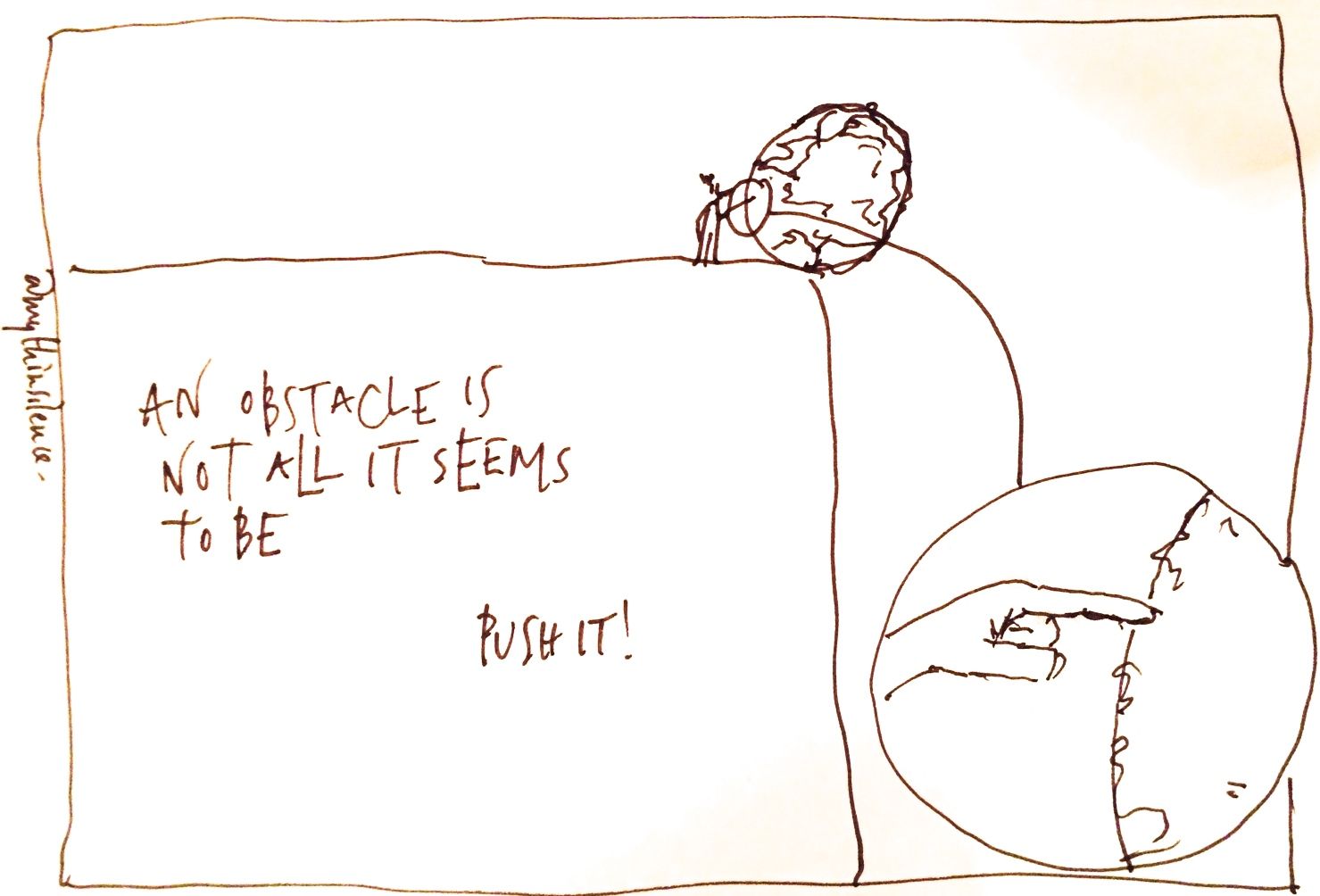
Every moment is an opportunity to explore and become something new.
Some of the most difficult moments offer us the best opportunities.
I mentioned I’m on a trip in which I’m exploring how to overcome obstacles, so this is something which is real for me.
I am seeing how it depends upon how I see and then act upon the obstacles which stand before me.
I can react with panic and anxiety, and end up paralysed.
I can respond positively and remove the obstacle to be able to continue – which is better.
Or, I can initiate and use the obstacle as an opportunity – which is best.
Having a goal is important. To keep focusing on the goal is not so important. What is really important is the process, meaning I can see the steps and enjoy the daily process rather than waiting for the goal to happen – which, without the process, the goal appears an insurmountable whole.*
Allied to this, along the way, it’s important to prototype, to iterate: ‘What gets you there is fast iteration, and fast failing.’** This tackles the element within the obstacle which is perfectionism. (I’ve been in an organisation for more than thirty years which does not allow for fast iteration and fast failing and it’s killing it.)
Those who have overcome their obstacles and delivered their art will have failed many, many times.
(*One of the things running has taught me is to respect the steps, the miles.)
(**From Ryan Holiday’s The Obstacle is the Way.)


I worked in the Total Quality Management movement in the 90’s. The goal was to “get it right first time”. We discovered that getting it right first time was an iterative process.
Thanks for this, Bob. There are two basic ways to deal with this. There is the more hidden and the more open ways. It sounds like yours is the more hidden – happening in house. The other is worked out with others; just today I read about Jane ni Dhulchaointigh who developed a malleable, self-setting rubber with the help of crowd-sourcing for six years. She makes three points: ‘Put your product in the user’s hands before it’s perfect. See what happens,’ ‘Show your users what they can do, rather than telling ten what they should do.’ and ‘Empower your users to be your ambassadors, their word is more powerful than yours.’ It’s called Sugru and you can check it out here.
There is always the thing of “horses for courses,” too.
Geoffrey,
True, but it was a pretty big house, and we did share around by means such as Process Benchmarking, where you have to know yourself and your own ways down to the last dot before any sharing can be meaningful. (I saw some disastrous results Bear in mind, upstream oil and gas has a quite restricted set of products, but an absolute multitude of ways and means of managing through people and processes. Improvements were achieved collectively. That’s when I learned that engineering is about people!