You

Both meaning and purpose are acts of self-transcendence. They are both about supplying a reason for being and action.*
AleXander McManus

To what can I compare this generation? They are like children sitting in the marketplaces and calling out to others: ‘We played the flute for you, and you did not dance; we sang a dirge, and you did not mourn.’**
Jesus of Nazerath

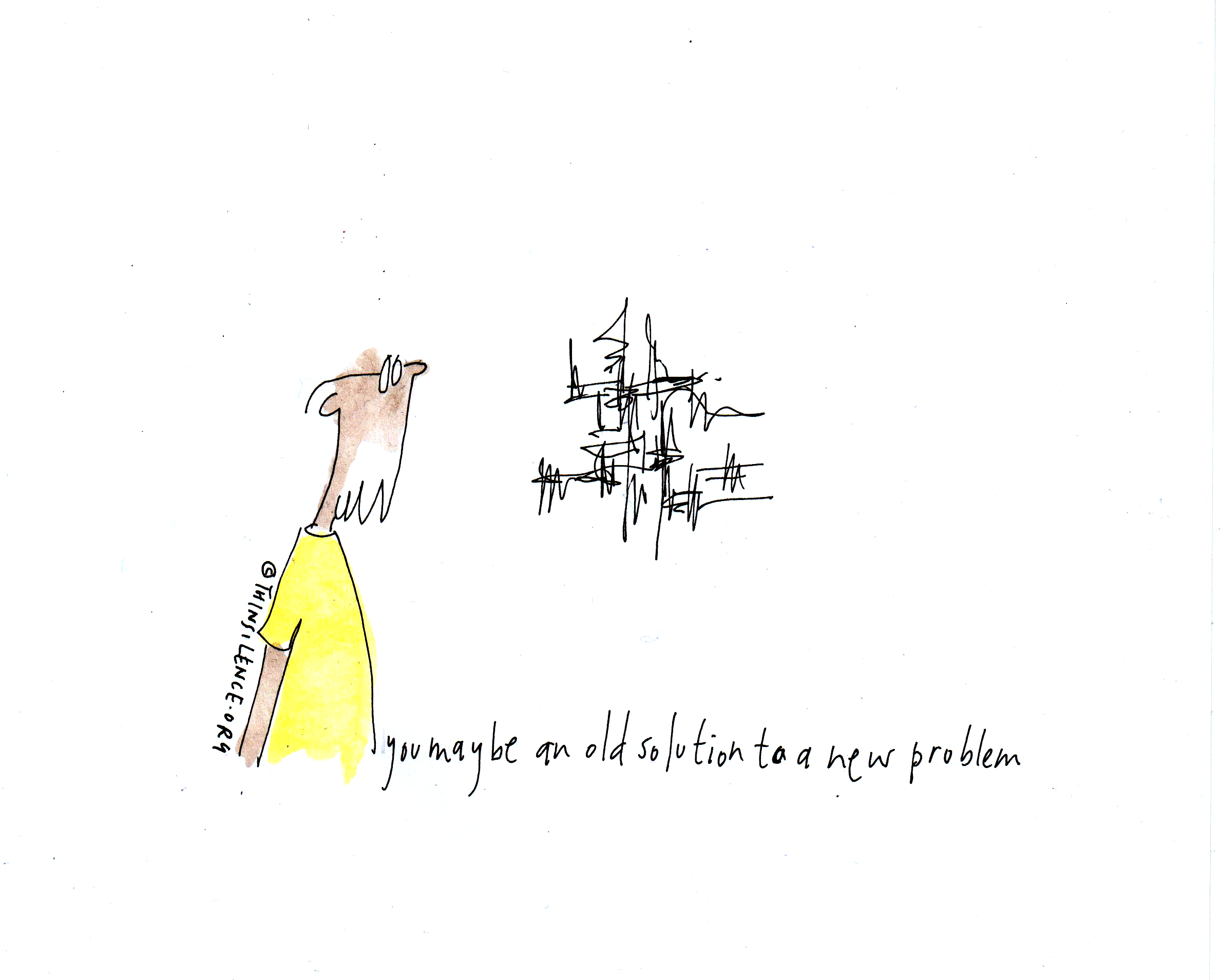
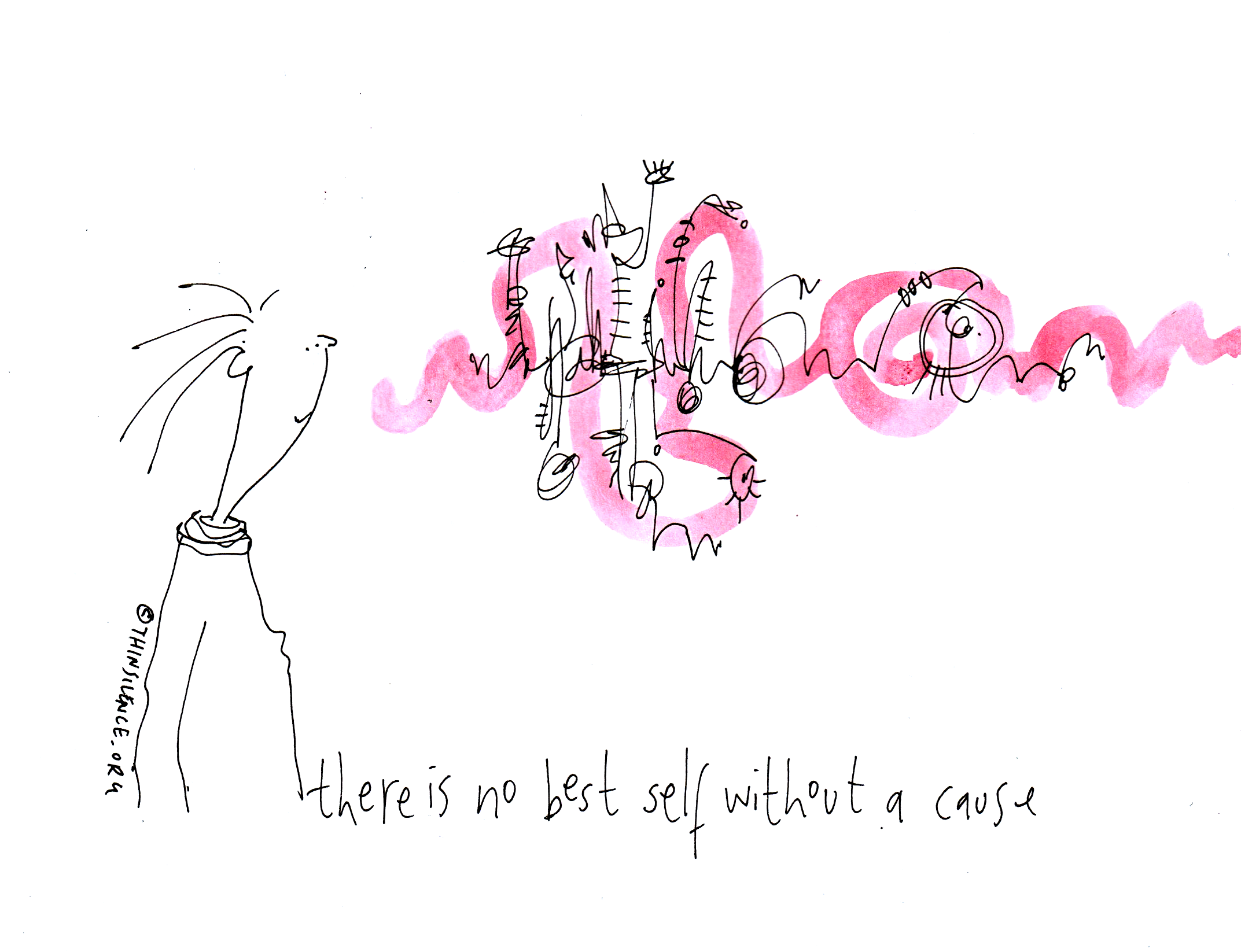
You are the problem and
you are the solution.

It’s okay for children
to want others to join their games.

As we advance in years
we discover it’s about serving others.^

We get over ourselves
and discover another “me.”

A transcendent “me”–
We each have one.

Meaning and purpose^^
will lead us there.

*AleXander McManus’ FutureU;
**Matthew 11:16-17;
^Check out the elemental truths: life is hard, you’re not as special as you think, it’s not about you, you’re not in control, you’re going to die (Richard Rohr’s Adam’s Return);
^^How might you write out your meaning and purpose? Where are they leading you?

SOME RANDOM THIN|SILENCE

An uncomfortable truth

Our best chance is not to have but to be.

The comforting fantasy will kill us dead for certain. You know how lethal fantasies go: “Some day …” and “If I only had …” and “He will change …” and “If I just learn to control myself … when I get really ready, when I have enough xyz, when the kids are grown, when I am more secure, when I find someone else, and as soon as I …” and so on.*
Clarissa Pinkola Estés

There will always be something
we haven’t got.

If that means we don’t begin
or take the next step,
Then this can be comforting.

We can let ourselves
off the hook for another day.

There’s always
what we have got.

Who we are
and what we have
right now
is likely more than enough to
move forward.

But perhaps
we didn’t want to hear that.

*Clarissa Pinkola Estés’ Women Who Run With the Wolves.

SOME RANDOM THIN|SILENCE

Sowing seeds

Here’s an idea for journalers:
I’ve begun to seed the pages of my journal–
Anything from my reading that captures my attention,
I sow them into the waiting pages.

An idea, a question, some explanation–
Cross-pollinating with other words I bring,
And I wonder each day what new varieties of
imagination and possibility might grow.

SOME RANDOM THIN|SILENCE

Three things

The only thing that happens every day is the opportunity to do the work. There are other energising forces but they’re less reliable. If the simple opportunity to do the work each dy is enough to renew your energy to do the work, you’ll always havre an energy source.*
Gabe Anderson

A crash means we have to grow. A crash means we’re at the threshold of learning something, which means we’re getting better, we’re acquiring the wisdom of our craft.**
Steven Pressfield

Something wants to appear, but
the more you pressure yourself
the harder this will be.

You may be idea-less,
Inspiration evading you,
But if you turn up here again there are
at least two things waiting to greet you:
Your love for what you do and
the experience that you bring–

Even when this time is bad
it’s good because you’re learning,
Which means you have more experience to bring
next time.

(Perhaps shape a form of remembering
what it is you love to do, for when you enter your workspace,
Also, bringing to mind the last
learning experience you have known.)

*Gabe Anderson’s blog: Energizing Force;
**Steven Pressfield’s Do the Work.

SOME RANDOM THIN|SILENCE

Breaking the rules

When our future rearranges us, then our past becomes the fuel for our art.

Remember, every time God forgives sins, he is saying that relationship matters more than his own rules. Think about that. Forgiveness honours disorder while still naming it disorder.*
Richard Rohr

Forgiveness restores our future to us,
Severing us from a heavy past
and uniting us with something brighter–
Not to deny what has happened,
Rather altering our relationship to it.

No longer are we held back, but
with a new heart are fuelled
forward, enabled
for creativity and beauty
as only each of us may deliver into the world.

Where does your forgiveness come from?–
How has it provided your future
and reshaped your past?

*Richard Rohr’s The Tears of Things.

SOME RANDOM THIN|SILENCE

The real story

The thing you’re good at is valuable and needed by your family and community. Don’t belittle what you’re good at. Own it and use it to your benefit and the benefit of the world around you.*
Gabe Anderson

I’ve come to recognise that changing the story, dismantling the stories that trap us, finding stories adequate to our realities, are foundational to finding our powers and possibilities.**
Rebecca Solnit

We can’t say this too often:
What you’re good at doesn’t have to be huge.

It doesn’t need to be adored by thousands, but
it must matter to you;
If it does then it’s likely to be
valuable to someone else, too.

This is a story shift–
Not from reality to fantasy–
If you’re good at something and telling yourself
it’s nothing then that’s the fantasy.

Ditch the story you’re telling yourself–
Find a better narrative that allows you to use what you’re good at.

(What are you good at, what’s the story you’re telling yourself?–
Try writing these out – do they match up?)

*Gabe Anderson’s blog: Realizing You’re Good At It;
**Rebecca Solnit’s No Straight Road Takes You There.

SOME RANDOM THIN|SILENCE

Strengths and weaknesses

Manage your weaknesses with boundaries and support while you focus on your strengths.*
Katherine Morgan Scafler

Keep this thought handy when you feel a fit of rage coming on – it isn’t manly to be enraged. Rather, gentleness and civility are more human, and therefore manlier…The nearer a man comes to a calm mind, the closer he is to strength.**
Marcus Aurelius

There are two kinds of strengths and weaknesses.

There are strengths and weaknesses of talent and ability:
Identify what you are good at and develop these–
You have already invested tens of thousands of hours
for them to be so strong.

Perhaps counterintuitively,
You need to identify what you are bad at because
these will rob you of your time, energy, and joy–
Unless you can find a passion for these and are willing to invest
years of practise, they are never going to be a strength.

If you can, stop doing these things,
If you cannot, explore how can you
manage them through your strengths?

There are strengths and weaknesses of character:
We need to work on all of these,
Selflessness, generosity, and wisdom being our goals–
Each orientated towards others, not ourselves.

Humility, gratitude, and faithfulness are always
helpful places to begin.

(Life isn’t simple. What will you add to your plan to further grow in who you are and what you can do?)

*Katherine Morgan Schafler’s The Perfectionist’s Guide to Losing Control;
**Ryan Holiday’s The Daily Stoic.

SOME RANDOM THIN|SILENCE

That’s not insignificant

Significance isn’t what we get … It’s what we do for others.*
Seth Godin

With your talents and abilities,
With what you hope for and are capable of,
With your heart,
It’s going to be hard for you to be insignificant.

It’s not about numbers,
Or success as often calculated, but
how you help to make something better,
Somewhere, for someone.

(When you free your imagination
to picture something better, what do you see?
It’s unlikely to come out of the blue
but grow out of your experience.)

*Seth Godin’s The Song of Significance.

SOME RANDOM THIN|SILENCE

THE NOTES (behind the reflection)
Significance is one of Strengthsfinder‘s 34 talent themes.
Its emphasis is not only on a personal desire to be recognised for one’s unique strengths, but to raise the belief and the play of those around.
I had been dreamwhispering with someone with this talent cum strength, and they were delighted to see how it included this emphasis on helping others to bring their best.
We all get the opportunity to be significant, though– perhaps not in the same way as people who excel in this talent, but nevertheless, when we have identified our own talents, when we have moved into our enriching environments, and when we are moving forward to the call of our values, then we will not only sense that this is important, but others will, too.
But it’s not about numbers; it may be for only one person, yet their life would be different if you or I did not step forward.
This is looking at life differently, growing into interdependence after independence.
If you have identified talents, enriching environments, and values, you can more trust your imagination and intuition, which have unfolded from the former.

The heart persists

That’s what our art requires of us. We show up and do it anyway, not because someone asked us to but because our persistent heart tells us we must.*
Bernadette Jiwa

The act of change-making is to help people decide that changing their action is exactly what they want to do. Not because it’s important to us, but because it’s important to them.**
Seth Godin

There’s that important word again:
Must, not should.

A must carries you into a day, through
difficulties and obstacles, into
an adventure.

A should from someone else
may get you started but lacks
your persistent heart.

If we want to see change,
There’s no better place to begin than
helping people to
ignore the shoulds and connect to
their heart-must.

(Art is the similar but different way you do something that fulfils you, helps others, and makes the world better in some way or other. What’s yours?)

*Bernadette Jiwa’s The Story of Telling blog: Doing the Work Anyway;
**Seth Godin’s This is Strategy.

SOME RANDOM THIN|SILENCE

THE NOTES (behind the reflection)
I first came across the power of MUST back in 2004 when I asked AleXander McManus what would move an organisation into the future: evolution or revolution. In what I discovered to be Alex’s inimitable way, he replied, “It will come through those who must.”
Must is not only something that pushes you, but pulls you, too, being embodied in your talents cum strengths, energies, and values.
I come across it again in Elle Luna’s wonderful essay and book: The Crossroads of Should and Must.
A Should comes from outside, it is what another speaks to us: You should do this, You should do that, but even the most well-meaning person doesn’t know how this fits with who we are and what we want to do in the same way we know ourselves.
A Must comes from within, our response to a need and our desire to make a difference.
A Should will sometimes get us started, and even keep us in a game, but only a Must will keep its going when the going gets tough without breaking anything inside us.
Change does not come quickly, but takes time – the kind of time that needs us to live and work from our Must.
We are all artists in the sense that there is something imaginative and creative we each can bring into the world.
This can look like what someone else does, but if you get closer you’ll see it’s super-nuanced, emanating from within rather than being copied from without.
A Must will make you better and also those around you – that’s how we know what it is.
It’s not magic, but of we turn up, again and again, we can make something magical for someone.
This is always for someone else– the remarkable and wonderful thing is, we have a whale of a life in pursuit.

The compass

Strategy isn’t a map. It’s a compass. Strategy is a better plan.*
Seth Godin

Radical engagement involves feeling our way forward to discover, open up, and work with cracks.**
Adam Kahane

Before the certainty of a map
there is a compass–
Trust your insight, shaped
by talents and values and energies;
These will show you the way through
the next-to-nothing
before you.

The most exhilarating experiences in your life so far were daring.
Your proudest moments were overcoming struggle.
The best happiness comes after some pain.^

(Our talents, values, energies, these are honourable, increasing our insight. How might you hone these in the new week?)

*Seth Godin’s This is Strategy;
**Adam Kahane’s Everyday Habits for Transforming Systems;
^Derek Sivers’ How To Live.

SOME RANDOM THIN|SILENCE

THE NOTES (behind the reflection):
We follow maps, but maps can’t show us everything.
Travelling with a compass and eyes wide open is more valuable.
Talents show up because we have taken the time to play with patterns of skills, a lot – we can accurately identify our talents in thirty minutes – it takes a lifetime to grow them, mind.
Further developing of talents hone them into strengths.
Strengths bring together ability, strong experiences, and passion.
On the other hand, a weakness may be a practised talent, but because our heart’s not in it, the experiences haven’t become more nuanced and flowing.
Values are not goals, but are hopes that are bigger than our lives; we can never achieve them – as we move towards them, they grow bigger.
Energies refer to those activities and spaces and people that send our energy spiking, but we also note when the activities and spaces and people that drain our energy away.
These sharp spikes of energy identify what I call enriching environments that not only do we prefer and grow as a result of, but our talents cum strengths enable us to create them.
The things that make us feel as if we’ve lost all our energy and will never regain it, identify what I name enervating environments; if we were Superman or Superwoman, this would be our kryptonite.
It is super-important to notice these because they sneak up on us– if we cannot escape them, we must learn how to manage them.
The best way to manage is to meet them with our strongest self.
Of course, one person’s enervating environment may be another person’s enriching environment.
All of this – talents, values, and energies – mean that we gain a good feel for where we are and what we must do; we can trust this.
Opportunities don’t appear before us as big open doors and bright lights– it’s more likely an itch, a crack, a glitch in the Matrix, and we have to work with this, but if you have noticed the crack, and trust who you are and what you have, then you will be able to do something,