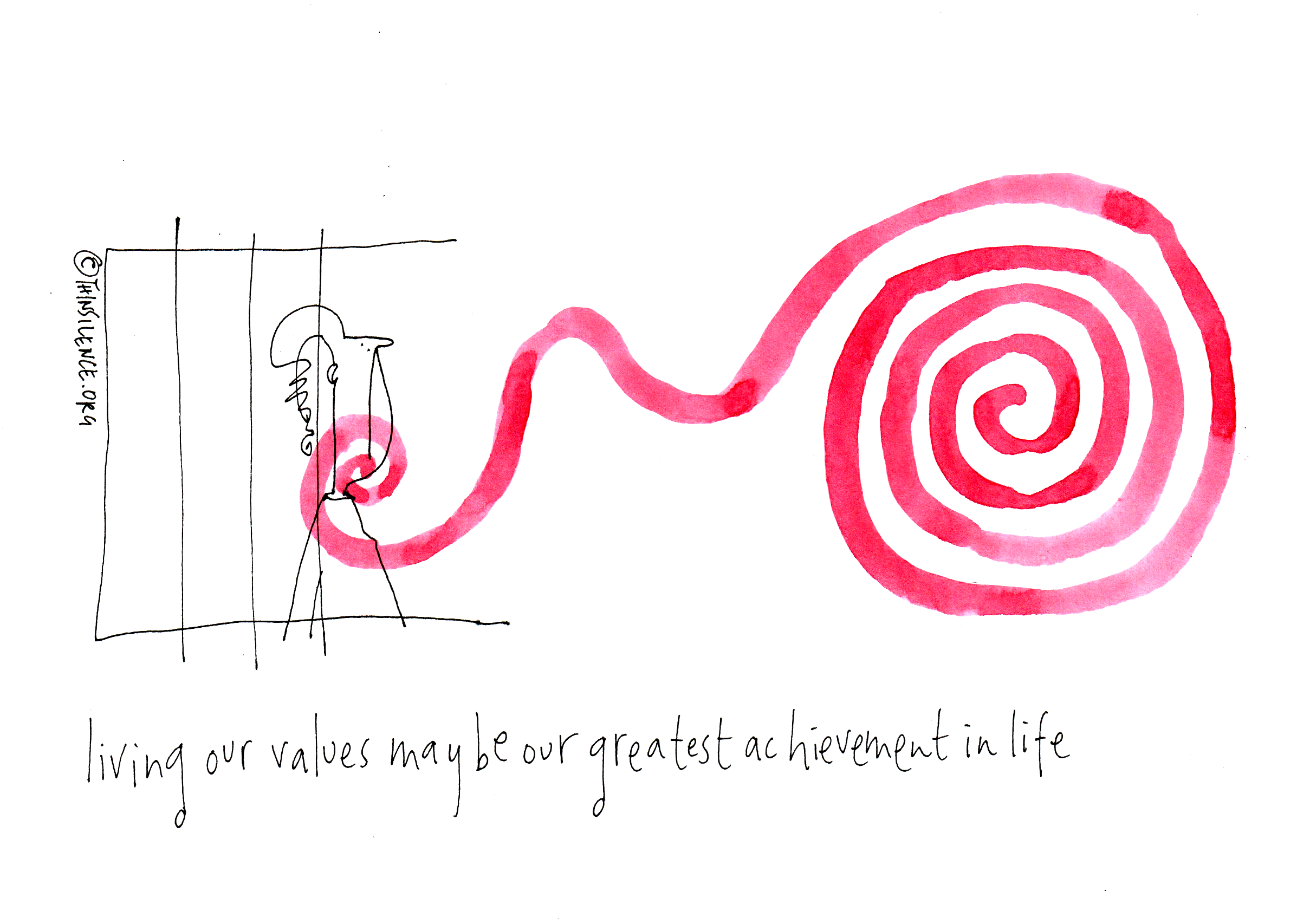
Such a character

Scientists and linguists believe that words are not only a window into who we are and how we believe, they also play a role in shaping these things.*
Naomi Bagdonas and Jennifer Aaker

Dan McAdams** is introducing me to the word imagoes for describing
the main characters in our life stories.

These fall into two types:
The agentic and the communal.

The agentic characters are comprised of
warriors, travellers, sages, and makers.

The communal characters of
lovers, caregivers, friends, and ritualists.

It’s likely that we’ll especially prefer one from either of the lists, to
have a sense of self in the larger world and our smaller worlds.^

It strikes me that we find these lists
echoed in different ways.

Mihaly Csikszentmihalyi writes about our need
for exploration, but also for conservation.^^

Christian Schwarz introduced me to this concept
more than twenty years ago in his interplay of the dynamic and the static.*^

So, I’m wondering whether, not only might we focus on an imago
from one list, but balance this with a supportive imago from the other.

Have a play: choose your two,
Identifying which is prime and which is supporting.

We see how important words can be for seeing
who we are and then shaping who we are.^*

(Important note to self: Always be playful,
Never allow yourself to be trapped by a word, term, or definition.)

*Naomi Bagdonas and Jennifer Aaker’s Humour, Seriously;
**Dan McAdams’ The Stories We Live By;
^We’re unlikely to use these precise words;
^^Mihaly Csikszentmihalyi’s Creativity;
*^Christian Schwarz’s Paradigm Shift in the Church;
^*Perhaps take 5-10 minutes to free-write why you have chosen these two.

SOME RANDOM THIN|SILENCE

Not all silence is absence

The soul has nothing to say. It’s essential silence makes voices possible but it has no voice of its own.*
James Carse

The soul is my deepest and most silent being –
It has made possible the writing of the last line,
Allowing this and other thoughts to arise,
Not directing, impelling, but giving my thoughts their space;
I grow this silent part of me by
not interrupting, not filling, nor
explaining, so that it provides the space for
everything else, and hence, it is not empty but full.

How do you deepen your silence?

*James Carse’s Breakfast At the Victory.

RANDOM THIN|SILENCE

Myths old and new

The Indigenous person who believed the myths of his or her culture probably had a stronger sense of self than today’s postmodern person, who denies all real or operative transcendence.*
Richard Rohr

Myths use to be big and hang around a while,
Now they’re small and replaced in fifteen minutes –
I’m not saying the old ones were better than the new,
Only that they carried a sense of deep identity within them,
A sense of soul-direction,
And soul opens awe, and
awe elicits transcendence, and transcendence uncovers
genius, and everyone has their
unrepeatable genius;
Awaken this and you have a myth that will hang
around for a lifetime.

How about taking five to ten minutes to write down your myth, describing how your soul is, your sense of awe and transcendence, your awareness of your genius?

*Richard Rohr’s The Tears of Things.

RANDOM THIN|SILENCE

The learner

Repitition is the writer’s mortal enemy.*
Robert McKee

We know that life contains way more repetition than
a writer dares to include –
Otherwise we’d just give up on the book or TV series,
But we also need to beware repetition in our daily lives:
The best repetitions will always stimulate the discovery of the new,
Whilst the best of the new will always produce repetitions;
If we only live in our repetitions it becomes repetitionism** –
Our mortal enemy, and if we only live in the new then
we have another -ism, and another mortal enemy –
The learner explores both the new and repetition.

How and where do you see this movement in your life?

*Robert McKee’s Character;
**I may have made a new word as it seems we are blind to this.

RANDOM THIN|SILENCE

Wiser?

We can be knowledgeable with other men’s knowledge, but we can’t be wise with other men’s wisdom.*
Michel de Montaigne

Homo sapiens, meaning wise one, appeared 200,000 years ago. We are latecomers in this [Earth] story. The term “wise ones” does not accurately describe what we have done to one another and to Earth, but it could yet describe what we will become.**
Philip Newell

Wise men or magi figure in
the Christmas story:
I hope that I’m on a journey
from knowing to wisdom –
Wisdom being a blossoming
of humility, gratitude, and faithfulness,
Becoming a person of courage and generosity –
Wisdom is knowledge in motion,
Not only as something I’m doing, but also
Something I’m becoming –
Another couple of hundred thousand years
would be nice, but I’ll do what I can with
what I have.

*David Brooks’ The Road to Character;
**Philip Newell’s The Great Search.

After all the words

Simplify, simplify, simplify.*
Henry David Thoreau

Sometimes all the scraps of information that come by seem to cohere into a picture; sometimes a pattern emerges. I yearn for patterns and meanings, since for me a sense of meaningless brings on depression. Orientation and purpose ward it off.**
Rebecca Solnit

There exists on the far side of complexity,
Some distilled form of simplicity,
Thinness forged more thinly,
Silence falling deeper –
A few words quietly spoken and then
the silence;
I offer remnants and oddments^ for
you to add to others you are gathering, out of which
you create your purpose.

*Henry David Thoreau’s Walden (adapted by Nicholas Bone);
**Rebecca Solnit’s No Straight Roads Take You There;
^This is all Thin|Silence aims to be each day.

RANDOM THIN|SILENCE

Have a doodleful Christmas

I tend to sketch a lot, and ideas usually start with a tiny doodle that you have no idea what the significance is at the time. That’s why it’s important to just doodle a lot and sketch a lot.*
Nick Park

I love this thought from Nick Park:
Doodling is just a very inexpensive and accessible gift you can
give to yourself and to others that you can
play with a lot.

Merry Christmas to you:
Have fun.

*From a Wallace and Gromit Exhibition.

Into the silence

All spoken words need to be born out of silence and constantly return to it.*
Henri Nouwen

It always comes back to silence for me.  Taking myself to silence.  Inviting others to silence.  Frequently.  Quiet our busy minds.  Set aside our relentless chatter. Just be quiet.  And then do something.  And then get quiet again.**
Bob Stilger

My favourite carol is probably Silent Night,
Sometimes begun with the alternative words Still the Night:
Silence and stillness, I value these most of all at Christmas;
It doesn’t have to be for long, but a little while
to be and to focus – these things I need.

The thinner the silence the better,
Meaning quietness charged with
whispers from somewhere else:
The aim of Thin|Silence is to offer a few words to reflect upon
before the rush of the day begins,
To be played with as you will, and
to see what happens.

I’ve also added a random thin|Silence selection (below) from the past eleven years.

*Henri Nouwen’s Spiritual Direction;
**Bob Stilger, from Brandy Agerbeck and Kelly Bird’s (editors) Drawn Together Through Visual Practice.

RANDOM THIN|SILENCE

The reset

May you recognise in your life the presence,
power and light of your soul …
May you have respect for your individuality and difference.*

John O’Donohue

Uncle Ben told Peter Parker, “with great power comes great responsibility.” Some people, hoping to avoid responsibility, insist that they don’t have great power. That’s a choice, but it might undermine what we’re capable of. [Also worth a thought: with great responsibility often comes great power.]**
Seth Godin

Scientist and poet Rebecca Elson declares with delight:
We live now in the epoch of self-recognition.
We are the dawning of the universe upon itself.^

Through our species, the universe has become aware of itself,
As far as we know, a phenomenon unrepeated across the vastness of space;
What a privilege,
And what shall we do with this?

When we look closer, we see the infinite lack of repetition in
human personality and creativity, each life
with something different to bring, and
though we are often distracted by the ordinary and mundane, which
hides the wonder of our and each other’s being from us,
There are ways and means that we can employ to
reset –
Some of the best still proving to be
stillness, slowness, solitude, silence, story, and,
Just to show they don’t all begin with “s,”
Curiosity, reflection, journaling.

*John O’Donohue’s Benedictus: For Solitude;
**Seth Godin’s blog: The Spiderman inversion;
^Rebecca Elson’s The Responsibility to Awe.