
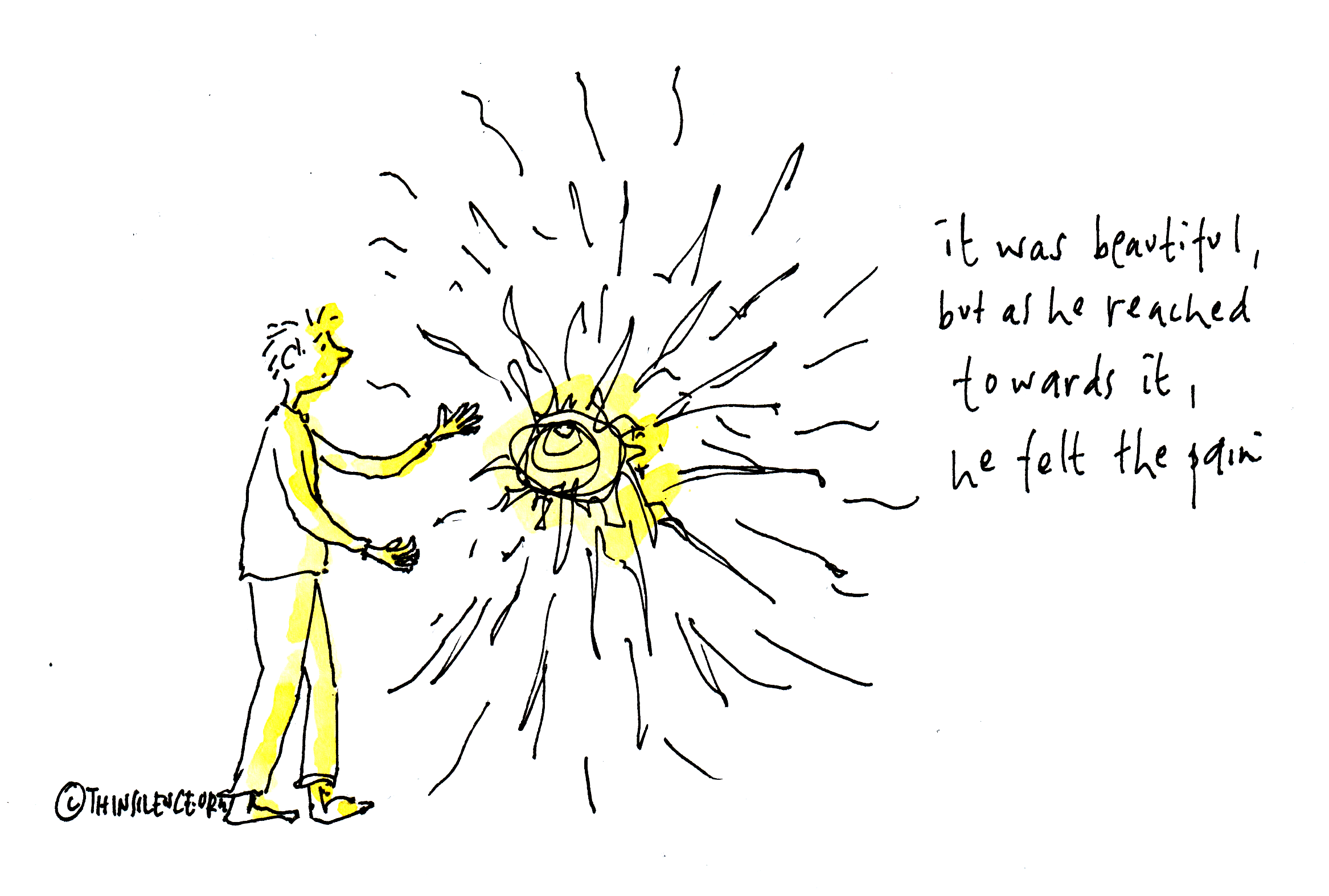
Energy may change forms, but the total cannot increase or decrease.*
Alan Lightman
The kingdom of heaven is like a mustard seed that someone took and sowed in his field; it is the smallest of all the seeds, but when it has grown it is the greatest of shrubs and becomes a tree, so that the birds of the air come and make nests in its branches … The kingdom of heaven is like yeast that a woman took and mixed in with three measures of flour until all of it was leavened.**
Jesus of Nazerath
Perhaps we should not say that
we gain or lose energy;
The energy that we are is
simply residing in a different state, waiting or acting,
Until the day that we hand it back to
our god or the universe –
The energy that is seed or yeast must die, though,
It must suffer, meaning to allow, and if we are to
use our energy for some creativeness,
There will be a cost to overcoming the resistance –
Which is always there –
We must allow something to die for
something else to live,
All that energy waiting for us to
play.^
We don’t play in order to distract ourselves from the world, but in order to partake in it.^^
*Alan Lightman’s The Transcendent Brain;
**The Gospel according to Matthew: 13:31-33;
^This is serious play: see Johan Huizinga’s Homo Ludens;
^^Ian Bogost’s Play Anything.
 THIN|SILENCE
Cool I like it 😊 I think you are also alluding to a saying by Jesus that the kernel must die in order for a seed to sprout. I really hope that is not true. Must be a way for life or the universe to be without pain. A playfulness maybe. Must work always be by “the sweat of our brow” (Genesis 3:19)? But what you’re saying makes sense. When we pass through one state or stage to another, we pay some cost. And then when we die we become something else 🌱
That’s it. We let go to let come. There’s something of Theory U in this, also Joseph Campbell’s hero’s journey. Touching on your remark about work, when we make this journey, we are able to enter into flow. And not to leave out Frederick Buechner who spoke about finding our purpose where our deepest gladness meets the world’s greatest need.
Cool 😊😊 what do those thinkers talk about? I haven’t read them
Joseph Campbell is a mythologist who invested his life in making mythology transparent ant available for us today. Theory U is a means of transforming business, society, and the self, from the Presenting Institute within MIT. It is available in the form of Ulab, a course that can be undertaken for free each year (enrolment is in July). Frederick Buechner was pastor and writer.
Cool did Campbell help people mythologize their lives? I know Jung pretty well. “Theory U”… I swear I’ve heard that somewhere. Thank you for the Ulab link. Now “Buechner” becomes familiar… just remembered there was a bio of him in a book by Philip Yancey
Yes for Campbell, and very likely that Yancey mentioned Buechner – it’s many years since I read Yancey, and I have now donated his books.
Pingback: Naturally | THIN|SILENCE