
‘I remember the many occasions on which help has come from precisely those people whom I thought had nothing to add to my life.’*
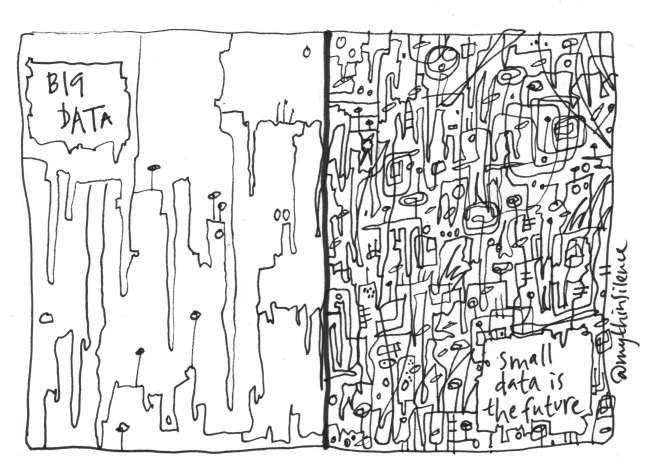
Often, we receive people and circumstances and environments as big data. The trouble is, though it can be impressive on a good day, big data is largely indigestible and ends up being viewed as irrelevant.
Maybe I say to you in a feedback situation: “You work well with people.” This may sound fine, but then you begin wondering:
What kind of work was I referring to?
What kind of skills was I observing and how can they be developed?
Was it a case of people getting what they wanted from me or was there a deeper impact?
Did I mean you work better with others rather than alone?
Was it about leading a team or fitting in?
Getting things done or helping the process along?
Do I know that enjoy doing this, or it drains you?
These kinds of questions are about small data:
“Big data can be made smart data if it can be made smaller, by transforming it to become contextual, relevant, and delivered to the right person at the right time in the right format.”**
I read this and realised small data is what I help people with when it comes to improving talents and performance, or which way to go next or the challenge to go for.
Small data helps us to make the journey, because it’s the journey which keeps us alive.
We then become the kind of people who can bring something to others, those who didn’t realise it wasn’t the big data they needed, but the small stuff from people who know how to work it.
(*From Paulo Coelho’s Aleph.)
(**Michael Fauscette, quoted in Rohit Bhargava’s Non-Obvious.)
 THIN|SILENCE