
‘So, instead of asking what it means to be human, it may be more helpful to ask, what will it take to become human?’*
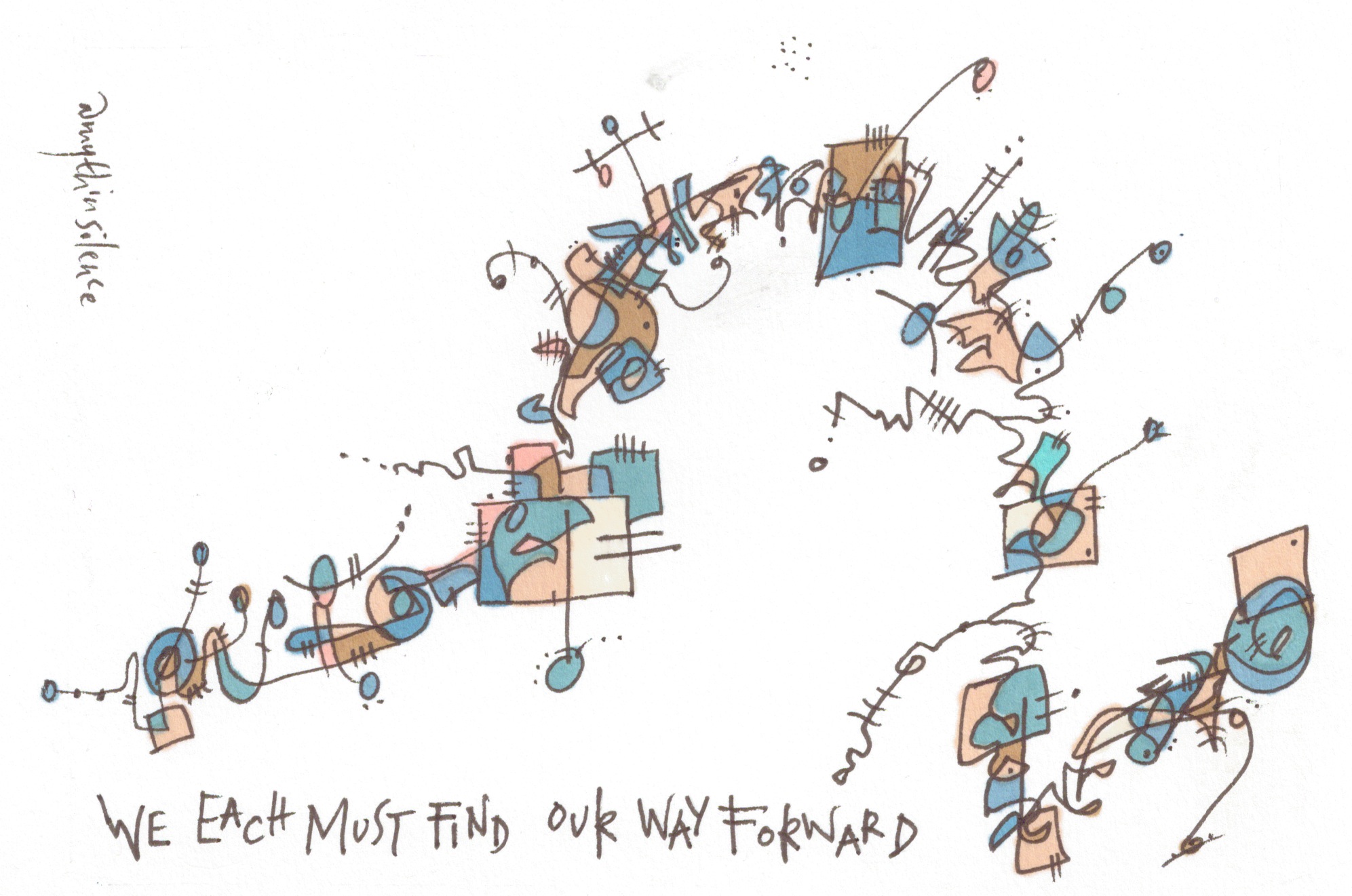
Each of us is finding our way forward.
Knowing who we are is an important part of this. There’s a difference between individualism and being an individual. Edward Deci would say the former lacks self-awareness whilst the latter possesses this towards autonomy.
Without self-awareness – which, in it’s purest form, includes other-awareness – we make little progress. Individualism sings at the top of its lungs, “I did it my way!”, but ‘when well integrated as individuals, people will be solid enough to persist as themselves in a society that is always shifting underfoot,’ whilst also drawing ‘strength from each other, to cherish [our] dependance on those others.’**
This relationship with others means I understand my place in the world in a fuller way. As a person with autonomy, I know I have something of my own choosing to bring to others, which does not require others to give to me: I owe, but I am not owed.
When I honour my obligations to others I am cherishing dependance.
I don’t wait for permission but move forward and persevere: the universe, life, god has already given me what I need by putting breath in me, the rest organises itself.
“You take up space (physical and emotional). And you better have something good to show for it.”^
‘And so, inevitably, these Masters, as they progress on their career paths, make a choice at a key moment in their lives: they decide to forge their own route, one that others will see as unconventional, but that suits their own spirit and rhythms and leads them closer to discovering the hidden truths of their objects of study.’^^
(*From Alex McManus’s Makers of Fire.)
(**From Edward Deci’s Why We Do What We Do.)
(^Rohan Rajiv, quoted in Seth Godin’s It’s Your Turn.)
(^^From Robert Greene’s Mastery.)
 THIN|SILENCE