
I was chatting with someone yesterday who wouldn’t take responsibility for the good and positive things she could do – worrying this would make her proud. All she would allow herself to be responsible for was when she did the bad stuff. While this may not sound like a terrible place to be, here’s what I walked away thinking.
It’s only in the crucible of deep practice and passion and failure and innovation, we’re each able to develop our unique contribution. When we take responsibility for what we’re good at, we can develop it into something utterly amazing through hundreds and hundreds of hours of practice and innovative ideas.* I suspect it’s difficult to experience this intensity when we hold back on taking responsibility.
This isn’t some ego-trip – quite the opposite. We’re vitally connected with others – learning, being helped and led – but all the time we’re moving our art on, into the needs around us, inspiring others.
Albert Espinosa named the hospital roommates who helped him through cancer treatment “yellows” – those who allowed him to be himself and supported him through the bad things. In all, he had twenty roommates, nineteen were yellow. the other was boring.
I happened to read Edward de Bono alongside this and noticed his comment on how it’s important to be interesting in our interactions with people, how this is something we must take responsibility for and work hard at:
‘Creativity is a skill and a habit. You
need to learn to practise the skill,
which then becomes a habit.’
I realised I’d been listening to the person yesterday for more than fifteen minutes and I still don’t know what her art is – she kept bringing the conversation back to how it’s wrong to take the credit for something good.
What a shame. I’d have love to have known.
(*Malcolm Gladwell demystifies the amazing achievements from all kinds of people when he spotlights the thousands of hours of practice they’ve put in: Outliers.)
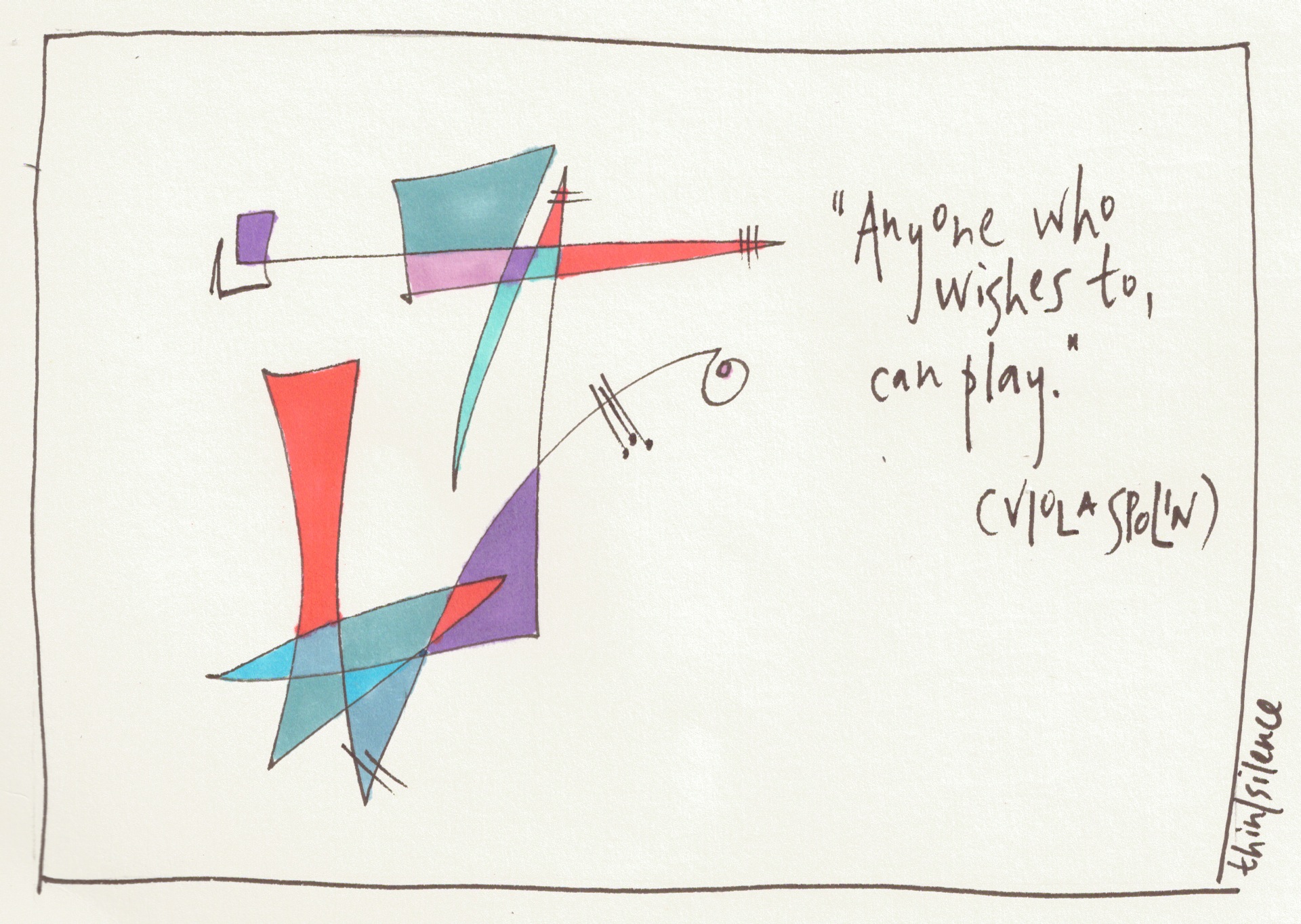
(Cartoon: director, teach, author Viola Spolin’s words are quoted in McNair Wilson’s Hatch.)
 THIN|SILENCE