
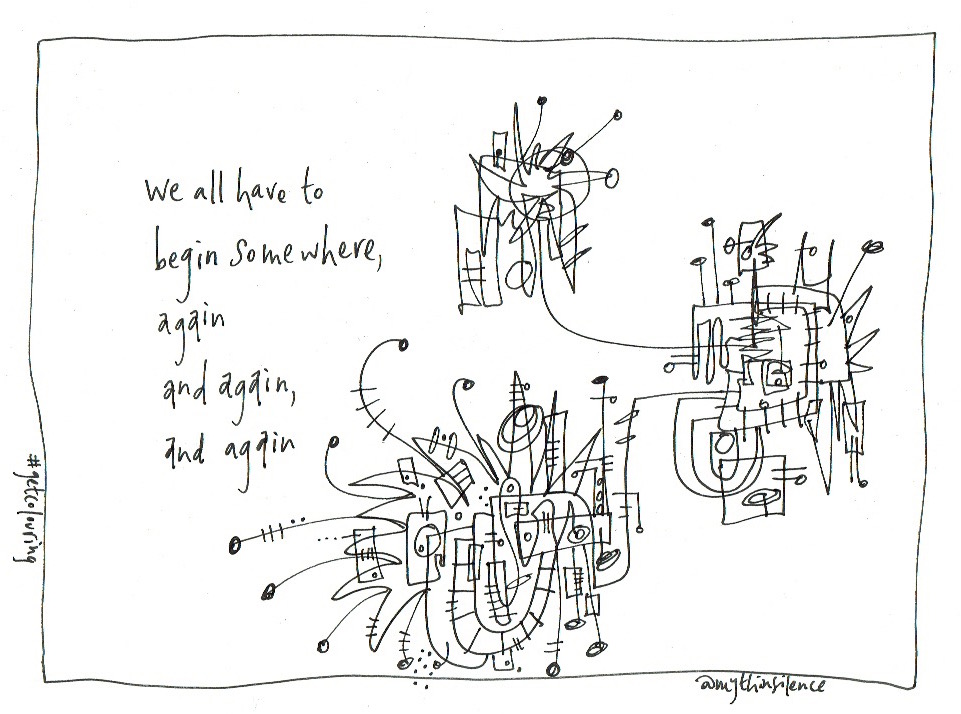
[I]n Japanese Zen, [the] idea of not being constrained by what we already know is called “beginner’s mind.” And people practice for years to recapture and keep ahold of it.’*
Brian McLaren frames life in terms of four seasons: simplicity, complexity, perplexity, and harmony,** so I thought to use these as a way of exploring our universe of randomness.
Simplicity believes, once we have learned or experienced something, that’s it – but complexity challenges us to see that this way of seeing and understanding cannot help us navigate an ever-opening universe. Our openness is critical.
In perplexity, we understand things to be far more complex than we’d thought; life is absolutely random. But there are more skills we can learn, helping us to interact with randomness as in a dance. Here we find some of the richest possibilities – for ourselves, one another, and our world. Whilst complexity corresponds to Nassim Taleb’s Mediocristan, perplexity is Extremistan.^
Harmony lies beyond perplexity, where we identify something rich and significant for us, worth investing ourselves in for others.
If, at the end of it all, we’re still absolute beginner, we’ll have made some of the greatest contribution we could possibly have made.
(*From Ed Catmull’s Creativity, Inc..)
(**From Brian McLaren’s Naked Spirituality.)
(^See Nassim Taleb’s The Black Swan.)
 THIN|SILENCE