
Bonus!: 365+1 in 2016.
Some fear failure so much that they will never risk.
Others have risked and failed and will never risk again.
People like Seth Godin have discovered that to risk often may bring many failures, but there’ll also be successes:
“If I fail more than you do, I win. Built into this notion is the ability to keep playing. If you get to keep playing, sooner or later you’re gonna make it succeed.”*
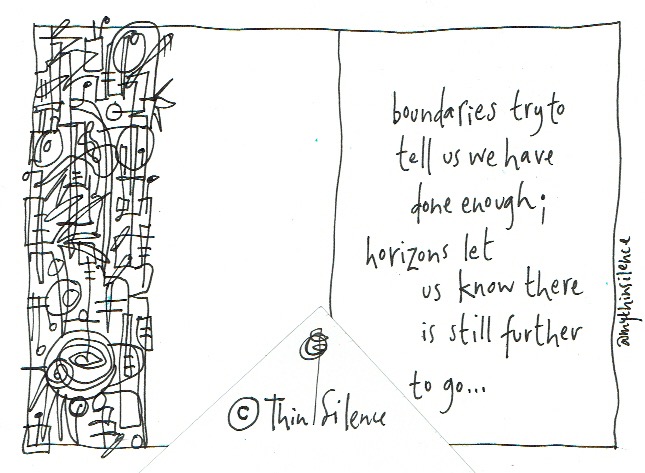
To be aware of something that is important to us, and do nothing, is a primary failure. Burning questions are a great place to start, but questions need to turn into quests. An initial question may be enough to carry us across a threshold, but there’s a difference between a threshold and a horizon – we can cross many boundaries and never reach the horizon.
Questions are important because they take us outside our normal, embedded ways of seeing and understanding, into “regions of uncertainty” – an “anchor” preventing us from moving forward:**
‘As in the case of lines, you are likely to stop when you are no longer sure you should go further – at the rear edge of the region of uncertainty.’**
The best questions make it possible for us to reach for the horizon, not just to cross a boundary.
We get at least 365 opportunities a year to ask our questions. When all of this builds up in a single direction, it becomes a powerful thing.
(*Seth Godin, quoted in Chris Guillebeau’s The Happiness of Pursuit.)
(**From Daniel Kahneman’s Thinking Fast and Slow.)
 THIN|SILENCE