
‘He remains cold and indifferent to the joys and sorrows of others, even his own. As a substitute for a live experience he substitutes the memory of past experiences. These memories are a precise possession … .’*
The miser turns everything into a possession, even experiences.
A part of our lives will be about possessions and transactions: in the West, when we purchase something, we expect the value of the object to be commensurate with the payment we make, and vice versa – reciprocity.
But life must also be about giftedness.
The best kind of gifting may move the gift between more than two people. If I give you something, I can keep an eye on it to see what you do with it. But if I give you something with the hope you’ll give it to someone else, then I lose sight of it, and perhaps it will keep travelling.
This is fascinating to me because of the work I love to do – helping people to awaken to their dreams and to live more fully who they are. So I love the idea of someone I journey with, journeying with another and this experience to be passed forward.
A century ago, ethnographer Bronislaw Malinowski lived amongst the Massim people of New Guinea. He was witness to an elaborate form of gifting. Armbands and necklaces would be gifted between islanders, across hundreds of miles of water, armbands travelling in one direction, necklaces in the other. This wasn’t how they dealt with everything they had – the Massim used a bartering economy – but there was also gifting.**
The miser makes everything a reciprocal transaction. The gift adds imbalance, something beautiful to life we create together.
Even if we’re in selling mode, we can always add a gift of some kind.
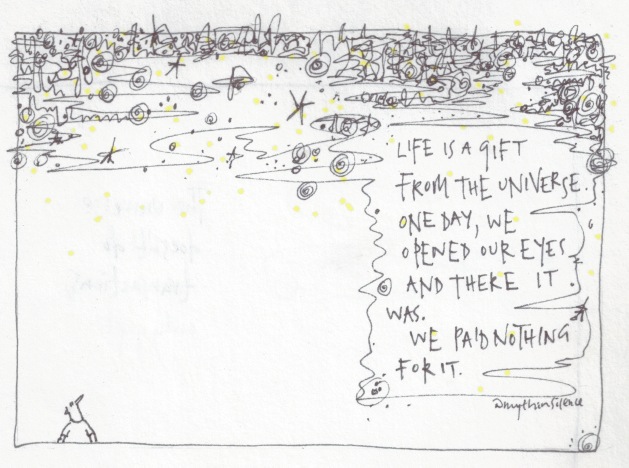
Life is a gift from the universe. One day, we opened our eyes and there it was. We paid nothing for it.
In this universe, gift comes first.
(*From Erich Fromm’s The Art of Being.)
(**From Lewis Hyde’s The Gift.)
 THIN|SILENCE