
For millions of years before the dawn of the Agricultural Age Humans were hunter-gatherers.
Perhaps we miss some of this – though not the uncertainty of food and the amount of time spent hunting and gathering.
A comment on the radio this morning caught my attention. About the rising numbers of relatively young people having strokes and the possible link with the stress of modern living.
There’s certainly a lot being written about how the most affluent generation is seeing rising figures for depression.
(I’m playing with an idea here.)
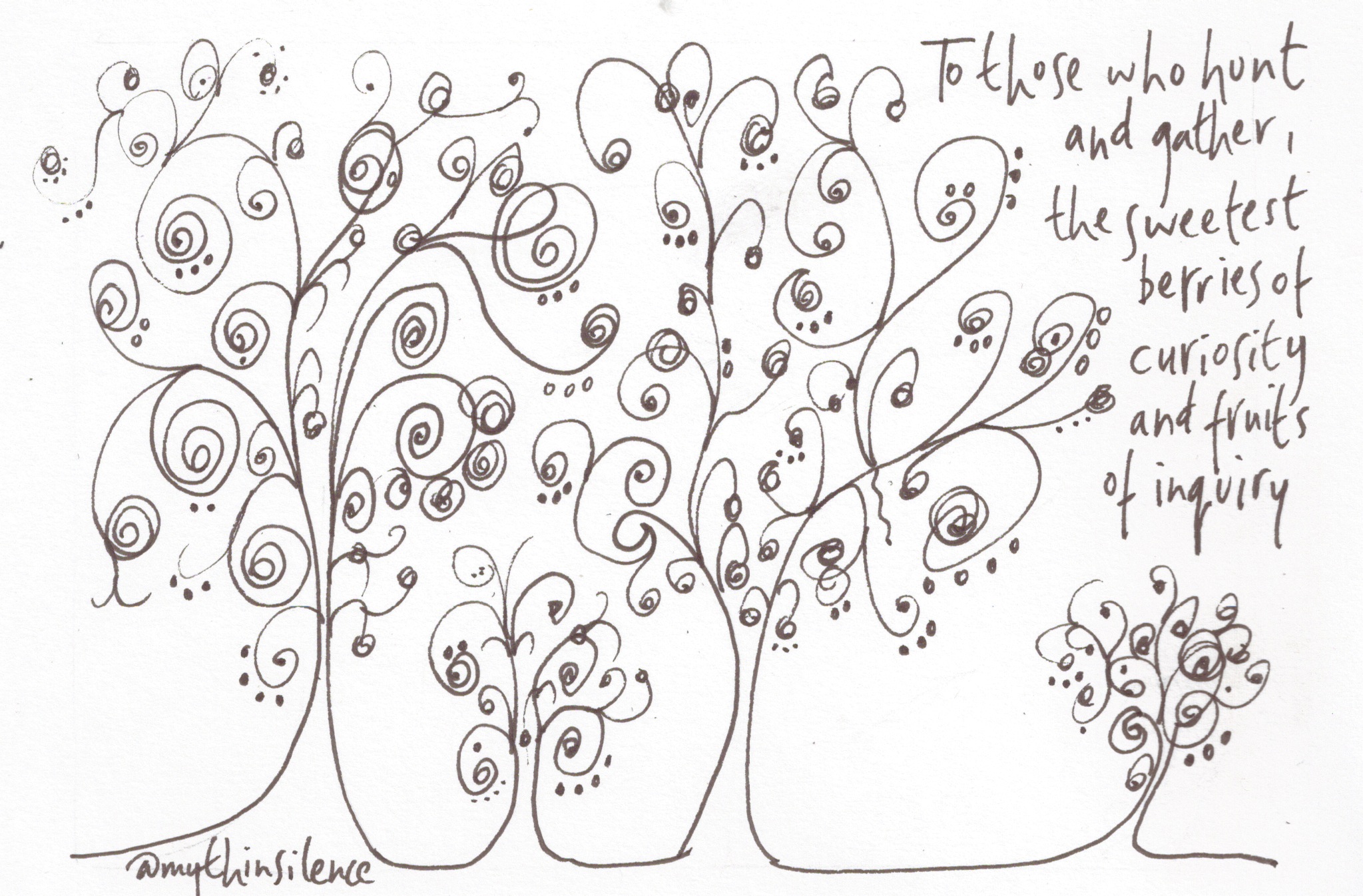
I wonder about the relationship between curiosity and asking, and healthier living. What if we could be hunter-gatherers in a different way? Not expected to come up with the answers, but rewarded for asking questions:
‘The missing ingredients in most conversations are curiosity and willingness to ask questions to which we do not already know the answer.’*
We miss so much to wonder about. Every day we are presented with clues and possibilities in the happenings, meetings, situations, and conversations we find ourselves in. To become more present is what our cognitive, agricultural, industrial, and digital revolutions have set us free for: “Liberté, égalité, fraternité.”
The infinite player lives this possibility of shaping a different future, whilst the finite player plays to get the same results as the past:
‘A finite player is trained not only to anticipate every future possibility, but to control the future, to prevent it from altering the past.’**
The infinite player opens up the future by the means of curiosity and questions, to increase wellbeing for as many as possible:
‘GDP is blind when it comes to whether it is human suffering or human thriving that increases the volume of goods and services.’^
(*From Edgar Schein’s Humble Inquiry.)
(**From James Carse’s Finite and Infinite Games.)
(^From Martin Seligman’s Flourish.)
 THIN|SILENCE