
What if you could not fail?*
A question made up of six short words. Having a simple and beautiful form, it’s been used by many people.
It was made popular by church pastor Robert Schuller at the end of the twentieth century, ‘In the past few years, the question has had another surge in popularity’.*
I love the idea of a question, like a piece of art, having provenance, a documented history because it is so valuable.
It has spawned other questions:
What if I succeed?**
What’s truly worth doing whether you fail or succeed?^
Humans are at their best when they are asking questions.
Here are three linked questions which lead to really interesting adventures:
Who am I?
What do I have?
What should I do (in the light of my answers)?
Some think the first of these questions isn’t very helpful. It’s the third one which is the most important.
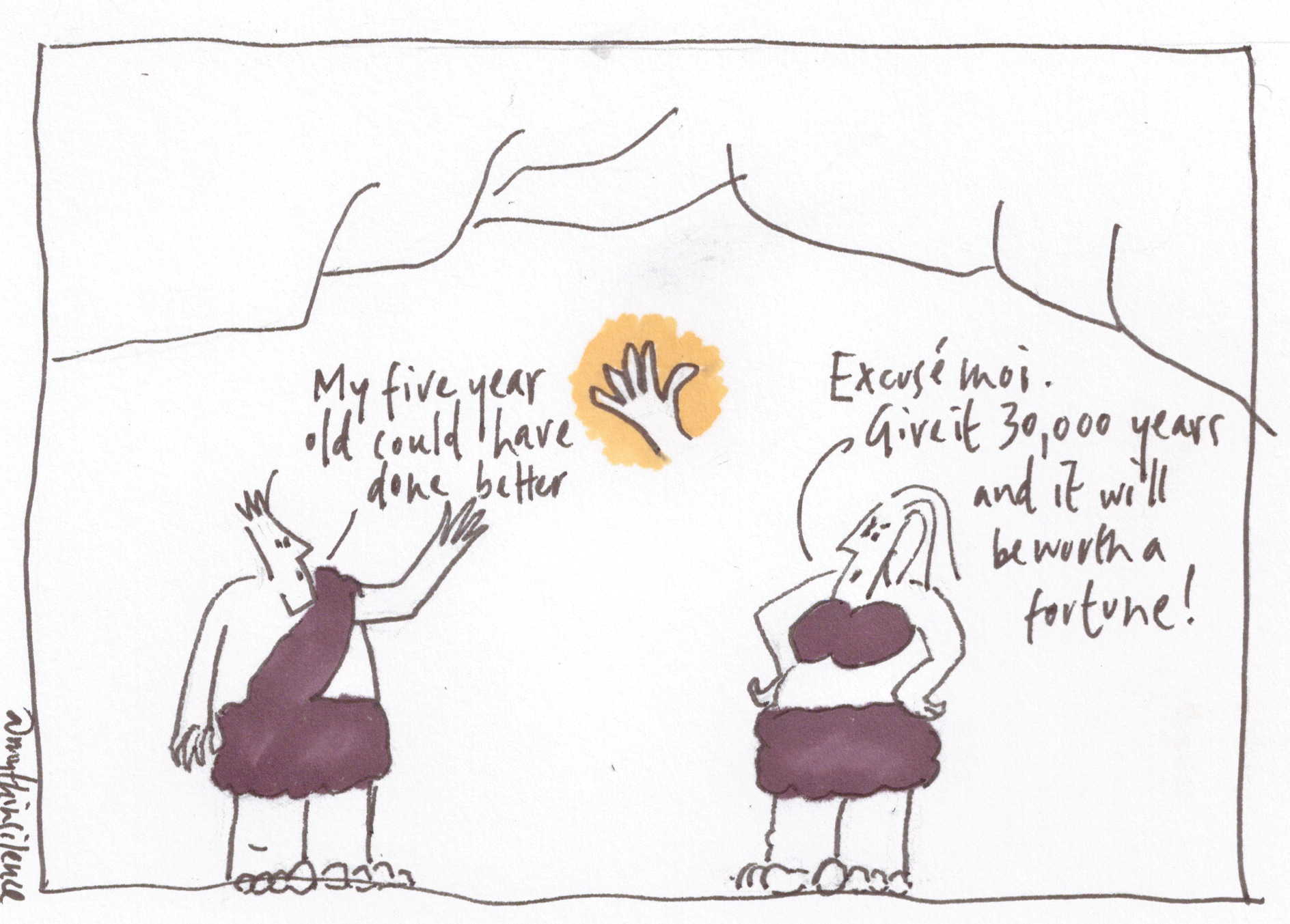
Yuval Noah Harari opens his book Sapiens with an image of a handprint discovered in the Chauvet-Pont-d’Arc cave in southern France. Believed to be 30,000 years old, Harari suggests, ‘Somebody tried to say, ‘I was here!”^^
Gripped by this image, I lay my hand down on the work-surface by my laptop is on roughly in the way I imagine this ancient artist must have done tens of thousands of years ago, and wonder if this was the result of a question forming in someone’s mind. Perhaps, Why am I here? (Or, maybe) an attempt to answer in the form of, I’m here for more than eating and procreating.
Why am I here? is a question we still use to figure out what we ought to do today, which, as I write, happens to be Monday.
(*From Warren Berger’s A More Beautiful Question.)
(**Author Jonathan Fields, quoted in Warren Berger’s A More Beautiful Question.)
(^Author Chris Guillebeau, quoted in Warren Berger’s A More Beautiful Question.)
(^^From Yuval Noah Harari’s Sapiens.)
 THIN|SILENCE