
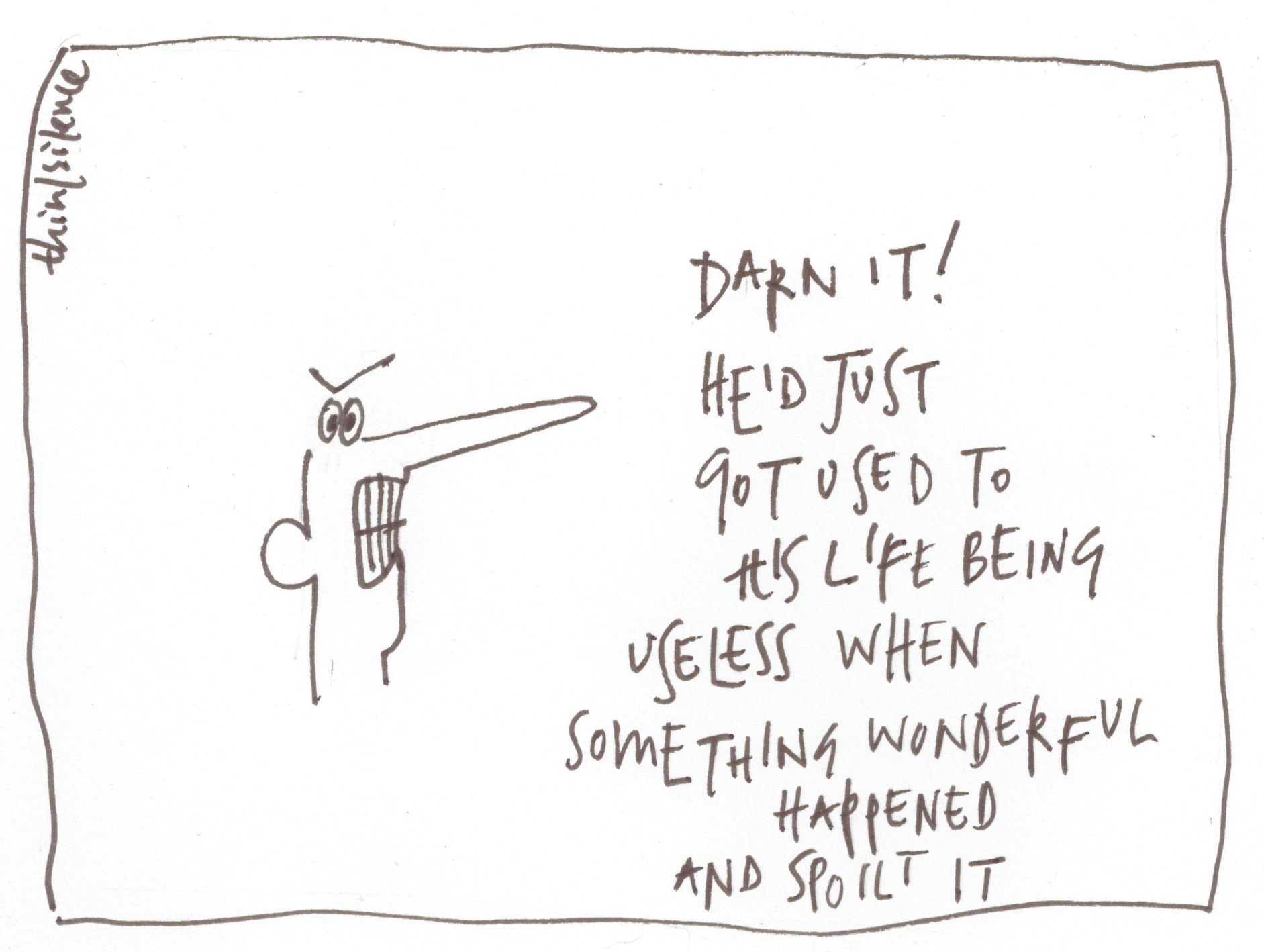
Richard Rohr offers five elemental truths, as gleaned from the initiation rites of different peoples.
I’ve shared a couple of these previously but here are all five:
Life is hard
You are not as special as you think
Your life is not about you
You are not in control
You are going to die
They’re intended to help a child become a contributing adult member of their society: to die first, and then live.
These elementals say, “You are Human,” and are found at the centre of who we are … waiting to be completed.
If we are to see the emerging future, we must recognise the pain in others, in our world, in our self, and, if we believe in God, even in God.
Italo Calvino‘s character Marco Polo describe the unhappy city of Raissa, where people ‘wake from one bad dream and another begins,’ yet there is another Raissa, if only people are willing to see it:
‘Also in Raissa, city of sadness, there runs an
invisible thread that binds one living being to
another for a moment, then unravels, then is
stretched again between moving points as it
draws new and rapid patterns so that at every
second the unhappy city contains a happy city
unaware of its own existence.’
The elemental truths are incomplete and we have the opportunity to be imaginative in how we can complete them:
Life is hard but …
You are not as special as you think, and yet …
Your life is not about you, so …
You are not in control, but …
You are going to die, so …
To do this is not easy, as Daniel Kahneman concedes when he writes:
Reframing is effortful and System 2* is
normally lazy. Unless there is an obvious
reason to do otherwise, most of us passively
accept decision problems as they are framed
and therefore rarely have an opportunity to
discover the extent to which are preferences
are frame-bound rather than reality-bound.’
When we allow ourselves to see this reality – the pain and the possibility – then we have a story worth sharing.
(*System 2 thinking is a slower, more deliberate way of thinking, in contrast to System 1 thinking which fast, instinctive, and emotional. It requires a lot of effort and therefore we tend to find it’s lazy. Nassim Taleb picks up on how energy-sapping open thinking is when he introduces the sceptical empiricist: whilst we may wish to come to a conclusion about something and move on, we can remain sceptical about whether we know all there is to know or have covered all the angles.)
 THIN|SILENCE