
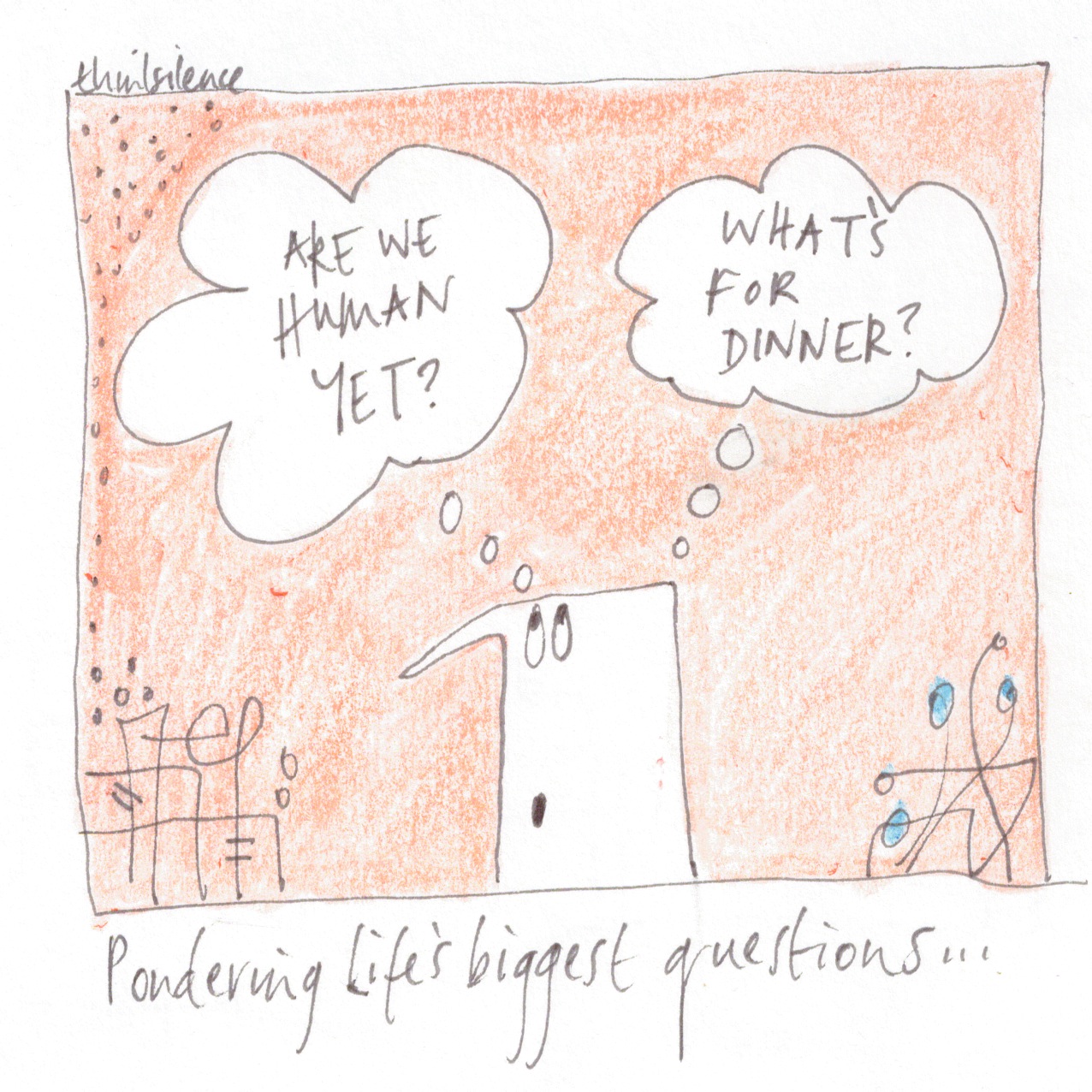
Being Human is to develop.
Humans keep developing things.
Being Human is changing.
In this post, I’m exploring some of the thinking behind the posts of the last eight days (from this one).
In the 21st Century we ask the dominant question: What does it mean to be Human?
But some ask, Is life itself about becoming Human?
Our journey is one of opening our minds, our hearts, our wills, identifying what we must contribute as our art, experimenting towards a sustainable delivery of what it is we love to do. There has never been a time like the one we live in for pursuing these things – we cannot think as our grandparents or parents did, nor even as we ourselves thought ten or fifteen years ago. We have the opportunity to bring together artefacts from many places and times and dimensions, and create something new from these. Frans Johansson encourages us forward in this direction when he writes:
‘The intersection of fields, cultures, and disciplines generates
combinations of different ideas, yes; but it also generates a
massive number of those combinations. People at the
Intersection, then, can pursue more ideas in search of the right ones.
Johansson’s intersection refers to is the place our journey takes us to, where we identify and begin to craft our art.
We just don’t know where al of this might lead, how far we can go. To begin to find out, though, all we need is permission, as Tina Seelig testifies to on noting the comment on a paper she was having marked at college:
‘When I got the paper back a week or so later a note written
on the top said, “Tina, you think like a scientist.” I was just
waiting for something to acknowledge my enthusiasm and
to give permission to pursue my interests.’
What we are hoping for, is for this journey to meet our needs, of which some we know and some we do not. Mihaly Csikszentmihalyi tells us there are two tendencies found in Humans, the conservative and the expansive. James McQuivey offers more detail to these when he writes about how each has a conscious and unconscious element: the conservative seeks comfort (unconscious) and connection (conscious), whilst the expansive seeks variety (unconscious) and uniqueness (conscious). Csikszentmihalyi suggests the conservative tendency needs no help, but the expansive does.*
If we’re blind to these dynamics, then we can end up going around in circles – the unconscious leading us into comfort and variety going nowhere, whilst connection and uniqueness can drive us towards a purpose greater than ourselves.
This is what it means to be Human, what we’re discovering more and more about. We are not just driven along by unconscious needs but we have the capacity to direct our lives – becoming more Human.
We do not always know why we do the things we do,** but we are becoming more aware and, perhaps, when technology and genetics are added – as they already are^ – then we will be able to explore the outer limits of being Human even more. McQuivery offers:
‘Today’s brains have shifted into overdrive. Thanks to digital,
we have the ability to meet more of our needs more often and to
a greater degree than our grandparents, our parents or even
ourselves from just ten years ago.’
Knowing these things, you have permission to do that thing you do: your art of rightness and goodness you long to unleash in a needy world.
(*Check out Chip and Dan Heath’s Switch, which looks at the unconscious as an elephant and the conscious as the rider – you’ll already have noticed the difference in size!)
(**Dan Ariely’s Predictably Irrational, Daniel Kahneman’s Thinking Fast and Slow, and Edward Deci’s Why We Do What We Do are all insightful reads when it comes to this.)
(^Ramez Naam’s More Than Human and Jeffrey Scott Coker’s Reinventing Life offer a useful glimpse at what is already happening and what may.)
 THIN|SILENCE