
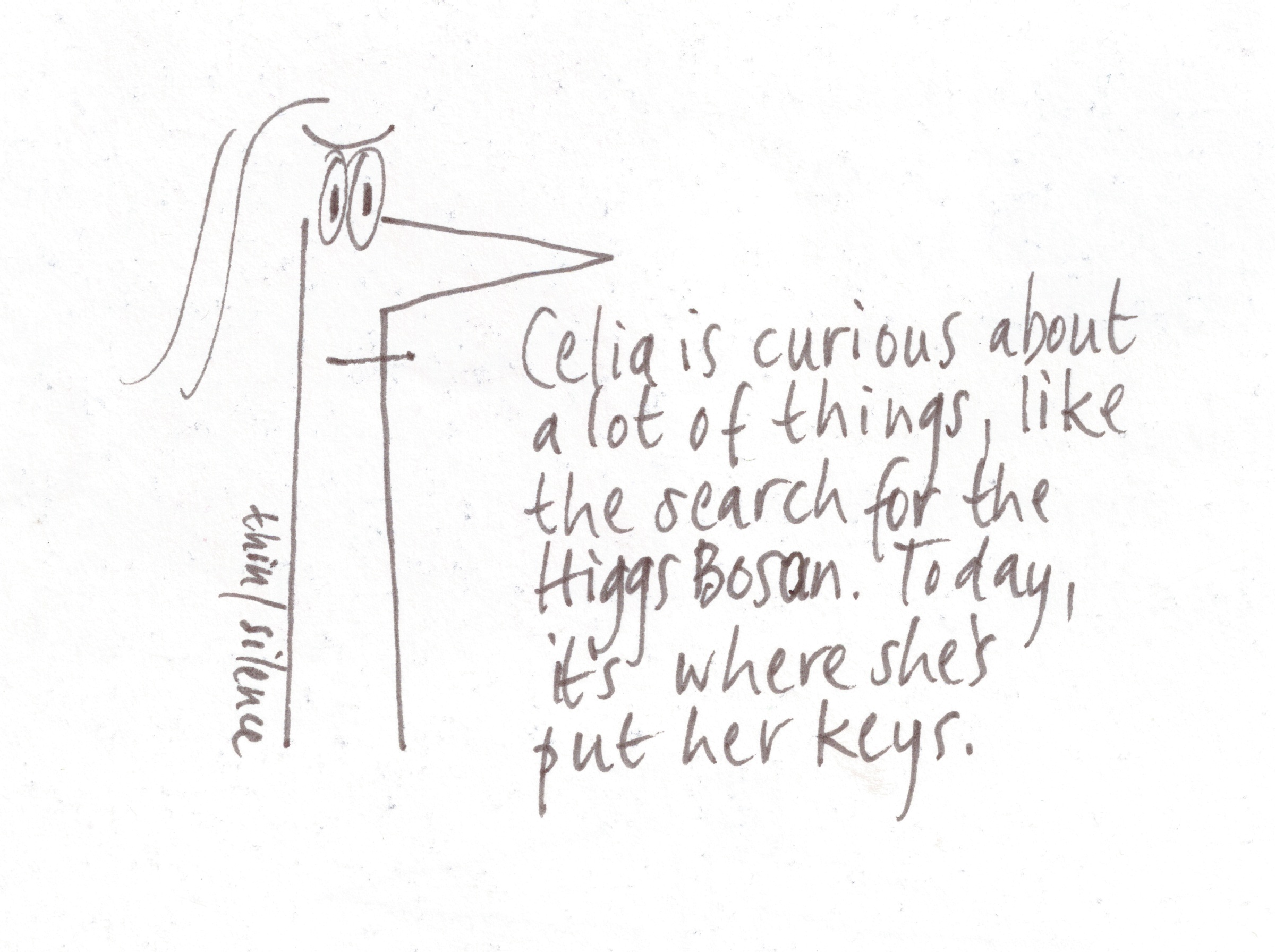
Last night, each person in group I’m a member of was selecting a key word to use as a focus for 2014 – the intention being to carry us beyond New Year’s resolutions.
From a table-top of different words, I picked up a number which have resonated with me for a long while or have buzzed with me recently.
I found myself with five and wondered which one to choose as my number one. I fell upon CURIOUS, as I know without this I cannot make any progress.
Every one is curious about something.
Humans try to understand their world and everything within it to find meaning if not Meaning – the big M kind. Some say, our brains are designed to look edges and patterns everywhere. These edges and patterns, once identified, tend to shape the way we think and see for a long while – and lead us to our personal and corporate understandings of meaning and Meaning.
This can lead is to the problem of WYSIATI (What You See Is All There Is), and we’re blind to the dar more than we see: “Each thing we see hides something else we want to see,” says Rene Magritte.
Curiosity takes me outside or beyond my present way of seeing and understanding. It may carry me to another book – especially one I would not have imagined reading, or to listen to how someone else sees and understands the world, or try out a skill in a different field, or try giving philanthropically and watch to see how useful it might be to people.
Curiosity, though, is tiring for Humans. We can’t be aware of everything all at once – we’d be overwhelmed, so we use what’s been termed selective sensory perception, and is the reason why Magritte can say what he does. I realise, in choosing the word CURIOUS I’ve decided to do some hard work.
We have help built in. We’re all interested in something, so everything in life for us is subjective and with this comes energy. Nothing is objective, and just as well. We can all begin by pushing the boundaries of what already interests us, leading to crossover experiences with sources, with people, with places. (The scientist who believes she is involved in some objective piece of work has chosen the subject or field for a reason which is, directly or indirectly, subjective; even if she is arbitrarily provided with an area for research, she’ll need to find ways of attaching to it, to be motivated by the work, to have the energy to complete.)
Curious to know where you might begin. I am.
 THIN|SILENCE