blessed are the weird

28 go on

And we’re all weird.*

There is no such thing as normal: people are looking more and more different to each other, following all kinds of divergent paths, converging in exciting new ways.

If you want to be normal, well, that’s just weird.

There’s never been abetter time to explore your weirdness, and the world needs what you have to contribute.

The industrial education and work systems have taught underperformance.  There’s some research which followed some teachers who’d been led to believe their students to be more intelligent than they were … and the students performed better!

‘If your actions inspire others to dream
more, learn more, do more and become
more, you are a leader.’**

What if you’ve been learning underperformance?

I ask the people I journey with lots of questions.  Listening carefully to what they share back with me, I see all manner of possibilities for their lives.

Listening is very important:

Talking can show how smart you are.  
Talking can convince others of your views.
Talking can help you clarify your own
thinking.  But talking only rarely gives you
something new.  Listening, on the other
hand, can give you new ideas – if you
try to receive them.’^


It is important to listen to others.

It is also important to listen to our lives, to their weirdness – their interests, passions, values, and skills, and to what all of these are saying to us today.

28 go on ... coloured

And then to dream and to do something weird.
(*One of my favourite short reads is Seth Godin’s We Are All Weird.)
(**From Tom Asacker’s The Business of Belief.)
(^From Edward de Bono’s How to Have a Beautiful Mind.)
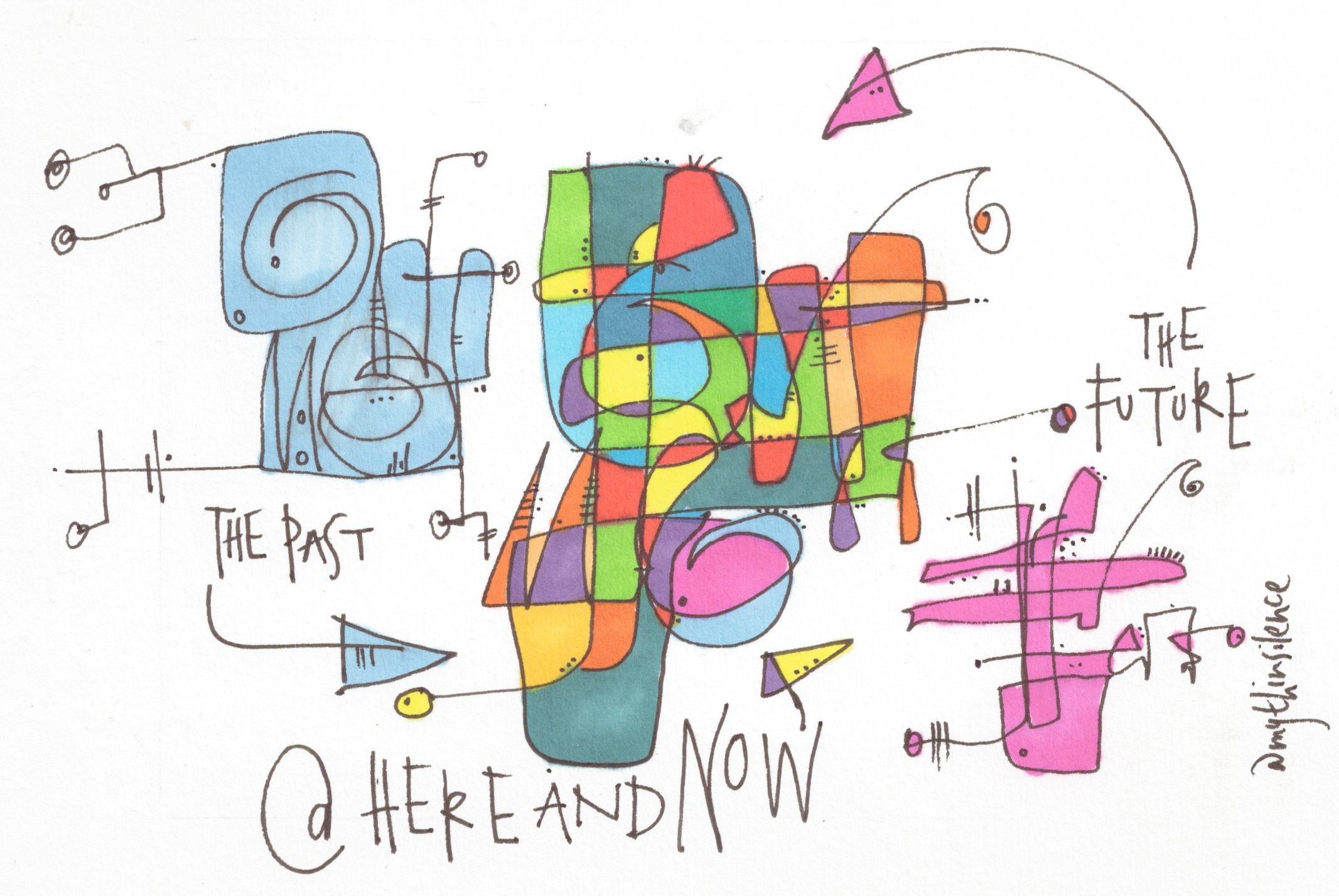
(Cartoon: I’ll colour this in later, but I thought you might like to have a play at colouring it in your weird way.  My friend Lou Davis introduced me to colouring for adults earlier today.  Lou has a downloadable colouring book ready.

in search of the beautiful

27 imagine beauty

It is said, Beauty is in the eye of the beholder.  

It is, in the eye of the Human.  Beauty is a word we’ve invented to describe something which captures our attention and pulls us out of the purely functional.

Beauty is very big, it is very high and wide and deep.

Some may want to reduce it to several lists, but beauty cannot be reduced.  All the time it is growing.

It breaks out of lists to be found in all kinds of places, creations, people, and moments.  Where, how, and who will always surprise us.

The universe is a beautiful place; it is also a hostile place.

Whilst made of the same stuff as the universe, Humans choose to add to and improve, unknowingly and knowingly through the choices we make.  Frank Schaeffer offers: ‘We are part of nature yet we have decided to be nicer than nature. … We live by ethics not found in nature and we enrich our lives with art.’

The universe is unmoved by these thoughts and yet it has provided the creatures who posit them: unconscious itself, it’s the home for growing consciousness.

Like a cussing and loving parent, the universe acts as if it doesn’t care but we then we come upon it shaping beauty which takes our breath away.

We cannot deny we need to watch the basics – food, shelter, sex – to survive as a species, but we keep finding ourselves looking upon the beautiful, perhaps first in our imagining and then in our making.

Eckhart Tolle wonders whether we’re coming to a time of greater Human awakening, the arrival of a greater consciousness.  Some wonder if we have only just arrived at great Human flowering.

The industrial age made us collectors of dots – where we are now in time and space makes it possible for us to become joiners of dots: in all kinds of ways, in all sorts of patterns, creators of all manner of beautiful things; not only art and music and such, but relationships and communities and societies and businesses.

There is  much beauty in our world and universe, there is much beauty within every person, and when we imagine what might be, we are beginning to create more beauty.


once upon a time

26 oh no ...

Four powerful words in the hands of the storyteller.

Some tell stories to hide things.

Others tell stories to reveal more.

Industries and schools and nations have all understood the importance of story; also, the rich and powerful and intelligent.  Their stories are often functional: work to feed and house and clothe yourself.

Poets and artists and entrepreneurs and adventurers and explorers  and inventors tell stories of how we are moving beyond function -only into a world of imagining and making as an expression of our creativity and generosity.

In the hands of an awakening-creative, Once Upon a Time rocks the status quo: a character, a situation, a challenge, leading to a deeper understanding of others, the world, and the future Self.

A friend has just passed me Eckhart Tolle’s A New Earth, and  he immediately caught my attention when he  suggests Human consciousness developed as our species moved beyond the functional.  He picks upon three symbols of the ethereal which capture our attention, symbols of enlightenment: a flower, a bird, a crystal:

‘The first recognition of beauty was one
of the most signifiant events in the evolution
of human consciousness. The feeling of joy
and love are intrinsically connected to that
recognition.’

Interesting.

Tolle goes on to describe things as they are often found – a case of WYSIATI:* our education and our work teaching us well to value only the functional and be sceptical or cynical about the reflective:

‘Until this happens, however, most
humans see only the outer forms,
unaware of the inner essence, just as
they are unaware of their own essence
and identity, only with their own
physical and psychological form.’

For me, this is saying is: Don’t let your story be told by others; you must tell (live) your story.  Not in a reactive or even a responsive way, but in an initiating way.

‘If willpower can be taught, why don’t
we teach it?  Simple: because industrialists
don’t need employees with willpower,
and marketers loathe consumers who
have it.’**

(*I’ll be layering Tolle’s ideas with Otto Scharmer and Theory U as I continue to read.)
(**From Seth Godin’s Whatcha Gonna Do With That Duck?)

not good enough

25 he was the last

Who said so?

Who closed a door to you or hid a path from you?

There are people who’ve placed themselves between us and the realisation of our dreams when we didn’t need anyone to sanction our journey, only to help.

Many have gilded the doorways to suit them; they have designed the paths according to their tastes.

For centuries, these experts and teachers and gurus have told us we’re not good enough.

It’s even okay to be told we’re not good at this, if we are helped to see we’re really good at that, but this often doesn’t happen.  No help.  Not a word.

Things are changing.

We live at the dawn of a time when those who install themselves in front of our door or our path will be seen for what they are: frauds and usurpers.

‘Think of the art we haven’t seen, the jobs
that haven’t been created, and the productivity
that hasn’t been imagined because generations
have been persuaded not to dream big.’*

The most tragic thing of all is when we believe the self-selecteded guardians and we tell ourselves we’re not good enough.

We must suspend the old ways of seeing things, and be present to the reality of who we are and the world around us, so we might realise the future we dream of.

(*From Seth Godin’s Stop Stealing Dreams, as found in Whatcha Gonna Do With That Duck?)

provocative

24 goon, push it

From the late Middle English, derived from the French provocatif, originating as the late Latin provocativus, meaning to call forth or challenge.

Provocative is deliberate and healthy when taking on the status quo – whether we find this in our own lives or within some corporate expression of life.

Nassim Taleb explores the effects of stressors on the fragile and antifragile: imagine dropping pottery espresso cup* one inch a thousand times – it will survive this minor stress; now imagine dropping the same cup one thousand inches just the once – I’ll need to buy a new cup.

What if the same cup were able to learn from its many small stress experiences and adapt – a little like the Borg?  It might even become unbreakable, or robust.

Of course, cups aren’t able to do this.

Humans can.

We are able to learn from, and adapt to, the small stressors of life, making it possible to face larger ones.  Taleb isn’t suggesting robust is the opposite of fragile, rather, antifragile is the opposite: ‘For the antifragile, shock brings more benefits (equivalently less harm) as their intensity increases (up to a point).’

Antifragilistas** learn to see which stressors or nonlinearities have more upside than downside: the risks worth taking.

The status quo is powerful, though, because its squared off all the round edges so it can’t be rolled, and it has mass.

The same things make it fragile.

We can provoke ourselves by learning new things, reading different subjects, engaging in new activities, meeting new people, asking questions we’ve never asked before (and then asking more) – we challenge our values and worldviews.

Along the way, we begin to notice we like certain things and people a lot, and we begin to integrate these into our lives (so now we’re adapting).  We discover we can take larger risks as we proceed, and begin things, unafraid of failure, willing to learn (stressors are the means by which we move from fragile to robust to antifragile).

From reacting – fragile and breakable, we begin to respond – we are robust because we can resist breakage, and then we begin to initiate – antifragilistas live provocative lives.

I think there’s a caveat to this.  None of us will be antifragile to everything, which is where an antifragile community, or communitas, is necessary.

The status quo must then beware.

(*My first drink of the day.)
(**Taleb uses the term fragilista for someone who is prone to live fragilely.)


incompetent

23 so, where were you

I’m just not competent to remain at the level of performance which I can be proud of and protect.

There’s incompetence which is about being unable to do the work expected of us, day in and day out.

Then there’s the incompetence which is about stepping outside of the routinised and predictable in order to stretch and grow and improve, perceiving the uniqueness of a situation or person and not treating it or them as every other case.

I am good at what I do, but I want to be better.

This demands I step outside of my competence.

The necessary breakthrough we see will seldom come from within what we already know – individually, communally, or organisationally.  We have to both welcome what or who comes from beyond our context, and we also have to step outside of it towards the other.

We’ll come across industrialised worldviews in people and places we didn’t expect when we step outside of competence.  Industrialised worldviews value competence – wanting you to keep turning up and produce the same results.

Incompetency of this kind questions the way things are, the status quo, wanting better, more, different, so, if yore already there, I just want to encourage you in your personal incompetence.

gamefulness

22 i don't care

I am convinced we must rediscover playfulness.

Not discover, rediscover.

There was a time in all our lives when we played.

Then we grew up and we forgot how to.

Gamefulness is opens to us more of what we really want to do and to do more, full-stop.

To be good, to be really good at something, we have to train, but training sounds like hard work, but through gamefulness or play they become smaller games towards what we really want to do.

This morning I read ‘How most of Kickstarter‘s magic is simply that they made a game out of raising money.’*  Kickstarter has a few rules which are ruthlessly enforced: set a deadline, set a minimum funding goal, keep to the deadline, have tiered levels for giving and thank-you gifts for each, and, leave the ownership entirely with the fund-raiser.

This is a finite game doing what it does best: supporting a bigger game – in this case, each of the Kickstarter projects.

What is it you really want to do with your life to express creativity and generosity, thereby providing you with enjoyment?  What are some of the smaller games (training) you need to play in order to pursue the larger game and to up your game?**

Leah Robb suggests there are three ways a piece of art can be developed: craftsmanship, substance, and innovation.  Ideally the “big picture” will push each of these as far as possible, though depending on what is being pursued, this can’t always be so: Leah suggests Tracey Emin’s Unmade Bed is high in innovation, not so high in substance, and lowest in craftsmanship.^

Our smaller games (or training), in support of the big game, can focus on one or more of these three components at any time.  Substance games can develop who we are and the purpose we are pursuing, craftsmanship games work on the skills, and innovation games enable us to look divergently across new fields and disciplines with the aim of fuelling our imaginations.

Games are serious ways for becoming more engaged in what we must do.^^

(*From Chris Anderson’s Makers; Kickstarter is the online crowd-funding movement for a diversity of projects; I’m working on onemyself.)
(**Imagine paying to go to a Premiership football match – better still a Championship game to watch Middlesbrough – only to find the players hadn’t trained since the last game – in fact, they hadn’t trained between games for several months – and now you’re watching them sluggishly move around the pitch, misdirect passes, argue with one another because they can’t agree what system to play.  Our lives move up through the gears as we gamefully train for what we do.)
(^What do you think?)
(^^When Martin Luther King Jr. arrived in Birmingham, Alabama, in 1963, he and his workers were very much the underdog.  What they did was to play a game which suited their goals and strengths – King to local activist Wyatt Walker: “Wyatt, you’ve got to find the means to create a crisis, to make Bull Connor tip his hand” – Eugene (Bull) Connor was the city’s racist public safety commissioner.  A photograph, resulting from a peaceful march which had brought out the violence of racism horrified a nation and began to change things.  This story is explored by Malcolm Gladwell in David and Goliath.)

in-between people

21 between this and that

In-between people avoid self-reinforcing arguments.

They search for better ways of relating to what they find around them – describing their exploring and discovering in words and pictures and metaphors and theories and paradigms, yet knowing how all of these are limited: knowing the something they describe is always something else.

In-between people suspect the best way to explore and experience their world and universe is playfully.

In their infinite game everyone has something to bring and should be allowed to play; they never recover from having the opportunity to participate in the greatest of Human adventures; and daily play with as many as possible for as long as possible.

Their experience is, when they give more to the game they get more from the game, but, when they hold back, they receive less.

The infinite gamer finds continents for exploration between finite gamers and games:* positions taken by at least two people, parties, or nations.

These in-between people try to see things which do not exist yet or are invisible, knowing imagination is our best path into the future.

And all the time, they know they must not be blind to where their questioning, imagining, or leading comes from, finding themselves wrestling to be more present to and mindful of who they are.  There is a great seriousness to their play.

Each new day, though, brings a new opportunity to play.

(*Finite games exclude, have a certain lifespan, and have to be played by the rules.)

storytellers of the universe

20 as someone fanous said  1

Every so often I like to zoom out and see a bigger picture.

As we look out on this amazing universe in which we find ourselves we get to record and remember what we see unfolding around us: we get to tell an incredible story.

Maybe it is in the spaces in-between the real wonder lies, in the relationships between ourselves and the vastness of space where stories are born and shaped.

In the spaces in-between, our questions form – we are the questioners in the universe.  As far as we know, there are no other questions being asked.

To ask a question is to make ourselves responsible. Who else will ask it?  No-one and no-thing?  Then, we will ask the question.

Perhaps the universe something very important when we stop asking questions, when we stop living in the “in-betweenness”?

There are three prime questions of responsibility:

Who am I?*
What do I have?
(Therefore) what will I do?

The more personal it gets, the more questions we will want to ask.  When it matters to us, we will not be satisfied with the first answer.**

You become the storyteller you must be when you answer the three prime questions.

Please, make sure your storytelling stands out as it will never be repeated.^

‘What happens when you’re afraid to
stand out is that you unconsciously
make sure you blend in.’^^

(*Some have suggested the better question, recognising the identity we find in relationships, is “Whose am I?”  There is certainly the need to understand ourselves in relation to others.)
(**In the organisation I am a part of, I’ve found myself asking more and more questions as I’ve been taking more responsibility for what I must do.) 
(^This is what I the next event I’m planning with others will be about: stories and superpowers.)
(^^From Bernadette Jiwa’s Make Your Idea Matter.)

lost in space?

19 ellen was ready

There are those who believe Humans will colonise the planets.

Others believe we’re already on an incredible spaceship hurtling through space with all the life-supports we need.

Some still believe the sun moves around the earth, at least in terms of Humans being the creatures everything else ought to bow before.

Still others believe Humans are significantly insignificant, bothering a great deal to tell us we ought not to bother.

We struggle to come to terms with Humans being truly amazing creatures in the universe – perhaps the only species to look and question and think about the universe in the way we do.

Perhaps.

All I know is I need to push on into better understanding my place within a universe of such size and complexity, unable to deny my difference to everything else whilst understanding I am made of the same “stuff,” to be grateful for the possibility of life I have and to make the most of this, and to somehow  live this out faithfully every day as long as I live to delve more deeply.

Maybe we find ourselves to be the gardener-poets of our planet, solar system and beyond: in an symbiotic relationship with our world and all inhabiting it, whilst speaking out words of wonder and amazement, but also words of love and hope and creativity, and more and more still, within it.

A tree-hugging friend helped me to see this more when she invited me to be one of many hundreds of people hugging another inhabitant of our planet – I highly recommend hugging a tree as well as hugging friends.  After the heavy handedness and footedness of industrialisation* we need people who walk in creative, interdependent and innovative ways: those who are curious about and present to the world in which we find ourselves as gardener/artist-poets.

Maybe then we’ll not be quite so lost in space.

(*Poet and Jesuit Gerard Manley Hopkins captures this well when in ‘God’s Grandeur’ when he looks on the industrial landscape of his time : “Generations have trod, have trod, have trod; /And all is seared with trade; bleared, smeared with toil; ?And wears man’s smudge and shares man’s smell: the soil /Is bare now, nor can foot feel, being shod.”)