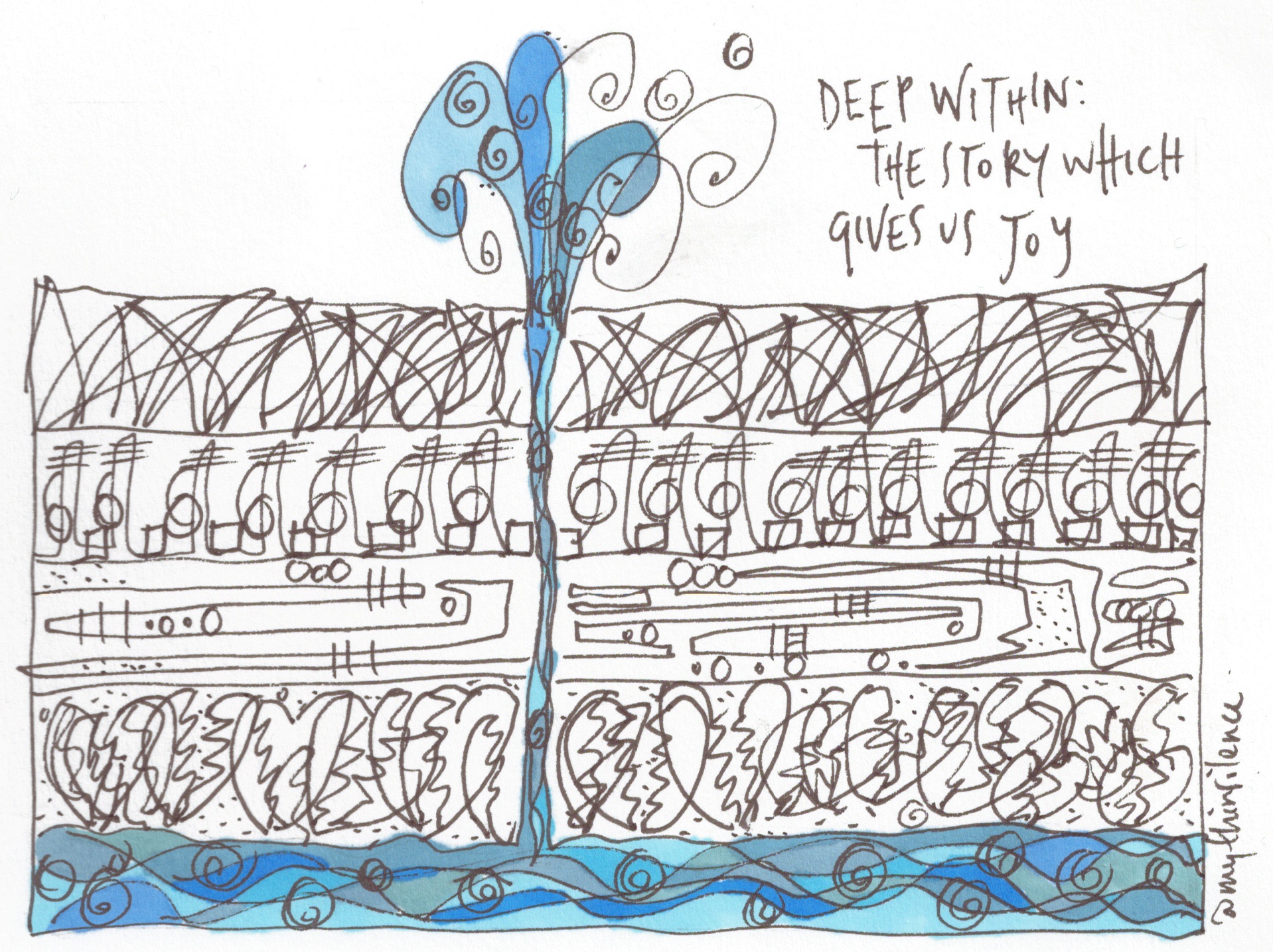
unlikely heroes

18 trust the process

You’re included.

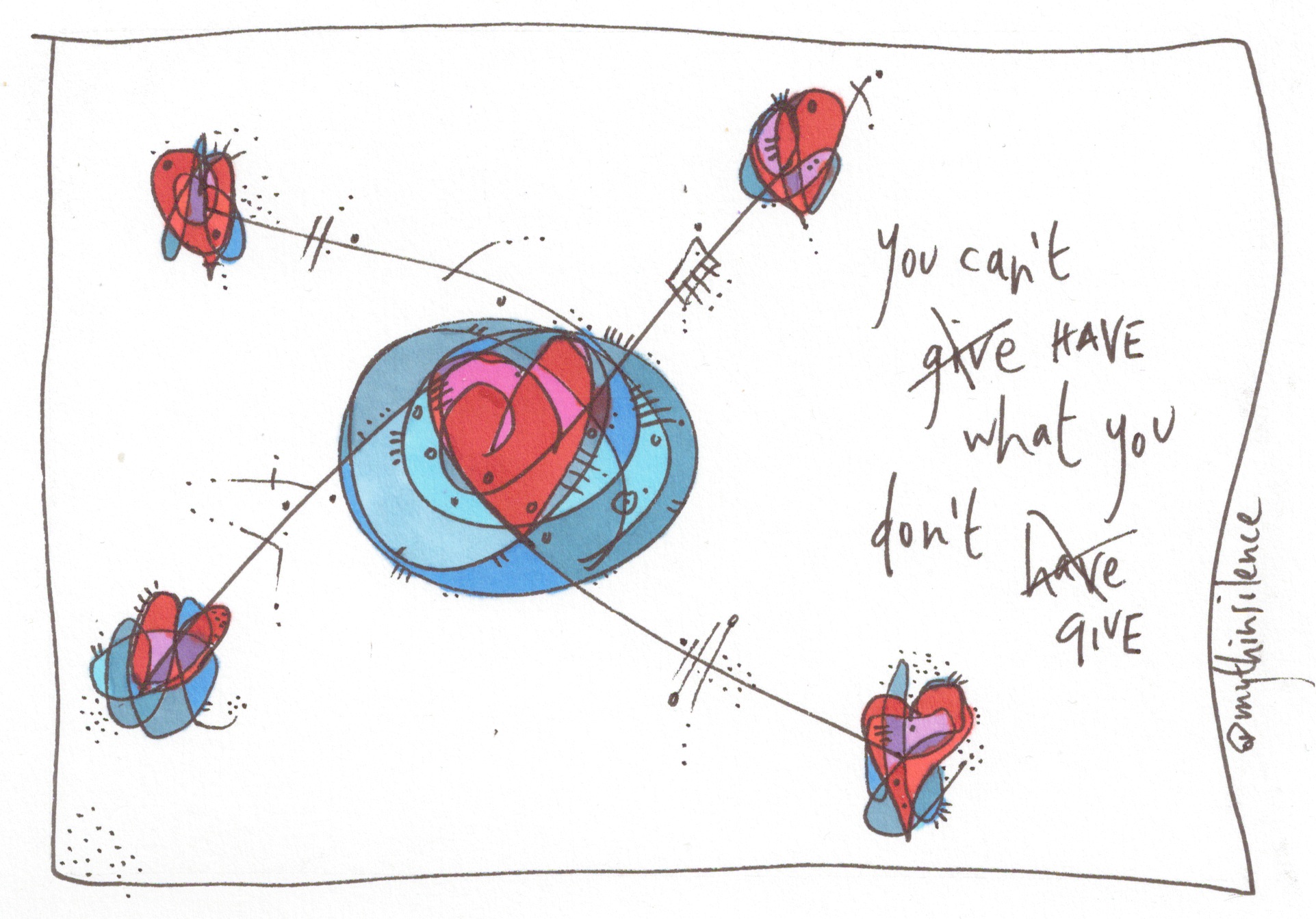
Courage is not the lack of fear.  It is acting in spite of fear.  Courage has also been defined as a lack of self.

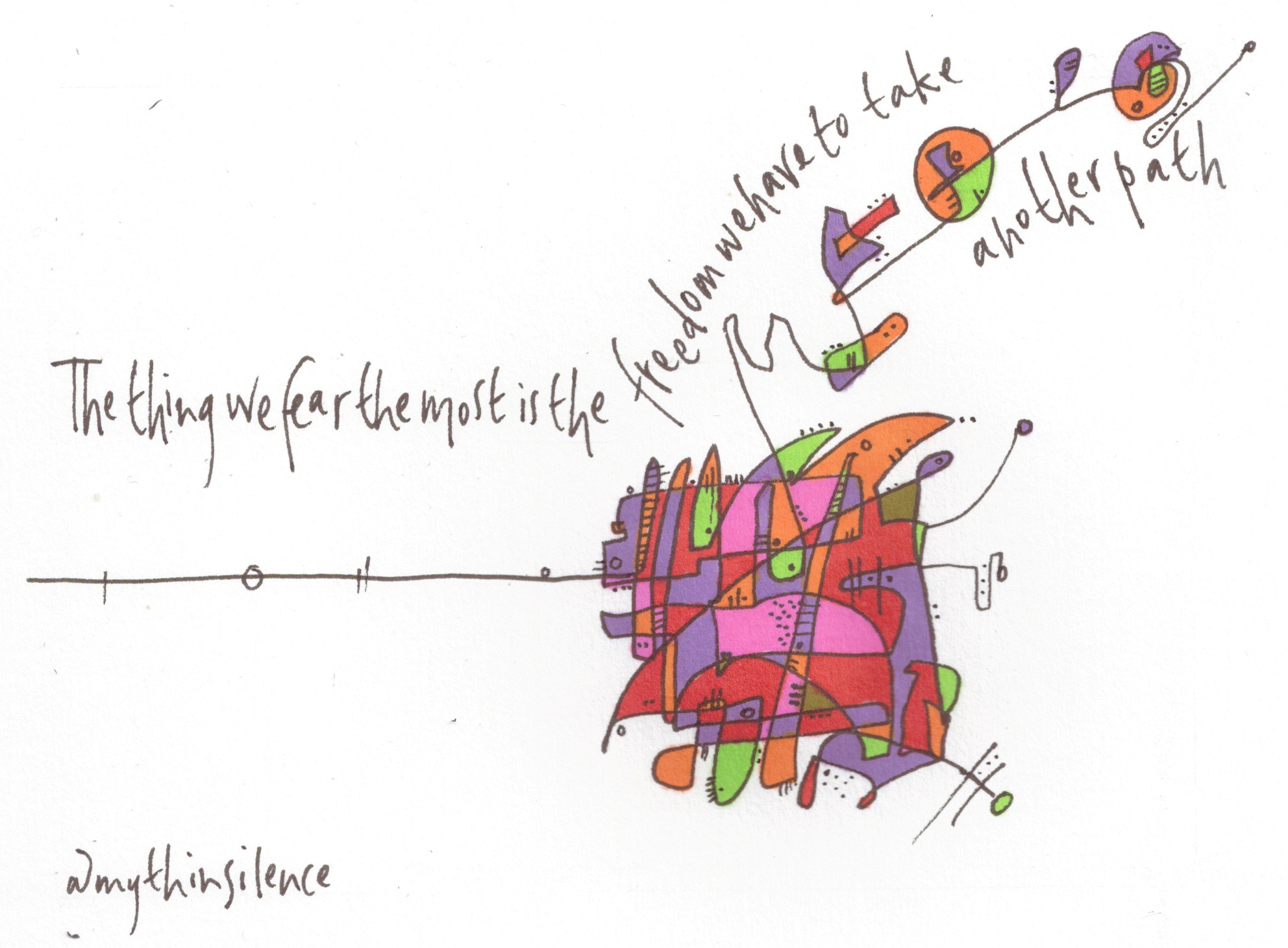
Fear is the third voice of resistance to be overcome, says Otto Scharmer.*

Psychiatrist JT MacCurdy writes, ”We are all of us not merely liable to fear, we are also prone to being afraid of being afraid.”**

Seth Godin adds to this short list of thoughts on fear by taking us inside how we or others make compliance work:

‘The shortcut to compliance, then,
isn’t to reason with someone, to outline
the options, and to sell a solution.  No,
the shortcut is to induce dear, to activate
the amygdala.’

Well meaning people, including those who love us, can unknowingly use this tool of fear, being concerned for what might happen if we take the wrong path.  Of course, there are times when we must listen to fear for good reason, but these are fewer than we think in the 21st Century.

When we connect with what we must do and pursue it, we find the terrible things we think may happen are not so terrible after all.^  We’ll be most heroic around the things which matter most to us and the people who matter most.

You have something to bring to the world, something never to be repeated because it’s about your skills, your experiences, your passions.

Please, don’t hide it.

And another thought: people with a mission like yours need to find others: a company of heroes.^^

(*The other voices are judgement and cynicism.)
(**Quoted by Malcolm Gladwell in David and Goliath.  Seth Godin describes fear in this way too: ‘Anxiety is experiencing failure in advance.’)
(^Gladwell explores three different kinds of terrible thing – a direct hit (which takes us out completely), a near miss (which wounds us but doesn’t wipe us out), and a remote miss (which doesn’t affect us at all).  Most terrible things come in the remote miss category, and, when we discover how ineffective these are, cause us to act more courageously.)
(^^Band of Brothers makes a great tale of a company of heroes (communitas) being formed in liminal experiences – when Lieutenant Dick Winters is asked by his grandson if he was a hero in the Second World War, he tells him, no, but he belonged to a company of heroes.)

a city of dreams (2)

17 in conversations

For hundreds of years scarcity and competition appeared to be the only ways of advancing and succeeding.

Today, abundance and cooperation through connection are how to move forward.

A city of dreamers is about the latter: skills and passions and experiences.

Such a city epitomises the infinite game: a game includes as many as possible for as long as possible, and when these things are threatened, changes the rules.

What the dreamers discover in the city is, the connecting and openness leads to more, not fewer, ideas.  They are generative places because they are filled with increasingly generative people.

None of this just happens.  You can’t walk into a city and all this connection and creation just happens.

It comes through the hard slog and sweat of opening up our minds to perspectives and ideas which are strange or alien to us, opening our hearts to people who are unlike us or we don’t instantly spark with, and. opening our wills to take the most frightening journey: from thinking about something to doing something.

A city of dreams does not exist apart from these three taking place.


a city of dreams

16 cities of dreamers

A group of butterflies is called a kaleidoscope.

Flamingoes group together as a flamboyant.

Owls are a parliament.

Rhinos are a crash.

A group of dreamers are a city.

Single dreamers and their dreams can be picked off.  Dreamers need to work together

“Daydreamer.”  “Get your head out of the clouds.”  “Show me a dreamer and I’ll show you someone who is no earthly use.”

A number of things happen when dreamers come together:

They know the smallest city comprises two people.
No exploration is off-limits.
There’s no such thing as a dumb question.
The first answer is not good enough – neither is the sixth or the sixteenth.
Cities are personally transformative spaces.
Everyone has something someone else needs.
Dreamers want to hear what other dreamers are thinking about – they’re like good vampires in this way.
This mixing of different people’s dreams mean more and more dreams are born.
Dreamers encourage one another to ruthlessly pursue and test out their dreams; they will not allow each other to have an idea and do nothing with it – it’s important to make it fail fast so it can become stronger.*
Dreamers are constantly making their environments more orgathetic,** so dreams are fed from many sources.**
They know the world needs to become more imaginative, so the city is never thought of as a sanctuary but rather a launchpad; dreamers are dangerous people.
They know the city is a library and a university too.  Everything they need comes through the people who inhabit it.
Their conversations are full of playful purpose, and to the observer it appears grossly wasteful because so may ideas are produced and shed.
Many of the dreamers become anam cara – soul friends.
They know they belong here – a different response to one they usually encounter.
They do not believe anyone to be beyond imagination.
Their conversations move ideas from System 1 to System 2 thinking^ – slower, more observant and deeply reflective – and they know in writing or journaling when they’re on their own proffers something similar as a tool to use.

“People continually had their perspective
expanded by everyone’s else’s.  And
invariably people would say, ‘There’s
more to this than I thought.'”^

(*The dreamer is also becoming stronger.)
(**Orgathetic is a term my friend Alex McManus coined to describe future life which is organic and technology, the synthetic – I use it here to include environments and societies.)
(From Peter Senge’s The Necessary Revolution: an example of people who wouldn’t think of themselves as dreamers discovering cities can come together anywhere with anyone.)
(These are Daniel Kahneman’s terms for the different kinds of thinking we involve ourselves in: intuitive and reflective.)

multiple-choice life

Scan

Tick a box.

Sorted.

Except it’s not.

One hundred years ago, Frederick Kelly came up with the multiple-choice test.  He later disowned it but the damage was done.  The industrial educationalists took it to heart and discarded Kelly instead.

What about all the great answers and thinking between the boxes?  Lost!

Whilst some education was better than no education, and industrialism in its various forms improved the life of the majority of people in many ways, its limitations are not able to lead us forward today.  There are many great answers and educations and careers between the boxes.

Seth Godin suggests, ‘Traditionally society assumed that artists, singers, artisans, writers, and scientists, and alchemists would find their calling, then find a mentor, and then learn the craft.’

Clearly there were limits to this system* – the child probably followed a parent into their line of work – but today we’re capable of improving on this with wider choice and greater mobility, making all those spaces between the boxes or the multiple-choice possibilities ripe for exploration.

In my own organisation, I’ve found innumerable possibilities of calling or flow or element which don’t fit pre-formed boxes or possibilities – but they’re there to add their genius if called on.  Systems-thinker Peter Senge is adamant we have to see the whole system, only then can we find our place to make our contribution within it.**

(*Many have been able to swim in the system, though, arguably, many more sink.)
(**In one example Senge offers – the building industry’s need to build greener houses, all the people in the industry needed to be brought together to work on the issue, but then, ‘people focused on areas in which they had most interest, expertise, and energy’.  Life is not multiple-choice, it’s about people expressing interest, expertise, and energy in a multiplicity of ways.)

easy

14 humans are at their best

Easy isn’t what it used to be.

Easy used to mean you would leave school and find a job you’d be in for maybe the rest of your working life.  Society both led, fed, and reinforced this.  You fitted in and it took care of you.  No need to fret or push it.  Easy.

There were always those who did a more than this, who engaged in a set of disciplines and toiling towards realising their dreams, but the opportunities were fewer: astronauts, adventurers, artists of all kinds.  It was never easy for these.

Easy now means what you do can be outsourced to another part of the world where they do easier cheaper: who wants to win the race to the bottom?*  The world is changing so quickly, what I’ve written may be out of date by this time next week.  Easy is no longer a solid or sound choice.  Unfortunately, psychologist Daniel Kahneman has noticed how people go shallow rather than deep, substituting difficult questions for easier ones, willing to believe What You See Is All There Is.**

The alternative – the possibilities for people to pursue and realise their dreams – isn’t the new easy: it’s still about disciplined hard slog, but there’s more of it, asking us to change the way we usually assess or reflect on our lives, and train them.

Now there are fewer jobs for life but many more possibilities for people to explore and realise their dreams.

Many would like change to be easy, reality is, change is hard work – but worth it.

(*As Seth Godin names it.)
(**Kahneman writes, ‘We can infer from the speed with which people respond to questions about their life, and from the effects of current mood on their responses, that they do not engage in a careful examination when they evaluate their life.  They must be using heuristics, which are examples of both
substitution and WYSIATI.’


compliance and brilliance

13 wherever you are

Compliance* is what our education systems are still set up for.

A hundred and fifty years ago, Industrialists were convinced if they allowed a child go to school rather than work in their factory, they would, in a few years time, receive a more compliant adult.**

Brilliance is what we can assume every Human has and it needs to be allowed to shine in some way or other.  Whatever our nature provides us with – the result of the couplings of parents and grandparents and beyond – positive environments and encouragements can help any Human develop in multitudinous ways.^

Seth Godin‘s thesis on education challenges the compliant systems we do not question, whilst McNair Wilson way assumes brilliance in everyone he meets.

More often than not, demanding compliance inhibits the possibilities for a person’s development, whilst assuming brilliance allows people space – from small to big – to become more of who they are and can be.

The problem is, compliance is the loud, bullying voice supported by the system, and has been for too many years.  This means we have to prioritise assuming brilliance wherever we can, until it becomes the norm.

We have a long way to go but if you happen to be in Edinburgh in November you’ll be very welcome to come along to one or both of a couple of happenings.^^

(*Compliance as I write about it today is a negative expression.  Of course, there are times when compliance can be a positive expression, though we tend to overestimate the cases for positive compliance and underestimate negative compliance.)
(**Education has a double edge, of course, offering a child skills to be developed, if, say, they went along to the public library and began reading whatever they could lay their hands on.)
(^Malcolm Gladwell shares the story of litigation lawyer David Boies who overcame dyslexia to become one of the best,  having developed the skills of listening and memorising way beyond his peers.)
(^^There’s #libraryofawesome on the 9th November – developing the idea of the library of the future being a transformative space for people – and VOXedinburgh on the 28th November – an evening of creativity on many levels only made possible through music, story, crafts, and generosity.)

h is for babit

12 henri was determined

Everyone has the same number of minutes to live through each day – those who seem to have more time are those who use more or better habits.

Minutes are “flat”: not able to hold an activity, a thought, an idea, a feeling until we mould so they can hold significant things.

This moulding activity is what we call shaping a habit: habits of working, of meeting, of training, of sleeping, to name a few.

Habits make it possible for us to find valuable and significant things in unlikely places, missed by others.

When Nassim Taleb talks about flâneurs and tinkerers being those who uncover options in our world, he’s not describing habit-less living, rather, the opposite.  These are people who’ve developed an art of seeing what others do not, and ruthlessly questioning what they see.

The flâneur knows she must not rush into everything a day requires of her: to wash, to eat, to work, to eat, to work, to eat, to collapse, but must mould habits of watchfulness and reflection – to see herself, others, her world differently.

‘When engaging in tinkering you incur
a lot of small losses, then once in a while
you find something rather significant.’*

There are many more moments in and around the things which fill our days: flat moments to be moulded and filled with significant things.

(*From Nassim Taleb’s Antifragile.)

is the universe a holodeck?

11 to boldly go

The crew of the USS Enterprise (The Next Generation) will be able to choose all manner of holodeck programmes to escape duties or idle away their down-time in space.*

Author and artist Frank Schaeffer offers: ‘Our brains have evolved to seek patterns.  We test these patterns and discover useful ways of perceiving what’s around us.  Our perception is not reality.  We create a narrative.  We want to see where we fit.’**

The universe allows us to do this.  Maybe life as we’re discovering it is the most amazing thing to come out of the universe’s billions of years of evolving – I appreciate, this a Human projection.  It’s as though it’s beholden on us to be imaginative and creative in a plethora of ways: maybe the meaning we give to planets and raindrops is what it’s all about.

In this way, the universe is a great big holodeck we programme with our meanings, both individual and collective, handling them all simultaneously.

Humans are strange creatures among the many species, having to search for meaning and happiness in whatever part of the world we find ourselves in … and, one day, among the stars.

Somehow we know there are better “programmes” than others.  We know the programme Nobel Peace Prize-winner Mulala Yousafzai has chosen for her life (working for the rights of children to education) is a far better one than the one the Taliban gunman who tried to take her life two years ago.  We also know many people will join her in this.

This suggests an interconnectedness between all the programmes: we need each other to run our individual programmes and others we will share in creating more amazing and complex ones.  I know the universe can’t smile, but if it could, it would.

I am guessing the best programmes will be those which allow us to continually and increasingly explore – people, our planet, who we are – rather than building systems with towering walls protecting us from what lies beyond.  Nassim Taleb captures this well, believing, ‘one needs flâneur-like abilities to keep capturing the opportunities that arise, not stay locked up in a bureaucratic mould.’

It all happens in this vast holodeck; go programme and prosper.

(*Future tense used because it is set in the 24th Century.)
(** Check out more from Bruce Hood in The Self Illusion on how this relates to the Self.)


doodle more

10 doodle everywhere

Last night I met a ton of people making innovative things happen, including motion designer and illustrator Erik.*

It turned out we’d both been encouraged by artist-blogger Hugh MacLeod’s Ignore Everybody.  Erik produces some new art everyday for his postitheads stream (I’ve got a couple of these in front of me as I write – a dinosaur wearing 3D glasses and a pirate).  For me MacLeod’s encouragement meant I took on the challenge to blog everyday for a year as long as I can cartoon with this.  (You wondered why there were so many of these things.)

I want to encourage you to doodle, to draw – because you can.

McNair Wilson caught my attention today with his question: ‘Have you ever heard of anyone who dreams in text?’

I know I don’t; do you?

Text follows image.

What particularly caught my attention was the word from which doodle most recently comes:

‘The modern word doodle burst upon the
scene in the 1930s from “dawdle” – meaning
wasting time, being lazy or completing a
task slowly.’**

I connect Wilson’s doodler with Nassim Taleb’s flâneur, who wanders through life in a way which allows for more of the options and possibilities the universe proffers to be noticed.  Drawing not only is our first “literacy,” but also allows us to notice more, remember more, and, I am finding, create more.

McNair Wilson and Erik have just upped the challenge to me to be even more visual.

Warning: if you also take up this challenge, people will think your daft or annoying, a dawdler of idle.

(*You can check out Erik’s great work here.)
(**Apparently, going back to the 17th century doodle was used of a fool or simpleton, from the German dude, meaning “to play.”  This is its sense in the song Yankee Doodle first sung by British troops before the American Revolution.)

mysterious

9 i am many things

I mean you.

You’re not one person, but many.

We can’t say, “This is who I am: facts, data, provable/disprovable.”  We are many more things.

The scientist in her lab scrutinises the object of her inquiry, and questions and tests, and begins again.  Later, she returns home and enjoys the taste of the food she’s prepared* with drink and significant friends without a data file in sight, nor would she dream of “datafying” this experience.

Life is a mysterious thing: the one person is many things, and these many things are one.  How does that work?

We can’t discover what life is by pressing it hard in simply one way; we must find ways of journeying which allow us to both observe and experience.  Nassim Taleb suggests “flâneuring”** as a way to make ourselves available to more, citing examples of clerics who provided significant work in industry and science and more besides, who used their spare time to inquire and explore, allowing them to see ‘a free option when it is handed to us.’

McNair Wilson tells the story of a business guy in one of his creative workshops who was struggling to take notes on unlined paper with coloured pens and doodles – the things participants were encouraged to engage in by Wilson – objecting, “I’m a matter-of-fact logical person.”

Only part of the story.

Being pressured by his team to join in, this man found he was also someone else: “But today, I am taking the best notes ever and loving it.  What did you do to me … ?”

There’s a lot of mystery in life.  There’s a lot of mystery in you, in your life.  Go with it … flâneur (turning a noun into a verb, but try it anyway – I’ve been trying it for years and interesting things happen).  Be open to the things which life and the universe and, if you have a god, your god brings to you.

It’s both/and.  Focused inquiry and wandering, thinking and feeling, concluding and staying open, drawings and words.^

(*She’s probably played with the ingredients too, changing some on a whim, introducing something to play with the flavour.)
(**Flâneur: flaˈnəː,French flanœʀ/noun 1. a man who saunters around observing society.  Instead of being a tourist, who won’t allow himself to participate in the culture he’s observing, Taleb is encouraging wandering through life in a way which allows us to experience it.  He includes the story of a guy who experienced the cities he visited by literally following his nose – rather than following a tourist trail, he sniffed his way around a new place.)
(^The first recording “literacy” for Humans was the drawing kind: the visual arguably comes before the written.  Everyone can draw, we just forget we can.)