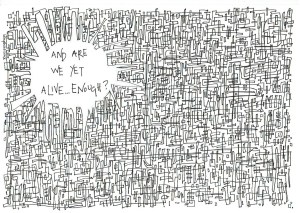
am i forgiven?

8 how forgiveness

In what can be an unforgiving universe, we’ve figured out ways of creating forgiveness.  We had to, we can’t exist without it.

‘You need to be generous with yourself in order to receive the love that surrounds you.’*

I found myself contemplating how forgiveness is just so crucial to human existence, including how it’s a really big deal in many of the world’s religions – humans needing to be forgiven by their gods, either conditionally or unconditionally, embodying this in all manner of rites and rituals.

8 we understand

More than this, I found myself positing how these might be understand to be our explorations into forgiveness.  How humans, amongst all of the higher species, have developed concepts and expression of forgiveness most of all.  It appears to be a fundamental expression within the human ability to step outside of natural selection.

‘Be aware of your breathing.  Being aware of your breathing takes attention away from thinking and creates space.  It is a way of generating consciousness.’**

We can be restricted, or worse, paralysed, by a lack of forgiveness.  We still function.  We move, work, relate, holiday, shop, and play sports, but we don’t notice how some things have become closed to us, whilst others have become more of a rut.  Like breathing, we hardly notice the atmosphere in which we’re immersed – until we stop and allow awareness to form in us.

And in becoming aware, we open up new paths.

‘Failing gracefully is part of the deal.’^

We’re surrounded by unforgiving situations.  Ben Zander recounts how, in his world of music, so many conductors lead in an autocratic way, unwilling to admit their own mistakes, and how:

‘Many corporate heads and managers I have spoken to have since let me know that the orchestra is not the only hierarchical setting where this dynamic occurs.’^^

This is the atmosphere we’re all immersed in.  Those who are not prepared to admit they’re wrong, forgive themselves, and receive the forgiveness of others perpetuate unforgiveness out to others.

Forgiveness doesn’t overlook wrongs, but provides an environment in which people open their minds (to see what is what), and also their hearts and wills – meaning they change and behave differently.

Here’s a whole day in which to give it a test run.

8 now we understand

(*John O’Donohue, quoted in the Northumbria Community‘s Morning Prayer, 8/4/16)
(**From Eckhart Tolle’s A New Earth.)
(^From Seth Godin’s Graceful.)
(^^From Rosamund and Benjamin Zander’s The Art of Possibility.)

what i seek is what i need

7 just give me

I seek wisdom.  (The people who know me know how I need this.)

Wisdom meaning all I am and all I have being contributed in the right way at the right time for the right reason in the right spirit.

I make such slow progress towards becoming a wiser person.  But perhaps slow is okay.  Maybe I have the whole of life to work at it.

‘[Perseverance] is the ability to stand and thrive under pressure.’*

Perseverance expressed as active patience is the ability to open my mind, my heart, and my will, to be truly present.

‘We persevere in the confidence that we ourselves are being transformed.  Perseverance produces character, and character, hope.  And hope, we will discover, is the ultimate gift gained in wisdom.’*

I find I can keep moving towards the future, figuring out more ways to make my contribution, what it is I can do and you can’t, and what it is you can do and I cannot:

‘Naming oneself and others as a contribution produces a shift away from self concern and engages us in a relationship with others that is an arena for making a difference.’**

No matter what our age, we are all able to keep moving forward in our thinking, our relating, and our behaving.  And we watch our worldview altering from one of scarcity to one of abundance.

There’s always another chance, another opportunity, another possibility, and usually it will appear in the most unusual or difficult places or times – and there make our contribution.

(*From Erwin MacManus’s Uprising.)
(**From Rosamund and Benjamin Zander’s The Art of Possibility.)

the games people play

6 figure out

‘I settled on a game called I am a contribution.  Unlike success and failure, contribution has no other side.  It is not arrived at by comparison.’*

I know, whenever I compare myself with others, I lose.

I choose to be content.

One of the things I’ve discovered later in life is that I’m really satisfied with the “second seat.”**  I love the way it allows me to ask questions like, “What if?”  There’s a contentment in following where the questions lead.  It’s not the easy way; it places me on the path of perseverance, a path of faithfully carrying out the things I must do.

This is because I am discontented.

My discontent is what informs me about what it is I must do.  It’s brought me to the “second seat” so I can support others be who they must be.  When discontent is mixed with a dream it becomes a cause, it leads to a contribution.

Everyone has a different contribution.

Because this contribution game has no need of comparisons it’s an infinite game^ in which everyone’s life-contribution becomes a gift for everyone else.^^

We all have a contribution to make – becoming a generative being is something we learn.

Frank Laubach came up with a game with minutes, believing that we can invent some way of making a contribution to others in every minute.*^

To be inventive with every minute is daunting to say the least, but each day provides many moments in which we can make our contribution and be a gift.

“How will I be a contribution today?”*

(*Ben Zander in Rosamund and Benjamin Zander’s The Art of Possibility.)
(**The “second seat” doesn’t mean I want this place instead of the third or fifty third seat, but whether it be an individual or a group of people, I prefer the second place, allowing others the first.)
(^See James Carse’s Finite and Infinite Games.  An infinite game includes as many as possible for as long as possible, and if the rules threaten to exclude people or close the game down, they are changed.)

(^^Roz and Ben Zander suggest “finite” games offer us opportunities to hone our skills.  A finite game includes some and excludes many, it has a certain duration, and always plays by the rules.)
(*^Frank Laubach’s The Game With Minutes.)

the story we do not know

5 to be willing

‘A life story is a “personal myth” about who you are deep down – where we come from, how we got this way, and what it all means.  Our life stories are who we are.  They are our identity.  Life story is not, however, an objective account.  A life story is a carefully shaped narrative that is replete with strategic forgetting and skilfully spun meanings.’*

‘The dreamer is consciousness itself – who you are.  To awaken within the dream is our purpose now.  When we are awake within the dream, the ego-created earth drama comes to an end and a more benign and wondrous dream emerges.  This is the new earth.’**

Between these two conditions there spans a journey of great challenges, for we must face those details of our lives we’re prone to leave out, or may not even be aware of.  I don’t think we’ll ever fully know who we are – that would require us to be perfect and complete.  Things none of us will be.  But there is a greater integrity and wholeness to faithfully explore – every day bringing us to the possibility of learning, which is an attitude of openness, moving us beyond WYSIATI (“what you see is all there is”).

Most of all, it’s in our interactions with others that we learn most of all:

‘You may ask, “Who, actually, is doing the changing?  And the answer is the relationship.  Because in the arena of possibility, everything occurs in that context.’^

Imagine the kind of change that can take place in those who enter into a conversation of great openness, in which everyone learns about themselves and each other, as well as the subject in hand and the possibilities which lie before the newly formed “company.”

(*From Jonathan Gottschall’s The Storytelling Animal.)
(**From Eckhart Tolle’s A New Earth.)
(^From Rosamund and Benjamin Zander’s The Art of Possibility.)

character plots

4 i once was

Talents are like ships, enabling us to cross great oceans of possibility.  But they need steering.

Character helps us to navigate months, even years of uncertainty; find our way when we’re blown off-course, makes it possible to deal with the mutinies, and to face the absolute unknown.

What character does is to grow our capacity to deal with complexity.  In particular, we’re able to overcome the voices of judgement, cynicism, and fear with the positives of openness, compassion, and courage.*

Ros and Ben Zander’s idea of giving people an A is all about openness winning over judgement.**  Then cynicism has nothing to feed on and is overcome by compassion.  When something matters to us, then we find courage overcoming fear – in the movie The Cobbler, Adam Sandler inherits a stitching machine that enables him to step inside the world of anyone whose shoes are repaired on it, but the lesson is: “It’s a privilege to walk in another man’s shoes, but it’s also a responsibility.”^

There’s nothing mysterious about character development; it’s hundreds of choices and actions which take us from self to others, from possessing to giving, and from knowing to learning.

‘Character is formed in the crucible of faithfulness and refined through the gauntlet of perseverance.  Remember, the shape of our character is the shape of our future.’^^

(*See Otto Scharmer’s Theory U.)
(**See Rosamund and Benjamin Zander’s The Art of Possibility.) 
(^Check out the words of Walk a Mile in My Shoes: sung here by Bryan Ferry.)
(^^From Erwin McManus’s Uprising.)

it’s time

Untitled

“I did the best I could with what I had.”*

‘Resistance has no strength of its own; its power derives derives entirely from our fear of it.’**

The sky is an endless nondescript grey.  The clouds are indistinct, slightly more grey over there than there.  Hardly an auspicious day to do something remarkable.

At some point, though, we have to begin.

‘There is a point when you’re not supposed to be full of potential; you’re supposed to be full of talent, capacity, product.’^

The thing that turns what I have into the best I can do is faithfulness: faithfulness replaces same old same old (SOSO), releasing imagination in practices and habits which ignore the grey skies, the grey thinking, the grey people – understanding what’s important is not out there, but what’s in here.

Whatever the climactic conditions of the day, you’re someone who’s always full of light and colour.  It’s time.

‘In order for imagination to flourish, there must be an opportunity to see things as other than they currently are or appear to be.  This begins with a simple question: What if?”^^

(*Justice Thurgood Marshall, quoted in Rosamund and Benjamin Zander’s The Art of Possibility.)
(**From Steven Pressfield’s The War of Art.)
(^From Erwin McManus’s Uprising.)

(^^John Seely Brown, quoted in Warren Berger’s A More Beautiful Question.)

road trip

2 thank you, but

‘You are created for more than just existing.’*

‘If you are content with being nobody in particular, content not to stand out, you align yourself with the power of the universe.’**

After twelve years working for General Motors, Sandi Wheaton was made redundant.  Connecting with her love of photography – something she had only pursued in her spare time – Wheaton took off on a road trip along Route 66, capturing 60,000 images by her journey’s conclusion.^

From childhood to adulthood, composer Gustav Mahler’s life was full of tragedy and difficulty, yet:

‘Mahler thought that he should put everything in life in his symphonies – so anything that can be imagined can be heard in them if you listen carefully enough.’^^

Two stories for navigating life, created by people who were not prepared to be victims of stories others write for them.  The stories make something more out of the things that fill our lives, and we’re all capable of creating them.

On the way, we meet people whose lives change us and for whom our lives bring change.

(*From Erwin McManus’s Uprising.)
(**From Eckhart Tolle’s A New Earth.)
(^Sandi Wheaton’s story is told in Chris Guillebeau’s The Happiness of Pursuit.)
(^^From Rosamund and Benjamin Zander’s The Art of Possibility.)

the craft

1 let us consider (colour)

‘It’s certainly possible to get by in life without dedication.  The craftsman represents the special human condition of being engaged.’*

The former General Electric CEO Jack Welch tells the story of a GE employee’s comment on changes the company was implementing, which would include employees in the creative processes.**   My memory’s a little rusty, but basically the employee said, “You’ve paid me for 25 years to use my hands, and all that time you could have had my mind for free.”

1 let us consider

Richard Sennett tells us that Aristotle uses the word cheirotechnon for craftsman, meaning “handworker,” but this replaced the earlier word demioergos, referring to people ‘who combined head and hand.’*

When a culture separates head and hand, making it normal for many of its citizens to be “hand people” only, innovation is removed – people become valued for only how quickly they can react to the needs and instructions of managers and employers. But when people are allowed to be “head and hand people” there’s the possibility for them of anticipating, designing, and transforming – towards a more imaginative future.

The person who pursues their craft knows that joy doesn’t come from external reward but from within.

What a crying shame if people move through life without appreciating they can write a different story – one that connects heads and hearts, identifying and developing their craft (and there are as many crafts as there are people), towards making the future dance.

Sometimes all it takes is for desperate people find each other.

(*From Richard Sennett’s The Craftsman.)
(**The story comes from either Jack Welch’s Straight From the Gut, or Winning.)
(Today’s doodle honours Lesley and Clive, two people who have recently encouraged me in my doodling.)


a long view

31 the self wishes

‘The Self wishes to create to evolve.  The Ego likes things just the way they are.’*

For forty days we’ve been exploring how and what to let go of in order to let a new something and new Self come, to emerge.

I’ve no idea what this might mean, only that there are possibilities in front of me I couldn’t sense before.  I know I’ve been given an “A” and I’m turning up to find out what this can mean.**

Turning up is part of what it means to have an A attitude.  It means the only thing I’m prepared to make a final judgement on is that I have and A, so I keep my mind open.  It means taking a long view, that nothing is going to happen in a hurry, but a lot might happen slowly.  It is an exodus, quest, odyssey.

When we’re on this kind of journey, there’ll be part of us screaming for conclusion: “I want to know what this is.  When will I arrive?  I want to know exactly what’s involved.”  All we know about what lies before us, though, is that we have the whisper of an idea which excites us, and, the journey will change us.

‘Acknowledging the good that is already in your life is the foundation for all abundance.’^

(*From Steven Pressfield’s The War of Art.)
(**The concept of giving people an “A” before they’ve done anything is explored in Rosamund and Benjamin Zander’s The Art of Possibility.)
(^From Eckhart Tolle’s A New Earth.)

stories for letting go and letting come (40)

30 acknowledging

For the last forty days, we’ve been exploring whys and ways for letting go so we can let come and receive what our futures can be.  Although the exploration hasn’t been linear or systematic, instead following thoughts wherever they have taken me, this does feel like a conclusion for me.

One of the switches we can make which effectively blocks this, is closing ourselves to what we need to receive from others, and asking of others what we need to do for ourselves.

The lives others live in a bigger world, the stories they have to tell, their words of encouragement, the new ideas they bring, the challenges they provide us with, are the things which open more to us.  One community named this more magis.*  Magis means to give everything and then to find we have even more to give.  In the more, there are many possibilities to explore.

When we take personal responsibility for doing certain things ourselves, we find there is a metamorphosis happening in us.  We are being transformed through the doing, we become.  This will never happen if we want someone else to do the hard work, even if the other is our god.

What we are growing is character.

We discover that our talent can only take us so far, whilst character takes who we are and what we have and move it into a powerful creativity beyond the malaise Ben Zander names second fiddle-itis.   This is something Zander sees falling on those who can’t be first violin, an cannot see how second fiddle can lead to incredible work.  We’ve all have been given an A up front and it’s our characters which understand the implication son this and make it possible for us to realise our A.**

If I may, I’ll conclude forty days of reflecting with a personal story.  I find myself thinking about sixteen years I spent in a “first violin” role that was mostly about administration – something I’m not very good at and have let go of.  The years were more about forming character, and letting go of the role has made it possible to let come my “second violin” role of life-whisperering.  Every day, I know I have to do the things I cannot give away to others, including being humble, grateful, and faithfully giving away who I am and what I have.

All of this leads me to say, I think what you are doing is amazing, but what you can be and do in the future is even more astonishing.  If there is any way I can be second violin supporting your first violin work, let me know.

(*See Chris Lowney’s account of the early Jesuits in Heroic Leadership.)
(**See Rosamund and Benjamin Zander’s The Art of Possibility.)