stories for letting go and letting come (39)

29 like ant-man

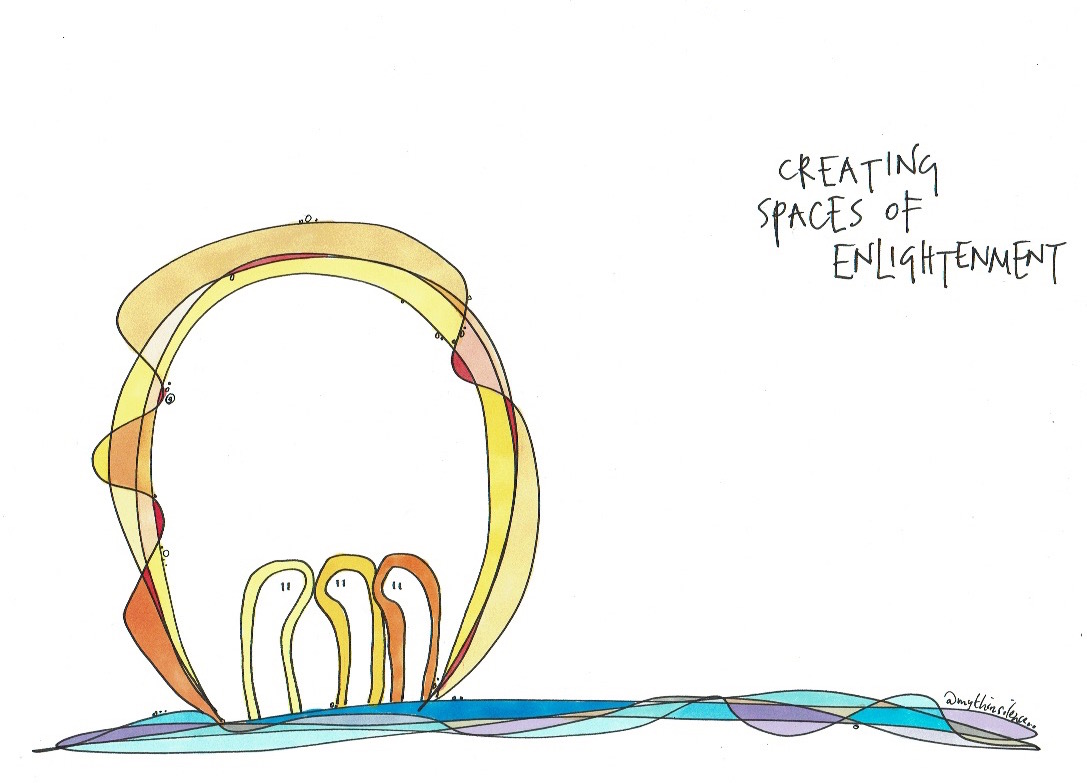
It feels like a whisper, compared to the gale-force powers around.

When a whisper is trained, though, it becomes a powerful thing – honed with humility, gratitude, and faithfulness, and tempered by courage, generosity, and wisdom.

‘The greatest art is an intersection of contrasts … pain and healing, despair and hope, darkness and light.’*

One group of whisperers used the training “circuit” of awareness, love, ingenuity, and courage, to develop their whispering into the lives of others.**

Whisperers know this, they know their power comes from within.  Facing the reality of who they are and who they can become, they see they can make a difference for others, innovate their particular talents for impact, and step into the vulnerability.

(*From Erwin McManus’s The Artisan Soul.)
(**Chris Lowney tells the story of the early Jesuits in his book Heroic Leadership.)

stories for letting go and letting come (38)

28 wisdom defines

‘There are always more obstacles, bigger challenges.  You’re always fighting uphill.  Get used to it and train accordingly.’*

“Well, with this life you lead no one would have a sense of creativity.”**

Wisdom navigates a universe full of obstacles with vigour and generativeness and goodness.  Not so that we can overcome and forget the obstacles, but to use them as means to grow and develop.

Wisdom discovered and articulated by those who have gone before us provides us with ways to begin, until we find our own way.

Wisdom defines reality so it can discern possibilities which enables ways into the future to be discovered.^

Foolishness isn’t stupid so much as the failure or unwillingness to define reality, meaning it can only repeat the ways it knows, so, then, the future only repeats the past.

Wisdom knows, what lies on the other side of an obstacle isn’t a smooth path but imagination and creativity.

(*From Eckhart Tolle’s A New Earth.)
(**Erich Fromm to a Hollywood writer, in The Art of Listening.)
(^Based on Alex McManus’s leadership triad in Makers of Fire.)

stories for letting go and letting come (37)

27 provoke

‘If the thought of lack – whether it be money, recognition, or love – has become part of who you think you are, you will always experience lack.  Rather than acknowledge the good that is already in your life, all you see is lack.  Acknowledging the good that is already in your life is the foundation for all abundance.’*

‘The takers of this world always need more [but] the giver is always open-handed.’**

There comes a moment when we have to choose a story.

When we choose the story of abundance, it’s as though we’re entering a new life – life begins again.

“Choose” is a very small word to describe a journey that invites us to open our minds to see and understand more, then open our hearts to what we have and love, so that we are able to open our wills, our hands, becoming producers of goodness and beauty from the abundance we have found within.

Every day this moment of choice appears to us.

(*From Eckhart Tolle’s A New Earth.)
(**From Erwin McManus’s Uprising.)

stories for letting go and letting come (36)

26 well done you

“Well done, you.”

An expression of celebration.

Though, we don’t always take the opportunity.  There’s always the next thing to do.  No time to stop.   We have to keep things moving.

But what if celebration is important to us for the long term?

What if, as Erwin McManus suggests, gratitude leads to wholeness and wholeness leads to generosity and, with generosity, we find joy – deep enjoyment?*

‘But perseverance is something larger [than persistence].  It’s a long game … until the end.’**

What if, rather than waiting for the pay-off at some unknown point in the future, we were to set ourselves for a long journey of achieving many things, celebrating sooner and more often.

What if this was moving our life from one of persistence – gritted-teeth living – into perseverance – imaginatively expansive living?

And, wherever possible, celebrating with others.

‘I can tell that there is an undeniable relationship between happiness and resilience.  People who enjoy life make life more enjoyable for others.’^

What if another word for perseverance is resilience?  Or more than resilience, antifragility?^^  More than retaining our integrity under stress, we grow; we take the opportunity to create more than response?

What if, when you’ve done something positive, we take a moment or more to celebrate, to somehow say, “Well done, you!”

(*Erwin McManus’s Uprising.)
(**From Ryan Holliday’s The Obstacle is the Way.)
(^From Erwin McManus’s The Artisan Soul.)
(^^See Nassim Taleb’s Antifragile.)


stories for letting go and letting come (35)

25 no longer

‘We live in interesting times, a remarkable age that offers countless opportunities for personal growth and advancement.’*

Once upon a time, there were the Some and the Others.  Some had a good education, secured a good work role, and identified clarity and purpose early on in life.  The Others didn’t.

Things are changing.  The Others are finding they can access an education to fit them, which are largely free, they are exploring identity, and figuring out what they want to do.  They may even find themselves with an advantage over those who have given up on their dreams for privilege, position, and pay.

I’ve been telling the story of Roz and Ben Zander’s idea of issuing an A to all Ben’s music students at the beginning of the academic year; here’s the explanation:

‘We give the A to finesse the stronghold of judgement that grades have over our consciousness from our earliest days.’**

The Zanders go on to explain how the A makes it possible for the teacher and pupil – and similar relationships in the workplace – to work together and make the A a reality, becoming ‘a team for accomplishing the extraordinary.’**

I guess we’ve all had experiences of not making the grade.  But now we have an A, and the question is, What are we waiting for?

If you’re still figuring our your quest, why not find others to explore with?   You can also check out some sites which provide free or very low cost course with all kinds of subjects: becoming astronauts, superheroes, and happiness, are just some I’ve signed up for recently.^

Also, you can also get in touch with me to explore the quests and curricula of possibility.

(*From Chris Guillebeau’s The Happiness of Pursuit.)
(**From Rosamund andBenjamin Zander’s The Art of Possibility.)
(^Here are some free education websites, giving a lot more reading, riting, and 
rithmetic: NovoEd, edX, TED, udemy.

stories for letting go and letting come (34)

24 hey, we all got %22a%22s

My friend Steve told me about how Ben Zander decided to give all his music students an “A” at the beginning of the year so they’d be free to produce their best work.  Anybody who does something like that deserves to be read, so I bought the book to find out more.

All the students had to do was to write to Zander within two weeks of beginning their course, imagining it to be the end of the year, and telling him how they had attained their A.

These letters from the students to Zander are moving, but the thing that catches my attention are the comments from the students about how they feel just making their way to the classroom:

“When I come to your class, Ben, I feel the glow coming as I walk down the corridor, and by the time I’ve arrived – I’ve arrived happy and excited and ready to go.”*

The thing is, we all have an A in life.  We just had to figure out what we’re going to do to show why – something beautiful, something which brings together your past, present, and future.

I went on to read this from Richard Sennett: ‘the desire to do something well for its own sake can be impaired by competitive pressure, by frustration, or by obsession.  Sennett is writing about how ‘Craftsmanship names an enduring, basic human desire to do a job well for its own sake,’**

Once pressure, frustration, and obsession are removed, Sennett says, the apprentice can learn from their experiences of resistance and ambiguity, developing skills to repair and improvise which, ultimately, make it possible ‘to conduct life with skill.’**  Such a person uses their progress to uncover more problems to overcome and, so, develop their skills.

‘Have you ever risen above the person you were and for at least a few moments become the person you only imagined yourself to be?’^

‘When you give an A, you find yourself speaking to people not from a place of measuring how they stack up against your standards, but from a place of respect that gives them room to realise themselves … a possibility to live into.’^^

(*Carina, quoted in Rosamund and Benjamin Zander’s The Art of Possibility.)
(**From Richard Sennett’s The Craftsman.)
(^From Erwin McManus’s The Artisan Soul.)
(^^From Rosamund and Benjamin Zander’s The Art of Possibility.)

stories for letting go and letting come (33)

23 how can we

‘How are my thoughts and actions, in this moment, a reflection of the measurement world?  And now?’*

Roz and Ben Zander’s question enables us to see a world of measurement we’re largely oblivious to.  Seeing this is necessary for moving into a universe of possibility.  It’s not a case of “Are my thoughts and actions … ?”  They are; it’s just a case of how much they are.

A year ago, I was reflecting on vuja de, created by comedian George Carlin and developed by IDEO’s Tom Kelley as the ability to “see what always been there but gone unnoticed.”**  The world of measurement is unable to notice some of the most important possibilities right before us.  For me, this means a person see ing things in their lives.

‘If you want to achieve the unimaginable, you start by imagining it.’^

‘The action in a universe of possibility maybe characterised a generative, or giving, in all senses of that word – producing new life, new ideas ,consciously endowing with meaning, contributing, yielding to the power of contexts.’*

There are two parts to life – these are not necessarily age related.

The first half of life is about learning a field, pursuing what we think is important, even identifying ways of giving to others – this half relates, I think, to the world of measurement.  This first part of life produces more than we can measure – the vuja de effect – and to see, we must step into another realm.  Into a universe of possibility, through imagining, then designing (prototyping) and then producing.

Some never make it into their second half of life.  They’re so immersed in the world of measurement that they feel they never have enough, not realising, what they really have is more invisible than visible.

For those prepared to step out, there’s a different way of seeing, understanding an unexplored universe of life in all its fullness.

(*From Rosamund and Benjamin Zander’s The Art of Possibility.)
(**Tom Kelley, quoted in Warren Berger’s A More Beautiful Question.)
(^From Chris Guillebeau’s The Happiness of Pursuit.)

stories for letting go and letting come (32)

22 living the prequel

“In the beginner’s mind there are many possibilities, but in the expert’s there are few.’*

Be a prequel, not a sequel.

Movie sequels come from the world of measurement; they are knowable, repeatable, and, therefore, guaranteeable.

For reasons like these, we can be attracted to a sequel-kind of life, where tomorrow is a repeat of yesterday because today was.

Movie prequels normally follow a successful series of film – like the more recent 2009 Star Trek, which tells the back story to the original series and subsequent legacy of films.

The prequel-kind of life, though, is about setting the scene or context for a story never been told:

‘[A] universe of possibility stretches beyond the world of measurement to include all worlds: infinite, generative, and abundant. … In the measurement world, you set a goal and strive for it.  In the universe of possibility, you set the context and let life unfold.”**

I’ve previously written about finite and infinite games; the world of measurement equates to the finite game and the universe of possibility to the infinite.

To open the mind is possibility.  So, we come to each new day as beginners, with questions to open our minds and to open the universe.  New words and metaphors and stories we encounter opens new worlds – and some of these will produce dancing in our hearts.

We never arrive.  How can we?  Just when we think we know our world, it opens further into hugeness before us.  Sequels build up one after the other following the original.

Prequels keep on enlarging the context in which we find ourselves, including the context of our lives, which are deeper and larger and more astonishing than we thought.

(*Shunryū Suzuki, quoted in Warren Berger’s A More Beautiful Question.)
(**From Rosamund and Benjamin Zander’s The Art of Possibility.)

stories for letting go and letting come (31)

21 the universe doesn't need

“The best criticism of the bad is the practice of the better.”*

As a new day begins, we make a choice.

Our choice determines whether we move in a world of abundance, a “universe of possibility,” or into one of scarcity.

Roz and Ben Zander, who offer the term “universe of possibility,” see scarcity as a result of our attempts to measure and weigh:

‘We grow up in a world of measurement, and in this world, we get to know each and things by measuring them, and by comparing and contrasting them.’**

It’s hard to measure what is unique, though, and this is what each person is.

Yes, we live in the same world doing the same everyday things everyone else engages in.  Yes, we play finite games – which are full of measuring – when we have to do this thing by this time in this way for these reasons and for this cost.

More than this, though, we know how each person is able to infinitely mix what they are curious about and skilled.

We don’t have to measure each other.  As Richard Rohr points out, if this is our choice,  we shall ‘not have strong and final opinions about everything, every event, or most people, as much as we allow things and people to delight us, sadden us, and truly influence us.’^

We imprison one another when we say, “Why can’t you be more like me/more like us!”  We liberate when we say, “Why can’t you be more like you!” – releasing the future Self.

(*Saint Francis, quoted in Richard Rohr’s Falling Upward.)
(**See Rosamund and Benjamin Zander’s The Art of Possibility.)
(^From Richard Rohr’s Falling Upward.)

stories for letting come and letting go (30)

Untitled

‘[M]yths tell us that not only are we the good guys, but we are the smartest, boldest, best guys that ever were.’*

‘A hero sets off in search of something elusive that has the power to change both their life and the world.’**

There are those who stand out because they want to and those because they have to.  One steps into a world of scarcity in which only a few stand out, the other steps into a world of abundance in which everyone finds their “something elusive.”  One moves towards the place of stability, the other moves towards the journey of instability.  One wants to be seen to have arrived, the other is happy to be a constant learner.  One prefers answers, the other questions.

As IDEO’s Paul Bennett the questions arrives out of not knowing: “being comfortable with not knowing – that’s the first part of being able to question.’^

‘Wisdom happily lives with mystery, doubt, and “unknowing,” and in such living, ironically resolves that very mystery to some degree.  I have never figured out why unknowing becomes another kind of knowing, but it surely seems to be.’^^

(*From Jonathan Gottschall’s The Storytelling Animal.)
(**From Chris Guillebeau’s The Happiness of Pursuit.)
(^Paul Bennett, quoted in Warren Berger’s A More Beautiful Question.)
(^^From Richard Rohr’s Falling Upward.)