hidden and unknown

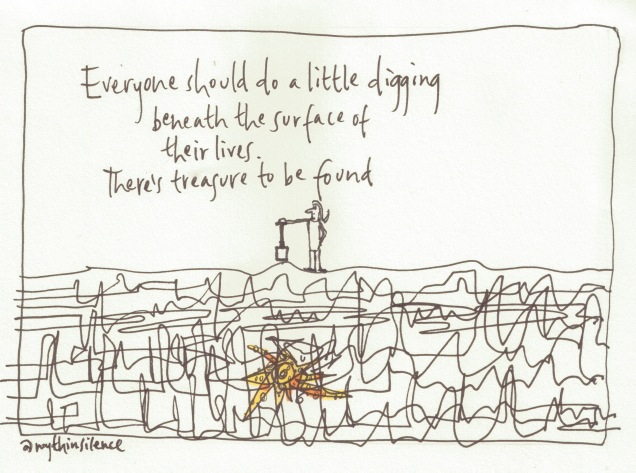
18 everyone should do a little digging

There’s something hidden and unknown in your life.  Some treasure, which, when uncovered, will delight you and those with whom you share it – some way of thinking, relating, or behaving – something you hadn’t recognised before.

A second thing.  You can buy a Mood Meter app as “a gift of self-awareness to yourself, and to others.”  The app promises that using it will help build emotional intelligence.

Our moods and emotions can also be hidden and unknown to us.  We usually focus on what’s happening to us and what our thinking, and ignore what we’re feeling.  But feeling energy and excitement assists us in uncovering the hidden treasures in our lives.  What de-energises or feels negative (e.g., sadness, helplessness, guilt, anger, disappointment, criticism, etc.) helps us to act: is this something to give up, or do we need to learn more hard or soft skills, or is this something to pass on, or do I need to embrace the feeling?

The third thing that can be described as hidden and unknown is found in the questions: What kind of mood do I put others in?

To uncover these things makes it possible for us to do three things which are important to living our life as fully as we can:

Suspending the old ways of seeing and understanding;
Diving deeply into what we are uncovering and knowing; and,
Letting go of what hinders and to taking hold of what now matters to us.

Repeat.

i am not me

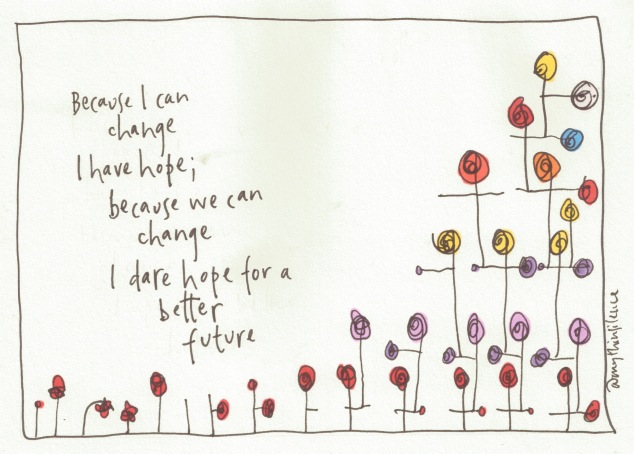
17 because i can change

I am not one person, I am many.

I am not who I was twenty, ten, or even three years ago, and I am not who I will be in ten years or twenty years time.  I am many different people held together by a narrative arc or story.

Again, my life has been, and is being, shaped by the lives of many others: I sat and named many of them this morning.

I seem to be acknowledging this more and more most, and am opening myself to what others bring to me.  I am becoming more connected: perhaps I am becoming we.

Some of the people I brought to mind at the beginning of the day made and make small changes in me, and some made and make large changes.

All of this makes it possible for me to follow Seth Godin’s advice when it come to what we each must do:

‘Don’t wait for it.  Pick yourself.  Teach yourself.’*

It also means I make myself available to esemplastic communities so we might create even more with and through one another.

And because of this, because I am not who I was yesterday, and there are many helping me, and because we can create together, I have hope.

(*From Seth Godin’s Whatcha Gonna Do With That Duck?)

esemplastic

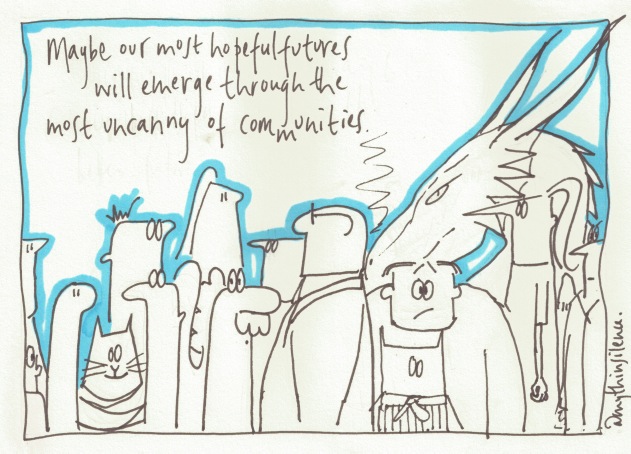
16 may the most hopeful futures

A new word on me, but one I like when I look up what it means: the coming together of diverse elements and/or ideas into an uncanny and unconscious oneness.*

This slightly longer post is about esemplastic communities and tribes, achieving together in uncanny ways for good towards a future always whispering to us.

Brian Hall got me thinking.  He does all his creative writing in libraries, bringing together many disparate observations and texts collected in these spaces:

“We – libraries and I – are allies, working together for the creative good.”**

Following Hall’s story of esemplasticity, Laura Damon-Moore and Erinn Batykefer offer this artistic practice:

‘Wander the shelves and find some fiction or nonfiction and at least one art compendium.  Leaf through until you light upon something that strikes you in each book – a quote or an image, for example.  Place these ideas in the context of your earlier sketches and conversation gathering.    Consider how they all might be part of a single story – how do they fit together to reveal someone’s character or drive the plot forward.’^

Furthermore (a word I like a lot because it’s made up of further and more), esemplasticism promises the deepest expression of unconscious collaboration.

“In art the self becomes self-forgetful.”^^

If we begin to think about what we are doing and how we do it and where it comes from and how it compares with someone else’s contribution, the we’re becoming self-conscious, and we lose the flow of our gift or art or must.  This in turn disrupts and compromises the esemplastic quality of the whole.  Here’s a longer quote from Lewis Hyde’s description of the gift understood in this way:

‘The moral is this: the gift is lost in self-consciousness.  To count, measure, reckon value, or seek the cause of a thing, is to step outside the circle, to cease being ‘all of a piece’ with the flow of gifts and become, instead, one part of the whole reflecting upon another part.  We participate in the esemplastic power of a gift by way of a particular kind of unconsciousness, then: unanalytic, undialetical consciousness.*^

We need the creativity esemplastic imagination offers.

Just this morning, listening to a BBC Radio 5 interview with Lord Carlile, I heard the Liberal Democrat peer speak about exterminating and destroying Islamic State, and whilst believing civilian casualties will be limited by precision bombing, also said, in the end, those who begin wars, as Islamic State have, bring casualties upon those around them.  Which sounds like more of a solution which has only helped to create the world we find ourselves in.  I could only think we need more imaginative possibilities.

Becoming less self-conscious, as Hyde describes, moves us deeper into empathic listening, learning, identifying and collaborating on ‘projects worth working on together.’^*  Otto Scharmer terms this as a movement to “I-in-Now,” moving us from ego to eco.  We move the other way when we become more self-conscious, towards the surface of things, towards “I-in-Me, and, therefore, from eco to ego.”⁺

‘Among the things that distinguish our species from others is our combination of idealism and artistry – our desire to both improve the world and to provide that world with something it didn’t know it was missing.’⁺⁺

(*I borrow the phrase uncanny encounters from my friend Charlotte Bosseaux’s Dubbing, Film and Performance – elements we we do expect to find together.)
(**Brian Hall, quoted in Laura Damon-Moore and Erinn Batykefer’s The Artist’s Library.
)
(^Laura Damon-Moore and Erinn Batykefer’s The Artist’s Library.)
(^^Flannery O’Connor, quoted in Lewis Hyde’s The Gift.)
(*^From Lewis Hyde’s The Gift.)
(^*From Seth Godin’s Whatcha Gonna Do With That Duck?)
(⁺From Otto Scharmer’s Theory U; the levels of deeper listening and presencing are: I-in-Me, I-in-It, I-in-You, and, I-in-Now.)
(⁺⁺From Daniel Pink’s To Sell is Human.)

imagine that

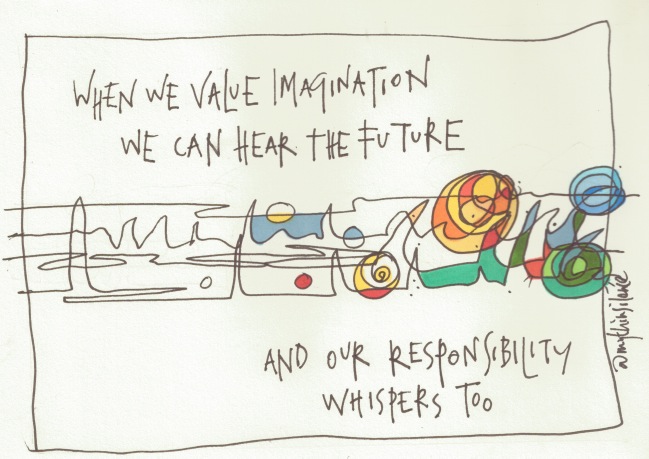
15 when we vallue imagination

What if our “mission” as Humans is to make all things thrive.

Imagine that.

Imagination carries us to new places and experiences and people – even into the 96% of the universe we still don’t know- and what if we don’t know how much we don’t know?

Here’s what space scientist Monica Grady was saying on the radio just this morning:

“We are very small people with, you know, our imaginations are sometimes not broad enough.  We really need to think beyond the boundaries of our own country, of our own earth, and look beyond. … People who get a glimpse of the night sky … and see the stars … there’s so much mystery and mythology and stories  you can weave about the stars.’*

What if the universe is the original Star Trek-like holodeck, waiting for us to create the best stories we can?

Some of our stories make it possible for all flora and fauna to thrive.  

At the other end of the stories-spectrum, there’re are narratives which only spoil and destroy.

‘We need to be alive to stay alive.’**

And imagination makes this possible.  Capable of continually exploring and learning forward, connecting and empathising creatively as homo connecticus, prototyping a better world.

But we can also close our minds, and, disconnecting from others, producing destructive stories which offer bleak, dystopian futures.

Every day, each of us has opportunity to use our imaginations in a positive and hopeful way:

‘The imagination has the power to assemble the elements of our experience into coherent, lively wholes: it has a gift.’^

We imagine ourselves forward.  Imagination creating stories creating imagination.

Towards a better future.

Imagine that.

(*From BBC2’s Good Morning Sunday.)
(**From Peter Diamandis and Steven Kotler’s Bold.  Studies have shown that people who retire at 55 are 98% more likely to die in the following ten years than people who retire at 65.)

(^From Lewis Hyde’s The Gift.)

much more than this

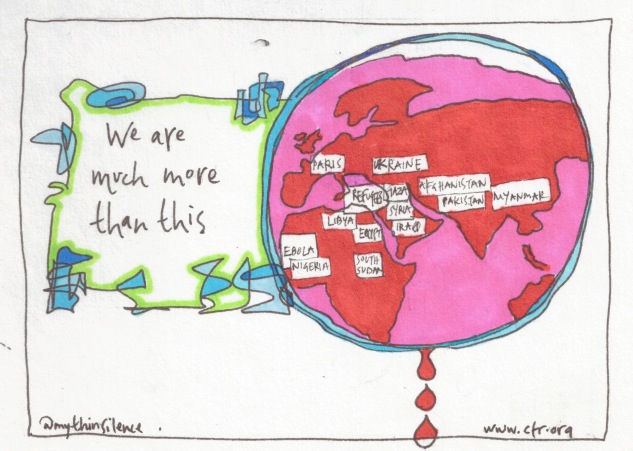
14 we are more than this

You’re more than your thoughts, more than what’s going on in your head.

When you’re more present to the intelligence of your heart and gut, you are listening to what your life is trying to tell you.

You’re more than the sum of your parts, more than your thoughts + feelings + skills +  experiences + values + passions.

What your life is, is a gift, and gifts are alive, spiritual, and social.

You’re more than a story you want to live on or have noticed by those you influence.  There’s some difference for good you can make.

You’re more than who you are in this moment, and must resist avoiding or neglecting what you can do.  When you leave the status quo, when you try something, when you act, you become more your future Self – and so do I, and so do we:

‘When who we are and what we do are one and the same, we are walking the road of Must.  When we choose Must, what we create is ourselves.’*

On a day when we’re following what happened in Paris last night,** we remember how we are much more than this – we’re determined to become more Human.

(*From Elle Luna’s The Crossroads of Should and Must.)
(**As I write this, it’s believed there are 128 dead and more than 200 injured because of the terrorist attacks in Paris.)

living present

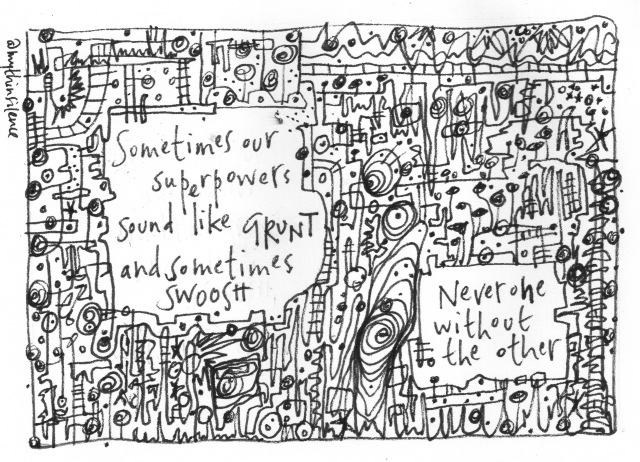
13 sometimes our superpowers

Staying alert to the future wanting to emerge through you.

Here are three questions:

What is my courage? (Who I am thinking of when I am most selfless and thinking of others?)
What is my generosity?  (What is it I want to give most of all to these others?)
What is my wisdom?  (The difference I hope to make?)

Here are three practices:

Wake up with your emerging future – some reflective practice – like journaling or mindfulness or prayer.
Stay connected throughout the day with the deep intention of your life – working on ways of remembering (such as the questions, above).
Sense and take hold of possibilities when they come your way.

As for me, a year ago I’d journaled my deep concern to somehow help release people into their futures, how the world is going without because people aren’t bringing their “art,” their “superpowers,” into the world.

it’s all holy

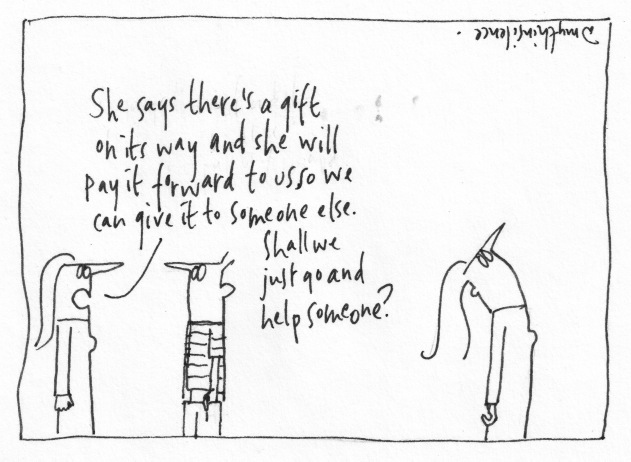
12 she says there's a gift

I don’t mean religiously.

Your gift is special.  It’s different to the gifts of others – it sets you apart.  Holy.

It’s also holy because it comes to you from somewhere or someone else: a muse or genius, a people or person, the universe or God.

Of course, this means the gift of others is different to your, meaning theirs is holy too.

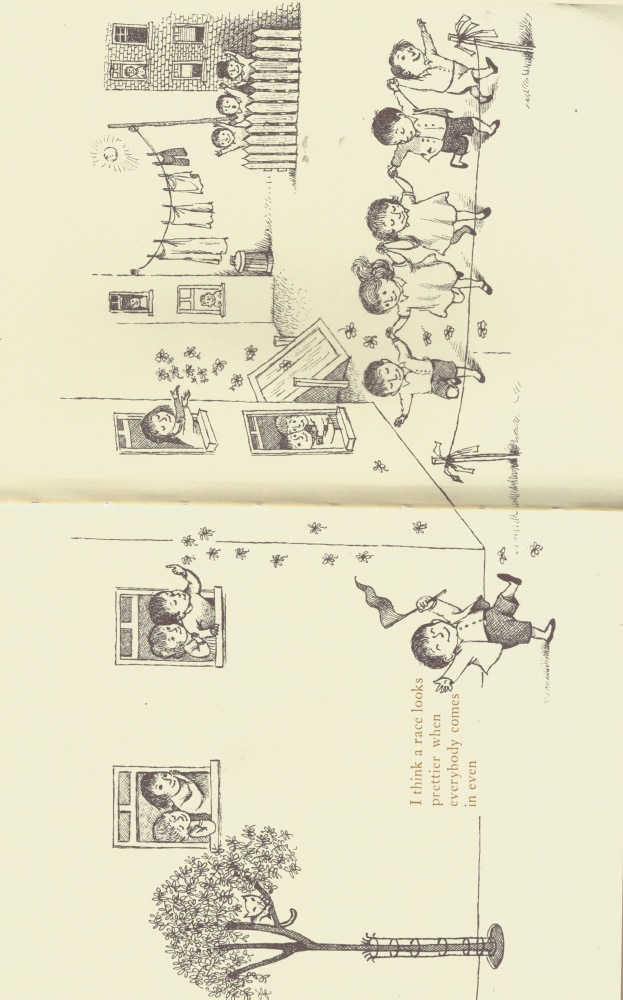
‘I think a race looks prettier when everybody comes in even’*

12 i think a race

Except someone’s reaching the line as a sprinter, another as long-distance runner, another as a cyclist …

Some say not everyone can be special.

Why not?

We’ve traditionally understood specialness in terms of ego, how we compare ourselves to others.  We’re coming to understand specialness from the place of eco – our connectedness to all things and people, including connecting to ourselves.

This eco-attitude, incorporating humility and gratitude, allows what wants to come to to come:

“You get a good poem and you don’t know where it came from.  ‘Did I say that?’  And so all you feel is: you feel humility, and you feel gratitude.  And you feel uncomfortable, I think, if you capitalised for much on that without admitting at some point that you got it from the Muse, or whatever, wherever, or however.”**

At the moment I’m reading Elle Luna’s excellent short essay on Should and Must.^  Must comes from within and reaches out to others so is more about the eco: the holy gift which comes to us and the holy gift we give to others, and doesn’t need popular recognition

Should comes from without, what others think we should do and is more about the ego: desiring the gratitude and plaudits of others.

Must is holy.

I hope today finds you caught up in the magic of your Must.

(*From Ruth Krauss and Maurice Sendak’s Open House For Butterflies.)
(**Poet Gary Snyder, quoted in Lewis Hyde’s The Gift.)

(^Elle Luna’s The Crossroads of Should and Must.)

the flow of gift

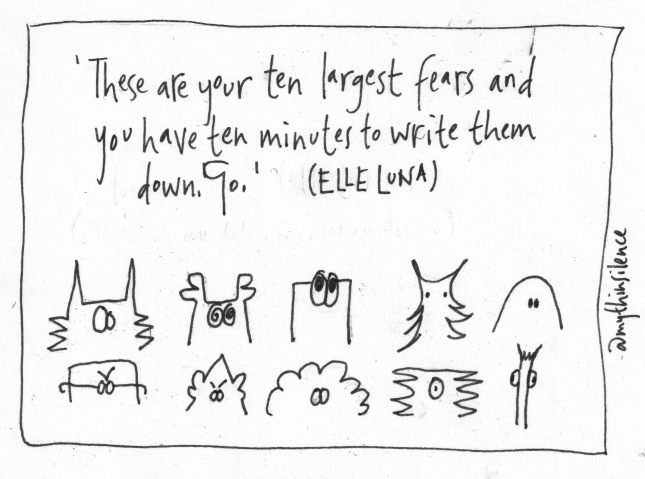
11 these are your ten

‘So long as the gift is not withheld, the creative spirit will remain a stranger to the economics of scarcity.’*

Bring who you are.

Bring what you have.

Bring what you can do.

Don’t wait for inspiration.  Turn up everyday with the things you work with and trust something will come.

Poet Allen Ginsberg said writing, as an expression of gift, is “just writing what yourself is saying”.**

For “writing,” substitute whatever activity is yours.

Mark Levy tells writers just to start writing.^  This translates into whatever your gift is.

Don’t be afraid of those who will criticise your gift.  It’s probably not for them.  Focus on those you give your gift to.

When you have given, you’ll find you want to give again: you cannot empty yourself:

‘Bestowal creates that empty space into which new energy may flow.’*

Gift-giving is always a risk.  Yet you know you must do it:

“I don’t know what your destiny will be, but one thing I know: The only ones among you who will be really happy are those who sought and found how to serve.”^^

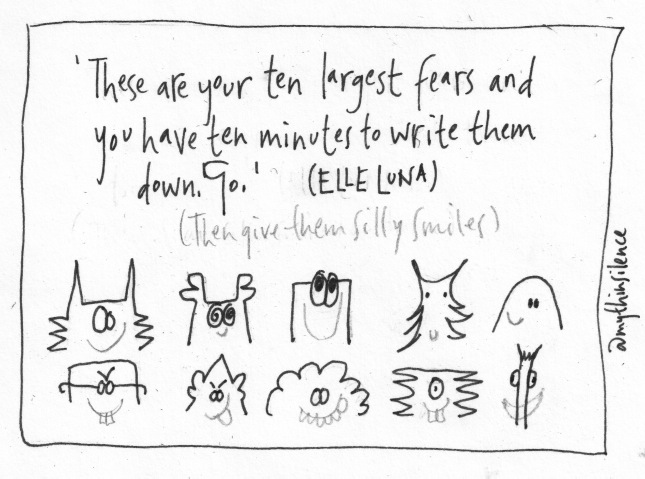
11 these are your ten (smiles)

(*From Lewis Hyde’s The Gift.)
(**Allen Ginsberg, quoted in Lewis Hyde’s The Gift.)
(^Mark Levy’s Accidental Genius.)
(^^Albert Schweitzer, quoted in Seth Godin’s Whatcha Gonna Do With That Duck?)

the thing about dreams

10 our dreams need to be big

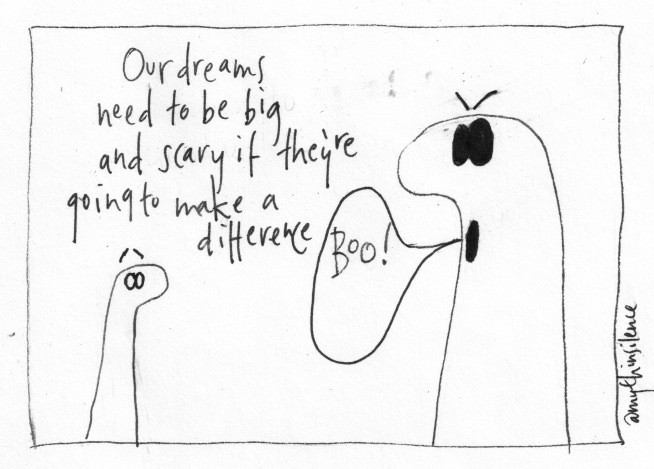
It wouldn’t be a dream if it were easy, if you were already doing it.

‘Well it turns out that the Must is scary, hard, like jumping off a terrifyingly high cliff, where you can’t see anything down below.’*

There have to be at least two whispers.

One comes from beyond you, out there, somewhere a need, a call, a question, a request.

The second comes from within, the way you want to respond, must respond to what you hear.

Dreams ask us to remain open when everything we are screams to be closed and known and decided.  Dreams also ask whether we’re willing to fail – it’s quite possible we’ve found a life which minimises failure, but dreams require we leave this behind:

‘If failure is not an option, then neither is success.’**

When you dream, others will be prepared to dream.

Another thing is, dreams don’t stay put.  As you move towards them, they say to you “yes and” and watch to see if you’re willing to play.

“Yes and” is who we are as Humans when we are at our most generative.

“”Yes and” isn”t a technique …. It’s a way of life.’^

Keep dreaming.

(*From Elle Luna’s The Crossroads of Should and Must.)
(**From Seth Godin’s Whatcha Gonna Do With That Duck?)
(^Cathy Salit, quoted in Daniel Pink’s To Sell is Human.)
deep must

9 are you dancing

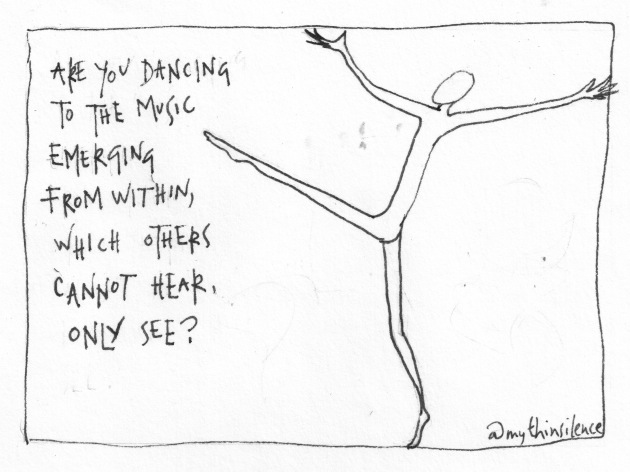
When we find our Must, we also find our deep concern, taking us deeper, beyond the surface of an issue, to the source and to a future possibility.

‘Must is what happens when we stop conforming to other people’s ideals and start connecting to our own.  Because when we choose Must, we are no longer looking for inspiration out there.  Instead, we are listening to our calling from within, from some luminous, mysterious place.’*

This is the deeper now, a different way of engaging and reimagining a circumstance – especially a different way for someone to engage with and reimagine their life.

We’ll likely be surprised by what we find at the deep source of ourselves and one another.  Here we are, ordinary people going about their lives, but connected to their Must (element, purpose, calling, vocation, strengths, superpowers, gift, genius) bringing extraordinary impact.

(*From Elle Luna’s The Crossroads of Should and Must.)