you belong here

8 the future will

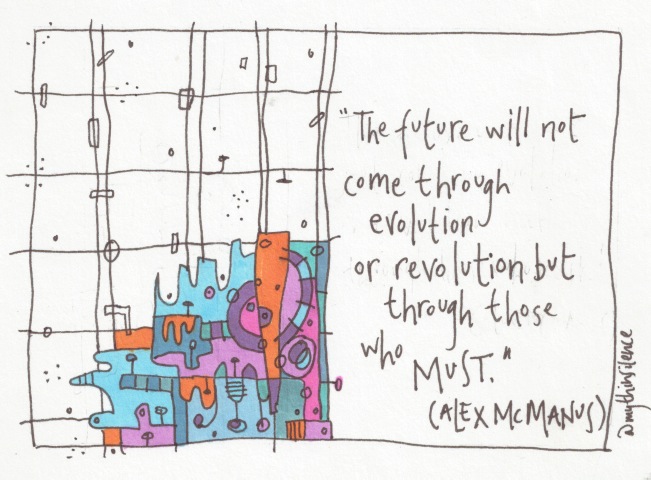
One of the favourite sayings of my friend Alex McManus.  He’s provided me and others a place to connect with deep creativity.

More than eleven years ago, Alex told me the future will come through those who must, setting me on a path that has led me to today.  Literally today, as I met some great people wanting to explore their deep creativity for the sake of others.

‘Must is who we are, what we believe, and what we do when we are alone with our truest, most authentic self.  It’s our instincts, our cravings and longings, the things and places and ideas we burn for, the intuition that swells up from somewhere deep inside of us.’*

You belong here is about being both centred and adventurous, shaping the kind of spaces in which others can explore, individually and collectively.

“When I walk into my library it feels like optimism and hope.  It simultaneously offers a sense of adventure and comfort.”**

(*From Elle Luna’s The Crossroads of Should and Must.)
(**Poet Joseph Mills, quoted in Laura Damon-Moore and Erinn Batykefer’s The Artist’s Library.)

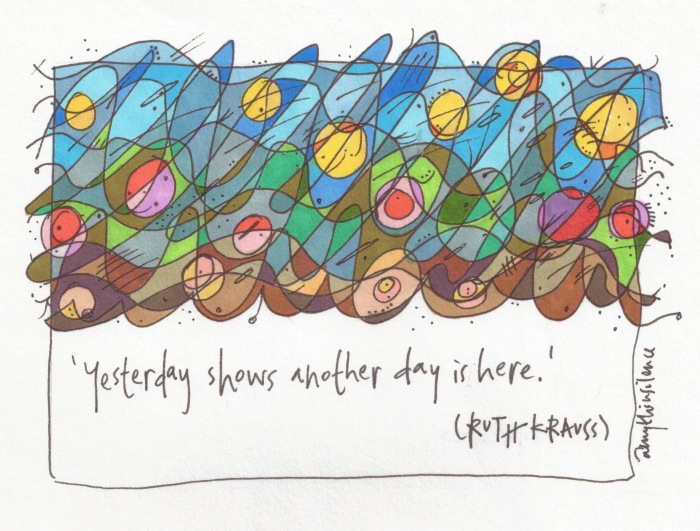
another day is here

7 yesterday shows

‘When all property is privatised, faith is privatised and all men feel fear at the boundary of the self.’*

Lewis Hyde is tracking the move a loan as gift moves across a boundary into usury and interest.  We’re so used to interest on loans that it’s hard to comprehend that this wasn’t the case for the majority of people within tribes, communities, and societies until around five hundred years ago.

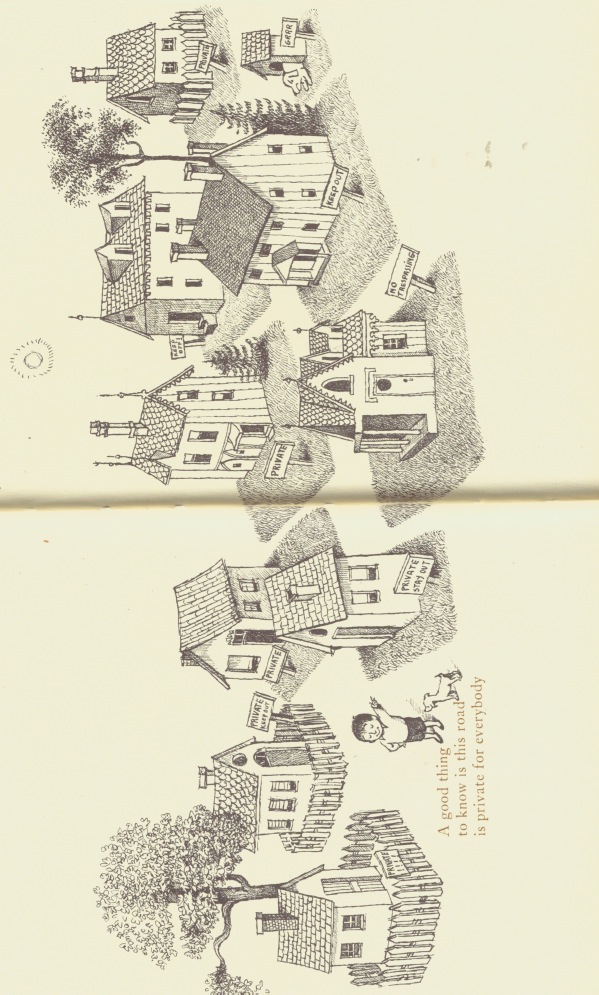
‘A good thing to know is this road is private for everybody.’**

Ruth Krauss’s children’s book from 1960 has some real gems in it and this is one of them.

7 butterflies

We need to unprivatise our lives.  We need spaces for this to happen in product ways.

Elle Luna writes about the crossroads of should and must.

Should comes from without and must from within.  Should is about living the life others want us to.  Must is about living the life we must in order to make our contribution before we leave this world.  We need more spaces for must-creativity to he encouraged and explored.  Luna’s essay provides a space: ‘It is for anyone thinking of making the jump from Should to Must.  Anyone looking to follow the energy deep within their chest but aren’t quite sure how.’^

I like the idea of a new day being here.  That there are spaces we can walk into and request help to put the most in and get the most out of a new day.

Yesterday, I mentioned an exploration called #libraryofawesome.  Libraries have been around for some time but they remain islands of gift in oceans of commodity to everybody to use ‘as an intuitive space that fosters curiosity and investigation in a variety of delightfully unexpected ways.’^^

The library begins in you and you must bring your library to others.

(*From Lewis Hyde’s The Gift.)
(**FromRuth Krauss and Maurice Sendak’s Open House For Butterflies.)
(^From Elle Luna’s The Crossroads of Should and Must.  I have shared on a number of occasions how my friend Alex McManus believes the future will not come through revolution or evolution but through the people who MUST.  Check out Luna’s short video telling of how this all began for her.)
(^^From Laura Damon-Moore and Erinn Batykefer’s The Artist’s Library.)

#libraryofawesome

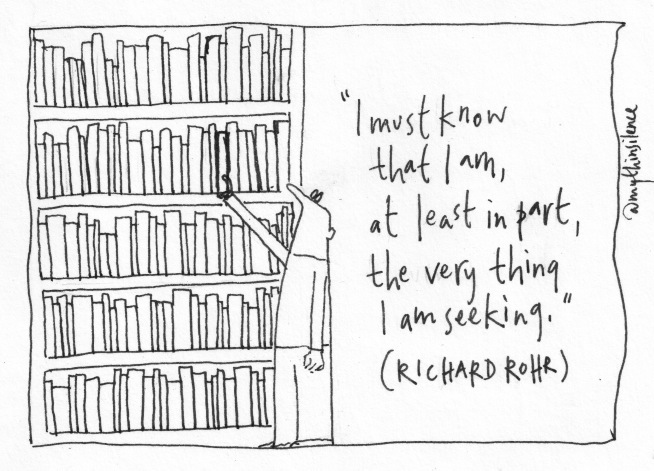
6 i must know

“I am fascinated by the idea that you can borrow books for free and that these books will pass through many hands before reaching you.”*

The library is a real gift and a place for gifts to move around for everyone regardless of where they are from or who they are.  When someone fails to return a book and is fined, this feels doubly wrong.

It doesn’t have to be a library; we need all kinds of open, encouraging, and  creative spaces.  #libraryofawesome happens to be a concept I’m exploring with a number of friends: a place where anyone can become all they can be, doing all they can do to bring their art, their contribution into the world.

‘All being can correctly and rightly be spoken of with one voice (univocity) … .  What I am and you also are, and so is the world.’**

(*Photographer Doreen Kennedy, quoted in Laura Damon-Moore and Erinn Batykefer’s The Artist’s Library.)
(**From Richard Rohr’s Eager to Love.)

why we need others

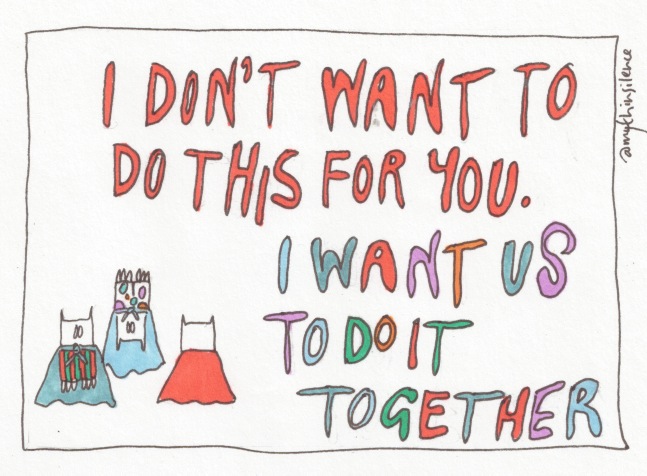
5 i don't want to

Sometimes we need experts.

I want someone who’s really good at flying to pilot the plane I’m on and not to do any experimenting.

More often, though, we need explorers:

“These are people who see a domain but not the path.  The fact that the path is not clearly defined is what excites them and motivates them.”*

Passionate explorers don’t just go this way, they turn around a lot,  realising there’s always more, and they’re always asking questions.

It doesn’t matter what they’re passionate about, these things describe them.  Passionate dreaming allows them to move beyond their present competence making rote obedience look increasingly clumsy and even  foolish.

And explorers know they need others to help them.

There so many people who will respond positively if you say to them, “I want to work out how my life can benefit others: will you help me figure this out?”

My friend Jo reminded me yesterday how we are on a journey from doing things to people, even doing things for people, and we’re discovering there’s something deeper than doing things with people, to doing things together.**

And they are the most worthwhile things in all the world.

(*John Hagel, quoted in Peter Diamandis and Steven Kotler’s Bold.)

upside-down journeys

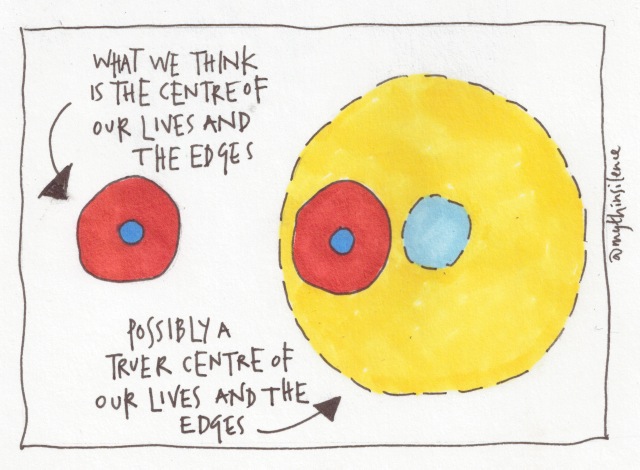
4 what we think is

Number One:

‘Suppose old people grow down as young people grow up.’*

Sometimes growing up can take us away from our creativity, but we can find our way back by nurturing our curiosity, playfulness, and imagination.

Journey Two:

‘It is ironic that you must go to the edge to find the centre.’**

We want centred, balanced lives, not realising we may be accepting less because none of us knows what we are truly capable of until we have journeyed to the edges.

Journey Three:

‘We champion the idea that the open and unpretentious library can offer a return to the quiet and unselfconscious art-making that so many adults have “grown out of” after childhood.’^

The third journey takes us into a community of explorers, rather than a community of experts.  Experts may be tempted to grow up and stop going to the edges.^^

(*From Ruth Krauss and Maurice Sendak’s Open House For Butterflies.)
(**From Richard Rohr’s Eager to Love.)
(^From Laura Damon-Moore and Erinn Batykefer’s The Artist’s Library.)
(^^If you’re in or around Edinburgh, I’d love for you to find TribePorty or VOXedinburgh.)

sneaky deep

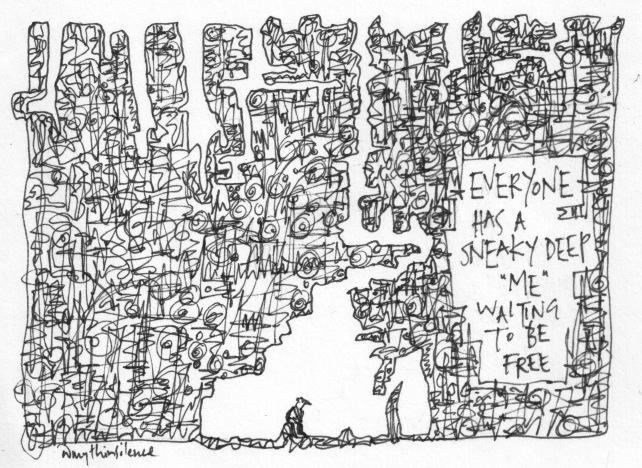
3 everyone has

A phrase I heard at an event last night from someone facilitating the telling of stories, forming poetry, and moving around the space as in dance, first without and then with music.

So we ended up doing things we didn’t know we could.

This morning I was asked what I do and I told them about the dreamwhispering.  He smiled as he said, sneaking things into people’s dreams while they sleep.

Not quite, it’s really about listening to someone’s dreams while they’re wide awake.

Sneaky deep is a great phrase.

Amazing talents and dreams already lie deep within people.

So we have to figure out together how to sneak them out from behind the resistance of denial or unknowing.

You don’t need anything more than you already have; you only need to go sneaky deep to set these things free.

Your head may tell you that you’re not enough, but deeper, your heart knows better and wants to be listened to.

“I have done what was mine to do, now you must do yours.”**

(*Francis of Assissi, quoted in Richard Rohr’s Eager to Love.)

fear of failure

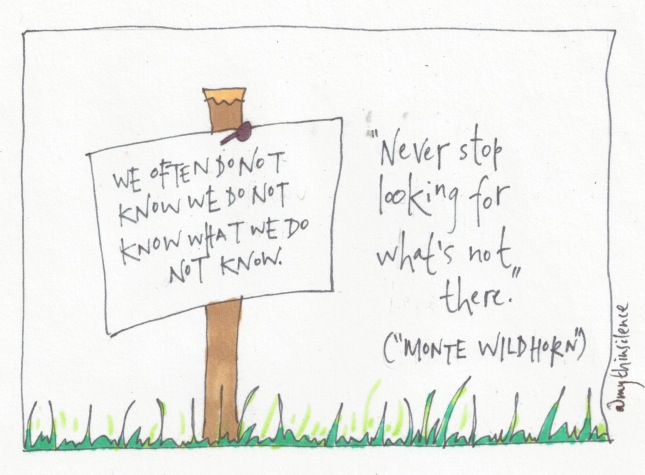
2 never stop

Three words with huge implications.

Failure doesn’t have to send us backwards but can move us forward.

Seth Godin’s encouragement to fail and fail and fail again has stuck with me since first reading it:

What have I learnt?
What do I see that I couldn’t see before?
What won’t I do again?
How can I try this again but smarter?

How can I now live, do, be better as a result of this?

When we fail forward, we’re able to attempt things we previously thought impossible because we dismissed them too soon: “We thought we’d fail so we didn’t try.”

We try, we fail, we learn, we take a step forward.  We’re on a journey from the visible to the invisible.

In the movie The Magic of Belle Isle, there’s a great line delivered by Morgan Freeman’s character Monte Wildhorn to nine year old Fin:

‘Never stop looking for what’s not there.’

Richard Rohr adds, ‘Matter is, and always has been, a hiding place for Spirit, forever offering itself to be discovered anew.’*

A word on the fear part of this post’s title.

Fear is important but often goes unquestioned.  Like The Wizard of Oz scene in which the Mighty Oz is revealed for who he is- “Pay no attention to that man behind the curtain” – it’s a feeling which must be questioned to really hear what it’s saying to us.  When we do pay attention fear becomes a message and not a feeling.

Often what it’s saying is something about ourselves.  And the great things is, every day the universe provides us with an opportunity to change: fail, learn, try again.

(*From Richard Rohr’s Eager to Love.)

just go with the flow

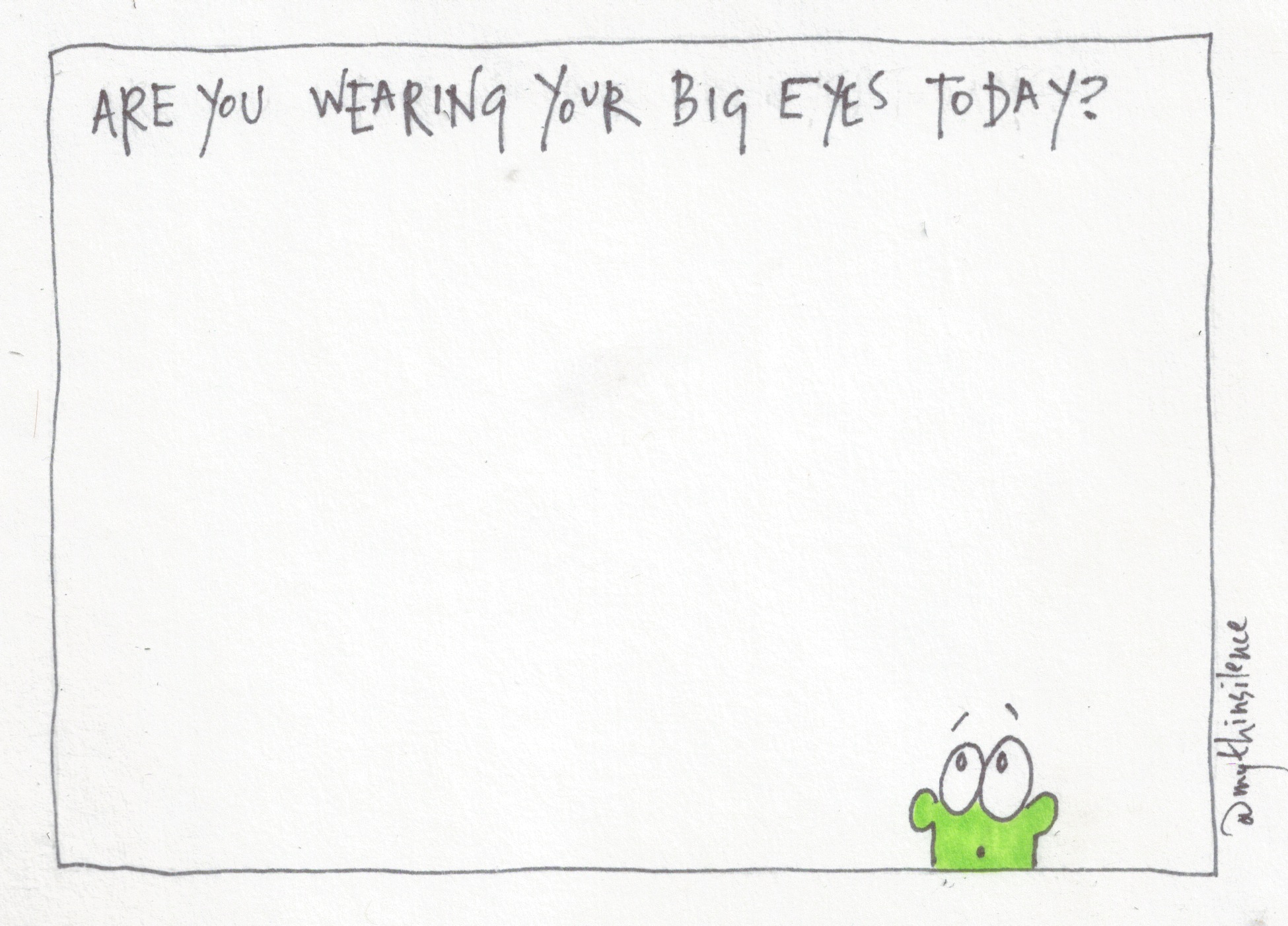
1 are you wearing

Today, I promise to open myself to more than I know and see.

I don’t know where this will lead me.  Experience tells me, there are no straight lines. We have to trust the flow which has brought us to here and will continue to guide us.*

In his book Creativity, Mihaly Csikszentmihalyi points to flow being about 1) seeing clear steps (more intuitive than destinational); 2) being able to recognise feedback immediately; 3) having a balance between our skills and the challenge; 4) we are fully focused; 5) and cannot be distracted; 6) failure does not restrain us; 7) we have no self-consciousness (sweet spot humility); 8) our sense of time is distorted; and, 9) we are so in the flow that the activity becomes autotelic – an end in itself.

Purpose and direction do not begin with convergence but with divergence, being open to more:

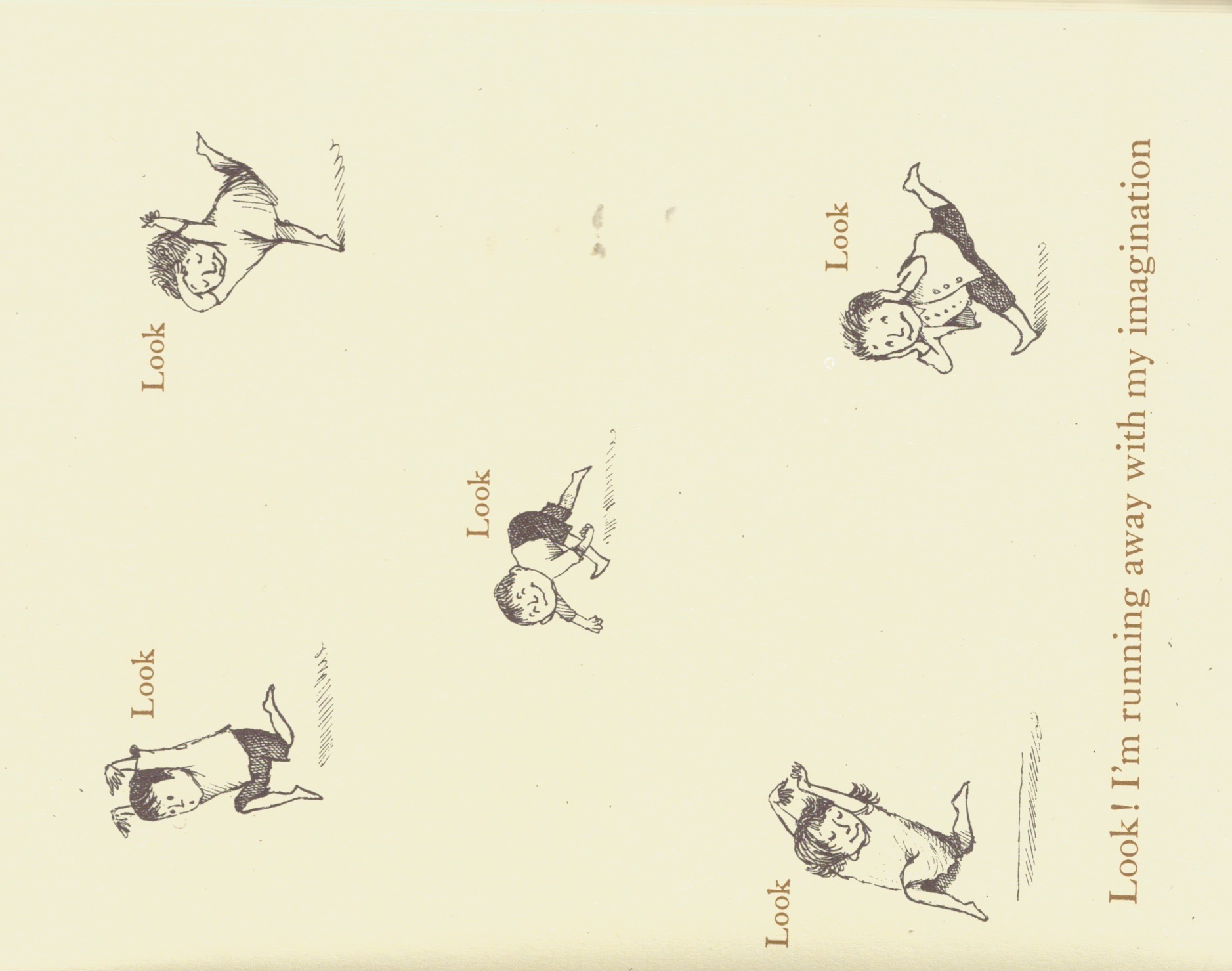
‘Look Look Look Look Look Look Look!  I’m running away with my imagination’.^

1 butterflies^

(^From Ruth Krauss and Maurice Sendak’s Open House For Butterflies.)

this way, that way

31 a tribe is

‘In aesthetic experiences, individuals immerse themselves but remain passive.’*

A this way experience comes to us, provided by others, impacting us but not being impacted by us.

I don’t have to go to a Universal Studios theme park for this kind of experience.  By walking into my White Stuff shop I can have coffee and cake on the house and see telephone boxes, a sweet counter, an old metal bench circling a fake tree, and wardrobes which turn out to be very big changing rooms.  However, I do not change the company in any way.

Increasingly, though, we’re living in a that way time: ‘When we change ourselves, we can change the world’ – words I shared yesterday from Nipun Mehta.  More and more people are making change in one way or another.

I was reminded of this in a conversation just yesterday with someone who was helping me figure out how to channel the thing I can do.  She mentioned Seth Godin’s book Tribes – about how people find one another and make a difference in the world:**

‘A tribe is a group of people connected to one another, connected to a leader, and connected to an idea.’^

On the leader part of this, Godin writes, ‘By challenging the status quo, a cadre of heretics is discovering that one person, just one, can make a huge difference. … Heretics are the new leaders.  The ones who challenge the status quo, who get out in front of their tribes, who create movements.’^

There’ll always be those who bemoan the state of how things are, the same way they were bemoaning the same thing a year ago.  Unsurprisingly, nothing changes.

Last night, I was privileged to be a part of a group of people who came together to make a difference and to have fun, many giving expression to how impact not only comes this way, it also goes that way.^^

(*From Joseph Pine and James Gilmore’s The Experience Economy.)
(**It was through reading this book I met the people with whom I’ve worked on creating a number of transformative experiences.)
(^From Seth Godin’s Tribes.)
(^^VOXedinburgh’s Sangai Runu event mixed great music, artwork, and conversation, with the intent of supporting a Nepalese educational charity.)

guerrilla gifts

30 when we change

Guerrilla gifts create disequilibrium.

I give you this but you don’t give back, you give forward – use it to cause disequilibrium somewhere else.

Nipun Mehta is turning gifts into more than an economy – into an ecology.  One exploration with interns saw them engaging in 21 days of kindness, but it had to be something new every day – their focus and engagement and wiring changed as a result (then they went on to 21 days of gratitude).

Rohit Bhargava names the non-obvious trend of Branded Benevolence,* citing the example, among others, of Elon Musk announcing, on the 12th June, 2014, he would be making Tesla patents openly available, to speed up innovation in the car industry – apparently, a big scale guerrilla gift.  (Some have been more than sceptical – I’ll leave it to you to decide whether this is truly subversive goodness, or not.)

To be a guerrilla gifters involves a move from the head to the heart; these words from Tom Asacker work here:

‘They’ve discovered that breakthrough achievement is about belief.  Conviction, then action.  Magic, then logic. Heart, then head.  They know that seeing isn’t believing.  Believing is seeing.’**

How to get going?

Suspend old belief.

Give something, consistently, over a long period of time – the thing the interns, mentioned above, did.

Take hold of new belief.

Enjoy exploring.

(*Rohit Bhargava’s Non-Obvious.)
(**FromTom Asacker’s The Business of Belief.)