causes, attractions, and influences

17 ever time

Or, causers, attractors, and influencers.

Two magnetic fields which make up our universe.

Magnetic Field 1:

‘The force of gravity isn’t a mysterious effect that leaps over infinite distances; it arises from the smooth variation of an invisible field that permeates all of space.’*

Proximity to a body of this or that size come into play within this magnetic field.

Though, every day this reality is largely invisible to us.

Magnetic Field 2:

‘One person, symbol, or prime idea can very definitely set the course of history and its meaning in one direction instead of another.’**

There is a relational field which is also largely invisible to us.  We can feel this or that way about someone or something but don’t know why.

Scientists help us to see what was previously invisible to us in the material universe.  Mindful and reflective people help us to see what is happening in the relational universe.

We are all capable of seeing more than we do right now, and when we see how we are caused upon, attracted, and influenced, we can avoid the negative and embrace the positive.  We can also become more those who  cause, attract,and influence through proximity and how we grow our lives to be bigger.

We may not have the energy to always be mindful and reflective, but we can each identify times and practices which allow us to make this journey, becoming people who shape the future with foresight, intention, and love.

‘The journey from being driven by past patterns and exterior forces … toward the place that allows us to shape the future from within … we shall call the journey of leadership.’^

Whether we are leading ourselves or leading others, what we are blind to and what is invisible to us becomes our nemesis.

(*From Sean Carroll’s The Particle at the End of the Universe.)
(**From Richard Rohr’s Eager to Love.)
(^From Otto Scharmer’s Theory U.)
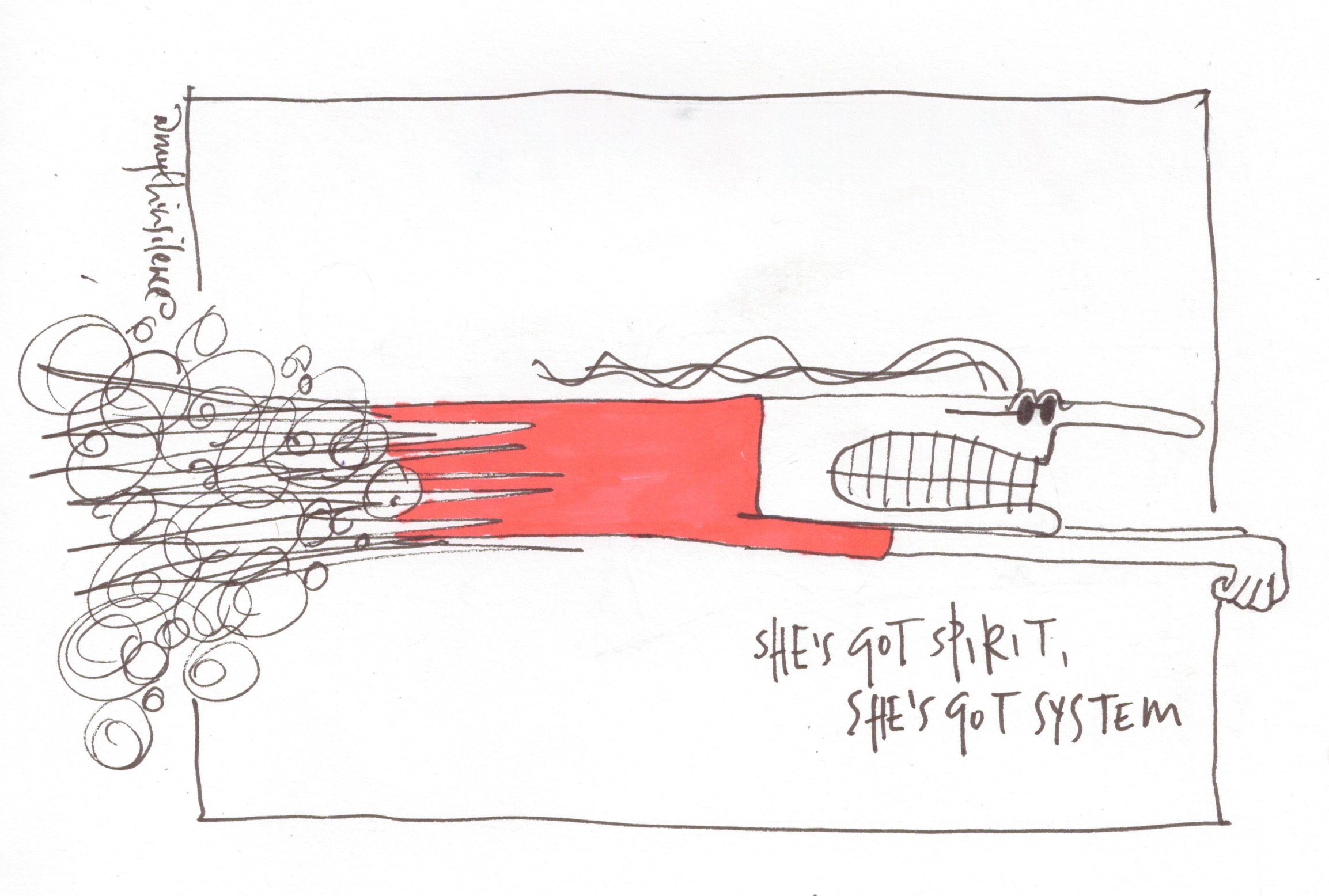
(Cartoon: a tribute to Helen – and so many like her – who do the things they love to do for the sake of others.)

empowering

16 this is not

Is the sign of a healthy relationship, whether in the family, with friends, or in the work place.

We empower when we understand each and every relationship to be mutual (I-You): when each is able to bring and share their very best with the other.

An unhealthy relationship is one which depersonalises and disempowers, believing a relationship can be more about us and our needs and our priorities (I-It): in effect, “You have nothing I need.”

(In the work I do, I have literally lost count of the number of times people have shared with me how the most de-energising experiences they’ve had are when they and others are not recognised as people with ideas and skills.)

Mutuality can feel too vulnerable, though, too “soft” for the hard circumstances we find ourselves in.*

Yet, when we power up over others rather than empower them, when we make ourselves invulnerable to what they have to bring, we also may be saying something profound about ourselves, how we are not enough.

Brené Brown defines love – which is all about how we treat each other before it is how we feel about each other – in this way:**

‘Love is not something we give or get; it is something we nurture and grow, a connection that can only be cultivated between two people when it exists within each one of them – we can only love others as much as we love ourselves.’^

When we are happy with who we are and see the possibility of growing without shame within this, we are loving ourselves as we ought and are more able to turn this love towards others.

Of course, people are not either or but a mix of empowering and disempowering in different relationships and environments.

What do we get to do today, though, is to explore being more empowering in all the relationships we find ourselves in.^^

(*Also, indicative of a dualistic few of life.)
(**Actions which, above, all seek to avoid shaming and controlling the other.)
(^From Brene Brown’s Daring Greatly.)
(^^What this looks like depends on the relationship.  An encounter with a sales assistant we don’t know will be different to some to whom we regularly report or who reports to us.  In part, what we are considering is how to be more aware and mindful before, during, and after these moments of connecting.)

spontaneous “me”

15 be a spontaneous me too

Who you are when you are not trying to be anyone or anything else.

We can pursue roles and titles when we feel ourselves to be not enough.

Yet, the spontaneous me is enough, not least because this me is the me who can be grown and developed best of all.

Eckhart Tolle coins the phrase spontaneous me as who we are beyond roles, but then adds: ‘But don’t try to be yourself.  That’s another role.’*

Whilst this “thoughtless” kind of personhood feels similar to telling someone, whatever they do, they mustn’t think of elephants, I appreciate what Tolle’s trying to take us to.  Roles and titles can threaten our incredible capacity for exploring, questioning, adapting, developing, failing, beginning over, connecting, collaborating, and creating.

I’m beginning to read Stephen Pyne’s fascinating history of fire** – our discovery of how to make fire has changed life on earth.  Fires require the triangle of combustable material, oxygen, and heat.

To embrace this imagery, we are heat.

The spontaneous me is the particular heat we are, our special ability to start fires, including the kind of fires we seek to combust, as all fires depend on the material they are consuming.  Fire is a synthesiser of its surroundings – without oxygen and fuel, there could be no fire: we cannot make fire without connection – to others and to our world.

Your spontaneous me is the most pure heat you can be.

Believing you are not enough, trying and be someone or something else, only isolates your heat and robs the world of the fires you can make.

(*From Eckhart Tolle’s A New Earth.)
(**Stephen Pyne’s Fire.)


personally speaking

14 we are created through

From per sonare – to sound through each other.*

In reality, we are inter-beings.  Each expresses the many: the larger whole.   We are made through each other, through our many interactions.

This is such a powerful experience, we can mistakenly see the person as an independent individual, reinforced by the roles we give ourselves and one another, or, as Eckhart Tolle has it: we are ‘corrupted and distorted by the mind-made “little me” and whatever role it happens to be playing.’**

Yet, as an inter-being, I am a person who is and who is not yet me – not the final me, not the future me.  With your help, though, I become more me.  And this will be enough.

(*Apparently, the understanding of the Human person devolved from how the early Christian Church understood the interrelatedness of the Trinity – each member communicating its face – sounding through – to the other.
(**From Eckhart Tolle’s A New Earth.)


enoughness

13 more than enough

This is what everyone has

Every choice you make will hide or reveal your enoughness.  

You will never lose it.

Others cannot take this from you: Viktor Frankl discovered this in the Nazi death camps.

Eckhart Tolle helpfully adds more detail when he describes the difference between being over form.  We compare ourselves to others in our forms: bigger, faster, stronger, knowing, but, when it comes to being, we are equal –  we are all enough.*

(We also understand ourselves in relation to the rest of nature in this same way: as Humans we are more developed in form than anything else on the planet, but in our being – all being expressions of nature – we understand how we’re one with all species.)

Elizabeth Bowen astutely captures this when she remarks: “To turn from everything to one face is to find oneself face to face with everything.”**

13 more than enough 2

When Brené Brown shares how, ‘research tells us that we judge people in areas where we’re vulnerable to shame.’ she’s underlining what happens when we focus more on form than on being in life’s interactions.^  Then, we are never enough.  In reality, though, what we have done is overed up and hidden our enoughness.

When we move from form to being, we make it possible for the most important of all human actions to flourish: love.^^  Love moves us from form to being and keeps on growing:

‘Love always grows, not just deeper, but wider.  Love always loves people more, and always loves more people.  Love calls us to community; love calls us to humanity; love calls us to each other.’^*

Love says you are enough and everyone you look upon is enough.  Life is all about uncovering this rather than hiding it.

(*Eckhart Tolle uses the comparison of adults and children to illustrate this.  Adults may be “greater” humans when it comes to form – they are bigger, et cetera – but in being they are equal.)
(**Quoted in Richard Rohr’s Eager to Love.)
(From Brené Brown’s Daring Greatly.)
(^^Love is a verb before it’s a feeling.)
(^*From Erwin McMaanus’s Soul Cravings.)
(The cartoon is unfinished.)

sham and shambolic

12 there's no sham
Two interesting words:
sham
ʃam/
noun
noun: sham; plural noun: shams
  1. 1.
    a thing that is not what it is purported to be.
    “our current free health service is a sham”
Origin
late 17th century: perhaps a northern English dialect variant of the noun shame.
As I finish the year, I find myself thinking about “the vulnerable way” as something necessary to being Human: to be open to others, to the world, and to our future Self.  One of the carcinogens to vulnerability is certainty – when certainty is impermeability to the new, the more, the different.  Certainty is a sham when we pretend this is that, our personalised Wizard of OZ hiding behind the curtain in feigned invulnerability, rather than standing in front, admitting what we can and cannot do.
Sham is interesting because it possibly derives from the word shame – the thing we feel when we caught out, when we fail, when we let others down – the thing Brené Brown want us to be resilient to.*  Shame is what we fear most if we’re to make ourselves vulnerable.  So we hide, we become a sham.  We lie to ourselves first, telling how this is this best route to take, but what we don’t see is what it leads to.
shambolic
ʃamˈbɒlɪk/
adjective

BRITISHinformal
adjective: shambolic
  1. chaotic, disorganized, or mismanaged.
    “the department’s shambolic accounting”
Shambolic does’t derive from the same place as sham, but they feel linked in the following way.  To live a sham-life leads to disruption and even chaos.  From shambles, we can shamble along, shuffle and stumble.  We can never be fully present to others and the world around us because we don’t know who we are and what we have to bring.
The truth is, we’re all moving from this state of shamness to something more authentic, integrated, and whole.
Today will throw many opportunities to avoid shamming it and to go for real instead – which may feel way more vulnerable, but it also allows the genius of you to flow.  And this is what the world wants to see.
(*Brené Brown wants us to be able to distinguish between shame, guilt, humiliation, and embarrassment.) 

are you certain?

11 the percentage 1

Certainty can be a dangerous thing.

The mystery of the universe continues to unfold before our eyes; even our understanding of the things we thought we knew with certainty continue to unfold and expand.

We cannot say dogmatically about many of the important things which touch and affect our lives,  “This is it.” Is there more beyond the Higg’s Boson?, or, Do I know everything about you?*

11 the percentage 2

Companies, governments, religions, individuals all come unstuck when they believe their certainty is the one which really matters.  There is hope, though: it’s you.

You are an enigma.  You live on this material planet, the product of a material universe, yet you ask questions about the mystery of life and being – spiritual stuff.

11 the percentage 3

Poets and philosophers and prophets lead us into the uncertainty of the unfolding mystery of the material and the spiritual alongside the scientists who’ve had to carry the exploration into the unknown on their own for too long.  Knowing doubt, questions, and ambiguity** are important dimensions of knowing and living life, they keep us moving forward.  Humans are the only explorers of the universe, as far as we know.

Like never before, we’re understanding our place in and relationship with the Earth and the universe.  Only yesterday, I heard an interview with casino-heir and conservationist Damien Aspinall speaking about his dedication to preserve endangered species as a member of the human species with no greater right than any other to dwell on Earth.

11 the percentage 5

Postmodernism has helped us to break away from certainty and now we’re asking towards what?  Dogma wants to take us back to something.  But the past has brought us to this point: so now what?

The people who will best lead us into the “Now what?” have honed doubt, questions, and ambiguity in the wild places of following hunches, thoughts and ideas, and taking risks in the uncertainties of life.

Every Human is capable of being this but not all answer the call and turn up.

(*Here’s a great podcast from the BBC’s Radio 5 Live interview with Canadian astronaut Chris Hadfield.)
(**Diana Butler Bass names these three dimensions are the legitimate elements of spirituality, in The Practicing Congregation.)
(Today’s cartoon will slowly develop.)

you’re not good enough

10 what we believe

Really?

Who said so?

I wonder how many people go through life believing this?

It’s often hidden, mind.  What brings it to the surface is change: new possibilities, new places, new people.

I can’t do this.
I could never go there.
I wouldn’t be able to meet them.

We have to beware handing over our sense of worth to others and their systems, making them sole judges of our performance.

One of the joys of my work is to uncover with the people I work with how they are better than they allow themselves to believe: they are more than capable of not only welcoming but also being creative with the kind of change life is full of.

I sometimes describe this as future-mentoring, which sounds like an oxymoron as the future hasn’t happened.  How can mentoring from the future happen?

In the words of a student to missionary Vincent Donovan, “do not try to bring them to where you are … as beautiful as that place might be to you.  Rather invite them to go to a place neither you nor they have ever been before.”*

I often travel to places with others I’ve never been to before.  Along the way, we discover we can do this.  We change.  We become antifragilistas**

Fragile people are more reactive, feeding their self-preservation; robust people are more responsive, maintaining their sense of self-worth under stress – even seen as the unflappable ones; whilst antifragilistas are more likely to seize possibilities and begin new things, go to new places, seek out new people.^

I’ve used the word believe a couple of times because it can be the problem.  What you believe and how you think can get in the way of what you are really capable of.  The world will be changed by people who are prepared to believe something different about themselves and about others, in order to make the journeys which see the transformation their lives are capable of.

You are good enough; just give me an hour and a coffee, and you’ll soon have me convinced you are.

(*Quoted by Brian McLaren in Why Did Jesus, Moses, the Buddha and Mohammed Cross the Road?)
(**Using Nassim Taleb‘s idea, we can become people who grow in response to stress, up to a point.)
(^Pride, greed, and foolishness are reactive traits; humility, gratitude, and faithfulness are more responsive; and, when they lead to integrity, wholeness and perseverance, allow for the antifragile traits of courage, generosity, and wisdom to be expressed.)

connection-killers

9 every advance

Human future will become more and more connected.

What we make of these connections is up to us: we are only beginning to glimpse the beginnings of the new Human.*

What about this statement by Richard Rohr?

‘Life is never about being correct, but only and always about being connected.  Just stay connected.’**

Have you ever been right but spoilt a relationship?

If you had the chance to do this differently, would you?  (I’m fascinated by grace:  opportunities to begin over again.)  I’ve certainly made many mistakes when it’s come to wanting to be correct and had to learn ways of coming back from the shame I’d felt.

Brené Brown suggests we can try and deal with shame^ by distancing ourselves from the other person(s), trying to appease them, or, trying to take control – all of these being connection-killers.  Brown has been there many times, and, knowing what she must do, reaches out to someone with empathy, speaks to herself as she would to someone in her position, and, as this is her story, choosing her own ending.  This caused me to reflect on the things I do.

Each day I write.  I’ve been doing this for more than sixteen years, and although I began writing for another reason, it gives me an opportunity to come face to face with what I or another has said or done: how do I react and, then, how I choose to deal with it, surrounded by the thoughts of others I happen to be reading.^^

“Emotional writing can also affect people’s sleep habits, work efficiency, and how they connect with others.”*^

I find myself wondering whether future Humans will pursue ways of connecting and building on divergent ideas, rather than one idea being right and another being wrong.

In the meantime, I’ll keep on writing.

(*And the reaction to this in violent fragmentation.)
(**Richard Rohr in Eager to Love.)
(^Brown tells of one time when she received an unpleasant email and wrote a bad-mouthed comment to forward to someone else, but hit the reply button instead!  The dangers of a more connected world.)
(^^Sometimes, I don’t even have to worry about the thing I’ve done immediately because I know I’ll have the opportunity to reflect upon it the next morning – though, it doesn’t always work like this.)
(*^James Pennebaker, author of Writing to Heal, quoted in Brené Brown’s Daring Greatly.  Another book for my wishlist, I think)
(Exercise: Try writing out your own thoughts about what has just happened and how you feel about the future – perhaps write to your future self or muse or God.  Where and when you write are almost as important as what you write as they’ll allow you to create a habit of writing.  Begin with five minutes – expand if necessary.)

an extraordinary life

8 who wants to be

People who live stand-out lives can be vilified or deified.

Vilified because their example makes us feel uncomfortable – “putting us to shame.”

Deified because they have to be amazing people to do what they’ve done – and we couldn’t possibly do the same.

Both attitudes make the same error: neither observe the details.  So neither can be impacted in the greatest way by the lives of others who are going farther with their lives.

There’s a third kind of response: we can be inspired and encouraged by what others have done – especially by observing more closely how they do they come to do the things they do.

Oh, I also need to say: be prepared to get up out of the “chair” your sitting in.  We will do new things because we are prepared to move from where we are.

‘Many people who stand out as being extraordinary do so because of choices they have made to stand radically apart from cultural norms; they may allocate time and resources in a very different way from their friends and neighbours.’*

We vilify such people because they make us feel bad; we feel shame and become defensive.  Brené Brown offers some helpful insight into the language we use: shame is not the same as guilt or humiliation or embarrassment, though we can mix all these up.

What we want to tackle is shame, because we’re not bad people.

We may make bad choices and are feeling guilty, but this is hopeful – towards making good choices.

We may feel humiliated, because we know who we are and this is not as bad as someone has made us out to be – so we’re beginning to separate ourselves from the accusation.

We feel embarrassed – the mildest feeling to recover from.

We deify people who do amazing things and we don’t know how.  Once we begin to observe them, we’ll see how they get things wrong, fail, struggle, sweat, advance accidentally, and more: the stuff their superpowers come from.

We have to see how they do what they do; we can only move and develop when we can empathise deeply with those who inspire and wow us.

By the way, the extraordinary life of the title – this is yours.

It’s all in your responses and choices.

(*David Shenk in The Genius in All of Us.)
(Observation Exercise: I’ve just tried this one out from Twyla Tharp – go to a public place where you can observe people interacting.  Pick, perhaps a couple, and list twenty things they do: gestures, speaking, looking away (this will accrue quickly); then select another interaction, but this time only list the things you like or which resonate with you: a smile, how they focus, leaning in (this one will take longer because you’re filtering lots of things out).  Tharp says you’re not observing the world; you’re observing 
you, the things which matter to you.  Why do these things matter to you?  The second couple I was watching – two men in suits – moved off before I could get to four things, but one thing I noticed is they never smiled, not once!)