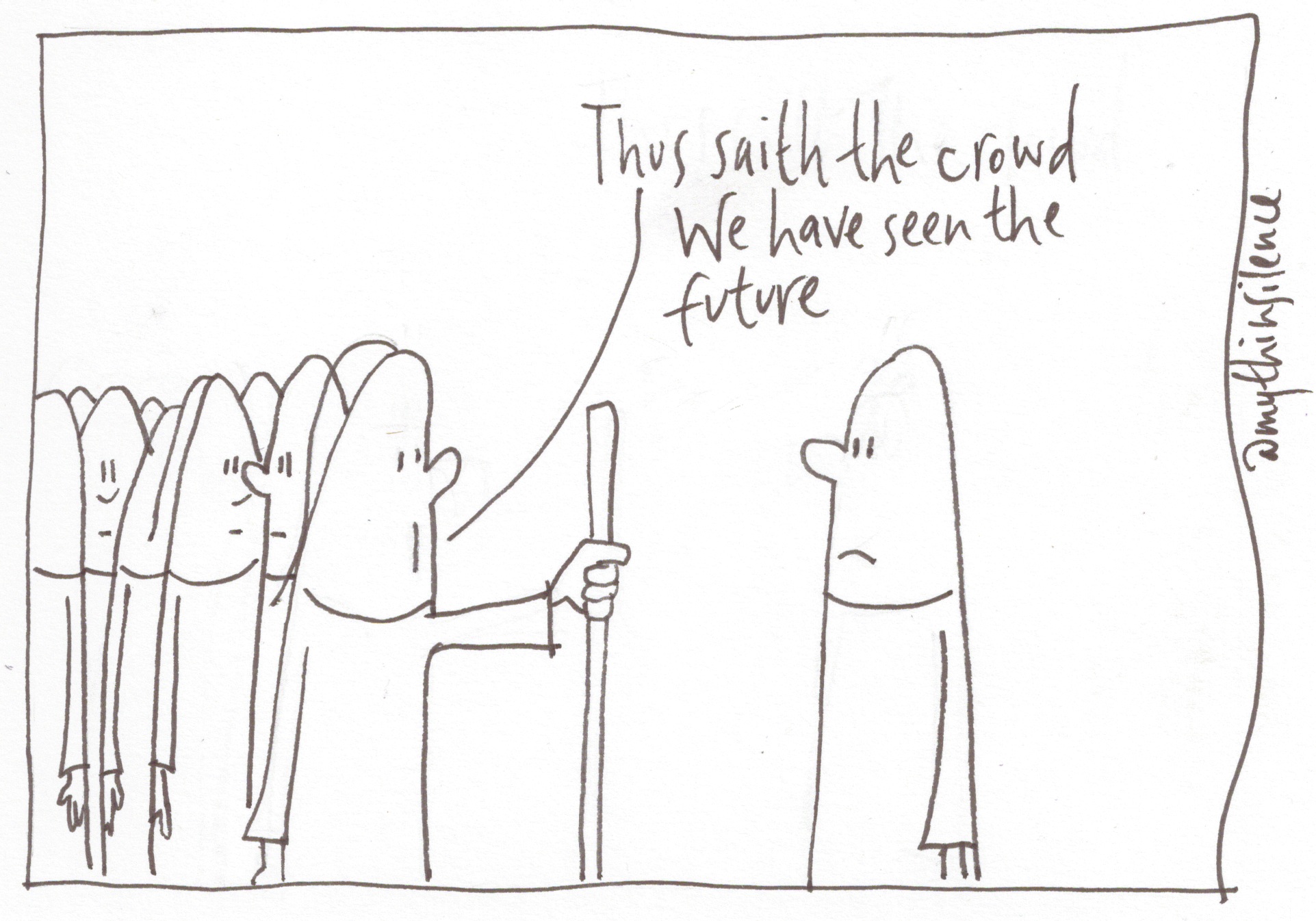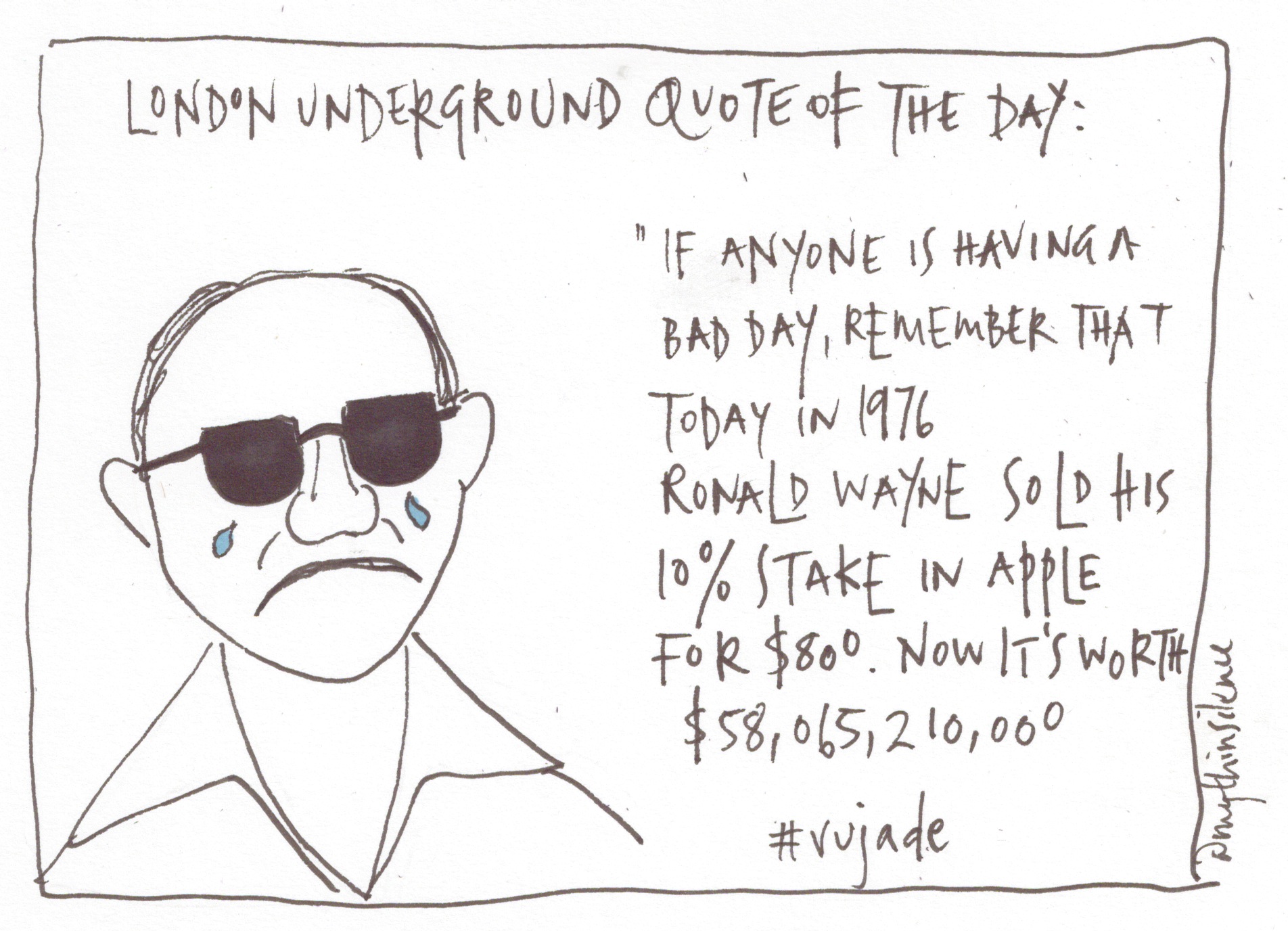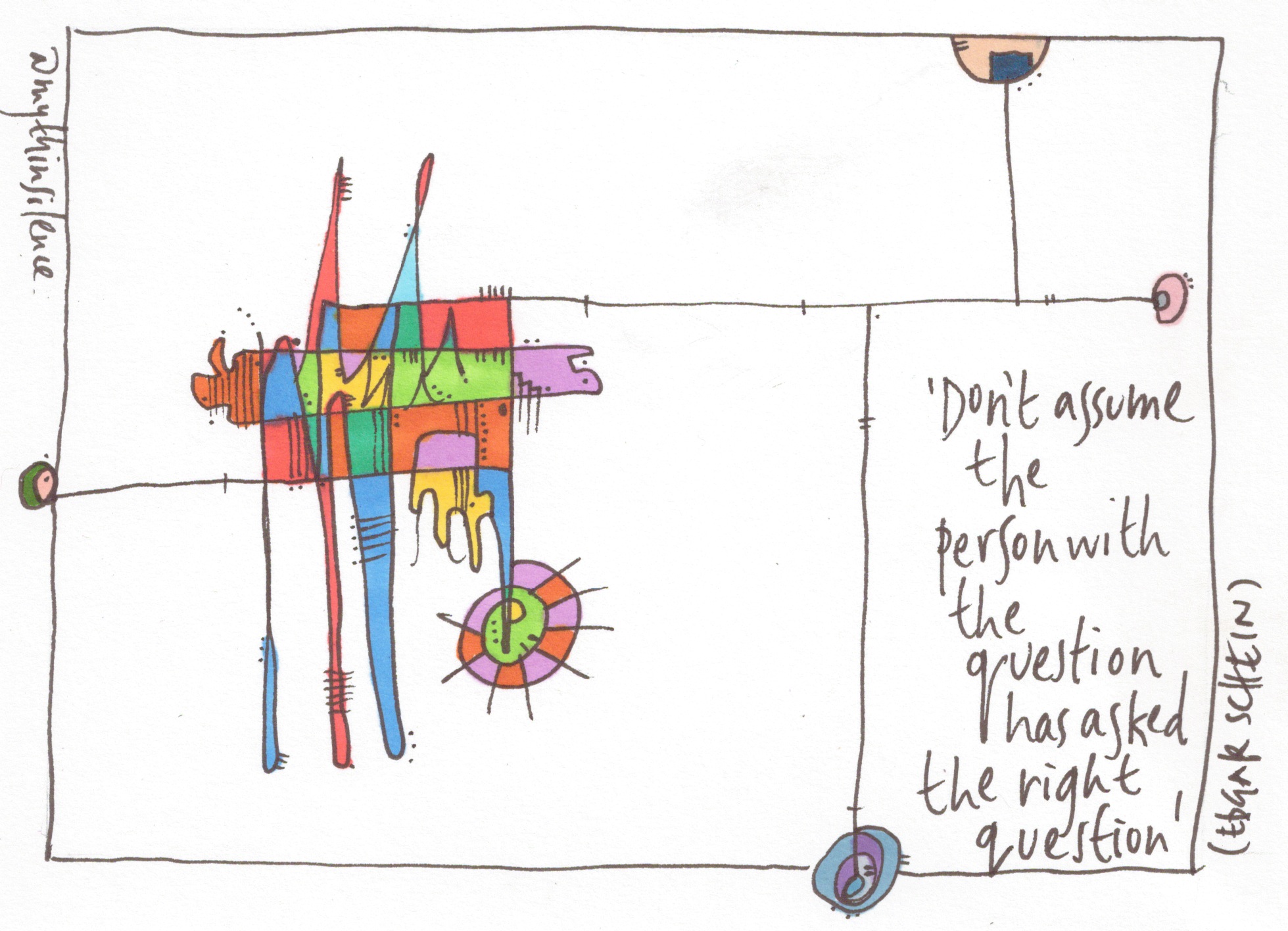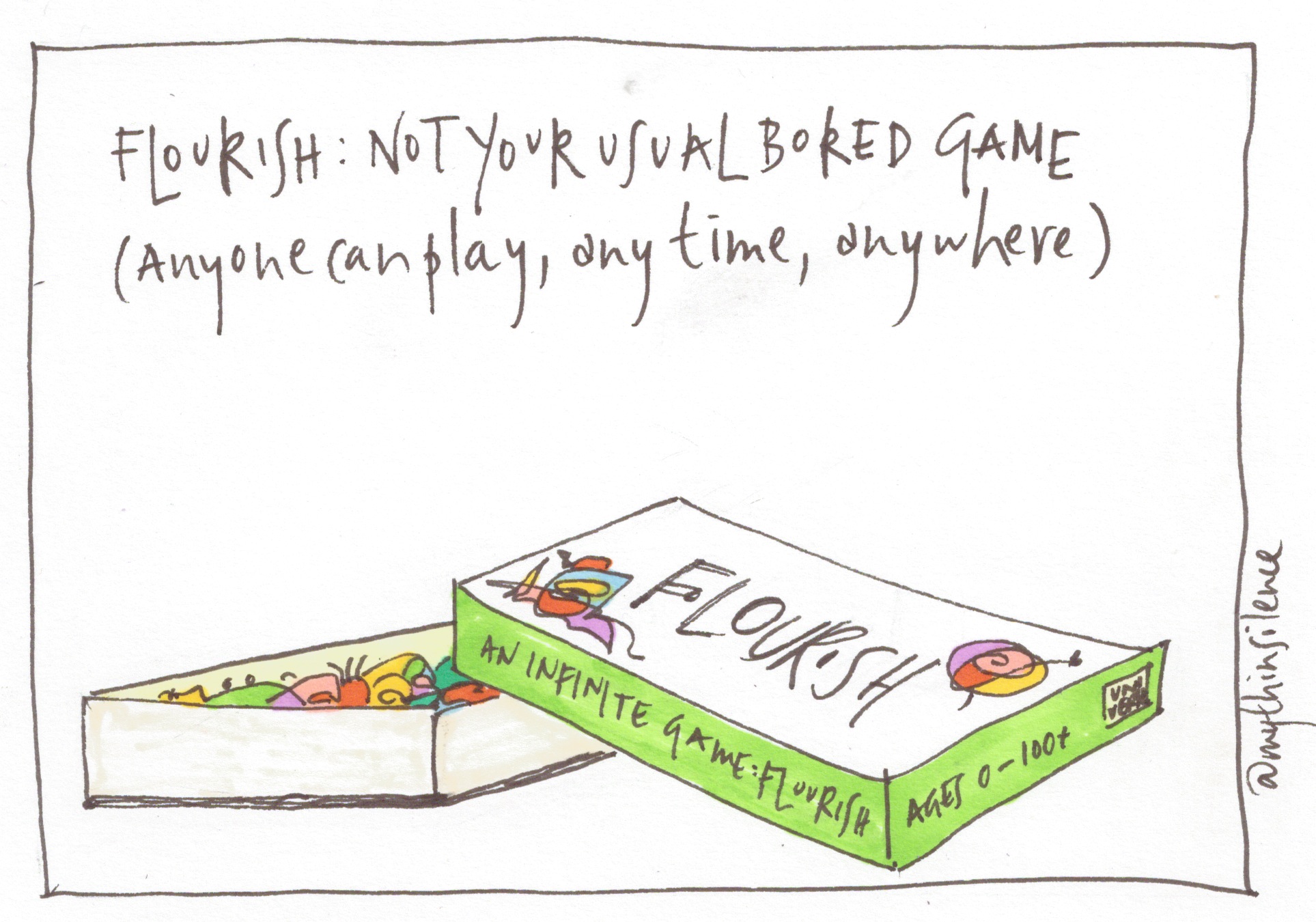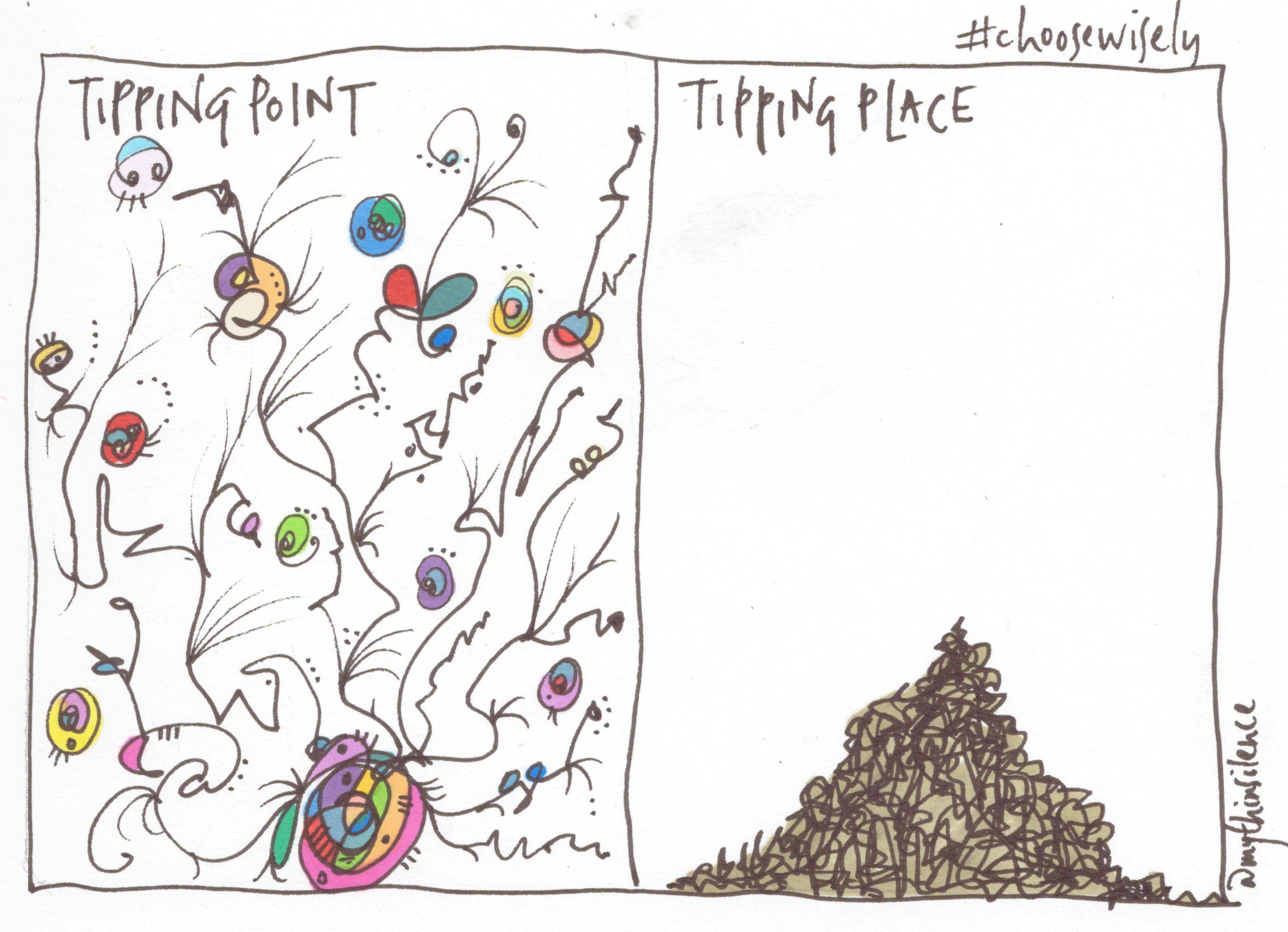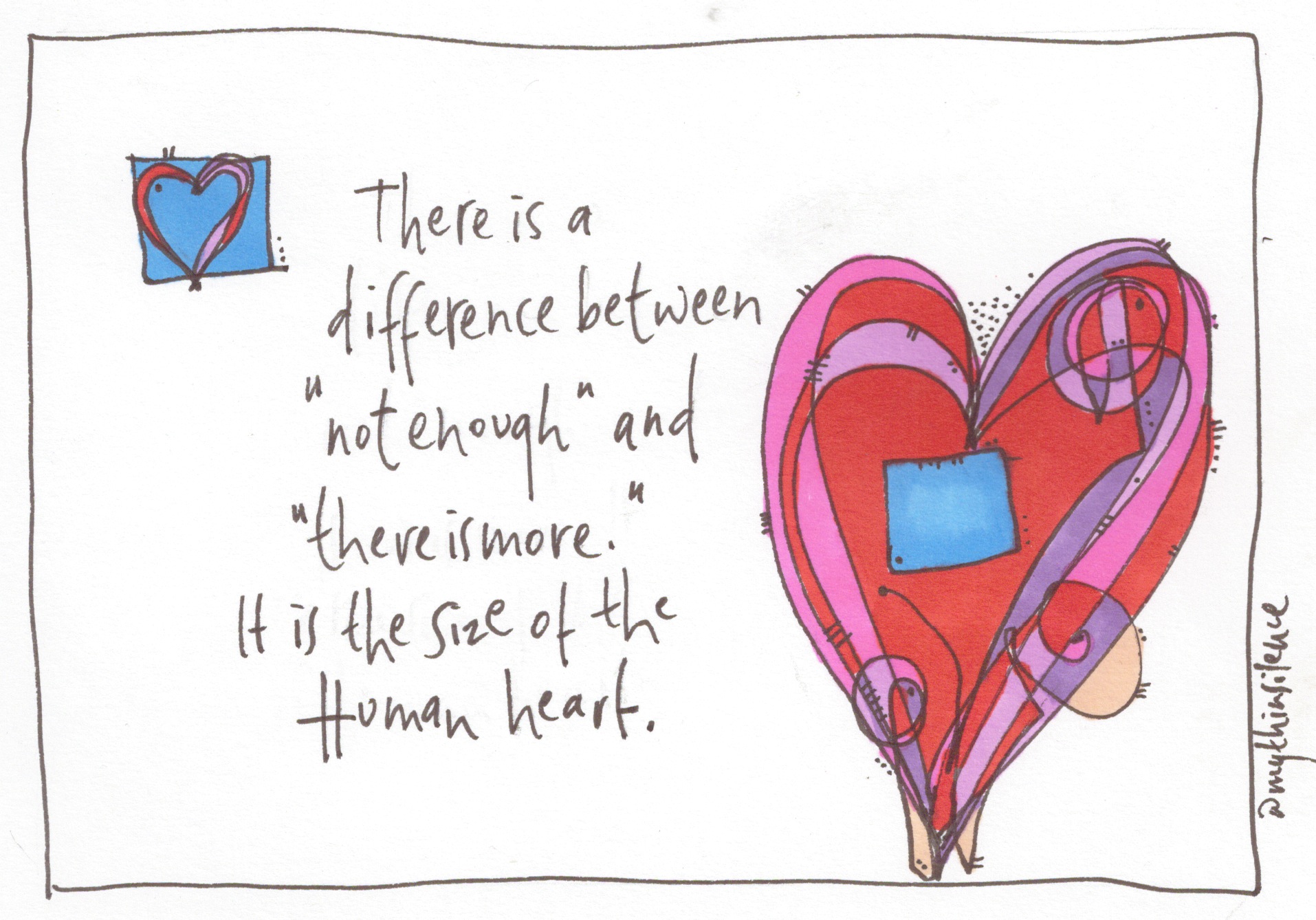
thin silences

7 thin silences

We want fire: setting our dry world ablaze.

We want earthquakes: dramatically shaking things up.

We want wind: blowing through the staleness of how things are.

7 thin silences 2

We can often miss gentle whisper, the thin silence, through which comes the question, “What must you do?”

Emerging futures appears in the thin silences between ideas and people and spaces.

7 thin silences 3

It requires we enter silent, empty places, and we fear these more than the wind, earthquake, and fire.

I’ve come to enjoy the silences most of all, though.  Each day I have to find time to listen deeply, and then bring into my day what I hear.  Wherever I am able I seek to bring silence to others, out of which some new activity emerges.

7 thin silences 4

Instead of looking for the next fire, earthquake, or wind, from someone or somewhere else, why not go to the thin silences?

Instead of waiting for fire, why not make some?  Instead of waiting for the earth to move, why not be the one who causes it to shift?

7 thin silences colour 2

In the thin silences, we find we’re more than capable.

Just a thought.

(Cartoon: The will develop in a number of images and be included in this blog.)


beyond shame

6 ain't no stopping

An unexplored country.

We grow when we move beyond our comfort zones: ‘our ability to grow is directly proportional to an ability to entertain the uncomfortable,’ writes Twyla Tharp.

Vulnerability is an expression of courage.

Shame holds us back.

‘If we want to be fully engaged, to be connected, we have to be vulnerable.  In order to be vulnerable, we need to develop resilience to shame.’*

The voices of shame speak loudly inside us as we seek to cross new borders and boundaries; there will be times when we have to open ourselves to new understanding, to realign our lives to the new and emerging, and to let go of things which are now redundant.  I guess we’ve all heard variations of these voices:

Who are you to think you could do this?
Why bother anyway; nothing changes.
Think about what you could lose if you do this?**

Self-worth is not to be found in our successes or failures: it’s dangerous to attach it to either.  The practices of humility, gratitude, and faithfulness lead to true self-worth, making it possible for changes to happen in us at a genetic level,^ producing an anti fragile, generative core comprised of integrity (different to perfection), wholeness different to completeness), and perseverance (different to certainty).^^

We keep going come success or failure:

‘A sense of worthiness inspires us to be vulnerable, share openly, and persevere.’*

(*From Brené Brown’s Daring Greatly.)
(**Brené Brown’s thinking links with Otto Scharmer’s voices of judgement, cynicism, and fear, we must overcome to make progress: see Theory U.)
(Check out David Shenk’s The Genius in All of Us, in which he describes our genes being like the slides and knobs of a mixer desk: ‘Rather than finished blueprints, genes – all twenty-two thousand of them – are more like volume knobs and switches.  Think of a giant control board in every cell of your body.’  These can be slightly changed by environmental input.)
(^^I’m throwing everything in here, including Nassim Taleb‘s antifragilista.)

[morethan]human

5 we are defined

My term for imagining what Humans might become.

Maybe it is the journey we find ourselves on: Human Becomings.

So different are we to our ancestors we appear not to be human anymore.

From being reactive creatures, we have developed abilities to respond.  We overcome and keep going – migrating over the earth, adapting to all climates and conditions, and now on the brink of populating the galaxy.

5 we are defined 2 1

More than responding, we are seeing how it is possible for every Human to initiate: to creatively act upon what we understand to be a universe of abundance.

The invitation and challenge of being part of this great Human adventure and story came to me again this morning.

I found myself pondering whether vulnerability is one of the greatest means by which we involve ourselves in becoming [morethan]human, enabling being open to and needing others.

The future Human is a more connected human.

Brené Brown admits ‘it never dawned on me that adults could love each other like that, that I could be loved for my vulnerabilities, not despite them.’*

I wonder where my default setting of “needing to do this on my own” comes from.  Why can’t the default setting be, “we do this together”?

Perhaps, as we’ve developed, we’ve only layered pride and shame over our basic survival instincts – feeling ourselves to be less than functioning as a woman or man ought.

5 we are defined 3

Perhaps we are leaving our more primitive instincts behind, our awareness and consciousness continuing to develop.  The tools we make are increasingly for  connecting.  Slowly we’re becoming a more connected species, even while there are always some who disconnect and seek to control others – a mutant form of connection?

This [morethan]human, connected future will increasingly be benevolent, forgiving, justice-seeking, boundary-crossing towards desiring every life to flourish

(*From Brené Brown’s Daring Greatly.)
(Cartoon: this will be shown in different forms as it develops.)


haecceity

4 if you see

Haecceity (/hɛkˈsiːɪti, hiːk-/; from the Latin haecceitas, which translates as “thisness”) is a term from medieval scholastic philosophy, first coined by Duns Scotus, which denotes the discrete qualities, properties or characteristics of a thing which make it a particular thing.

You are you very specifically, not generally – this is your youness or thisness.

Haecceity counteracts the ideologies which purport to have something better in mind for a society, culture, or nation.  A top-down “ology” struggles to recognise or arrive at the specific, the individual.  Whilst not without its issues, to see the one, allows us to see the many: we are holons and all are valued.

We’re always trying to make sense of the individual and the society because we are, at the same time, both.  There would be no society without individuals and there would be no individuals without a society in which to be nurtured.

Denis Wood differentiates between mapping and mapmaking as, the former is the passing on of information from person to person within a society, and the latter, the exploration of blank spaces with the goal of accruing and recording knowledge to be accessed by those who wish to use it.

Perhaps the first could be described as insiderism – passed on to a certain few, whilst the second has been described as colonialism – the making of maps in the image of the exploring society without reference to the mapping of those already within the area.

The first is passed on through experience, the second can be accessed, through limited cost and effort, via a book, a website, or a real map.

Perhaps there are problems and dangers to both.  The experiential method of mapping is time-consuming – sometimes taking a lifetime, whilst the industrialised mapmaking can use and abuse information without engagement with what is being represented:

‘It is this subsumed and amassed cultural capital that mapmaking societies bring to the task of making maps, not he patiently acquired mastery of this or that individual more or less carefully passed on – often in secret – through speech or gesture or inculcated habit.’*

Whilst it is possible access the information of a map and never visit the represented area, this is not the case when it comes to mapping.  You have to be there, you have to see the people and trees and rivers – to be aware of the thinness, and to appreciate how, ‘The principle here is to “go deep in any one place and you will meet all places.”‘**

So far, we’ve related mapmaking and mapping to societies, cultures, and nations, but we could be talking about our schools and universities, councils, religious organisations, councils, businesses, and families.

It isn’t a case of having to go either/or, but I think I prefer starting with thisness.

(*From Denis Wood’s The Power of Maps.)
(**From Richard Rohr’s Eager to Love.)


borderlands

3 we go to

The places between people and peoples: difficult and fascinating places.

They’re places of tension and complex culture, equally promising the worst and the best of what it is to be Human.

Here we find hope in vulnerability: a dance played out between people and peoples who inhabit a diversity of borderlands.

It is a dance because vulnerability requires mutuality if it is to be a positive experience.

It’s not me telling you everything about me and you not telling me anything about you.

When vulnerability is the dance of two people or peoples, mutually responding and initiating – depending on where the dance is going – the prize is worth it:

‘The result of this mutually respectful vulnerability is increased connection, trust, and engagement.’*

We might even go further than suggesting we dance with one another, to a perichoretic** exploration of dancing in one another: we enter into the stories and lives of others, allowing for something greater to emerge.

Here’s an interesting question from my friend Alex McManus: we know stories elicit cortisol and oxytocin – enabling us to feel empathy and focus – so, what if we could take these chemicals, knowing we’d become more connected and empathic as people – would we?

Of course, if stories produce these drugs, then, when we come together, our endeavours would be helped by creating a story together, one we believe in, and engage and commit to.

When vulnerability is expressed in the borderlands between people and peoples, we learn to move forward as a Human species, it is how we negotiate the chaos and randomness we find in the spaces in-between spaces.

And vulnerability, because it has to be mutual, brings grace with it.  Grace offered to one another so we can become all we each can become: holons and fractals.

(*From Brené Brown’s Daring Greatly.)
(**Meaning an intersection or interpenetration of lives: oneness.  Christians used this to explore how God might be three and one.)

examplar

2 show me - colour

Someone who doesn’t get in the way of their message or their product, but expresses it in their living and breathing.

I want to see what you’re telling me not only revealed in your words, but your passion and your risking.

2 show me

I want to see how you believe in this mission which is bigger than you.  I want to see this because the truth is I want to be involved in something which matters too.

To reveal – the revelation thing – might sound powerful: some beneficent offering of a favour from a mighty to a lesser being, but really it means one vulnerable Human turning up to another.

2 show me 2

Vulnerability, again.

I know this isn’t easy for you, but it’s more real for me now than it would have been without vulnerability.  I get how, in not hiding but being an example to me, your are putting yourself in a place of possible hurt, because this thing you do, really matters to you.

2 show me 3

‘To live is to be vulnerable.”*

(*Madeleine L’Engle, quoted in Brené Brown’s Daring Greatly.)

what’s the question again?

1 his punishment

The one vulnerability asks of us:

Are you committed to this?

Why do we talk about 110% or 200% commitment?

Probably because we haven’t fully committed: not yet.

Vulnerability is freeing and frightening at the same time.

It’s the ability to be wounded, so it’s no wonder Brené Brown found people she talked to about vulnerability were using the word naked a lot.

‘What’s worth doing even if I fail?’*

For almost forty years I’ve had to engage in public speaking.  I don’t think I’ve ever – really never-ever – walked away from one of these occasions thinking “I nailed it.”  The next time I come back and try another way; just yesterday, I tried another way for the first time.

Why do I keep doing this?

I don’t think it’s because I love public speaking.  I think it’s because of the message I’m trying to share – the thing which is worth failing at.

Twayla Tharp shares how discovering there are two states to life was a clarifying and liberating moment for her – this through the Greek words zoe (general and big picture) and bios (specific and detailed).  Both are vital ways of seeing life, but Tharp had been worried about her work being too distant – this helped her to see how there was a close-up factor for her too – The thing worth doing even if she fails? – though she’d always prefer zoe to bios.

What is it you value so much you’re willing to fail at it in order to pursue it?

For me, it’s to help people identify the adjacent possibilities for their lives: what they could do right now if they were to pursue their dreams, and to support them towards realising this in their art.

‘Could our lives be journeys in which we stumble on things of indescribable beauty?  Are we to be alert even to the most ordinary moments of our live for the possibilities”**

(*From Brené Brown’s Daring Greatly.)
(**Alex McManus in a short video he put together for a little event I’d arranged.)
(Cartoon: The quote comes from Jeanette Wintertson’s retelling of the Atlas myth: Weight.)


risk-full

30 riskfullness

When we step outside of the roles and the everyday norm, we see and understand there is more to us than we think.

When we step into the worlds of others and allow them to step into ours, we’re opening ourselves to a future which wants to emerge.

To open our minds to see and understand more.

To open our hearts and be present to others.

These have required our vulnerability and riskfullness.

We have been brought to something new we must commit ourselves to; something Otto Scharmer has critically named the “essential emergence” – an opportunity to live  beyond WYSIATI.*

A year ago, I saw such an experience offer itself to someone.**   She was excited at first, but she later realised this would ask her to risk something (perhaps what others thought of her, perhaps what she thought about herself).  She withdrew from the possibility.   All I have left is the note in my journal capturing her initial excitement.

Only a risk-full life increases the possibility of more.

(*What You See Is All There Is.)
(**I journaled this as I thought it important for this person at the time: a serendipitous moment.)

to risk more

29 another word

There are three contexts for risking more.

There’s the internal context, when we’re prepared to explore the deepest, uncharted areas of our lives.  We’ve called this severally: contemplation, meditation, reflection, mindfulness: as there’s a hiddenness to all growing things, we too have a hiddenness for why we are who we are and do what we do.

There’s the external context, where we’re prepared to connect with people, discover more about how the world and the universe works, engage in our work, and are prepared to commit to causes which are important to us.

Then there’s the deep source of emergence,* the possibility of new things happening in and through our internal and external worlds, especially including what we can be about together because of the deep connections we’ve been able to make with others – deep because we have brought a greater understanding of who we are which enable us to overcome the obstacles and barriers we experience to others.

To deepen and expand each of these contexts requires risk.  And the willingness to risk, Brené Brown argues, is only made possible by our vulnerability.

Daily, we live in our relationships and do the work we do – not knowing how we will fair – because of our willingness to be vulnerable.

To be vulnerable is to be an experiential, feeling Human.  We already are vulnerable, so what we are contemplating is the possibility of knowing and exercising vulnerability so we can expand and develop it more: towards the things we feel to be so very important in life – the pursuit and living of our values and beliefs.

If we hope for anything, vulnerability is involved.

Whilst vulnerability opens us to what we are most fearful of and want to avoid – and it will be its very nature – it also opens up all we desire and value:

‘Vulnerability is the birthplace of love, belonging, joy, courage, empathy, and creativity.  It is the source of hope, empathy, and authenticity.  If we want greater clarity and purpose or deeper and more meaningful spiritual lives, vulnerability is the path.’**

(*So named by Otto Scharmer in Theory U.)
(**From Brené Brown’s Daring Greatly.)

focal length

28 unfinished

As in the focal length of camera lenses as a way of  thinking about focal length in our lives.

Dancer and choreographer Twyla Tharp shares different examples of artist’s work: some have a panoramic view, some work in the distance – observing and observed, whilst others are close up.  Of photographer Ansel Adams, Tharp offers:

‘Earth and heaven in their most expansive form was how Adams saw the world.  It was his signature, and expression of his creative temperament.  It was his DNA.’*

This got me thinking.

I love when ideas from different people come together and open up possibilities, and these thoughts from Tharp appear to collide with Otto Scharmer‘s about how we need to be people opening our minds, our hearts, and our wills towards an emerging future.

Seeing the panoramic or bigger picture means opening our seeing and understanding to there being more; inhabiting the middle ground is about getting closer to see and hear and touch the details we cannot appreciate in the big vista (we see and feel, and are seen and felt); and, the up-close (macro?) is about involvement, commitment, delivery with no escape.

Two thoughts then.

All focal lengths are desirable for our lives: the big picture of more, the close enough to see and be seen, and the up close and engaged.

We’ll also have a favourite lens.  Our signature, as Tharp puts it.

(From Twyla Tharp’s The Creative Habit.)