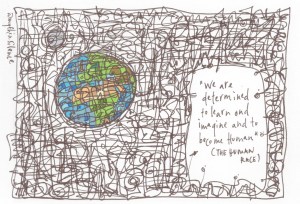
a small crack of nothingness

hold that thought

Here’s the full quote from Otto Scharmer:

‘Between these two movements, breathing in and breathing out, there is a small crack of nothingness.  That silent pause is the mystery at the bottom of the U.’*

This caught my attention when I read it last year because it sounds like the thin silence of something important which comes to us from beyond, the invisible we’re always exploring.

Breathing happens to us, but we can hold our breath.

Thinking also happens to us, but we can explore a thought.

When we breath in – think-in – the more of the universe, of the other, and what life means in us, and before we breathe out, there’s something which comes to us as the thing we MUST do.

There’s no rigid line between breathing in and breathing out, between thinking in and thinking out.  Instead, there’s an opportunity.**

(*From Otto Scharmer’s Theory U.  The “U” is the downward and upward journey of becoming more present to lifeL downward through opening our minds, our hearts, and our wills, and the upward through identifying what our purpose is, prototyping this, and then creating our art.)
(**Thanks to Seth Godin for the original quote from Whatcha Gonna Do With That Duck, which I’ve altered: ‘There’s no rigid line between job and art.  Instead, there’s an opportunity.’)
(Here’s a great little blog from Seth Godin to put alongside this.)

what’s your story?

a story of disccovery

Not your past story, or even your present story, but your future story.

You are the creator of your story: maybe eighty years and then the story closes.

These our our little stories, lived out within the great Human story – an incredible journey of discovery and invention – littered with failures and lit up with great triumphs.

One thing we know of the big story – mirrored or echoed in the little stories – is we’re made to explore and discover.  Paradoxically, the more we journey to discover, the more we belong.  We know and are known.

‘The very nature of the universe invites you to journey and discover it.’*

Here are some questions important for creating stories provided by Keith Yamashita:
How will the world be better off thanks to you having been on this earth?
What are your unique gifts and superpowers?
Who have you been when you’ve been at your best?
Who must you fearlessly become?**

It’s paradoxical, but the older we are the more there’s to discover about ourselves and the more we have to contribute.  You’d think we’d completely know ourselves by the time we get to 30, 40, 50, 60 (keep going) but the years have added experiences and skills and passions we do not fully understand or exercise yet.

In knowing these, we catch sight of what our future journey must be.

(*John O’Donohue in Eternal Echoes.)
(**Based on Keith Yamashita’s questions for finding purpose in Make Your Mark.)

destined to discover

photo-40

We never grow weary of discovery.  We want to know even when we do not know why.

“All men by nature desire to know,” Aristotle wrote.   John O”Donohue puts it sweetly when he offers: ‘This is the secret magic and danger of having a mind.  Even though your body is always bound to one place, your mind is a relentless voyager.’*

There’s always another journey, another discovery, and I feel this need to keep moving, not because I am not satisfied but because I am:

‘Knowing calls you out of yourself.  Discovery delights the heart.’*

There is something transfiguring in discovery.  When I know I am also known.  We share with each other our discoveries and we know each other better.

Who are the people of discovery who lead you into more, and who are those you leading?

Happy Discovery-mas.

Whatever these days contain for you, may they be rich and meaningful … and fun.

2014 design small

(From John O”Donohue’s Eternal Echoes.)


imperfections

24 good things

There are many voices speaking inside of our lives in an endless way.

There are the negative voices, critical of who we and what we are doing.  Otto Scharmer names these voices: judgement, cynicism, and fear.  Brené Brown names the voices: embarrassment, guilt, humiliation,and shame.

Who hasn’t heard one or all of these at some time?

There are also the positive voices, encouraging us on, telling us we are more than enough, urging us to begin because we can.

We can’t wait for everything to be good, or perfect, before me move, before we initiate.  A better way is to embrace one’s imperfections,* because these might be the very means by which the future comes to us, especially through our openness to the other: we can’t do this, but this person can; I feel disconnected from nature, but here is what the universe is teaching me; I cannot do this, but one day, in the not too distant future, I will be able to.

When muscle tears and mends, we don’t call it muscle failure, we talk about muscle-building, they become stronger.  When lives tear and mend, the same is true, they become stronger and more beautiful.

May your art become reality and live among us.

‘Iterate, iterate, iterate: create, adapt, and always be in dialogue with the universe.’**

(*The actual imperfections, not the wrongly perceived ones.)
(**Otto Scharmer in Theory U.)

triangles of fire

23 the triangle of fire

One triangle of fire comprises fuel, oxygen, and heat.

It provides us with a great metaphor for Human life: we are makers of fire.

Humans are the heat ignoring the fuel of artefacts – buildings, landscaping, institutions, businesses, paintings, music, ideas are fuel to makers of fire – with the available oxygen – culture-thinking, paradigms, philosophies, religions.

Infinite ways of mixing oxygen and fuel to innovate and make new fires.

We’ve developed making fires by controlling environments, removing the indeterminate and uncertainty.  Even so, things can go wrong – the electrical fire in a home, the failure of one small seal on a spacecraft.  Nassim Taleb would possibly name this state Mediocristan – risks are lower and more predictable.

The second triangle of fire comprises terrain, weather, and fuels, all of which, both on their own, and in combination, affect the fire.

This is more about the future, which doesn’t exist and so takes us out of what we know and controlled environments, into the random and nonlinear.  If Nassim Taleb calls the more controlled environments Mediocristan, he would name these Extremistan.

Makers of Fire have to take greater risks by the very nature of these environments, whilst also benefiting from discovering what might be,when Human futurity, spirituality, and creativity converge.

Different people bring different heat, produce different fire.  More than ever before in Human history, we each have the opportunity to identify the kind of heat we bring to the kinds of fuel and oxygen which fascinate us.

When we work together, though, we’re able to create fires which jump boundaries which have been able to resist us, and we create preferred future to benefit everyone.

‘A large proportion of your activity distracts you from remembering you are a guest of the universe, to whom one life has been given.’*

Make fire.

(*From John O’Donohue’s Eternal Echoes.)


balance or rhythm

22 hmmm

We can easily fall into the language of talking about work-life balance.  Perhaps rhythm is what we’re really looking for.

Balance – weights on scales, a moment of equilibrium, a trapeze artist tentatively edging forward on a high wire, ten minutes into a game of Jenga, columns of figures.

Rhythm – movement through seasons, poise and dance, music, tidal ebb and flow, flow of talents and passions.

Rhythms may contain moments of stillness, balance may always struggle with the wriggles of rhythm.

In his exploring of belonging, John O’Donohue suggests belonging is not about owning something – this belongs to me – rather, it’s about belonging with.  He suggests this is something we have lost: I’m trying to get my life back.  When we try to balance our lives, we’re really trying to recover our rhythm with life, including with ourselves, with others, with the world, and, if you have a god, then with your god:

‘When we are in rhythm with our own nature, things flow and balance naturally.’*

One place to begin, is to carefully listen to what your life is saying to you; try writing out: your values, the things you notice most of all in the world, your talents, times when you’ve felt yourself energised, times when you have felt yourself severely de-energised, which experiences of your life have been most directing for you, how do you relate to others, how do you relate to quietness, do you have to talk things out or carry on a conversation in your head.  You’ll find a lot of clues in these telling you about your future possibilities and how to live them in rhythm.

‘Connect to the future that stays in need of you – crystallise your vision and intent.’**

(*From John O’Donohue’s Eternal Echoes.)
(**Otto Scharmer in Theory U.)


longing and be-longing

21 our hunger

Within each of us, there is a deep longing and yearning to wonder, explore, and discover, and there is also a need to be-long.

These are like the inward and outward movements of a circle dance: into the centre and then out towards the extremities.

‘There is a constant and vital tension between longing and belonging.  Without the shelter of belonging, our longings lack direction and focus.’*

Brené Brown describes a condition I know I have, which she names foreboding joy.

It’s the feeling when things are going well, something bad is going to happen, so I live with the expectation this joy won’t last and begin to brace myself, so the joy is lost even more quickly.  If not dealt with, it can be a chronic pain in the background to all I do.

For some time now, my remedy has been to express gratitude (and humility) at the beginning of the day: to recognise what I have and who I am and how this is enough.  These take me to the joy of what is, and away from the concern of what may never be.

Brown describes some surprising results of research undertaken into foreboding joy:

‘Participants described happiness as an emotion that’s connected to circumstances, and they described joy as a spiritual way of engaging with the world that’s connected to practicing gratitude.’**

As I contemplate this, I wonder how much my sense of foreboding comes from “old lizard brain” trying to cope with an ever complex world, whilst gratitude takes me to the place of higher Human thinking.^

Whatever we perceive to be more risky – watching Bear Grylls on TV undertaking one of his adventures, or being with him on an adventure – is where we’ll experience foreboding and we’ll hold back.  My guess is, it’ll be the outward movement which provides the greatest consternation for us, moving away from the comfortable to the unknown.  Gratitude, and humility, allows us to know we have enough and we are enough and can respond to the call to adventure, crossing the thresholds, following the path of many trials, triumphing in the great encounter, and returning with the gift.^^

(*From John O’Donohue’s Eternal Echoes.) 
(**From Brené Brown’s Daring Greatly.)
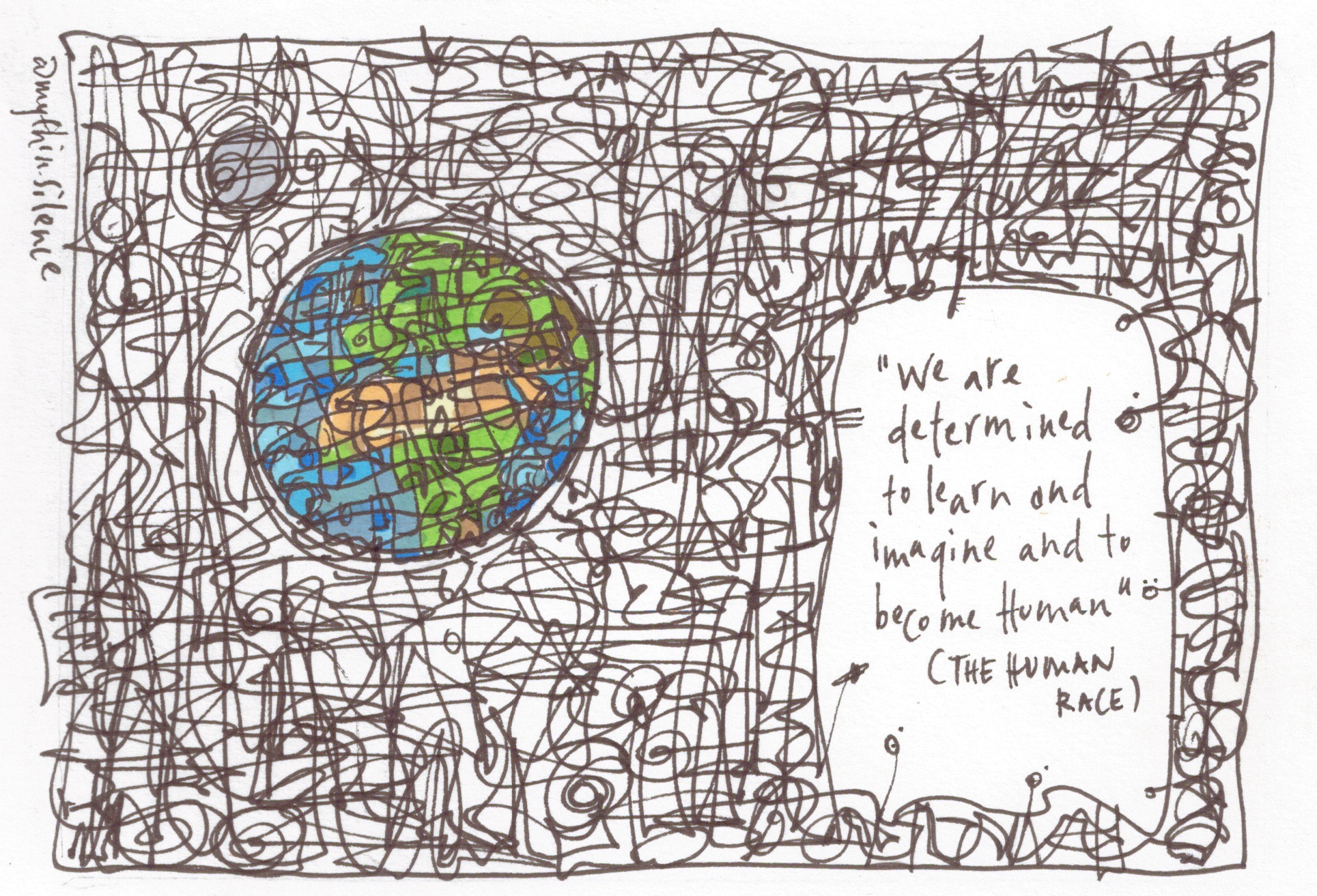
(^A tangental offering from Sunni Brown suggests this doodling exercise: on a sheet of paper, doodle an unbroken line, creating enclosed spaces for just ten seconds – my first stage of today’s cartoon does just this – see below, though, as I write, I haven’t yet doodled it – and colour in the spaces.  What you have done, Brown says, is released glucose and oxygen-rich blood into the visual and imaginative parts of the brain – The Doodle Revolution.)
(^^This may seem dramatic but tells the way of the classic hero, identified in everything from the myths of yore through to the present-day movie.  Whilst we may not think of ourselves as heroes on our own, we can we heroes with others – heroic companies.)

21 one continuous line

phenomenal

20 oxygen

The Human ability to change and learn and grow, to sense and initiate, the fail and begin over, is nothing short of phenomenal.

We are unlike any other species.  As I ponder these things, Smudge lies on my lap, and whilst we’ll train him to do a number of things which will suit him, he won’t develop and grow over time in the same way a Human is able to.  He’s surrounded by books, images, a computer, pens and paper but he’s never once been interested in them apart from bopping them about as a play thing.  He can be surrounded by these for the rest of his life and the same will be true every day.

smudge

I’m being fascinated by Stephen Pyne’s exploration of fire and am wondering at how important the ability to start, contain, and utilise fire has been to our development as a species.

If we could not make fire, would we have migrated across so much of the planet, or be largely fruiterian in diet, or developed so many of our skills, or would the most valued members of society be those who maintained communal fires, made possible by natural fires and carried back to the dwelling areas.

Or was it inevitable we would capture and understand fire to the extent we use it now: think about our phones, cars, TVs, food, space travel, books, computers, home-building – at different points in their existence fire is necessary.  Fire is hugely important to us:

‘Yet ultimately the relationship is deeply unequal.  Remove fire, and humanity will soon wither away.  Remove people, and fire will adapt and establish its own stable regime.’*

Yet, with ingenuity, we are makers of fire.

This is true individually, but we are especially clever in our cooperation, making it possible for even more elaborate forms of fire and products from fire to be produced.

Here’s a metaphor for the potency of our lives.

As I’ve mentioned elsewhere, fire is dependent on three elements: fuel, oxygen, and heat.  Fuel and oxygen, whilst highly combustible, will not normally spontaneously catch fire; they require the introduction of heat to ignite – stones falling against each other and sparking, lightening, or lava.

You and your community brings the heat to the fuel of the artefacts you find around you and the oxygen of ways of thinking and world views.*

The kind of heat we are depends on what we are passionate about, our skills, and our life experiences, but that we are makers of fire is not in doubt.

The first sentence is really about you: your ability to change and learn and grow, to sense and initiate, the fail and begin over, is nothing short of phenomenal.

(*From Stephen Pyne’s Fire.)
(**My friend Alex McManus has written about this in his own saga of fire: Makers of Fire.)

the hero’s journey (revisited)

19 sometimes

Because once you’ve made the journey it has to be repeated.

Things happen when you’re prepared to journey into what is not visible or does not yet exist.  The journey of exploring your art and the things you do, whether physically, intellectually, or relationally, are game changers: they bring heat to the oxygen and fuel you find on the way, and create fire.

(Guaranteed: nothing happens if you stay where you are.)

‘Courage comes from willingness to “die,” to go forth into an unknown territory that begins to manifest itself only after you dare to step into that void.’*

There is a general trajectory to this journey and there is a specific one.

The general trajectory is our knowledge of  how the giving of self for others is the Human story at its best.

The specific trajectory is there being a way only you can live this journey.

We need both.  Identifying one does not release us from the other; they need to exist in tension, keeping us on track.

Of course, reality can feel quite different.

We want to protect ourselves from things like voids and deaths. Brené Brown writes about our personal vulnerability armouries, which we’ve built up from our tween years.  Yet, when we protect ourselves from risks and failures, we’re also removing ourselves from being successful and flourishing with our art.

But we have ENOUGH to make the journey:**  We only have to figure out new ways of expressing all of this:

“The illiterate of the 21st century will no be those who cannot read or write, but those who cannot LEARN, UNLEARN, and RELEARN.”^

There needs to be a revolution of ENOUGH.  I suspect the people taking the lead are those who, having made the hero’s journey, figure out how to make it again and again: Transformed people transform people.’^^

(*From Otto Scharmer’s Theory U.)
(**I like Brené Brown’s opposite to scarcity: enough!  Abundance is everyone having enough; we only need to have enough to use – and we find we keep getting enough.)
(^Alvin Toffler, quoted in Sunni Brown’s The Doodle Revolution.)
(^^From Richard Rohr’s Eager to Love.)

transfiguration

18 she who dares 3
transfiguration
ˌtransfɪɡəˈreɪʃ(ə)n,ˌtrɑːns-,-ɡjʊr-,-nz-/
noun
  1. a complete change of form or appearance into a more beautiful or spiritual state.
    “in this light the junk undergoes a transfiguration; it shines”

18 she who dares

Can we say this is what can happen to someone when they dare to listen to what their life is calling them to do with their passions, skills, and experiences, and when they dare open themselves to others in order to make this happen?

she who dares 2

This is not about imagining more than we can be, and it’s certainly not about imagining less – though less is where many people find themselves.

The most courageous journey a person takes can be the one which recognises, develops, and delivers who they are to those around with whom they connect.  It’s courageous because it requires vulnerability – “If this is who I really am and this is what I can do, what if I’m misunderstood and criticised when I offer it?”

I have worked with hundreds of people on exploring their talents and passions.  Some have been “transfigured” by their journey.  My hope always is this will be what each person gets to experience; it ought to be a commonplace experience.

One thing I’ve noticed, transformation rarely takes place without others.  There’s huge need for transformational and transfiguring communities, companies, and tribes to be established, which can mean beginning with one other for sharing journeys.

Why not begin one if you can’t find one?

‘Co-initiate a diverse core group that inspires a common intention.’*

(From Otto Scharmer’s Theory U.)
(Cartoon: this will slowly develop and be included in the text.)