this slow dawn is mine

22 what if we could be 1

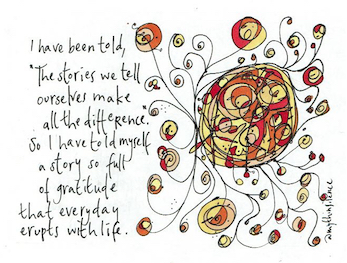
This morning I watched the dawn.  The promise of a new day lit up the few clouds with orange and salmon-pink.

I am grateful for this gift of beauty, feeling as if it was meant for me alone.

Timely, then, that I should be reading these words from poet Walt Whitman:

“Dazzling and tremendous how quickly the sunrise would kill me, if I could not now and always send sunrise out of me.”*

Whitman spoke of the two phases of the artist’s labour as sympathy and pride: breathing in and breathing out.  The poet inhales, being sympathetic to the dawn, but then must exhale, if he is to live.  Asserting himself, then, he shares himself with others – the poet’s pride.

With gratitude, we receive our gift of this dawn, this new day, and find we cannot hold it within ourselves, we cannot hold our breath.  We must exhale, offer something out, and this something is different to what we inhaled.  We have made more of it, we have generated something new.

I thought the dawn would soon be over and give way to the day, but it continued for most of an hour.  Perhaps at this time of year the dawns are slow.  And then, oh my.

The brightest white light completed this beginning.

So I am wondering.  Do those who awaken more slowly to what they are able to give out to others bring the brightest light?

(*Walt Whitman, quoted in Lewis Hyde’s The Gift.)

santiago swallow

21 presence

You can follow Santiago Swallow on Twitter.  He has over 8,000 followers and has posted more than 900 tweets.

The main thing you need to know about Santiago is that he doesn’t exist: he’s a social experiment.  At his height he had tens of thousands of followers when Kevin Ashton wrote a glowing article about him, but:

‘As a social experiment, Ashton had created Swallow’s profile a mere three days before, purchased thousands of fake Twitter followers for him and set up a fake WordPress account behind all of it.  The total investment for all these efforts came to a grand total of $68 and two hours of set up time.’*

Santiago Swallow’s complete fabrication presents a quick and cheap possibility for creating our own online personas.

However, real life is far more compelling.

Cheryl Song’s fingerprint art also caught my attention this morning.  The fingerprint is made up of the names of writers and their writings.**  Which made me wonder: what if we each were able to identify the different influences, influencers, values, talents, passions we could create our own unique fingerprint to impress upon the world and leave behind as our legacy.

21 fingerprint

Our persona doesn’t happen in two hours and photoshop but in thousands of hours of unique exploration of life in all its fullness:

‘Read, look to other areas, use different learning mediums, ask better questions, reflect, reopen to ideas, be surrounded by learners, and prioritise learning.^

(*From Rohit Bhargava’s Non-Obvious.  Bhargava tells this story as an example of a trend he predicted for 2015 and named Experimedia; ‘Content creators use social experiments and real life interactions to study human behaviour in unique new ways and build more realistic and entertaining narratives.’)
(**From Laura Damon-Moore and Erinn Batykefer’s The Artist’s Library.)
(^From Michael Heppell’s The Edge.)

fanciful?

20 the initator

“The idea of … is a simple one.  It will be a place for people to find happiness and knowledge.  It will be a place for parents and children to share pleasant times in one another’s company: a place for teachers and pupils to discover greater ways of understanding and education. Here the older generation can recapture the nostalgia of days gone by, and the younger generation can savour the challenge of the future.”*

Fanciful?

I left out one word: Disneyland.  This is Walt Disney’s 1953 pitch to potential financial backers for his first theme park.

Disney’s dream includes a picture or story of what would happen in this park.  Behind it lay his own dissatisfaction with existing amusement parks which lacked a coherent story.

On reading this, I found myself reflecting on my own dissatisfaction with the dearth of opportunities people have to connect to and pursue what really matters to them and that can make a difference to others.

My dream is a simple one.  It is for there to be a place where people can come to know their deep creativity and how much they have to give.  It will be a place for anyone, regardless of their past or background or identity has another opportunity to shape an opening and deepening life which embraces both themselves and others.

Creativity, generosity, enjoyment.

Fanciful?

“I just thought, in order to make a difference, something needed to be done.  I wanted to have an impact.  I wanted to create something substantially better than what came before.”**

(*Walt Disney, quoted in Joseph Pine and James Gilmore’s The Experience Economy.)
(**Elon Musk, quoted in Peter Diamandis and Steven Kotler’s Bold.)

no straight lines

19 life has no straight lines 100

‘Many see a supposedly good thing but still in an old way, which is to say, with their old self, from the egoic position of self-advantage and self-importance’*

We have to see new things in new ways, especially the gifts which come to us.  The awakening of the gift depends on it – what it is we must do with our lives.  So too awakening to the gift – aligning our lives to this purpose, remembering that the gift asks us to grow up and be worthy of it.

This alignment, or new way of seeing, will find us exploring unknown limits.  We’re on a journey forwards, sometimes with maps, always with the compass provided by the gift.  Seth Godin names this movement forward zooming:

‘Zooming is about stretching your limits without it threatening your foundations.  It’s about handling new ideas, new opportunities and new challenges without triggering the change-avoidance reflex.  You already zoom everyday … doing the same things as usual only different.’

Zooming doesn’t mean straight lines.  Moving forward what we love to do, even when we align our lives with the gift, still doesn’t mean straight lines. We’ll always be paradoxical creatures, living in a paradoxical world.  Write Daniel Wilson has his sentient humanoid Nine Oh Two speaks these words:

‘Peering down at the straight lines of my legs, I contemplate their machined perfection.  Nature does not create straight lines.  Only men do that.  All around me are fractal spirals hidden in the patterns of leaves, the wirl of falling snow, and even the placement of the debris on the ground.  I have names for the patterns I see in nature: Natural distribution.  Beta.  Gamma.  Poisson.  Divichlet.’**

And with it,almost infinite variation and possibility.

(*From Richard Rohr’s Eager to Love.)
(**From Daniel Wilson’s Robogenesis.  This reflection caught my attention because the phrase no straight lines describes many things to me and I purposefully avoid straight lines in my doodles.)

hidden and unknown

18 everyone should do a little digging

There’s something hidden and unknown in your life.  Some treasure, which, when uncovered, will delight you and those with whom you share it – some way of thinking, relating, or behaving – something you hadn’t recognised before.

A second thing.  You can buy a Mood Meter app as “a gift of self-awareness to yourself, and to others.”  The app promises that using it will help build emotional intelligence.

Our moods and emotions can also be hidden and unknown to us.  We usually focus on what’s happening to us and what our thinking, and ignore what we’re feeling.  But feeling energy and excitement assists us in uncovering the hidden treasures in our lives.  What de-energises or feels negative (e.g., sadness, helplessness, guilt, anger, disappointment, criticism, etc.) helps us to act: is this something to give up, or do we need to learn more hard or soft skills, or is this something to pass on, or do I need to embrace the feeling?

The third thing that can be described as hidden and unknown is found in the questions: What kind of mood do I put others in?

To uncover these things makes it possible for us to do three things which are important to living our life as fully as we can:

Suspending the old ways of seeing and understanding;
Diving deeply into what we are uncovering and knowing; and,
Letting go of what hinders and to taking hold of what now matters to us.

Repeat.

i am not me

17 because i can change

I am not one person, I am many.

I am not who I was twenty, ten, or even three years ago, and I am not who I will be in ten years or twenty years time.  I am many different people held together by a narrative arc or story.

Again, my life has been, and is being, shaped by the lives of many others: I sat and named many of them this morning.

I seem to be acknowledging this more and more most, and am opening myself to what others bring to me.  I am becoming more connected: perhaps I am becoming we.

Some of the people I brought to mind at the beginning of the day made and make small changes in me, and some made and make large changes.

All of this makes it possible for me to follow Seth Godin’s advice when it come to what we each must do:

‘Don’t wait for it.  Pick yourself.  Teach yourself.’*

It also means I make myself available to esemplastic communities so we might create even more with and through one another.

And because of this, because I am not who I was yesterday, and there are many helping me, and because we can create together, I have hope.

(*From Seth Godin’s Whatcha Gonna Do With That Duck?)

esemplastic

16 may the most hopeful futures

A new word on me, but one I like when I look up what it means: the coming together of diverse elements and/or ideas into an uncanny and unconscious oneness.*

This slightly longer post is about esemplastic communities and tribes, achieving together in uncanny ways for good towards a future always whispering to us.

Brian Hall got me thinking.  He does all his creative writing in libraries, bringing together many disparate observations and texts collected in these spaces:

“We – libraries and I – are allies, working together for the creative good.”**

Following Hall’s story of esemplasticity, Laura Damon-Moore and Erinn Batykefer offer this artistic practice:

‘Wander the shelves and find some fiction or nonfiction and at least one art compendium.  Leaf through until you light upon something that strikes you in each book – a quote or an image, for example.  Place these ideas in the context of your earlier sketches and conversation gathering.    Consider how they all might be part of a single story – how do they fit together to reveal someone’s character or drive the plot forward.’^

Furthermore (a word I like a lot because it’s made up of further and more), esemplasticism promises the deepest expression of unconscious collaboration.

“In art the self becomes self-forgetful.”^^

If we begin to think about what we are doing and how we do it and where it comes from and how it compares with someone else’s contribution, the we’re becoming self-conscious, and we lose the flow of our gift or art or must.  This in turn disrupts and compromises the esemplastic quality of the whole.  Here’s a longer quote from Lewis Hyde’s description of the gift understood in this way:

‘The moral is this: the gift is lost in self-consciousness.  To count, measure, reckon value, or seek the cause of a thing, is to step outside the circle, to cease being ‘all of a piece’ with the flow of gifts and become, instead, one part of the whole reflecting upon another part.  We participate in the esemplastic power of a gift by way of a particular kind of unconsciousness, then: unanalytic, undialetical consciousness.*^

We need the creativity esemplastic imagination offers.

Just this morning, listening to a BBC Radio 5 interview with Lord Carlile, I heard the Liberal Democrat peer speak about exterminating and destroying Islamic State, and whilst believing civilian casualties will be limited by precision bombing, also said, in the end, those who begin wars, as Islamic State have, bring casualties upon those around them.  Which sounds like more of a solution which has only helped to create the world we find ourselves in.  I could only think we need more imaginative possibilities.

Becoming less self-conscious, as Hyde describes, moves us deeper into empathic listening, learning, identifying and collaborating on ‘projects worth working on together.’^*  Otto Scharmer terms this as a movement to “I-in-Now,” moving us from ego to eco.  We move the other way when we become more self-conscious, towards the surface of things, towards “I-in-Me, and, therefore, from eco to ego.”⁺

‘Among the things that distinguish our species from others is our combination of idealism and artistry – our desire to both improve the world and to provide that world with something it didn’t know it was missing.’⁺⁺

(*I borrow the phrase uncanny encounters from my friend Charlotte Bosseaux’s Dubbing, Film and Performance – elements we we do expect to find together.)
(**Brian Hall, quoted in Laura Damon-Moore and Erinn Batykefer’s The Artist’s Library.
)
(^Laura Damon-Moore and Erinn Batykefer’s The Artist’s Library.)
(^^Flannery O’Connor, quoted in Lewis Hyde’s The Gift.)
(*^From Lewis Hyde’s The Gift.)
(^*From Seth Godin’s Whatcha Gonna Do With That Duck?)
(⁺From Otto Scharmer’s Theory U; the levels of deeper listening and presencing are: I-in-Me, I-in-It, I-in-You, and, I-in-Now.)
(⁺⁺From Daniel Pink’s To Sell is Human.)

imagine that

15 when we vallue imagination

What if our “mission” as Humans is to make all things thrive.

Imagine that.

Imagination carries us to new places and experiences and people – even into the 96% of the universe we still don’t know- and what if we don’t know how much we don’t know?

Here’s what space scientist Monica Grady was saying on the radio just this morning:

“We are very small people with, you know, our imaginations are sometimes not broad enough.  We really need to think beyond the boundaries of our own country, of our own earth, and look beyond. … People who get a glimpse of the night sky … and see the stars … there’s so much mystery and mythology and stories  you can weave about the stars.’*

What if the universe is the original Star Trek-like holodeck, waiting for us to create the best stories we can?

Some of our stories make it possible for all flora and fauna to thrive.  

At the other end of the stories-spectrum, there’re are narratives which only spoil and destroy.

‘We need to be alive to stay alive.’**

And imagination makes this possible.  Capable of continually exploring and learning forward, connecting and empathising creatively as homo connecticus, prototyping a better world.

But we can also close our minds, and, disconnecting from others, producing destructive stories which offer bleak, dystopian futures.

Every day, each of us has opportunity to use our imaginations in a positive and hopeful way:

‘The imagination has the power to assemble the elements of our experience into coherent, lively wholes: it has a gift.’^

We imagine ourselves forward.  Imagination creating stories creating imagination.

Towards a better future.

Imagine that.

(*From BBC2’s Good Morning Sunday.)
(**From Peter Diamandis and Steven Kotler’s Bold.  Studies have shown that people who retire at 55 are 98% more likely to die in the following ten years than people who retire at 65.)

(^From Lewis Hyde’s The Gift.)

much more than this

14 we are more than this

You’re more than your thoughts, more than what’s going on in your head.

When you’re more present to the intelligence of your heart and gut, you are listening to what your life is trying to tell you.

You’re more than the sum of your parts, more than your thoughts + feelings + skills +  experiences + values + passions.

What your life is, is a gift, and gifts are alive, spiritual, and social.

You’re more than a story you want to live on or have noticed by those you influence.  There’s some difference for good you can make.

You’re more than who you are in this moment, and must resist avoiding or neglecting what you can do.  When you leave the status quo, when you try something, when you act, you become more your future Self – and so do I, and so do we:

‘When who we are and what we do are one and the same, we are walking the road of Must.  When we choose Must, what we create is ourselves.’*

On a day when we’re following what happened in Paris last night,** we remember how we are much more than this – we’re determined to become more Human.

(*From Elle Luna’s The Crossroads of Should and Must.)
(**As I write this, it’s believed there are 128 dead and more than 200 injured because of the terrorist attacks in Paris.)

living present

13 sometimes our superpowers

Staying alert to the future wanting to emerge through you.

Here are three questions:

What is my courage? (Who I am thinking of when I am most selfless and thinking of others?)
What is my generosity?  (What is it I want to give most of all to these others?)
What is my wisdom?  (The difference I hope to make?)

Here are three practices:

Wake up with your emerging future – some reflective practice – like journaling or mindfulness or prayer.
Stay connected throughout the day with the deep intention of your life – working on ways of remembering (such as the questions, above).
Sense and take hold of possibilities when they come your way.

As for me, a year ago I’d journaled my deep concern to somehow help release people into their futures, how the world is going without because people aren’t bringing their “art,” their “superpowers,” into the world.