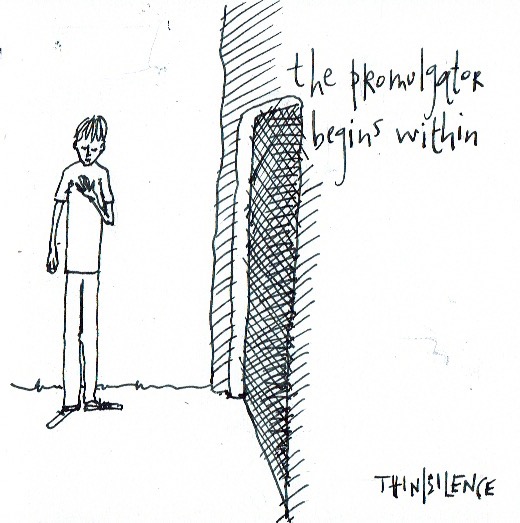
Beyond stuff

“Live the questions now.”*
(Rainer Maria Rilke)

‘So what don’t we have enough of?

Short answer: Mattering.  Making a difference.  Doing something important.’**
(Hugh Macleod)

The industrial revolutions have been very good at providing us with stuff, more than enough stuff.  Human life has benefited in many ways but not in all ways.  We find we still need to add more.  Otherwise we sleepwalk through consumerist answers being directed at us every day, but we can be awakened by our questions about meaning and “mattering.”  Keri Smith writes:

‘A consumerist system creates a belief in the “scarcity within,” the belief that we need material goods to invoke the imagination, that we are incapable of constructing our own lives out of whatever we have at our disposal, that only others can provide us with the things needed to live.’^

Joseph Campbell offers this:

‘Privation and suffering alone can open the mind to all that is hidden from others.’^^

Beyond all the stuff and its answers, there’re the questions that promise to engage us in a fully awakened life:

‘[T]echnology is not going save us.  Our computers, our tools, our machines are not enough.  We have to rely on our intuition, our true being.’^^

(*Rainer Maria Rilke, quoted in the Northumbria Community’s Morning Prayer.)
(**From gapingvoid’s blog: Our infinite need to be meaningful.)
(^From Keri Smith’s The Wander Society.)
(^^From Joseph Campbell and Bill Moyers’ The Power of Myth.)

Less hiding and more revealing

‘Yes, we frequently sell ourselves too short.  We don’t ask for compensation commensurate with the value we create. It’s a form of hiding. But the most common form of this hiding is not merely lowering the price. No, the mistake we make is in not telling stories that create more value, in not doing the hard work of building something unique and worth seeking out.’*
(Seth Godin)

“Each one of us is the custodian of an inner world that we carry around with us.  Now, other people can glimpse it from [its outer expressions].  But no one but you knows what your inner world is actually like, and no one can force you to reveal it until you actually tell them about it.  That’s the whole mystery of writing and language and expression — that when you do say it, what others hear and what you intend and know are often totally different kinds of things.”**
(John O’Donohue)

We can spend our whole of our life hiding: wasting time, staying put, picking second-best, avoiding the questions that can change everything.  I know, I’ve tried a lot of these and more.

We do this because we believe we have nothing others want, that we’ll jeopardise the way things are, others will think less of us, we’ll find ourselves alone, and many such and similar things.  It becomes difficult to tell our excuses from the reasons.  Yet the very things we say mean we cannot turn up and do the different thing are the very things we can use uniquely:

‘Constraints are the womb of creation.’^

This is our “inner world,” as John O’Donohue names it, and it is a world, big and crammed with astonishment, surprise and wonder.

Don’t hide your world – many will value seeing it.

(*From Seth Godin’s blog: Getting paid what you deserve.)
(**John O’Donohue, quoted in Maria Popova’s Brain Pickings: A Gentle Corrective for the Epidemic of Politics Turning Us On Each Other and Ourselves.)
(^From Alex Mcmanus’ Makers of Fire – eBook version.)

Wise from the inside out

On the one hand, wisdom isn’t something we have but is more the relationship existing between our true self and the world around us.

On the other hand, we cannot rely on others for our happiness – we must generate this within ourselves, and for this we must know what lies deep within.

It is knowing what lies deep within that allows us to hold these two thoughts together: wisdom appears when my deep and your deep meet.  This is not easy, as John O’Donohue points out:

“One of the sad things today is that so many people are frightened by the wonder of their own presence.  They are dying to tie themselves into a system, a role, or to an image, or to a predetermined identity that other people have actually settled on for them.  This identity may be totally at variance with the wild energies that are rising inside in their souls.  Many of us get very afraid and we eventually compromise.  We settle for something that is safe, rather than engaging the danger and the wildness that is in our own hearts.”*

Too often we meet each other in our “lessness” rather than our “moreness.”  When we do not find the “me” we want to be, I suspect we refuse the “me” in each other.  If this language sounds strange it is indicative of the extent to which we have lost the means of self-reflection in our modern life.

In her thoughtful essay cum blog exploring how we find more reasons for excluding each other rather than including, Maria Popova  reflects:

‘Where Walt Whitman once invited us to celebrate the glorious multitudes we each contain and to welcome the wonder that comes from discovering one another’s multitudes afresh, we now cling to our identity-fragments, using them as badges and badgering artillery in confronting the templated identity-fragments of others.  (For instance, some of mine: woman, reader, immigrant, writer, queer, survivor of Communism.)’**

Whilst we must work against exclusion if we are to find a wiser world, we must also be careful not to create new exclusions – like my touch-screen gloves that, while allowing me to use touch-screen technology and keep my hands war – limit my contact to a finger and thumb on each hand:

‘The censors of yore have been replaced by the “sensitivity readers” of today, fraying the fabric of freedom — of speech, even of thought — from opposite ends, but fraying it nonetheless.  The safety of conformity to an old-guard mainstream has been supplanted by the safety of conformity to a new-order minority predicated on some fragment of identity, so that those within each new group (and sub-group, and sub-sub-group) are as harsh to judge and as fast to exclude “outsiders” (that is, those of unlike identity-fragments) from the conversation as the old mainstream once was in judging and excluding them.’**

Correctness sells us short every time:

‘In our effort to liberate, we have ended up imprisoning — imprisoning ourselves in the fractal infinity of our ever-subdividing identities, imprisoning each other in our exponentially multiplying varieties of otherness.’**

I didn’t know I’d be reading Popova’s thoughts when, yesterday,  I was conversing with my friend and mentor Alex McManus on this very thing.  It also just happens that I came upon these words from Alex this morning:

‘Love is the emergent capacity of empathetically including others within our own self-identity.  It is the context for all faith and love.^

This allowing others within our identity appears to be the most frightening thing of all to us for we struggle with it so much that we avoid going there because of what may be found.  As Brené Brown reflects on a disagreement she had with her husband:

‘Both of us were scared to embrace our own vulnerabilities, even knowing full well that vulnerability is the only path out of the shame storm and back to each other.’^^

Kosuke Koyama caught my attention when he remarked:

‘Straightness is not natural. […] It is technological.

[…]

Nature is full of curves that embrace curves; acute curves and gentle curves.  Curves produce irregular forms.  Straightness contains only fragments of straight line.  Human nature is made up of nature and un-nature, un-artificial and artificial.’*^

Koyama admits that he has no idea how a photocopier works but he can press a button and it copies for him:

‘I work only “superficially” from the outside.  It works for me.  Technology is increasingly making us outsiders.’*^

I found myself wondering whether our language for others is becoming more technological, straight, efficient, superficial, when we need it to be curved.

Koyama illustrates where we began today, of knowing my own deep self is only one end of the wisdom tension:

‘There is not point in crying out “I see myself.  As long as I see myself, I am not lost!”  Precisely then I am lost.  Strangely “I see myself” is a lost condition.  I must see myself among others.  Personality is not a static condition.  Personality is an event.  It takes place when there is a meeting between myself and others.’*^

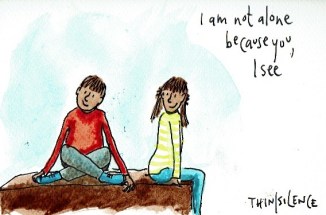
I cannot be lost when you, I see.

(*John O’Donohue, quoted in Maria Popova’s Brain Pickings:  A Gentle Corrective for the Epidemic of Politics Turning Us On Each Other and Ourselves.)
(**From Maria Popova’s Brain Pickings:  A Gentle Corrective for the Epidemic of Politics Turning Us On Each Other and Ourselves.)
(^From Alex McManus’ Makers of Fire – eBook version.)
(^^From Brené Brown’s Rising Strong.)
(*^From Kosuke Koyama’s Three Mile an Hour God.)

 

The speed of light

“When a great moment knocks on the door of your life,
it is often no louder than the beating of your heart,
and it is very easy to miss it.”
(Boris Pasternak)

‘[T]he human heart may perceive future events before the brain does
[…]
at the very least it implies that the brain does not act alone in the perception of human events’.**
(Joseph Jaworski)

Shedding light uncovers many things that may otherwise be missed … and each of us is light.

Early in the day we connect with the things that make it possible for us to produce our light, making it possible to see what others may not, and, because light is not about hiding but disclosing – we benefit from the light of 0thers, as they benefit from ours.

Futurist Ramez Naam believes we’re going to see something very important happen in human thinking – which is what human light is about:

‘We stand poised on the brink of the largest ever explosion of human mental power, a second Renaissance more transformative, and more inclusive than the first.’^

Joseph Jaworski, above, reminds us that this will be further enhanced by recognising how our hearts and guts also display intelligence, allowing us to “see” more of what we might otherwise miss.

In their latest book The Power of Moments, Chip and Dan Heath write about how and why moments hold significance for us; these moments can be transitions, milestones, and also pits (the opposite of peaks).  Whilst we may want to avoid looking at these too closely, they can become some of the most valuable things we see:

‘What’s least commonsensical is that pits can be flipped into peaks.’^^

A company can turn a bad experience into a loyalty-building moment if it’s prepared to see it for what it is.  And we can make a difference, even be defined by, the very things that causes us most difficulty and, even, pain.

Our light, or ability to see, is greater with the light others provide for us – as well as connecting to our own light as early as possible in the day, when we include others – their books, podcast, articles, videos.  More available than ever, the light of others may well be one of the most powerful forces in making Naam’s dream a reality, though it will never be by brainpower alone.  Our light shines even more brightly when mind and heart and gut combine:

‘Careless thinking and impurity of heart can make a dreadfully destructive combination.  The brain must be guided by the heart.  The heart must be enlightened by the brain.’*^

(*Boris Pasternak, quoted in the Northumbria Community‘s Morning Prayer.)
(**From Joseph Jaworski’s Source.)
(^From Ramez Naam’s The Infinite Resource.)
(^^From Chip and Dan Heath’s The Power of Moments.)
(*^From Kosuke Koyama’s Three Mile an Hour God.)
The possibilities of becoming in a universe of wonder

‘See ever so far … there is limitless space outside of that,
Count ever so much … there is limitless time around that.’*
(Walt Whitman)

“Without us here to notice, the universe is just pointless physics unfolding.”**
(“Cormac Wallace”)

In Harry Potter and the Order of the Phoenix, Ron Weasley has to ask of Hermione when she’s saying it’s fun breaking the rules, “Who are you and what have you done with Hermione Grainger?”

It’s a question about who we think we are and who we are capable of becoming.  And it’s a questions, as Maria helps us to see, that demands our honesty because:

‘the unquestioned confines us to smaller and smaller compartments of ourselves’.^

The best questions enlarge our worlds, connecting us with the wonder both around and within us, and the possibilities for what life can become. Popova quotes John O’Donohue from a conversation he had in 1997 with John Quinn:

“One of the most exciting and energetic forms of thought is the question.  I always think that the question is like a lantern.  It illuminates new landscapes and new areas as it moves.  Therefore, the question always assumes that there are many different dimensions to a thought that you are either blind to or that are not available to you.  bSo a question is really one of the forms in which wonder expresses itself.  One of the reasons that we wonder is because we are limited, and that limitation is one of the great gateways to wonder.”^^

The best questions are capable of opening the mind, the heart and the will – to be nothing less than present:

“Take me down to the spring of my life, and tell me my nature and my name.”*^

But there’re also bad questions, and they can be closing and limiting and destructive, leading to absencing:

“All thinking that is imbued with wonder is graceful and gracious thinking … And thought, if it’s not open to wonder, can be limiting, destructive and very, very dangerous.”^^

Mary Alice Arthur writes about what happens when listening rather than speaking takes the lead:

‘I’ve seen things dramatically shift when participants realised we were moving away from keynote speakers to keynote listeners, and they were being asked to become sensemakers themselves.’^*

We simply have no idea of just how much we are capable of growing and becoming in such a universe as the one we find ourselves in, one in which we are each invited to become more and more present.  Our next move will involve honesty about where we are and where we are moving to; we can only begin here:

‘The journey of a thousand miles begins beneath our feet.’⁺

(*From Walt Whitman’s Leaves of Grass.)
(**Daniel Wilson’s protagonist Cormac Wallace in Robogenesis.)
(From Maria Popova’s Brain Pickings: A Gentle Corrective for the Epidemic of Politics Turning Us On Each Other and Ourselves.)
(^^John O’Donohue, quoted in Popova’s Brain Pickings: A Gentle Corrective for the Epidemic of Politics Turning Us On Each Other and Ourselves.)
(*^George Appleton, quoted in the Northumbria Community‘s Morning Prayer.)
(^*From Drawn Together Through Visual Practice.)
(⁺From Geoff Nicholson’s The Lost Art of Walking.)

All we have

All is about intensity, imagination and love are about diversity.

Everyone is included, no one is excluded, except by our choice.

Alex McManus speaks of how:

‘A world that works for everyone does not exist except in the imagination.  So we must feed the imagination.’*

Without imagination and love we persist at things but life lacks flair and wonder.  Without intensity we give up before breaking through -but life if often a slow journey in the same direction.

Edgar Schein writes about how we need four forms of inquiry to go deeper, to break through: pure, diagnostic, confrontational and process-orientated.    The question is not “Can we?” but “Dare we?”

When intensity and passion come together we enter into a different kind of time.   Chronos time – seconds becoming minutes becoming hours becoming days …  – can be too up close, not allowing us to see the wonder of a moment as an expression or manifestation of the greater picture of who we are becoming and what we are contributing – story over a list of pros and cons.

We need to learn how to live in both forms of time:

‘Could our lives be journeys in which we stumble on things of indescribable beauty?  Are we to be alert to even the most ordinary moments of our for the possibilities?’**

(*From Alex McManus’ Makers of Fire – eBook version.)
(Alex McManus from a lost source.)

Is this the best you can do?

No.

But give me more time to read, speak to a few people, have different experiences – with their accompanying failings and resulting learnings, and I can come up with better:

‘Every once in a while, someone steps up and makes something better,  Much better.  When it happens, it’s up to us to stand up and notice it.’*

Two things from these words from Seth Godin: we can always do better and others always benefit when we do.

Of course, we could be thinking “This is the best there is.”  Not only is there no possibility for improvement but there’s no need, so we stop trying.  The other downside of this way of thinking is that we personally don’t get any better:

“”I’ve been trying all my life to find out what my limits are and have never reached them yet.  But then the universe doesn’t really help, it keeps on expanding and won’t allow me to know it entirely.”**

(*From Seth Godin’s blog: Why we don’t have nice things.)
(**Paulo Coelho’s character J in Aleph.)


COLOUR YOUR WAY INTO A NEW UNDERSTANDING AND EXPERIENCE OF LIFE

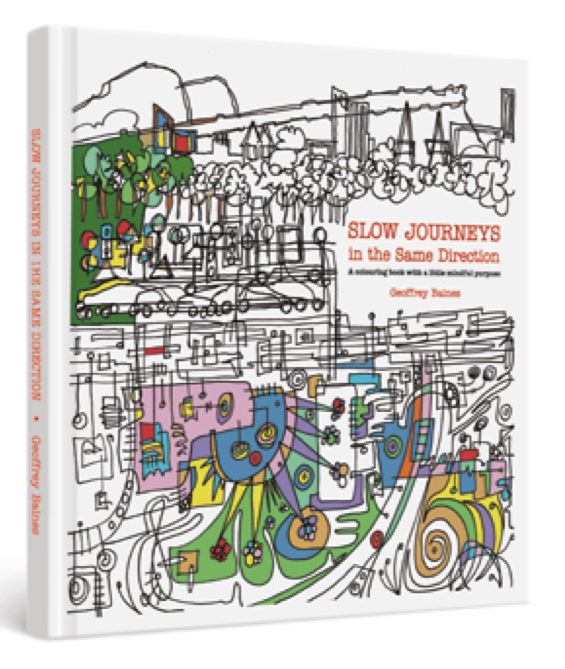
Slow Journeys in the Same Direction is coming out soon (5 February).  It is not only a colouring book but an accompanied journey with an online resource for anyone wanting to notice more, feel more and do more.

You can pre-order a copy here: cost £5.99 plus postage and packing.

Simply the best

The best you can do is not to copy someone else really well.  It’s really about doing what only you can do with as much truth, nobility, rightness, purity, loveliness, admirableness, excellence and praiseworthiness as you can pursue in.

What would that look like?

“Don’t colour over the lines,” we were once told, but now we know we don’t want to just colour within the lines of others: we can create our own unique lines.

This uniqueness will come from thousands of places.

It won’t try to be everything to everyone.

It will pare more down to be less and then grow less to be more.

Andy Warhol visualises this for us, taking images that were all around him from the culture of his day and doing something new no one else had imagined or thought to do.

None of us plucks newness and uniqueness out of the air.  We take the artefacts of others, we understand the culture in which we find ourselves and then we add our spark.  This might well be some art as we commonly think about it, it may be ideas that we have, or ways of relating to others, communicating a message or getting the job done (all of which are art in the sense that art is the thing we produce with imagination, dexterity and determination.

For more resourcing, check out Alex McManus writing about the three things needed for fire making: fuel, oxygen and spark.  These he respectively relates to artefacts (thoughts and things), the culture in which we find ourselves, and our unique creativity; we are becoming Makers of Fire.


It’s still your turn

‘[Ideas and poetry] come out of an elite experience, the experience of people particularly gifted whose ears are open to the songs of the universe.’*
(Joseph Campbell)

“With sloth, you will live a longer, happier, and more rewarding life by removing the nagging tug of passion, creativity, and individual desire. … Comfort is much more important than any social achievement or social contract.”**
(Wendy Wasserstein)

Mythologist Joseph Campbell speaks of an elite experience but I believe this to be our choice not the privilege of some.

Playwright Wendy Wasserstein, parodied the self-help genre when she wrote a guide to non-committal inertia.

There remains, however, something tugging at us, a pull from beyond us.  It comes to us every day, reminding us that when it comes to bringing our art of hoping, imagining and creating as our contribution or gift to others, it is still our turn.

(*Joseph Campbell from Joseph Campbell and Bill Moyers’ The Power of Myth.)
(**Wendy Wasserstein, quoted in Patrick Dodson’s Psychotic Inertia.)

Other resources to connect to today’s theme include It’s Your Turn – a wonderful, illustrated encouragement of a book from Seth Godin.   His thesis Stop Stealing Dreams explores what education can look like towards this.  Ken Robinson’s TEDtalk on education is an entertaining uncovering how education lets us down; his books The Element and Finding Your Element are serious guides to identifying individuality.  Elle Luna’s essay The Crossroads of Should and Must takes a look at look at some of the things that get in the way; it is also available in a longer form as a book.


YOU CAN FIND OUT MORE ABOUT THE TUG YOU FEEL IN YOUR OWN LIFE

Dreamwhispering is a way of exploring what it is your life is trying to tell you.  A journey of five conversations will lead you through identifying your passions, talents, and story, and can be entered into through meeting, skyping, or telephone (£175).

Drop me a line to find out more.

The greater silence

“True wisdom consists in respecting the simple things we fo, for they can take us where we need to go.”*
(Yad)

“Drink in the silence. Seek solitude.

Listen to the silence.

It will teach you. It will build strength
Let others share it with you.
It is little to be found elsewhere.

Silence will speak more to you in a day than the world of voices can teach you in a lifetime.
Find silence. Find solitude – and having discovered her riches, bind her to your heart.”**
(Frances Roberts)

In the silence we are completely free to be no more and no less than who we are – which is a work in progress.

More than this, when we enter the silence alone we carry our silence and the integrity of solitude within.  Then, when we are surrounded by the noise and the crowd, we can be our most true self.

This can be our daily play, this game of silence and solitude.  Kosuke Koyama speaks of nirvana as the “cooled life,” the way of tranquility, which sounds as though it could be the life silence and solitude afford:

‘The affirmed life is new life.
The new life is overwhelmed life.
Overwhelmed life lives with danger and promise.’^

Here we find the person in progress each of us most strongly is.

(*Paule Coelho’s character Yad in Aleph.)
(**Frances Roberts, quoted in the Northumbria Community‘s Morning Prayer.)
(^From Kosuke Koyama’s Three Mile an Hour God.)