when we laugh together

‘For it really is quite unreasonable to grant every other of life’s professions opportunities for fun, but to allow no fun to all the scholars.  What if the jokes bring with them some serious ideas?’*

‘We have contradictory desires.  We want to be seen and we want not to be seen.  We want to be known and we want not to be known.’**

I happened on these two quotes as I was rereading Sherry Turkle’s thoughts about how we’re expecting more from technology and less from people.  Specifically, how her research uncovered people interacting with robots and websites as a means of getting things out that allow them to say sorry without apologising:

‘Each act makes the same claim … . […] In each, something less than a conversation begins to seem like a conversation. […] Sheryl’s online confessions do not lead her to talk to those she has wronged or to try to make amends.  She goes online to feel better, not to make things right.’^

There feels to be an over-seriousness here at how we see ourselves, reminding me of Eckhart Tolle’s identifying of the ego as being the place of the false self, wherein resides our painbody.  This is the part of us that wants to be upset and hurt by others because it confirms what we think about them, and, perhaps worse, what we think about ourselves.^^

In identifying the ego, we’re beginning to disarm it because it doesn’t want to be noticed.  Perhaps, then, by learning to laugh at ourselves when confronted with many of the things people say or do to us (but not the more serious affronts and attacks), we’re releasing ourselves from some of the horrible things that play upon our minds and hearts.  Instead of being preoccupied with these or carrying them around, we instead allow something greater to grow.  Our future self is freed to wonder, be amazed, and to play in deep gladness.

Hugh Macleod writes about how those who are willing to fail are best able to innovate.  I connect this here, because when we take ourselves too seriously, we find it harder to admit our failings and struggle to engage in the kind of innovation failure makes possible.  Laughing at ourselves doesn’t guarantee that we flip this, but it does mean we can relax into exploring the possibilities.

Seth Godin finishes a blog with these words, which I think fit well here:

‘He’s a jerk, a two-timer, a double-crosser. He deserves everything you throw at him, your cutting remarks, your sarcasm, your enmity. […] The thing is, it’s not clear that we benefit from carrying around all that vitriol. All the time we spend hating is time that we’ve given away to someone who hasn’t earned our time. […] Teaching someone a lesson is often overrated.  Doing the lesson teaching in your head helps no one.

What happens if we walk away and make something magical instead?‘*^

(*From Roger Clarke’s translation of Erasmus’ Praise of Folly.)
(**From Kio Stark’s When Strangers Meet.)
(^From Sherry Turkle’s Alone Together.)
(^^See Eckhart Tolle’s A New Earth.)
(*^From Seth Godin’s blog: He deserves it, but do you?)
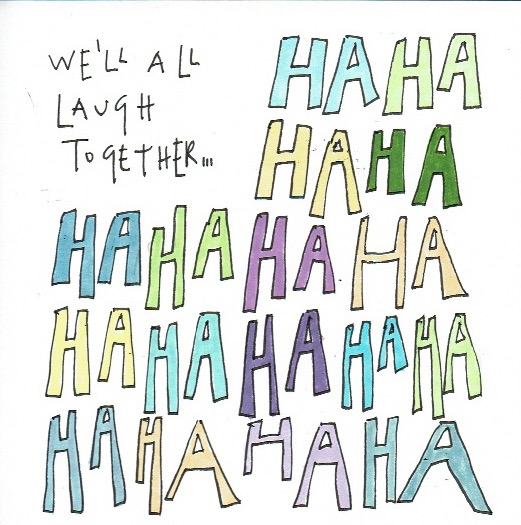
(^*For the doodle, I had Paul McCartney’s Frog Chorus: We All Stand Together in mind as I drew We’ll All Laugh Together.)
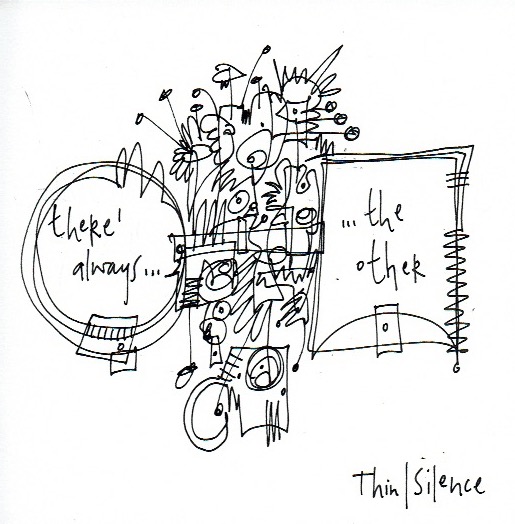
there’s always the other

‘Some people as they grow up become less. […] Some people as they grow up become more.’*

Whatever you’ve accomplished, someone else has been involved.

We depend on relationships, the thing that happens or occurs in the space between us.  Whether it be a person in realtime, or an idea or an image or a sound from someone, whether it’s a book or podcast or video we’re engaging with.

Today’s my birthday and I “decided to celebrate” (not!) by knocking over a full bottle of Quink Permanent Black Ink.  (Who said using a fountain pen isn’t dangerous!)   It was the drip drip drip that told me something was wrong – down the wall, all over the carpet.

Enter Christine with her superpowers.

She’d remembered something a carpet salesman had told her more than thirty years ago!  I couldn’t even remember the carpet-fitter.

Dab stains with kitchen roll, use warm water.  Keep dabbing and wetting, dabbing and wetting.  

It worked.

Christine’s superpowers had been passed on to her by someone else.  There’s always the other.  We need them.

Anne Lamott confesses this need to depend on the other is hard to deal with:

‘That’s the hard part, not taking but receiving.’**

This is simply an invitation to be grateful for the others in our lives, whether the ones we live in dynamic relationship with at a moment of ink-crisis at a distance of more than thirty years, or those we live in dynamic relationship for many years.

I think the others help us become more, and I believe the relationship is more than the sum of itsparts.

(*From Eugene Peterson’s Run With the Horses.)
(**From Anne Lamott’s Hallelujah Anyway.)

seen enough?

A couple of days ago, a friend and I found ourselves having a conversation about non-judgemental learning.  This feels really important for a world in which we make our minds up about people and things in seconds, heuristically.

It also feels very difficult to do.

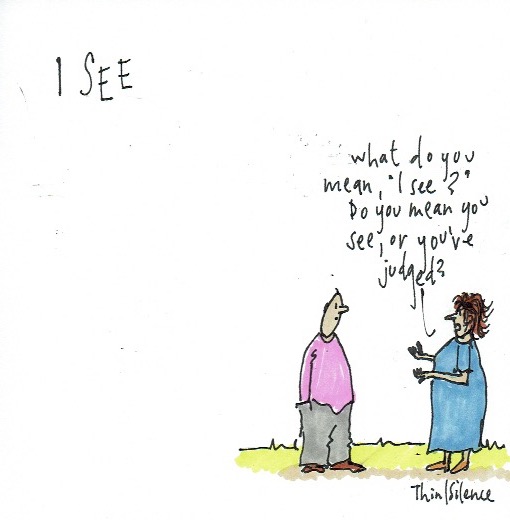
“I see” can mean I am opening to something for the first time.  It can also mean, I’m judging what I am seeing by a particular way of understanding.

This needn’t be bad.  It can lead me to say, Show me more, as well as, I’ve seen enough.

One way of seeing is fast – intuitive, the other is seeing slow – wondering what may come into view if we keep looking.

We need both of course, but I wonder whether we too often say to ourselves, or to others, We’ve seen enough, when there’s no good reason to stop looking.

One is more anchored in the past, the other, more anchored in the future.

As long as we know; it may be important.


our greatest venture?

‘Acts of selecting, refining and arranging to add value – my working definition of curation – help us overcome overload.

[…]

We solved the problem of insufficiency, only to find it was replaced by abundance.  As a result we’ll have to curate far more effectively.  In order to prosper we’ll start to appreciate the value of less, of simplicity in a complex world.’*

In a Huffington Post article published at the end of 2016, Otto Scharmer names ours as an Age of Disruption, characterised by three fundamentalisms.

The first fundamentalism, Scharmer argues, was cultural and religious in nature, highlighted in 2001 by the attacks of 9/11.

The second took the form of the social-economic fundamentalism witnessed in the financial collapse of 2008.

2016 brought to the fore the techno-political, the political upheavals being experienced, and how these were reported and spread by social media:

‘The rise of Trump in the US and the rise of the far right globally has put on display another key vulnerability of our democracies—namely, that any democratic system is only as good as the political discourse that comes with it.  In 2016, the political discourse—the public conversation—took a sharp downward turn, as if in a race to the bottom.’**

Fundamentalism stands in whatever form or sphere, as a voice crying out, This is how it was and is – one truth, one body, one action or behaviour.

Nothing is changeless, though, in a world constantly moving from ignorance to knowledge – what we do with our knowledge is, of course, another thing.

There is a need, more than ever, for cultures and religions, for societies and economics, and for technology and politics to learn and practice openness.  Where the aim is not to judge quickly or win but to remain open to one another for as long as possible.  To provide the chance we need to discover that all people are, as Roz and Ben Zander point out, ‘remarkably generative, prolific, and creative,’ especially those we disagree with.^  Such generativeness on the part of the human species means we’ll produce more, so one thing openness needs to bring to the fore is curation.

Michael Bhaskar’s words about curation which open this post, perhaps helps us to see the following practices, encouraged by Scharmer, as  curation:

‘If you want to be an active participant in co-shaping where the future takes us, here are five concrete actions to consider:

  • ‘Adopt a practice of intentional stillness—a moment of 5–15 minutes every day when you tune out everything that isn’t essential and focus on your true intention, on what matters most to you.
  • At least once a day, listen deeply to someone who is very different from you. The more different, the better.
  • Create a circle or holding space with a few of your closest friends or fellow travelers in which you support each other in these difficult times. The more disruption we experience, the more we need each other’s support. A small number of people (5–7) meeting in person is best; but in the u.lab we have also found that meeting virtually (via Skype or Zoom) can also be very effective.
  • Find ways to link your networks with platforms that promote dialogue and function as a network of networks. Doing so will help to align your efforts on a larger scale.’**

All of this allows me to let you know that enrolment for the U.Lab 2017 course is now open.  This thirteen week online course which allows anyone and everyone to explore Otto Scharmer and MIT’s Presencing Institute’s thinking is free; it will provide the opportunity of meeting with others with whom you might well embark on some adventure to change the world for the better.

(*From Michael Bhaskar’s Curation.)
(**From Otto Scharmer’s Huffington Post article: 2017-Trump-Are We Ready To Rise?)
(^From Benjamin and Rosalind Zander’s The Art of Possibility.)


while I have breath

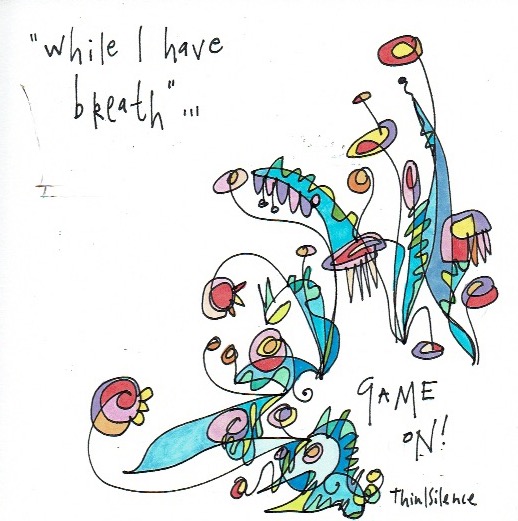
While I have breath I will keep seeking, knocking, asking.

At some point in our lives, whatever we fill our lives with and whatever we place value in, there wheedling itself in will be this question: What is the legacy I seek to leave?

The question may not exactly look like this, but it will be there, at some point in our lives.

While I have breath, I wish to live with creativity, generosity, and enjoyment.

This is my response to the question: What does it mean to you to be human?

While I have breath … game on.

One thing for sure is, when I have ceased to breathe, there can be no answer.   Now is the time to be dreaming wide-awake.

Towards this – whatever this may be for each of us- Bernadette Jiwa offer six steps: focus, notice, questoin, discern, predict, try and test.*

These feel as if they relate to the U journey Otto Scharmer and the Presencing Institute outline: Focus and Notice are about opening our minds; Question and Discern, opening our hearts; and, Predict, and Try and test are about opening our wills.

A year ago, I had a highly embarrassing farewell from the organisation I’d been part of for over thirty five years.  Unable to recognise the work that I had been part of (Jiwa’s first two steps) meant that they couldn’t describe what matters most to me (the second two steps), or seen all the things I’d been developing (the last two steps).

I’ve simply recognised that while I have breath, I must keep moving on with the things that matter most to me because there’s only a certain amount of breathing I have left to me.

One thing leads to another leads to another.  This is story.

As Jorge Luis Borges pointed out:

‘all prose is fiction’.**

It may be story, but the best stories are those we can invite others into.

(*From Bernadette Jiwa’s Hunch.)
(**Jorge Luis Borges, quoted in Ursula Le Guin’s Words Are My Matter.)

what are you going to replace that with?

‘As we seem to grow further apart from one another, as our phones become more attached to our hands and our politics to our hearts, we need empathy more than ever.’*

These words from Hugh Macleod are connected by Erich Fromm for me to some from Erwin McManus; firstly Fromm:

‘If one is aware of oneself without at the same time making steps which are the consequences of the new awareness, then all awareness remains ineffective.’**

‘Integrity not only harnesses our passions but focuses our intentions.’^

Awareness that does not lead to things happening is not awareness at all.  It promises the possibility of moving from a less desirable past to a brighter future.  Increasingly, though, Sherry Turkle highlights a concern she has identified in researching human interaction with robots and with confessional  websites:

‘Each act makes the same claim: bad feelings become less toxic when released. […] In each, something that is less than a conversation begins to seem like a conversation.  Venting feelings comes to feel like sharing them.  There is a danger that we will come to see this reduction in our expectations as a new norm.’^^

We haven’t needed to wait on technology to avoid doing something when we become aware of something else.  Instead of calling her son, with whom she has had a profound disagreement, Anne Lamott confesses to going shopping, knowing exactly what she was doing – there’s more to life than “letting ourselves off the hook” or  “getting away with it.”:

‘What’s wrong with this, aside from its being expensive, squandering our time and money, distracting us from life, and wearing off?’*^

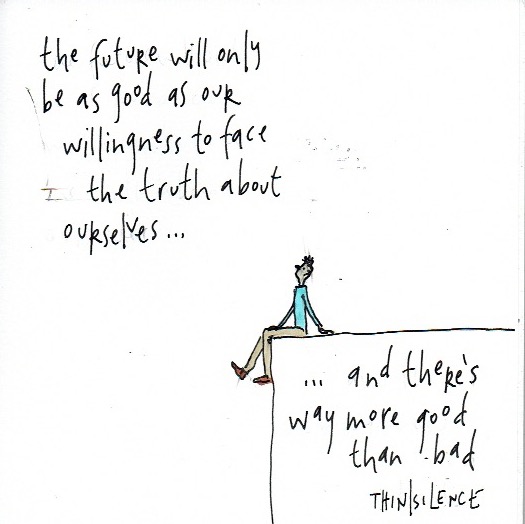
Walter Brueggemann’s offers a process of orientation, disorientation, and reorientation for moving from the past to the future.  Becoming aware orientates us to something, disorientating us in our present way of being, leading us towards a more hopeful reorientation – not a return to the past but the opening of a better future.^*  It can only happen in the deepest places of our lives.

Our lives aren’t fixed and there’s hope in the way the universe had produced us with the greatest plasticity.  Kio Stark counsels us, then, to be very suspicious of anything that suggests otherwise:

‘But turn your most suspicious eye on theories that say humans are hardwired for anything.’⁺

(*From gapingvoid’s Naturally Irrational.) 
(**From Erich Fromm’s The Art of Listening.)
(^From Erwin MacManus’ Stand Against the Wind.)
(^^From Sherry Turkle’s Alone Together.)
(*^From Anne Lamott’s Hallelujah Anyway.)
(^*Richard Rohre mentione Walter Bruegemann’s process in The Divine Dance.)
(⁺From Kio Stark’s When Strangers Meet.)

1979

We tell our stories in the way we understand things.

Our understanding is changing all the time but sometimes we forget to update our stories.

I see the world totally differently now to how I saw it when I was twenty.  Think about how our knowledge about so many things has changed since 1979.*

I cannot say, “I am who I am.”  Perhaps I am being more accurate if I say, ” I will be who I will be.”

At least this is true if I am attentive, something Iris Murdoch encourages us to be in our everyday lives in “little peerings”:

‘The task of attention goes on all the time and at apparently empty and everyday moments we are ‘looking’, making those little peering efforts of imagination which have such important cumulative results. […] Will cannot run very far ahead of knowledge and attention is our daily bread.’**

Paul Cezanne intuitively knew that we see are the lines and our brains add the details:

‘Whenever we open our eyes, the brain engages in an act of astonishing imagination as it transforms the residue of light into a world of form and space that we can understand. […] Reality is not out there waiting to be witnessed; reality is made by the mind. […] This is Cezanne’s genius: he forces us to see, in the same static canvas, the beginning and end of our sight. […] The painting emerges from somewhere inside our mind.’^

Attentiveness leads to increasing knowledge, adding more “lines,” and we then have to figure out how to fill in the details:

When we refuse to see that this is how it is we create personal and social bubbles.  When it comes to the bubbles that most threaten our world, Peter Senge writes about how it will take the coming together of many people to both share what they see and listen to what everyone else sees:

‘In shaping life beyond the Bubble, many visions will be needed.’^^

When this happens we need to change our stories.

(*I picked on 20 because I happened to mention Tina Seelig’s What I Wish I Knew When I Was 20.)
(**From Iris Murdoch’s The Sovereignty of Good.)

(^From Jonah Lehrer’s Proust was a Neuroscientist.)
(^^From Peter Senge’s The Necessary Revolution.)

when life isn’t useful

“Listen to your life.
See it for the fathomless mystery that it is.
In the boredom and pain of it
no less than in the excitement and gladness:
touch, taste, smell your way to the holy and hidden heart of it
because in the last analysis all moments are key moments,
and life itself is grace.”*

In his essay Time for the Stars, Alan Lightman expresses a concern that applied science is given precedence over pure science.  He’s already warned in the essay Nothing but the Truth:

‘In science, as in other activities there is a tendency to find what you’re looking for.’**

Life is full of what we have no idea exists.  This is true for inner science as well as outer science.  Our opening words from Frederick Buechner are feeling their way towards this science of our lives.  We often come upon these things by accident, simply by happenstance, especially when we’re “out there” searching, exploring for “we don’t know what.”

Seth Godin notices a dangerous direction in businesses and technology – I think it spoils over into our personal lives, especially social media:

‘Dumber is an intentional act, a selfish trade for mass.  It requires us to hold something back, to avoid creating any discomfort, to fail to teach.  Dumber always works in the short run, but not in the long run.’^

When we’re inquiring into our lives, searching and wondering what’s in here, we find a different direction to dumber, here identified by Erwin McManus:

‘This path is not only a promise of adventure, it is the promise of wholeness. […] It is here where the synergistic interplay of courage, wisdom and generosity make us most creative.’^^

It was a happenstance conversation with Erwin, whilst on a trip to the United States that was full of inquiry, that a whole new way of seeing myself and others opened up.

Yesterday, I closed with these important words from Anne Lamott about what maps can make happen for us:

‘Maps can change a life, a person, returning us to dreams, to our childhood, to the poetic, to what is real.  They can move us forward to what we didn’t even know were looking for.  A map can change a god-awful day or month,  ruin a rut, give us directions home and to everywhere else, near and far, to the golden past and today, to the centre and back to the periphery, to our true selves, our lost selves, the traveller, the mystic, the child, the artist.’*^

What Erwin McManus is pointing us to, though, goes beyond maps, to setting out into the unknown with a compass to be creators of maps.

Maps feel more applied, compasses feel purer.

“Things change when you grab whatever you love and give it everything.”^*

(*Frederick Buechner, quoted in the Northumbria Community’s Morning Prayer.)
(**From Alan Lightman’s Dance for Two.)
(^From Seth Godin’s blog: Toward dumber.)
(^^From Erwin McManus’ Uprising.)
(*^From Anne Lamott’s Hallelujah Anyway.)
(^*Student Amanda Burr, quoted in Rosalind and Benjamin Zander’s The Art of Possibility.)

life at 3mph

The Proclaimers proclaimed:

“But I would walk 500 miles
And I would walk 500 more
Just to be the man who walked a thousand miles
To fall down at your door.”

I’d imagine, after a thousand miles, most of us would want to fall down.

Ten thousand steps is the more popular song to sing today – I was gifted a fitbit so try to walk my ten thousand each day.  Though, by the end of a recent graduation ceremony, which turned into an hour of clapping, I completed most of my steps without taking any!

Rebecca Solnit reflects on what walking makes possible:

‘Walking shares with making and working that crucial element of engagement of the body and the mind with the world, of knowing the world through the body and the body through the world.’*

Reflecting the thinking of phenomenologist Edmund Husserl, Solnit writes:

‘The body […] is our experience of what is always here, and the body in motion experiences the unity of all its parts as the continuous “here” that moves toward and through the various “theres.”‘*

We are more than a continuity of self, though, we are also a changing self – metaphored in the ship of Theseus.

This possibility of being changed as we walk appears to be under threat.  We can move faster in various boxes, separated from the “various theres” through which we move.  We often work in spaces that confine us, swapping sensory enrichment with sensory deprivation:

“If the body is a metaphor for our locatedness in space and times and this for the finitude of human perception and knowledge, then the postmodern body is no body at all.”**

Even if we get the feeling that we want to change we often struggle to know how … and for why.  Yet, as Ed Catmull reminds us, not being able to change our minds can be downright dangerous – especially to ourselves:

‘I think the person who can’t change his or her mind is dangerous.’^

To walk is to provide ourselves with the opportunity of seeing more, feeling more, towards doing more.  When we’re speeding through life it’s hard to change direction, or even to see the possibilities of change.

At three miles an hour we can spot the new directions.

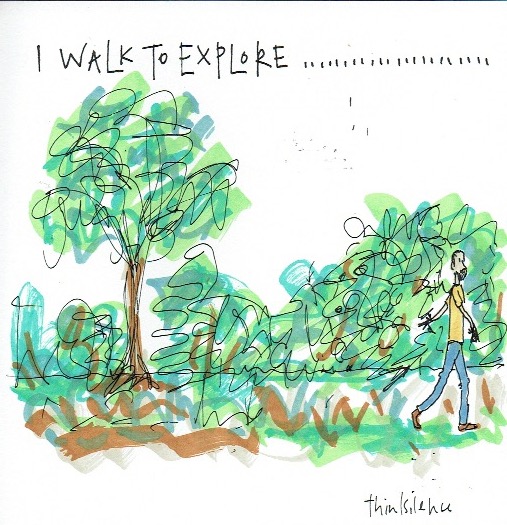
We walk to explore:

‘Maps can change a life, a person, returning us to dreams, to our childhood, to the poetic, to what is real.  They can move us forward to what we didn’t even know were looking for.  A map can change a god-awful day or month,  ruin a rut, give us directions home and to everywhere else, near and far, to the golden past and today, to the centre and back to the periphery, to our true selves, our lost selves, the traveller, the mystic, the child, the artist.’^^

(*From Rebecca Solnit’s Wanderlust.)
(**Susan Burdo, quoted in Rebecca Solnit’s Wanderlust.)
(^From Ed Catmull’s Creativity, Inc..)
(^^From Anne Lamott’s Hallelujah Anyway.)

i haven’t got time for this

I suspect there are things that will open to gentleness and peacefulness that will not open to power, that will respond to a humble question rather than an I-need-to-prove-I’m-right answer.

These are qualities that I long to express.

Richard Rohr holds out:

‘Love is not something you do; love is someone you are.’*

Anne Lamott says something similar about mercy:

‘Mercy means compassion, empathy, a heart for someone’s troubles.  It’s not something you do – it is something in you, accessed, revealed, or cultivated through use, like a muscle.’**

I think that peacefulness and gentleness must grow around love and mercy, these desires that aim for relationship and communion with others.   So, I suspect, they too are what I am, not what I do.  What I desire doesn’t come easy.

They are cultivated through use and openness, which most likely means in difficult moments when things are harsh or conflicting – interrupting things, distracting things, when we feel we have least time.  I’ve got things to do, you know. So I avoid, make my excuses.  Move on.  Or …

… pursue the future I hope for.

We become what we give our time to, I guess.

(*From Richard Rohr’s The Divine Dance.)
(**From Anne Lamott’s Hallelujah Anyway.)