the culture of possibility

“I will not live an unlived life. […] I choose to inhabit my days”.*

‘Innovation is culture, not technology.’**

Culture is what happens between people.

When each of us inhabits our days – which I read as turning up with our talents, passions, and experiences, when we bring our best selves together and learn to play the “yes and” game, creativity emerges, possibilities open, and we get ‘to imagine what the truth may be.’^

(*Dawna Markova, quoted in the Northumbria Community‘s Morning Prayer.)
(**From gapingvoid’s The Origin of Species/Innovation.)
(^From Benjamin and Rosalind Zander’s The Art of Possibility.)

what next (again)?

What next?

It’s a question that lies at the heart of the human story.

George MacDonald saw the importance of being prepared for comes next because there’s always next:

“If people would but do what they have to do, the would always find themselves ready for what came next.”*

As I read this morning, I followed with these words from Nassim Taleb about human hubris in a random world, when we make things fit our ways of seeing things:

‘[W]hen the map does not correspond to the territory, there is a certain category of fool – the overeducated, the academic, the journalist, the newspaper reader, the mechanistic “scientist,” the pseudo-empiricist, those endowed with what I call “epistemic arrogance,” this wonderful ability to discount what they did not see, the unobserved – who enter a state of denial, imagining a territory as fitting his map.’**

Taleb probably caught most of us in this aphorism delivered with his typical frankness, but there’s something within this which I find more hopeful than Sherry Turkle’s research into confessional websites, where she comes upon twenty two year old Nancy who confesses:

“I don’t have enough discipline to keep a diary.  I don’t think I’m important enough to do that.”^

Apart from this being a comment from someone who is being disabled by technology, the apparent lack of hubris seems to be a better place to be than Taleb’s hubris-people, believing so much, as they do, in their way of seeing things that they make everything comply  to it – after Procrustes, the character who slept guests in his iron bed by cutting body parts off tall people and stretching short people to fit.

However, I found myself thinking about the different tribes identified by Dave Logan, John King, and Halee Fischer-Wright who identify different tribes in the workplace.  Nancy would be in the second of these tribes, with the mantra My life sucks, although yours doesn’t.  Taleb’s characters, though, are likely in the third tribe – We’re great, but you’re not. Both are trying to domesticate life but life cannot be domesticated.^^

Logan, King, and Fischer-Wright, who point to five tribes all together, follow these two with two more, claiming that each must be worked through in turn – we cannot leap one or two.  The forth tribe claims,  We’re great, but they aren’t, but the fifth tribe expresses, Life is great, and we can fix the world together.   Unhappiness and discontent are the realities we bring our imagination to bear on:

‘Unhappiness can lead to new beginnings. […] Discontent can be a source of growth and inspiration.’*^

What next? never comes pain-free.  We’re growing, stretching, changing and being changed.  As we press on towards the heart of life, there’s love to find and make and share: love for others, love for our planet, and love for ourselves.  I leave the final words for Nassim Taleb:

‘Love without sacrifice is theft.’**

(*George MacDonald, quoted in the Northumbria Community‘s Morning Prayer.)
(**From Nassim Taleb’s The Bed of Procrustes.)
(^Nancy, quoted in Sherry Turkle’s Alone Together.)
(^^See Dave Logan, John King, and Halee Fischer Wright’s Tribal Leadership.)
(*^From Chris Guillebeau’s The Happiness of Pursuit.)

the reclaiming of your days

‘Peace has a dividend.  Economic peace, political peace, interpersonal peace.  It gives us room to dream, to get restless and to make things even better.’*

Add intra-personal peace to this: how we greet and welcome the stranger in us.

Seth Godin’s words about peace catch my attention because my name, Geoffrey, means “Peace of God” and I’ve long felt that I ought to provide others with some kind of peace.

Our desire to dream and make a better contribution doesn’t have to be tied up to our name, but there is a mission life provides each of us with.  You could say, it comes with the territory of being human – “Your mission, should you choose to accept it is …” – that sort of thing:

‘[S]hould mission statements be mission questions?’**

Conflict and interruption may be helpful for us to get our imagination moving, we have to come to a place of peace with the challenge, with those we find ourselves teamed with in the conflict, and, with who we are and who we are becoming.  We’re then able to move from reacting to responding to taking the initiative.

Kio Stark describes her great fascination as she begins her book When Strangers Meet:

‘Talking to people I’ve never met before is my adventure.  It’s my joy, my rebellion, my liberation.  It’s how I live.  Here’s why.  When you talk with strangers, you make beautiful and surprising interruptions in the expected narrative of your daily life.  You shift perspective.  You form momentary, meaningful connections.  You find questions whose answers you thought you knew.  You reject the ideas that make us so suspicious of each other.’^

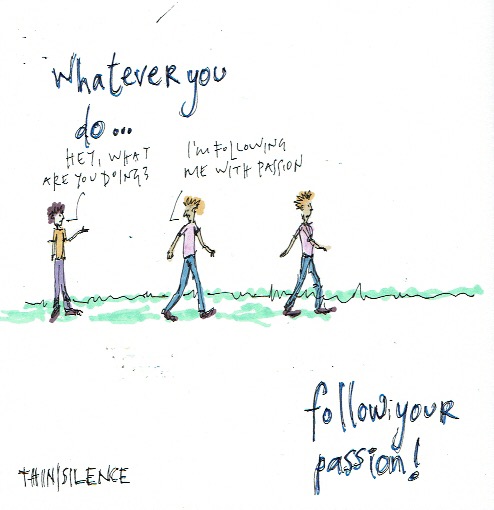
You may be thinking, This is the kind of passion that I wouldn’t even have to change job to do.  That’s the thing, our passions are closer and accessible and executable than we think when they are wrapped around a question.^^  Wrapped around a question rather than an answer, things begin to happen.

Each of us has only the the one life to do this in.  We must count our days wisely as we wrap them around our deepest passions.

(*From Seth Godin’s Strength through peace.)
(**From Warren Berger’s A More Beautiful Question.)
(^From Kio Stark’s When Strangers Meet.)
(^^My question, which I wrote down when thinking about this, is: 
How can this person find their story?)

the stranger

“Be open to the night…

Pray with open hand, not with clenched fist…

Shapes loom out of the darkness, uncertain and unclear: but the hooded stranger on horseback emerging from the mist need not be assumed to be the bearer of ill…

The night is large and full of wonders…”*

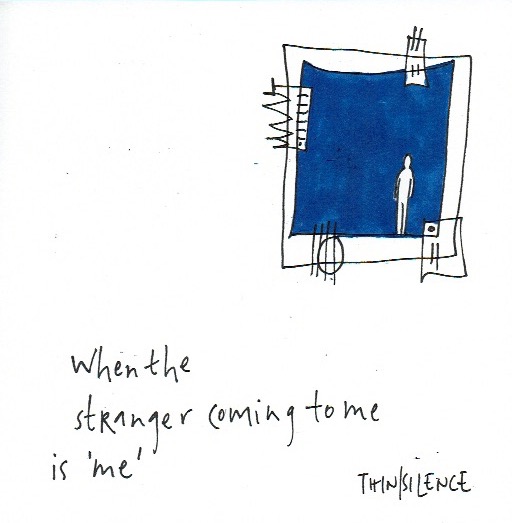
What if the stranger you see coming out of the darkness of the light is you?  The “you” with hopes and dreams and aspirations overpowered and driven away by practicality.

Now, your dreaming and hoping you is returning.

It will take some time to know this person and to trust them.  Neither do we cease to be the person peering into the darkness from the past, but this you from the past seeks to find synchronicity to the you from the future.  Perhaps this is why the one emerging from the darkness scares or terrifies us.  They do not come with force but with possibility.

(*Lord Dunsany, quoted in the Northumbria Community‘s Morning Prayer.)

common grace

“I want to unfold.  I don’t want to stay folded anymore because where I am folded, there I am a lie.”*

“It is an unprecedented change in the human condition.  For the first time – literally – substantial and rapidly growing numbers of people have choices.  For the first time, they have to manage themselves.  And society is totally unprepared for it.”**

We are the Noticers of the universe.

We notice all there is.  And there are so many things to notice that no individual or group can claim to have noticed all that is important.  Together, then, we notice in diversity and then we connect diversity.  Noticing is our way of ‘revealing the inherent goodness, truth, and beauty in everything’.^

One of the greatest noticers I’ve come across is Annie Dillard – her Pilgrim at Tinker Creek is a wonderful observation of all the life in a small space she visited over a year or so:

“Together we notice not only each mountain shadow and each stone on the beach but, especially, we notice the beautiful faces and complex natures of each other. … Otherwise creation would be playing to an empty house.”^^

Noticing in the way I’ve been outlining has about it a wisdom that lies beyond simply being data or information or knowledge.  There’s a wise life on the far side of noticing, it is a simplicity and coherence on the far side of complexity.  Erwin McManus suggests as much when he notices how:

‘There is an elegance and beauty to wisdom.  She brings simplicity out of complexity.’*^

When we begin noticing, the reality is we don’t know the answer when we start out.  In the second of my opening quotes, Peter Drucker envisages societies with increasing choice.  In recent times there’s been much research into happiness and wellbeing, into talent and imagination, into innovation and artisanship.  I see these things as the expressions of growing choices in society, which will lead to more.  Not all will know just what to do with this, as Drucker posits, but we have this incredible opportunity to live in unprecedented ways of human fulfilment.

It’s probably more of a hope than a belief, but I personally trust the many to do more with what they have than the few have done with so much in the past.

We are, as our opening quote from Rainer Maria Rilke protests, unfolding.  Religion, politics, despots, cultures, industry, and education have folded us up.  Anne Lamott has to admit, ‘folded feels like home, small, familiar, hugged.’^*  It’s why we’ll struggle to explore our unfoldedness, but then we remember, foldedness is what we moan and groan and seek to sabotage in conscious and unconscious ways, and we turn to our stories.  Our stories are were we encourage and evaluate our unfolding.  We do not know the end at the beginning, but, then, neither is someone else writing our stories for us.

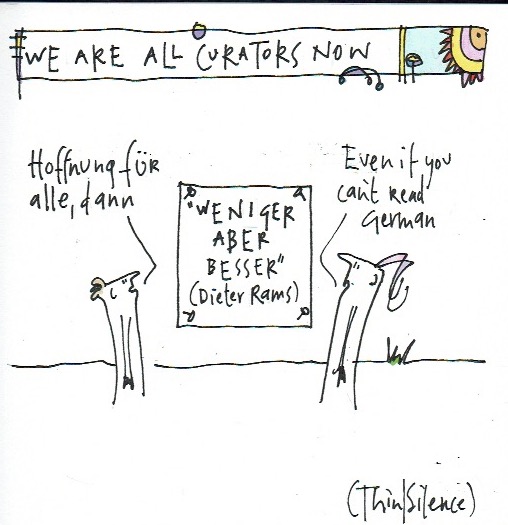
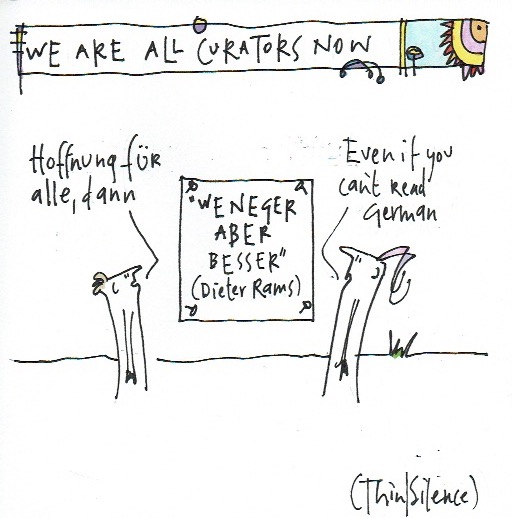
Today’s doodle reminds us that what we have the opportunity to do is to curate our lives, to curate more together – curation as another way of thinking about story.  Curation does not include everything but selects, arranges, refines, reduces, displays, simplifies, presents, and explains.

Weniger aber besser = Less, but better.

(*Rainer Maria Rilke, quoted in Anne Lamott’s Hallelujah Anyway.)
(**Peter Drucker, quoted in Michael Bhaskar’s Curation.)
(^From Richard Rohr’s The Divine Dance.)
(^^Annie Dillard, quoted in Richard Rohr’s The Divine Dance.)
(*^From Erwin McManus’ Uprising.)
(^*From Anne Lamott’s Hallelujah Anyway.)

the storm and the silence

What are the storm and the silence saying to each other?

Giving and receiving?

Finding mutuality?

I came across some intriguing thoughts from Ursula Le Guin at the beginning of today.  She writes:

“Any two things that oscillate at about the same interval, if they’re physically near each other, will gradually tend to lock in and pulse at exactly the same interval.  Things are lazy.  It takes less energy to pulse cooperatively than to pulse in opposition.  Physicists call this beautiful, economical laziness mutual phase locking or entrainment.”*

Picking up on the energy that is the universe – of which we are expressions, Le Guin continues:

“All living things are oscillators.  We vibrate. […] That constant, delicate, complex throbbing is the process of life itself made visible.”*

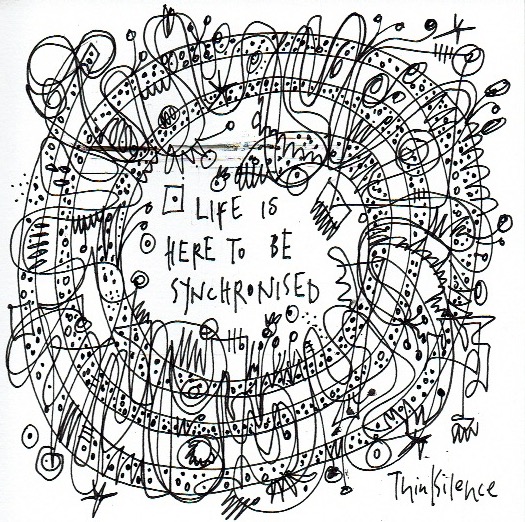
I see this entrainment, or synching, both happening within me – I seek to bring together my dreams, talents, and experiences, my emotional, spiritual, physical, and spiritual so they might pulse harmoniously – and between me and what is not me – my dreams with the dreams of others, and so on.

It seems we’re made for this: we live in tightly compacted in towns and cities, we create complicated means of government and business and care; we also mirror one another in our meetings – one person leans on their chin, the other does the same.  Perhaps debate is foreplay before the possibility of synchronising thoughts and conversations?  Maybe its our consciousness that pulls us away from what we really hope for, the joining in a greater conversation.

On this thought, Alan Lightman tells of when he opened a scientific journal to discover that scientists in Japan were tackling the same problem he was.  Reflecting on this, Lightman shares:

‘one has the overwhelming feeling that there exists some objective reality outside ourselves, that various discoveries are waiting fully formed, like plums to be picked’.**

This feels like synching, connecting with what is around us, being surprised, even shocked, to discover this “desire” to “connect” is out there as well as in here – some kind of deep calling to deep – entrainment is a deeper conversation, as Le Guin claims, telling is listening.

I close with some words from Stephen Pyne about the relationship we have with fire, how in this relationship is about learning to be human:

‘The sense of Burning Man as a symbol has substance.  Embedded in the ritual is the realisation that humanity’s identity is bound to that fire.  Each depends on the other.  Before people could control fire, they had to control themselves.’^

(*Ursula Le Guin, quoted in Maria Popova’s Brain Pickings: Telling is Listening.)
(**From Alan Lightman’s Dance for Two.)
(^From Stephen Pyne’s Fire.)


magnificence

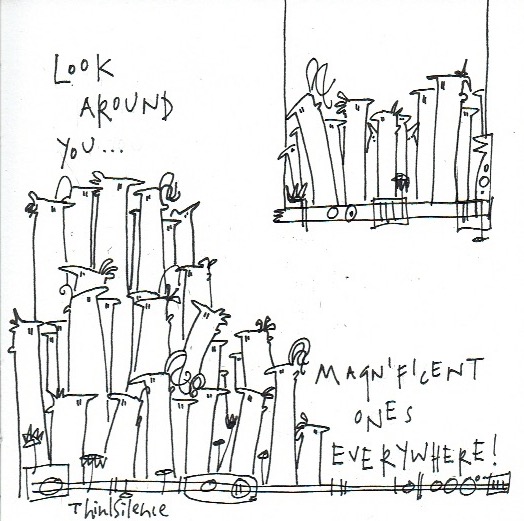
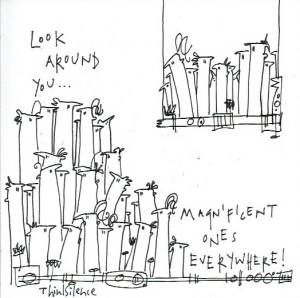
The magnificent are everywhere, especially among the unrecognised, undervalued, unregarded and discarded.

In his book of aphorisms, Nassim Taleb introduces the the idea of The Magnificent, from Aristotle’s megalopsychos, or “great-souled.”

What if magnificence is something lived from the inside out, without need of title, role, position, or possession?  Christian theologians wrote and spoke about imago Dei, the image of god found in every person, but went on to add qualifications and conditions which looked very ugly in real life.

Mihaly Csikszentmihalyi reflects this inside-outness when he writes:

‘Whether we are happy depends on inner harmony, not on the controls we are able to exert over the great forces of the universe.’**

This has to do with how we see people, and if we see people wrongly or badly, as Seth Godin points out, we can change our way of seeing for a better one:

‘If the way you see the world isn’t helping you make the changes you seek to make, consider seeing the world differently.’^

Richard Rohr’s “great being” sounds magnificent or the great-souled.  Whilst coming from a developing Christian tradition, Rohr’s understanding of the person with great being emerged from learning from an Indian holy man:

‘A great being stays with what she loves; she’s patient, she forgives and she allows what she loves to develop, to grow.  She overlooks its mistakes, and in this sense she suffers for and with reality.  This is the deepest meaning of passion: patior is the Latin verb meaning to suffer or to undergo reality (as opposed to controlling it).^^

It’s the final phrase about undergoing reality that captures my attention here.  Magnificent ones are not marked by their role, position, title, or possessions – though they may have some or all of these things, they are first of all people who understand they must form a relationship with the universe because they cannot control it.

Csikszentmihalyi writes about our world and universe in terms of perspectives:

‘The earth may be our home, but it is a one full of booby traps.  It is not that the universe is random in an abstract mathematical sense.  The motion of the stars, the transformations of energy that occur in it might be predicted and explained well enough.  But natural processes do not take human desires into account.  They are deaf and blind to our needs, and this they are random contrast with the order we attempt to establish through our goals.’**

He’s saying what we see and what the universe “sees” are two different things.

What we think of as our life appears somewhere between these two seeings.

This relationship exists between the two powers of reality (the universe) and imagination (the human perspective), described by Wallace Stevens as the pressure of reality and the power of imagination.  They cannot overpower each other but what forms between is a very interesting life.

Both are the universe.  We are the product of the universe, formed of what the rest of the universe is made of.

In his fable of creation, Alan Lightman writes about how human existence transitions from impermanence to permanence, by which he means our atoms formed into our lives for seventy or eighty years are the impermanent, their permanent state being a cycling and recycling through the world.

We are the world, the world is us.  As Martin Buber expressed it, we are moving from “I-it” to “I-Thou” understanding, which brings us back to seeing.

Imagine meeting another human being, both of you for this moment being stripped of title, position, role, possessions.  Who do you meet?

Rohr suggests we are meeting an “anointed one,” which from his tradition is saying “a christ.”  We are meeting magnificence.

(*From Nassim Taleb’s The Bed of Procrustes.)
(**From Mihaly Csikzentmihalyi’s Flow.)
(^From Seth Godin’s blog: A shared and useful illusion.)
(^^From Richard Rohr’s The Divine Dance.)

nonsense

What if the way we must find for our lives is not an answer but a question?

“Live the questions now.
Perhaps then, someday far away in the future,
you will gradually,
without even noticing it,
live your way into the answer.”*

‘The idea, then, is to force your brain off those predictable paths to purposefully “thinking wrong” – coming up with ideas that seem to make no sense, mixing and matching things that don’t normally go together.’**

Predictable is the dangerous path.  It’s akin to Theory U‘s downloaded path, to Mindfulness’ autopilot.  I’ve noticed how I miss so much because of the speed at which I move through life with predictability.  I try to slow down in order to notice more – three or four slow breaths now helps me to stop the rush.

Erwin McManus makes the connection between noticing more and our quest for enlightenment:

‘It should be obvious that those who live enlightened lives have demonstrated a unique ability to learn from everyone and everything around them.’^

Living our questions is also about unfolding the stories in which we set our questions.  Richard Rohr reflects the transformational nature for us of living what we love:

‘I see it in human beings all the time, we all become what we love.’^^

Erwin McManus helps us to see more of the detail of what is happening here:

‘We persevere in the confidence that we ourselves are being transformed.  Perseverance produces character, and character, hope.  And hope, we will discover, is the ultimate gift gained in wisdom.’^

Seeing our lives as stories lived around questions is about drawing lines through the randomness and complexity of life.  Predictability hates questions because they enable us to see our lives for what they can be rather than what they are.

What is your question?  (You’re allowed more than one.)

(*Rainer Maria Rilke, quoted in the Northumbria Community‘s Morning Prayer.)
(**From Warren Berger’s A More Beautiful Question.)
(^From Erwin McManus’ Uprising.)
(^^From Richard Rohr’s The Divine Dance.)
secrets of joy

When we live out our joy then we leave our joy lying around for others to find.

Life provides us with opportunities of making things that give us joy – thoughts, relationships, artefacts – that we can hide for others to find – because we don’t always have opportunity to give directly.

Maria Popova speaks of what I think of as conversations with purpose in this way: ‘the possibility of planting into another mind a seed sprouted in ours and watching it blossom into a breathtaking flower of mutual understanding’.*

Of course, there’s always risk involved.  The beautiful thought – or relationship of artefact –  can be misunderstood or not valued.  Sometimes, though, in the relationship that forms between two or more people, a possibility can grow even more, and, because of this, it is worth it.

(*From Maria Popova’s Brain Pickings: Telling is Listening.)

the jungle of motivation

No one wants to be Sisyphus.

He’s the guy In Greek mythology who, because of his hubris, was condemned by Zeus to endlessly roll a boulder up a hill only for it to roll back down because of an enchantment placed upon it.

Here is the “Sisyphic” condition: being caught in an endeavour without meaning or purpose.  None of us want to find ourselves or to condemn others to live in this place devoid of motivation.

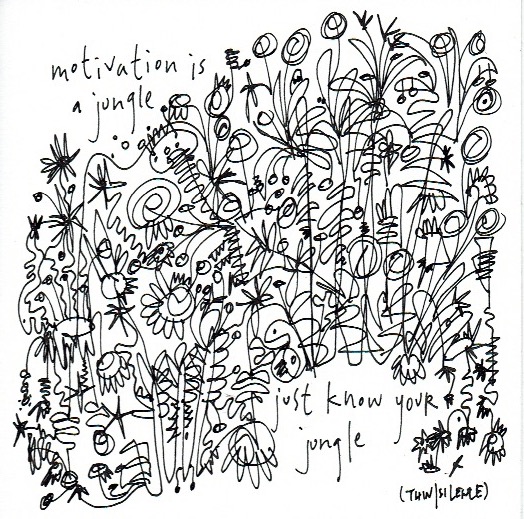
The following words from Dan Ariely, Duke University’s Professor of Psychology and Behavioural Economics, describes motivation as a jungle.  My interest and curiosity were piqued as soon as I read them:

‘Motivation is a forest full of twisting trees, unexplored rivers, threatening insects, weird plants, and colourful birds.’*

Motivation’s complexity – because not everything is equally important in the jungle and we can end up placing greater value on the wrong things – means we can be tempted to overlook the source of our own motivation in favour of something more predictable or measurable, such as the product.  Yet, whilst others will be able to copy our super-widget, they will not be able to copy our story.

‘We are the CEOs of our own lives.’*

Here are three invaluable things when it comes to motivation, what it is to be human:

Autonomy: no one is completely free but we can each embrace how more or less free we are – when we face our experiences, our character, our story, our choices – and then we can grow them.

Mastery: we have each developed skills into talents into strengths over many thousands of hours; the ways we think, relate, communicate, and execute are unique and are full of the kinds of detail that not only can be repeated but also developed and innovated.

Purpose: the purpose bigger than ourselves that we want to contribute to, moving us towards investing in the lives of others – perhaps the greatest of all contributions: ‘the place where [our] deep gladness and the world’s deep hunger meet,’ as Frederick Buechner put it.

All of these can be turned into the kinds of habit and practice that make it possible for us to turn up to our days with meaning and purpose.  Motivation may be a jungle but we can know our jungles.

(*From Dan Ariely’s Payoff.)