made for playfulness

9-can-you-come

‘KAGEMUND They say that your superheroes say a lot about you.  Americans have Superman, Spiderman and batman.  Danes have … well … Cakeman.’*

When our son Luke was five he would go around to our next door neighbour to ask him if he was coming out to play: Mr Kerr was seventy years old and he would “play” – it looked a lot like gardening – but Mrs Kerr didn’t.

We use play to open, connect, and create.  Playfulness is huge part of how we grow up, and we are always growing up.

We are a playful species.

Those who don’t take themselves too seriously get this.  They understand how the shapes and forms of society and culture are finite games we’ve made up and invited or forced people to play.

Alan Lightman in his wonderful book Einstein’s Dreams imagines a world that knows it will come to a end in one month, in which people drop their pretence. and  begin to see the beauty that is around them and in one another.  I can only imagine they rediscover their playfulness too.

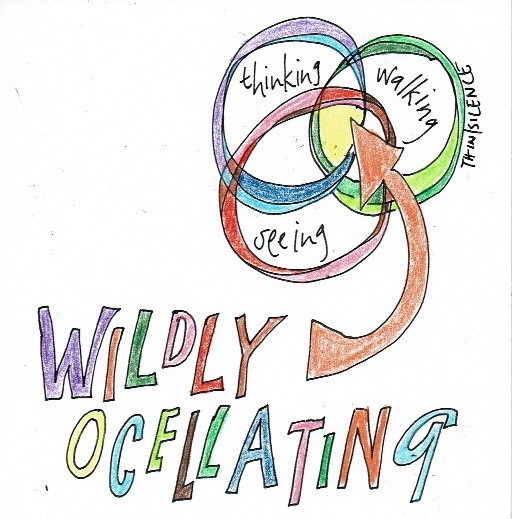
Wandering, doodling, the “yes and” game, superheroes and talents, confabulating new words, cakemaking and (add your kind of playing here) are all ways and means of diminishing seriousness, making it possible to see more.  And seeing more, including imagining and dreaming, leads to feeling more and then to doing more of what adds to the wonder of life rather than taking it away.

With only minutes to go before the end of Lightman’s imaginary world comes to an end:

‘It is so absolutely quiet that each person can hear the beat of the person to his right or his left.’**

Our world is much to valuable not to be playful.

(*From Meik Wiking’s The Little Book of Hygge.)
(**From Alan Lightman’s Einstein’s Dreams.)

a life of opposites

8-life-is-found

I suspect there’s no such thing as work/life balance; we place the line between the wrong this and that.

‘You need to be generous to yourself in order to receive the love that surrounds you. … We must remain attentive in order to receive.’*

‘[There] are the sensory impulse and the formal impulse, both of which aim at truth, and neither of which get there without the other.’**

The true line of balance, or rhythm or flow, lies between the person we’ve become – the formal impulse – and the person we’re becoming – the sensory impulse.  These opposites, as identified by Friedrich Schiller, also appear to be identified as opposite poles of static and dynamic by Christian Schwarz and by Mihaly Csikszentmihalyi as conservative and expansive.^

Between these opposites we find what we might describe as life-in-all-its-fullness: ‘Truth is realised in embodiment.  Beauty is instantiated we might say, in a human being fully alive.’**

Each warns us about how a formal-, static-, conservative-only emphasis results in a rigidity of form, whilst a sensory-, dynamic-, expansive-only emphasis results in some kind of formless state, like the person not fully rematerialising in the USS Enterprise’s transporter.

When we move between the opposites, or paradoxical, though, we feel a “zinging” of creative energy inside of us – Schwarz describes how the dynamic produces the static and the static stimulates the dynamic.

‘No matter what, expect the unexpected.  And wherever possible BE the unexpected.’^^

(*John O’Donohue, quote in the Northumbria Community‘s Morning Prayer.)
(**From Harriet Harris‘s essay The Epistemology of Feminist Theology.)
(^See Christian Schwarz’s Paradigm Shift in the Church, and Mihaly Csikszentmihalyi’s Creativity.  They aren’t exactly saying the exact same thing, but their opposites connect in many ways.)
(^^Linda Barry in 99U’s Make Your Mark.)

the creative life

7-we-can-only-be

We are vehemently faithful to our own view of the world.   We want to know what new story we’re stepping into before we exit the old one.’*

We’re a loss-averse species.  It’s why we see small numbers of people move into the new, who are followed by a few more who see the possibilities of the new and begin to make it inhabitable.  Only then do larger numbers of people move into this new reality and move us forward with momentum.  One of the bi-products is that the old reality, which seemed to us the safest or wisest place or best or most popular, no longer is.

A year ago, I was part of a group of people shaping a creative space.  We understood how this space needed to be three-dimensional, being freedom, importance, and curiosity.

One year on, these still look good both for the individual as well as a group.

Freedom is not only about being freed from something but freed to something

‘Take me down to the spring of my life, and tell me my nature and my name.’**

“To name oneself is one of the most powerful acts a person can do.  A name is not just a word by which one is identified.  A name also provides the conceptual framework, the point of reference, the mental constructs that are used in thinking, and relating to a person, and idea, a movement.”^

Importance, or significance, means we want to do something that leaves a mark: I was here, I did that.

Curiosity is about how we’re all different and have such diverse creativity.  It’s why we can only be creative our way.

I think it takes all our years to grow up – becoming more and more ourselves and less what we inherited.

At least, that’s the theory to be tested.

(*From Stephen Grosz’s The Examined Life.)
(**George Appleton, quoted in the Northumbria Community‘s Morning Prayer.)

(^Ada Maria Isis-Diaz, quoted in Harriet Harris‘s The Epistemology of Feminist Theology.)

between inspiration and expiration

6-life-is

‘Longing is the deepest and most ancient voice in the human soul.  It is the secret source of all presence and the driving force of all creativity and imagination: longing keeps the door open and calls toward us the gifts and blessings of which our lives dream.’*

‘Little or big, learned or unlearned, white or black, legal or illegal, sick or well, from the first inspiration down the windpipe to the last expiration out of it, all that a male or female does that is vigorous and benevolent and clean is so much more profit to him or her in the unshakable order of the universe and through the whole scope of it forever.’**

Who’s watching what we do today?  Perhaps some Muse or god or hero?

Today is the day that counts, the only time we can directly influence – yesterday has gone and tomorrow must be waited for.  The future will decide how well or badly today’s choices concerning bringing some kind of beauty into the world, especially the kind that is a gift for others.

Maybe the one who inspires me, who watches me from the future in what I do today, is me, who knows my values full grown and encourages me towards them.  Maybe.

‘The prescient poet projects himself centuries ahead and judges performer and performance after the changes of time.’**

(*From John O’Donohue’s Eternal Echoes.) 
(**From Walt Whitman’s Leaves of Grass.)

we may never know

5-the-saunterer

I got to see La La Land yesterday.  Twenty minutes and I was hooked.  Without giving the storyline away, there’s a kind of alternative story played out at the end which the lead characters Mia and Sebastian appear both able to imagine.

Most of us don’t have the opportunity to see what might have been if we had done this, chosen that, went there, thought differently.

‘She worries that she does not have the time to take her time on the things that matter.  And it is hard to maintain a sense of what matters in the din of constant communication. … we have created a communication culture that has decreased the amount of time for us to sit and think uninterrupted … we don’t allow sufficient space to consider complicated problems.”*

I wonder about the self we’re allowing to be shaped by the worlds we unquestionably inhabit.  What if we made different worlds?

I am challenged

I’ve been blogging and doodling every day since the 1st January 2014 – whatever was happening and wherever I found myself.  I know there’ll come a day when I won’t be able to do it and I don’t look forward to it.  At the same time I don’t want this to be something that moves me rather than me moving it so I’m going to go offline in a week or so.  I want to explore what this makes possible.

“As for me, if you have nothing indigenous in your own heart, no living preference, no fine, human scorn, I leave you to the tide, it will step you somewhere. … I wish you may find degeneration no more painful than your neighbours, soon sink into apathy, and be long spared a state of respectable somnambulism, from the grave to which we haste.”

Through our determination to be a “mover” rather than “moved,” each of us is able to pick up our living preference and to know more of what presently lies hidden to us.^

(*From Sherry Turkle’s Alone Together.)
(**Robert Louis Stevenson, quoted in Patrick Dodson’s Psychotic Inertia.)
(^What we must do with our lives may feel more like a “fine, human scorn,” which I have elsewhere described as a holy discontent, something we cannot ignore and must do something about.)

an opening world

4-the-child-and

Every generation believes themselves to be the most intelligent, socially aware, and generally enlightened.

This of course means that those who follow will be even more so and we could well look quite dim, insensitive, and backward to them, until they remember how they may be seem in similar ways by those who follow them.

When we see ourselves from the perspective of the future, we’re able to change today a little bit more, shaping the future – this is the emerging future.  We live in an opening world.

This opening world presents itself to the humble and grateful and faithful: meaning we try to see ourselves more truthfully, seeing what we have is enough, and living accordingly.

Peter Diamandis and Steven Kotler offer their perspective of building new communities for bold innovation by suggesting we need to avoid greed, fame, and short term desires.*

Otto Scharmer equally warns against this trio pf pitfalls of fame, money, and empire-building when it comes to being present to the emerging future.**

If we run some thoughts from Rohit Bjargava across these, we can see how the trio impedes and closesmdown the future rather than opening it.  And some of the biggest things to happen politically in 2016 were about a closing world paradigm prevailing.  (Discuss.)  Bhargava warns against bias, judgement, and an inability to play the “yes and” game.^

Because bias closes down the possibility of another way.

Because fast judgement heavily filters what is allowed to happen.

Because no “yes and” game assures us of only one side winning, being correct, having their way.

Erich Fromm steps back and takes a larger view of humankind, how we have emerged through consciousness from the animal kingdom and now are separate from it in so many ways.  This separateness means we’re seeking to find another reality to replace our isolation, how the religions and philosophies of the ages are a history of this seeking to be reunited:

‘The deepest need of man, them is the need to overcome his separateness, to leave the prison of his aloneness.’^^

This is the journey we find ourselves making.  My mentor Erwin McManus would say that we seek honour, nobility, and enlightenment.*^  To which, I believe, the world will open.

(*See Peter Diamandis and Steven Kotler’s Bold.)
(**See Otto Scharmer’s Theory U.)
(^See Rohit Bhargava’s Non-Obvious.)
^^From Erich Fromm’s The Art of Loving.)
(*^See Erwin McManus’s Uprising.)

salvation

3-time-to-explore

Or, ‘the open possibilities of tomorrow.’*

Movies mirror life in that they are often about salvation – which is basically being saved from something and to something.  Whether its Phil Connors in Groundhog Day or the surviving humans in Terminator Salvation, the characters are changed as they overcome great obstacles and challenges in order to get their lives back.

These stories fascinate us because they theatrically portray the reality of our lives.  Punxsutawney may not be where we find ourselves waking up to each day being  the same day, yet the issues we wake up with day after day may be just as imprisoning.  Maybe cyborgs aren’t after us but sometimes we feel we’re going to be wiped out by the things we have to do at work.

‘Rumbling with our story and owning our truth in order to write a more courageous ending transforms who we are and how we engage with the world.’**

Brené Brown would probably describe salvation as our Day 3, and how, first of all, we have to face Day 1: The Reckoning – our willingness to engage with our unpleasant stories and to integrate them into a greater story rather than to deny them.  Then comes Day 2 and The Rumble.

What we’re doing throughout is becoming more open: opening our minds, our hearts, and our wills.  Openness is our greatest tactic when it comes to salvation; perhaps it is what salvation most of all is.

(*From Alex McManus’s Makers of Fire.)
(**From Brené Brown’s Rising Strong.)

the bonus

2-in-the-moment

“Find silence.  Find solitude – and having discovered her riches, bind her to your heart.”*

‘But there is a consciousness here in the body.  I have a feeling that consciousness and energy are the same thing somehow.   Where you really see life energy, there’s consciousness.’**

Introversion and extroversion are not about shyness and outgoing-ness.  They’re about where we prefer to go to in order to find our energy … and, as always, there’s an incredible spectrum.

Preference is an important word here because it underlines how this is about our choices, not some immutable programming.

Then there’s consciousness or awareness, the heightening of which does something amazing to and with our lives.  Consciousness is not only about our heads but about being connected with our bodies – especially heart and gut:

‘Yes, your mind can tell left from right, but it cannot perceive invisible things such as love, eternity, fear, wholeness, mystery, or the Divine.’^

Developing consciousness takes us both inwards and outwards.  This doesn’t take away our preferring of one over the other, it simply means we are developing our freedom to grow our awareness.

“For me, the journey is much more delightful if you can derive pleasure from the process every day, rather than at the end of the year.”^^

The bonus comes every day, not at the end of the year or maybe not at the end of the year.

(*Frances Roberts, quoted in the Northumbria Community‘s Morning Prayer.)
(**Joseph Campbell in Jospeh Campbell and Bill Moyer’s The Power of Myth.)
(^From Richard Rohr’s The Naked Now.)
(^^Sebastian Thrun, quoted in 99U’s Make Your Mark.)

day 2

1-only-the-deluded

‘You can’t skip day two.  You can’t skip day 2.  You can’t skip day 2.  Where is the messy middle?  Where is Act 2?*

“The illiterate of the 21st century will be those who cannot read or write, but those who cannot LEARN, UNLEARN, and RELEARN.**

We like beginnings, new possibilities, startovers: Day 1.

We like endings, results, the new state of being: Day 3.

In between, there’s the messy, difficult, awkward, challenging: Day 2.

The messy can be avoided, mind.  We can get to Day 3 without the failing, the falling, the wrestling with all the randomness and complexity.  The results might not be as groundbreaking but it’ll do.

I’d begun today reading about Henry Ford’s desire to create a cheaper car that many more people would have access to (Day 1).  After various trials he made it to Day 3: the Model T.^  In-between was a Day 2 that introduced the assembly line but I found myself wondering whether this still was too simple a solution because it would significantly contribute to the de-skilling of the labour force – something still prevalent today in both hard and soft industries.

Day 2 is where our passions, talents, energies, imaginations, and determinations have to be engaged.  Perhaps, more than ever, we find ourselves in Day 2, the unlearning before relearning.

(*From Brené Brown’s Rising Strong.)
(**Alvin Toffler, quoted in Sunni Brown’s The Doodle Revolution.)
(^See Chan Kim and Renée Mauborgne’s Blue Ocean Strategy.)

tethered

31-free-at-last

“I glance at my watch to sense the time; I glance at my Blackberry to get a sense of my life.”*

“Discovery consists of seeing what everybody else has seen and thinking what nobody has thought.”**

We wonder what can be accomplished if we stay connected and available.  This is our tethered world.  It’s efficient but not particularly effective in what matters most.  Effectiveness required presence.  Multi-tasking is another way of saying we’re not doing anything particularly well.

When we’re able to focus our minds and hearts and bodies then we not only see, we feel and find our minds working in unusual ways.  No computer necessary – and new things appear.

‘Then there are those who think their bodies don’t exist.  They live in mechanical time.’^

With no smartphone in sight, wanderer “R” notices someone she thinks she recognises, a little later she notices him again as he walks in the opposite direction.  She walks to where the man has returned from, noticing a box tied to a tree with pamphlets in it, she takes a copy.  It’s The Perigrinator, a publication of the Wander Society containing a number of strange articles for how to wander.  Touching on something as mysterious as this and yet timely for the age we live in, she expresses:

“I hugged the paper to my chest and felt myself wanting to run excitedly down the street.”^^

Perhaps here is a picture of a life, untethered from an ineffective continual copresence in which we try to remain connected in many directions at all times.

‘Let us allow our wild spirits to roam unfettered and unbound.’*^

(*A university student, quoted in Sherry Turkle’s Alone Together.)
(**Physician Albert Szentgyorgyi, quoted by Rohit Bhargava in NonObvious.)
(^From Alan Lightman’s Einstein’s Dreams.)
(^^Wanderer “R,” quoted in Keri Smith’s The Wander Society.  She comes to the realisation the man she had seen and recognised could have been Nick Papadimitriou, also known as the London erambulator.)
(*^From Keri Smith’s The Wander Society.)