what is my task today?

22 your mission today

‘In shaping life beyond the Bubble, many visions will be needed.’*

The Bubble being the unsustainable present.  The same old same old what you see is all there is of economy, society, and the natural world.

Simply redefining life in the Bubble will not be enough.

Life beyond the Bubble will require new-ancient attributes and skills on our part.  Humility, gratitude, and faithfulness will not only allow us to survive but thrive.

Humility is about accepting the fullness of who we are.
Gratitude about recognising all we have.
Faithfulness about identifying ways and means of living these out towards others.

The practice of these leads to inward and outward alignment, and alignment is powerful:

‘An inner alignment starts to develop that can release extraordinary energy and creativity, qualities previously dissipated by denial, inner contradictions, and unawareness of the situation and oneself.’*

There is a boundarylessness to be explored – taking everything we are into everything we do.

What is my task today?

I could say it’s getting on with moving things from our old home to our new, but it’s more.

My task today is to be as Human as I can be.

‘There is a deep beauty within each person. … In the real sense, beauty is the illumination of your soul.’^

(*From Peter Senge’s The Necessary Revolution.)
(**From John O’Donohue’s Anam Cara.)

creative tension

21 creative tension

Creative tension exists between reality and vision.

It’s not just about how we think and act towards shaping the future.  It’s also about how we feel – usually negative emotions like anxiety, stress, judgement, and hopelessness.

The temptation then is to reduce our aspirations because we can do something about this.

We try to ignore our emotions and instead reach out for some comfort in someone or something.

When we face our emotions, they subside; they can even be transformed into positive energy to use creatively.  This energy transformation is one of the biotic principles I’ve mentioned which make it possible to learn from the natural world and how it works.

John O’Donohue puts it nicely when he writes:

‘In the neglected crevices and corners of your evaded solitude, you will find the treasure you always sought somewhere else. … Unless you find belonging in your solitude, your external longing remains needy and driven.’*

(*From John O’ Donohue’s Anam Cara.)

wasteful

20 our values

Companies are beginning to eliminate the manufacturing of waste.  Xerox put a lot of effort into a new line of copiers which were 97% recyclable.  Drivers of electric vehicles will lease rather than buy their fuel cells, meaning these remain the responsibility of the manufacturer.

I began thinking yesterday about how we are learning more from nature, Peter Senge using the phrase “nature’s constraint” as the starting  point for what we imagine and invent.

This got me thinking about nature’s constraint on Human life, how we can eliminate waste, especially how we can be less wasteful with what each person is capable of whilst they walk this planet.

Life coach and influencer Michael Heppell – his goal is to positively influence one million lives – encourages us to identify our values, or create new ones, if necessary:

‘I want you to live these values, I want you to feel these values, every day.’*

Knowing what is important to in life is an important part of preventing waste, and, add, knowing and employing skills and talents in service of values.

Though, if we can’t see there’s more to our life than meets the eye, there’s going to be waste.

And wanting to be better than the rest is wasteful of everyone else’s talents.  Far less wasteful is to look for ways to bring the best out of others.

(*From Michael Heppell’s How To Be Brilliant.)

live long and prosper

19 life is both

We’re increasing learning from nature.  It makes sense.  We’re a part of nature, not apart from it – out of the bubble.

Two observations:

We’re most in danger when we experience continued equilibrium,

We cannot remain in a constant state of disequilibrium.

We need equilibrium and disequilibrium: familiar and the unknown.

Christian Schwarz adds some detail to how we can thrive by imitating nature in what he calls biotic principles:

Life is interdependent: we’re part of a whole system;
Life multiplies: the fruit of an apple tree is not an apple but another apple tree;
Life transforms energy: we can’t turn the wave but we can learn to surf;
Life multi-uses: nothing is wasted;
Life is symbiotic: fauna and flora live together in mutually beneficial ways;
Life is functional: it does what it’s meant to do.*

‘And they learn that tapping these capacities cannot be achieved without people being who they are and learning how to integrate their own lives.’

(*From Christian Schwarz’s Natural Church Development Handbook.)
(**From Peter Senge’s The Necessary Revolution.)

we are future

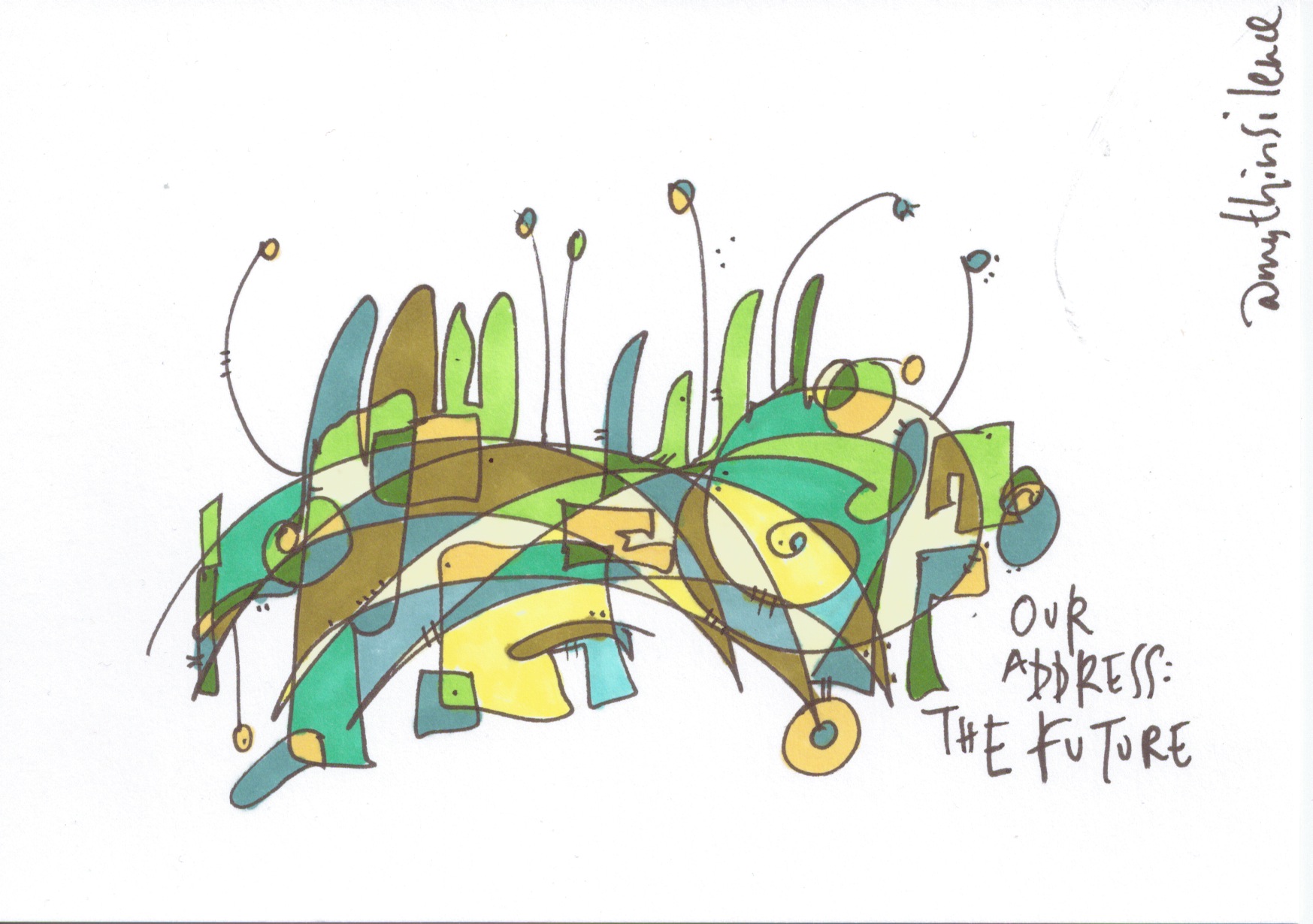
18 our address

When we react to something or someone, it’s exactly that: a re-action.  We repeat what we have always done, suggesting limited choice.

When we respond to something or someone, we’re considering the options and making the best choice – usually connected to past experience.

When we initiate, despite the something or someone happening to us, it’s likely we have travelled to the future.  We imagine and persevere towards creating what it is we see and does not presently exist.

I have a feeling Nassim Taleb would call the first fragility, the second robustness, and the third antifragility.*

‘the vast changes required by a regenerative society will not be achieved just be reacting to crises after they arrive.  They will require inspiration, aspiration, imagination, patience, perseverance, and no small amount of humility.’**

(*See Nassim Taleb’s Antifragile.)
(**From Peter Senge’s The Necessary Revolution.  This comes from a captivating introduction on moving from problem solving to creating.)

real magic

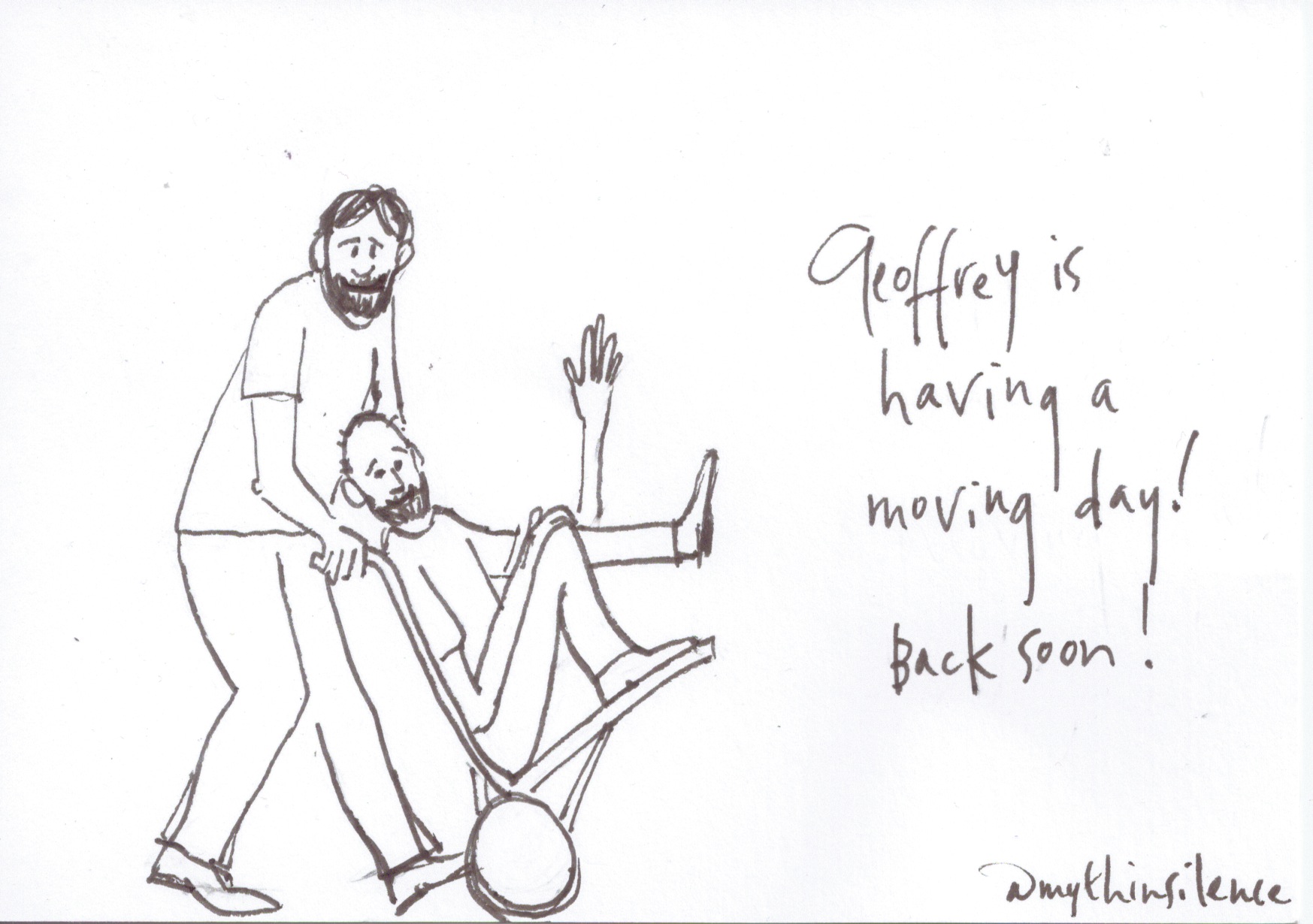
17 geoffrey is having

If we wait for something magical to happen then probably nothing will.

The real magic happens when we make intentional, deepening moves in the way we think and relate and behave.

Real magic happens not in an instance but in the journey.

i am because you are

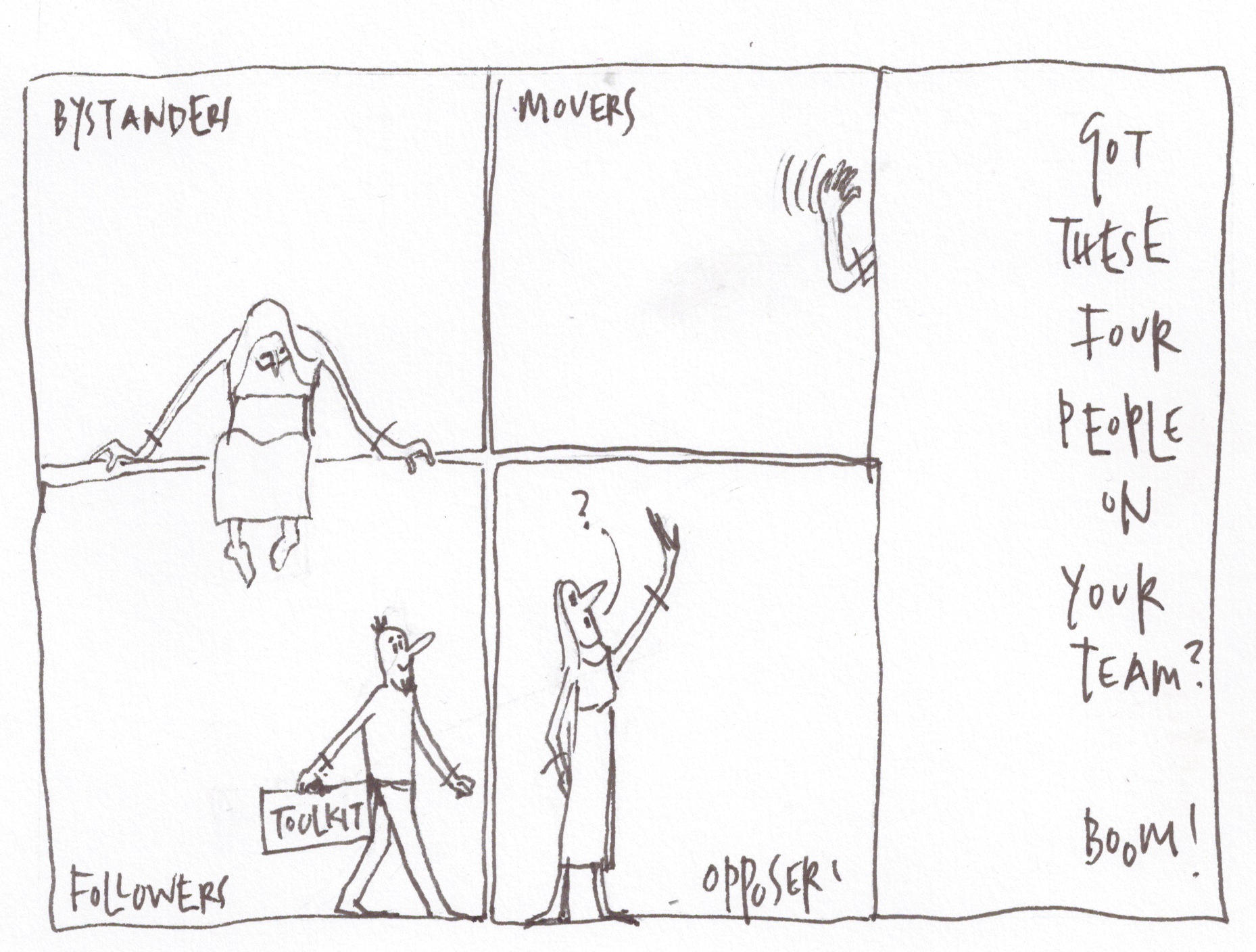
16 got these four

“I am because you are; you are because we are.  Every person is a person through other people.”*

We need a tribe.

Some would argue, it is the only way we can become Human.  This has been my experience – it will continue to be.

Erich Fromm held that every encounter changes us in at least some small (probably unnoticed) way.  When we use encounters intentionally and creatively I can only imagine the world becoming better:

‘In one sense, the work of innovators … comes down to helping people recognise that seeing systems ultimately means seeing one another.’**

It means valuing different perspectives which are brought honestly and humbly.  Systems thinker and practitioner David Kantor holds that four perspectives are important to creating better systems: Movers – who initiate action and provide direction; Opposers – who oppose to correct and refine; Followers – who support an action to completion; and, Bystanders – who observe and offer a (different) perspective.**

I enjoy the way Kantor posits the possibility of each of these perspectives being offered positively – tribes need to be more than a homogeny.

(*An African proverb quoted by Steve Chalke in Being Human.)
(**From Peter Senge’s The Necessary Revolution.)

addition and subtraction

15 steve got to

“When you create additively, complexity comes free of charge.”

In their new book, Peter Diamandis and Steven Kotler highlight what’s happening in additive manufacturing with 3D printing.

Making by subtracting tends to leave large amounts of bi-product – it we call waste, I like the idea of adding wherever possible and avoiding taking away from.

Imagine a world in which we encourage people to keep adding and enhancing the abilities they already have, adding to, rather than subtracting from, life.

Pride, greed, and foolishness are the basic subtractors – imagine being on the receiving end of just one of these.

But humility, gratitude, and faithfulness are the basic components of addition.  3D layering of these “materials” lead to multiplication.  

Layer healthy humility and you produce integrity; layering gratitude leads to wholeness; and, building up faithfulness leads to perseverance.  Put these together as a multiplier and something amazing and beautiful is going to happen.

Of course, we’re each a mixture of addition and subtraction, but staying mind and heart-focused comes up with surprising results for everyone.

(*From Peter Diamandis and Steven Kotler’s Bold.)

in this together?

14 sorry, can't talk

Over the next ten to fifteen years how Human life develops is going to be very interesting to see, even better as an experience.

‘Thinking about robots … is a way of thinking about the essence of personhood.  Thinking about connectivity is a way to think about what we mean to each other.’*

Human need and suffering will always be with us, and so will be the need to help one another through.  Technology promises to bring us together and to keep us apart.

Two stories:

Someone shares intimate details with their “friends” on Facebook.  Friends “like” their painful story, add a short “comment,” and forty six comments later has intimacy really been experienced?**

A Costco team travels from the United States to Guatemala so it can meet bean-growers and create a better system.  Not asking Guatemalan representatives to fly north is intentional, and, unexpectedly, finds the US team invited by the leader of a local cooperative leader to the mass for his son who has recently died.  Before anything else happens on the trip, the Americans sit in a church in rural Guatemala, mourning the loss of a child from the community they have come to experience.^

Which story speaks of intimacy?

(*From Sherry Turkle’s Alone Together.)
(**This story is a composite of a number I’ve spotted recently.)
(^From Peter Senge’s The Necessary Revolution.)

life is stranger than the gartner hype cycle

15 riding the

When I came upon the Gartner Hype Cycle in Peter Diamandis and Steven Kotler’s  Bold, I just had to take a closer look.  This graph for new technology looks to mirror how we develop our personal story or purpose.  Here’s my journaled copy tracking the journey of maturity and viability:

13 gartner hype cycle

Here’s how it can work out personally.

Something triggers a person’s need to take a long look at their lives and make some changes.

When they identify the way they want or must take, enthusiasm levels are high and there’s a hype of expectation and a flurry of activity.

Then reality hits and it’s clear this is going to be harder than first thought.   Disillusionment and de-energising now follow, leading to the hype of disillusionment.

If we can break through this, we begin to identify the things we need to do in order to grow our story: ‘the most important telltale factor is the development of a simple and elegant user interface – a gateway of effortless interaction’.*

We find a way which works for us: a personal interface of values, curiosities, skills, Sitz im Leben, and hopes, out from which the flow of our lives emerges.

(*From Peter Diamandis and Steven Kotler’s Bold.)