Seize the day

Paradoxically, a self-centred self cannot become more complex, because all the psychic energy at its disposal is invested in fulfilling its current goals, instead of learning about new ones.*
(Mihaly Csikszentmihalyi)

The deepest need of man […] is the need to overcome his separateness, to leave the prison of his aloneness.’**
(Erich Fromm)

There are those who, ignoring developing the inner self, must crave stimulation from outside and the other in order to save themselves from boredom or anxiety.

There are those who, constantly developing their inner world, are able to stimulate themselves in all circumstances and take their richness into the other.

Of course, it’s not that we are either or but somewhere on a journey, moving towards the one or the other.  The key is knowing that developing the self is not about fate but a choice.

(*From Mihaly Csikszentmihalyi’s Flow.)
(**From Erich Fromm’s The Art of Loving.)

Intelligent design

You’re a better designer if you love the people you’re designing for.*
(Fred Dust)

True innovation isn’t about finding an alternative that gets us from A to B; it’s about envisioning new As and Bs.  It’s about being open to redefining where problems begin and where solutions must end […].**
(Bernadette Jiwa)

Intelligent design is when we make something for an other we know they need or want.

But the intelligence doesn’t stop there.

The creative journey that makes it possible to help an other find what they need brings about growth in ourselves that simply doing what we want to do will never achieve.  Nothing new comes into existence in a world where we are the centre of our own attention.

The other person presents a problem that requires we move beyond ourselves and what we know and what we have so far made:

“Imagination is more important than knowledge.  For knowledge is listed, whereas imagination embraces the entire world, stimulating progress, giving birth to evolution.”^

The other part of this is, as far as is possible for maximum transformation, these new possibilities must be co-designed..

(*IDEO’s Fred Dust, quoted in Bernadette Jiwa’s Meaningful.)
(**From Bernadette Jiwa’s Hunch.)
(^Albert Einstein, quoted in Ben Hardy’s These 20 Pictures Will Teach You More Than Reading 100 Books.)

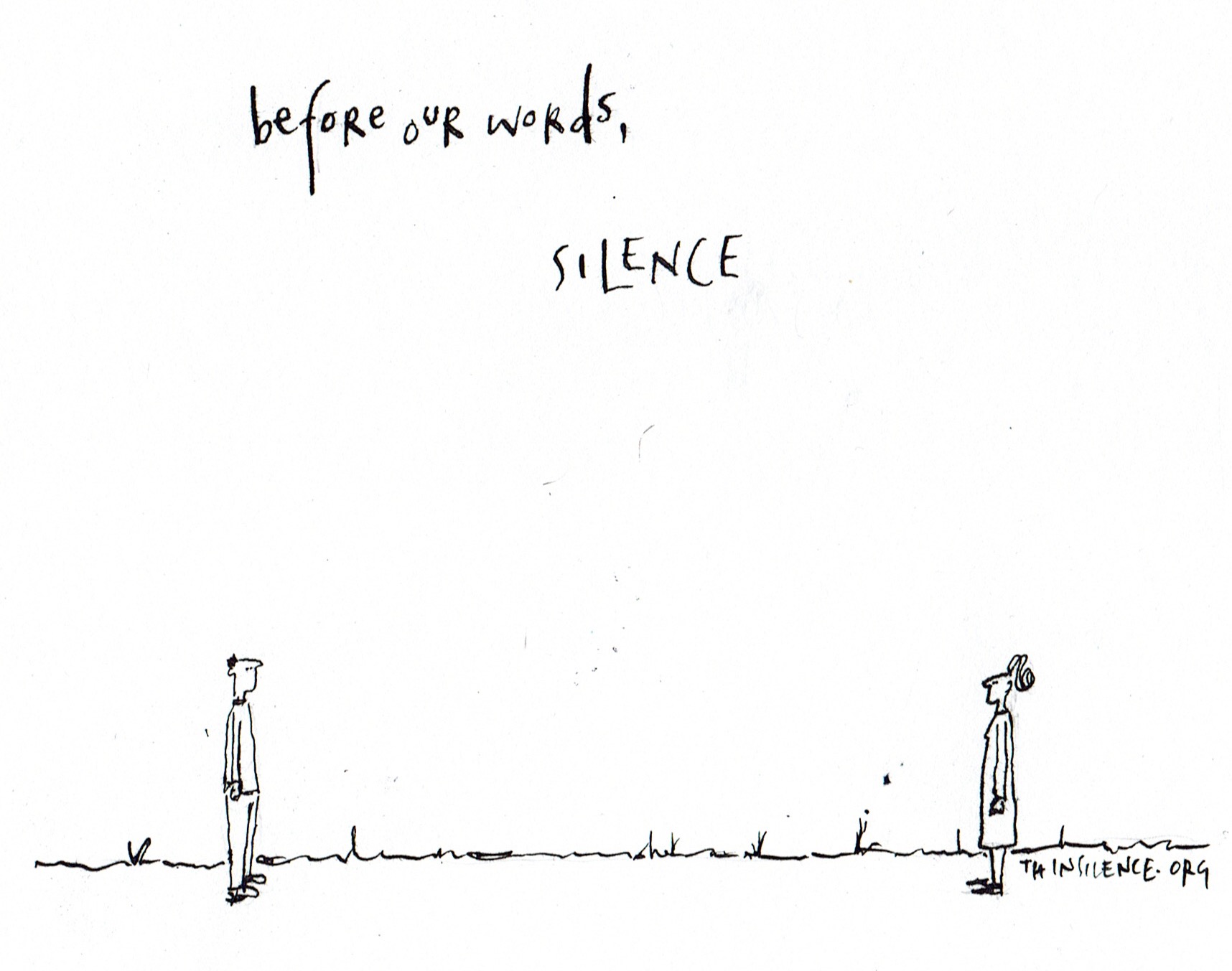
Filling in the silence

Silence will teach you more in a day than a world of voices can teach you in a lifetime.*
(Frances Roberts)

The decline of our personal momentum might be the great untold story of our time.  That electronic media, incoming, ‘breaking’, please reply, didn’t you see that, react right now, click here … this has a cost.  And the cost is our internal drive to initiate instead of to just react.

Someone’s driving.  It’s either you, going where you choose, or someone else, pushing you.**
(Seth Godin)

You and I, we are more than what we do and what we have.

There’s an inside and an outside to all of us, whether we tend to this or not.   Life appears richer when we join these up.

Henri Nouwen announced:

‘I must listen to my life telling me who I am.’^

It seems we struggle to do this, though.

I’ve just been listening to a radio piece on ten years of the smart phone.  The snippets of interviews suggested we don’t go to the silence when we have a moment but check our phones.  Sherry Turkle writes:

‘We build technologies that leave us vulnerable in new ways’.^^

We have yet to see just how and to what extent we will be more vulnerable.

Alongside our use of technology, we need to build in more silence and reflection.  Reception is always good and the service plans are free.  What we’ll be able to find is the kind of flow that takes us beyond boredom and through anxiety that being more reactive people leaves us with.*^

The doodle for today is about bringing the inside and outside world together through dreamwhispering and mindful doodling – something I’m putting together for a year of amazing journeying.  Get in touch with me to find out more: geoffrey@thinsilence.org.

(*Frances Roberts, quoted in the Northumbria Community‘s Morning Prayer.)
(**From Seth Godin’s blog: The motor.)
(^From Henri Nouwen’s Discernment.)
(^^From Sherry Turkle’s Alone Together.)
(*^A point made by Mihaly Csikszentmihalyi in Flow.)

The imbalance

It seems that occasionally giving up self-consciousness is necessary for building a strong self-concept.*
(Mihaly Csikszentmihalyi)

Only when an organism shares in the ordered relations of its environment does it secure the stability essential to living.**
(John Dewey)

For something beautiful to come into being for others, it’s often necessary to lose ourselves.

Mihaly Csikszentmihalyi is pointing out, though, that if we bring our art, we don’t lose ourselves at all.  We become stronger.

There is a choice before us on a daily basis.  To turn up to whatever the day means for us and to be absorbed by the environment, whether it be a person, persons or system of some kind.  Or we can turn up with our art: the way we think and feel and create.  To bring our art is to create imbalance within the environment.   It is in the offering to an other, others or system that possibilities open up that didn’t exist before.

There’ll be many times when it doesn’t work but sometimes it does, and the future changes.

(*From Mihaly Csikszentmihalyi’s Flow.)
(**John Dewey, quoted in Richard Sennett’s The Craftsman.)

Use it or lose it

God and the universe have already made their move.  If you’re waiting for another message then all you may hear is static.

They wait to see what we will do with these minds, these hearts, these hands.

It’s not only that if we don’t use it then we’ll lose it, as if who we are and what we can do is some fixed thing.  It’s about growing, developing, unfolding, building, moving beyond.

I’m still here and a little more

Gratitude is how we acknowledge our humble place in the universe, our place in the big dance.*
(Hugh Macleod)

The best way to predict your future is to create it.**
(Abraham Lincoln)

While many in the world are waiting to feel grateful about something, others know it’s a habit born of a choice to be honed every day.

As Viktor Frankl reminds us, although others may take everything else from us, they cannot take away our choice of how to respond.

(*From gapingvoid’s blog: Count your blessings.)
(**Abraham Lincoln, quoted in Ben Hardy’s These 20 Pictures Will Teach You More Than Reading 100 Books.)

The unbreakable thread

Rumbling with our story and owning our truth in order to write a more courageous ending transforms who we are and how we engage with the world.*
(Brené Brown)

Sometimes we look for great wealth to save us, a great power to save us, or great ideas to save us, when all we need is that piece of string.**
(Bill Moyers)

It was Ariadne who gave to her lover Theseus a ball of thread so he could enter and return from Daedalus’ labyrinth.

Yesterday, I was taking part in a storytelling workshop and it struck me that we were given a ball of thread in the form of writing.   We were able to enter our personal stories, gain something we needed and to return by writing them out.   I am grateful to have been a part of this and hearing people’s astonishing tales.

One form of story writing is personal daily journaling, making it possible to enter into the past, present and future stories of our lives as the protagonist and not the victim.

I do this with many trustworthy guides to strengthen the thread – Seth Godin, Alex and Erwin McManus, Brené Brown, Keri Smith, Elle Luna, Hugh Macleod and Mihaly Csikszentmihalyi are a few of mine.  You will have your own.  Find the right ones, the ones who open a bright future rather than leave you submerged in the past and the present, gather them around you when you open your journal, pick up your pen and begin to write the adventure.

How do I know I’m grown up?

When are they going to know that they’re now men and must put aside childish things?

[…]

But there is a consciousness in the body.  The whole living world is informed by consciousness.  I have a feeling that consciousness and energy are the same thing somehow.  Where you really see life energy, there’s consciousness.*
(Joseph Campbell)

Joseph Campbell’s concern was over our loss of myths that work for us when it comes to who we are and how we connect to our society.  He argues that the inability to find or create new ones is the result of the speed of change.  In noticing our energy, though, he identifies something that can help us navigate and shape humanity’s future.

Ben Hardy writes about his culture wall keeping him on track, this created by Hugh Macleod and gapingvoid.  It’s something I’m now exploring more in order to bring my own dreamwhispering and doodling more together:

‘The Culture Wall is intended to create an environment that continually reminds me of what I stand for and what I aspire toward. […] I call these artefacts TRANSFORMATIONAL TRIGGERS.’**

As we move from the myths of the past towards those we’re capable of creating for the future, we have become stuck in the experience economy beyond which lies a transformation economy.

Being grown up has, in part, meant different things for different ages.  We’re now in an age of unlocking and fuelling a greater personal capacity, able to carry us beyond our culture and society of self-indulgence into one that can facilitate making a difference in the lives of others.

I finish with the words of Seth Godin which Ben Hardy uses to open his article with:

Art isn’t only a painting.  Art is anything that’s creative, passionate, and personal.  An artist is someone who uses bravery, insight, creativity, and boldness to challenge the status quo.  Art is a personal gift that changes the recipient.  The medium doesn’t matter.  The intent does.  Art is a personal act of courage, something one human does that creates change in another.”^

(*Joseph Campbell, from Joseph Campbell and Bill Moyers’ The Power of Myth.)
(**From Ben Hardy’s article: These 20 Pictures Will Teach You More Than Reading 100 Books.)
(^Seth Godin, quoted in Ben Hardy’s article: These 20 Pictures Will Teach You More Than Reading 100 Books.)


A choice – more or less

Some people as they grow up become less […].  Some people as they grow up become more.*
(Eugene Peterson)

I suggest wisdom is precisely the wisdom to be present.**
(Richard Rohr)

Every day, I feel as though I am only beginning.

Today is my birthday.  I am 59 years old and still so much to be open to and discover, seeking to become more present, to others, to the world, to my God, and to my self.

Rohit Bhargava provides me with some help when it comes to moving into the life that is more and avoiding the life that is less.  In his latest iteration of Non Obvious he encourages me to practise the five habits of a trend curator: be curious, be observant, be fickle (i.e, not too be fixated on something), be thoughtful, be elegant.

These help me select and arrange and add value to the things of my life.  They are what I try to make available to others, so, as it’s my birthday, I would like to offer a gift: a dreamwhispering journey of discovery for someone.

All you have to do is email me at gb@geoffreybaines.com telling me why this is the right time for you to be open to more.

To be more or to be less – it’s a choice.

(*From Eugene Peterson’s Run with the Horses.)
(**From Richard Rohr’s The Naked Now.)

Reclaiming work

The capacity to be present to everything that is happening, without resistance, creates possibility.*
(Roz and Ben Zander)

There are no rules when it comes to developing our capacity to work – where our skills and knowledge being turned into greater artfulness.

We don’t have to “switch off” at 5pm, or at the end of the week and do what we really want to do.  There’s never been a time like this, when, armed with a smart phone, tablet, laptop or computer, we can open up greater areas of adjacent knowledge and connect with people who are as passionate as we are about something.

In this way, everyone is at least a skillful sub-contractor, bringing their ever-developing best to what they are doing.  You are not your job description, you have always been more

‘Let us allow our wild spirits to roam unfettered and unbound.  Let us roar and howl and voice our deepest yearnings without caring about what other will think about us.’**

(*From Rosamund and Benjamin Zander’s The Art of Possibility.)
(**From Keri Smith’s The Wander Society.)