The slower we walk the farther we go

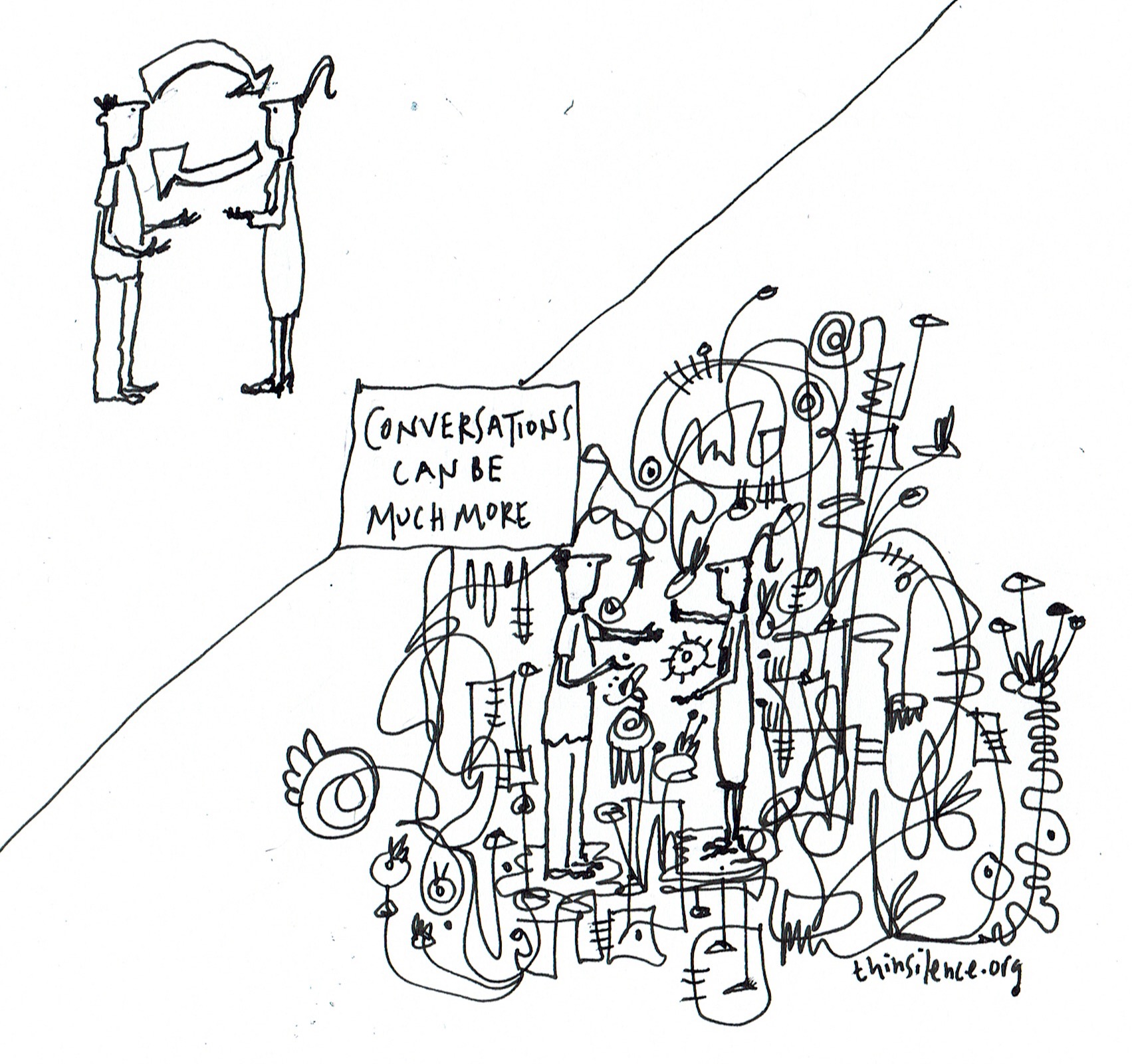
How far would we make it through today without relationships, without others helping us to find what we need or to do what we must do?

Or put it another way: how many relationships will we invest in today?

We know relationships are important – the bus driver who’ll help me get to work today, the co-worker who’ll work on the project.

To build relationships we need to pay attention, but attention needs some help:

‘To be its best, Attention, from inside itself it seems, summons Ease.  Ease emerges and dips and saunters, draping itself around Attention’s focus, allowing it dimensions greater than focus alone can produce.

[…]

We bought into an equation […].  Rushed = Important.  Tense = Focused.  Tight = Professional.  Pressured = Alive.  They are all the same thing.  And not one is true.’*

It’s counter intuitive but we are rediscovering that the more time we invest in relationships the more we produce:

‘Walking, I realised long ago in another desert, is how the body measures itself against the earth.’**

(*From Nancy Kline’s More Time to Think.)
(**From Rebecca Solnit’s Wanderlust.)


The city’s unfinished

Take deep-dive journeys to the place of most potential.*
(Otto Scharmer)

She walked through the city of endless building works.

It can never leave things be, as if it has more questions than answers.

Never one to miss a metaphor, she realises, here is a picture of our lives.

She determines to keep walking, our of judgement, cynicism and fear.

(*From Otto Scharmer’s Theory U.)

I am from here

I am from here.

I was born somewhere else but I am from here.

I have lived in many different places through the years but I am from here.

I face my challenges that disorientate but I am from here.

Being here, fully present, belonging, is more about finding the right Self than it is about finding the right place.


Deep time therapy

The sense of deep time brings a deep peace with it, a detachment from the timescale, the urgencies, of daily life.  Seeing these volcanic islands and coral atolls, and wandering, above all, through this cycad forest on Rota, has given me an intimate feeling of the antiquity of the earth, and the slow, continuous processes by which different forms of life evolve and come into being.  Standing here in the jungle, I feel part of a larger, calmer identity; I feel a profound sense of being at home, a sort of companionship with the earth.*
(Oliver Sacks)

The tree-lined reservoir was only a few miles from my home in the compacted mill town of Oldham and I was standing among its tall pines on a windy day, mesmerised by the swaying of their straightened trunks, creaking and moaning as they adapted and resisted the wind.  I don’t know how long I was there.  It felt as if it was a long time and it felt as if it was a short time, and even now, maybe fifteen years later, I am still deeply moved by the memory.

Winston Churchill had reflected on the adversarial layout of the House of Commons:

“we shape our buildings and afterwards our buildings shape us”.

The same must be true of our towns and cities.  They are human creations shaping our thinking and feeling and behaviour directly and indirectly.

Nature is another place all together.  I’m not saying one is wrong and one right, but they are very different.

Deep time for me means the deep past and the imaginable future being somehow present in the now, holding a sense of both my smallness and bigness.

For all my present home of Edinburgh represents many centuries of inhabitants and all their buildings, but it’s the cities volcanic hills that provide me with a sense of deeper time – some 350 million years, and outside the city, the hills and trees and skies take me into deeper possibilities.

‘Look at this Indian paintbrush,” he said.  “Have you ever seen this colour of magenta?”

[…]

A stunning boulder left behind by glaciers loomed large on a slope speckled with yellow and orange lichen.  Chanterelle mushrooms looked like the gold fringe of a fallen log.  It was a good stopping place for lunch.’**

(*From Maria Popova’s Brain Pickings: Oliver Sacks on Nature’s Beauty as a Gateway into Deep Time and a Lens on the Interconnectedness of the Universe.)
(**From Terry Tempest Williams The Hour of Land, quoting her father as they walked along the Teton Crest Trail in the Grand Teton National Park.)

The disadvantage game

When we disadvantage others to get ahead, we disadvantage ourselves.  Many will decry the notion that every person has some kind of art to bring into the world, but what do they offer instead, what’s their advantage in believing that?:

Art isn’t only a painting.  Art is anything that’s creative, passionate, and personal.  An artist is someone who uses bravery, insight, creativity, and boldness to challenge the status quo.  Art is a personal gift that changes the recipient.  The medium doesn’t matter.  The intent does.  Art is a personal act of courage, something one human does that creates change in another.”*

(*Seth Godin, quoted in Ben Hardy’s blog: These 20 Pictures Will Teach You More Than Reading 100 Books.)

The most wonderful world of all

This is an amazing planet.

Yes, it produces nettles and hogweed but it also holds the possibilities of ice-cream and chocolate and espressos.  How does that happen?

We know we are very capable of taking the commodities from the planet and making many things from these.  More and more faster and faster is not the problem.  Adding value is:

‘Curation is about selecting and arranging to add value – defined in the broadest possible sense.’*

Just before writing these words about this critical element of curation in the 21st century, Michael Bhaskar points out that good curation will demand we move out of our comfort into the uncomfortable to bring things of value into being:

‘Now more than ever, we need to argue that good curation takes us beyond our comfort zones.’*

It’s not good enough to blame the system, to point at others and say it’s their fault; we all need to take responsibility as someone who sucks stuff in and churns stuff out.

If we are to do this, I think we will have to slow down to see what is possible:

‘Walking shares with making and working that crucial element of engagement of the body and mind with the world, of knowing the world through the body and body through the world.’**

The faster we move, the harder it is to change the trajectory we’re on.  Walking, going slow, provides us with the opportunity to see many new directions, to see a wonderful world and imagine its future.

(*From Michael Bhaskar’s Curation.)
(**From Rebecca Solnit’s Wanderlust.)

The blessing

The challenge is to find the resolve to bring your work to someone who will benefit from it. To learn from what doesn’t work and then to do the work again.*
(Seth Godin)

Curation that doesn’t have the sense of taking care, preserving, nurturing is more likely to lead to negative outcomes.**
(Michael Bhaskar)

There are two important things to keep in mind and heart when it comes to a blessing.

One: You are the blessing so it’s important to have identified and developed what it is you want to bring to others: values x talents x energy and much more.

Two: It’s only a blessing to those who want to receive what you bring – if it’s not what they want or the right time then maybe ask what would be helpful before you move on?

(*From Seth Godin’s blog: Batting average is a trap.)
(**From Michael Bhaskar’s Curation.)

She dreams in the now

But sometimes life isn’t just about following your dreams.  Sometimes life is just about happily managing the here and now.’*
(Hugh Macleod)

Dreams are not so much about destinations, they’re about journeys.  If they don’t alter how we live today, being present in the small things as well as the big things then it’s probably not a dream worth having.

The question I find myself asking each day is: How can I live in some creativity, some generosity and some enjoyment today?

(*From gapingvoid’s blog: Enjoy just being alive.)

Pursuit

I don’t have enough discipline to keep a diary.  I don’t think I’m important enough to do that.*
(Nancy)

Unhappiness can lead to new beginnings. […] Discontent can be a source of growth and inspiration.**
(Chris Guillebeau)

The thing you really want to do, to bring into the world, may not be this, but you will probably never get to what it is unless you do this.  This is your pursuit.  George MacDonald encourages us in this way:

“If people would do what they have to do, they would always find themselves ready for what came next.”^

There’s probably a ton of learning and growing to be done in this, so figuring out what you can really do in this makes it possible to move on to the thing that comes next.  Just being able to do this, to stick with something when others give up, may be the remarkable thing you are able to do and others need to see and hear:

‘Not curating, just letting things spill out and pile on one another, is in many ways an easy option; curating well is tough, patient stuff.^^

(*Nancy, quoted in Sherry Turkle’s Alone Together.)
(**From Chris Guillebeau’s The Happiness of Pursuit.)
(^George MacDonald, quoted in the Northumbria Community‘s Morning Prayer.)
(^^From Michael Bhaskar’s Curation.)

Condiments

Friendship is probably one of the highest expressions of what it means to be human.

To overcome differences that demand this or that and to find the third possibility for journeying together is a really amazing thing to be able to do.

Not everyone is able to do this, we know.  It demands learning the skill or art of “making place for the other” in our lives, as Karen Armstrong describes it.

Seth Godin caught my attention with his condiment blog, in which he names his five favourite food condiments:

‘With nothing but these five condiments, I could happily eat beans, kale and rice for the rest of my days.’*

I’ll let you go to Godin’s blog to see what the five condiments are.

He got me thinking, though, about how people who become friends or offer friendship become the condiments that add flavour to our lives.

Condiments give rather than take.

Figuring out how we can be friends, or at least be friendly, is one of the biggest adventures we can engage in.  Firstly, I offer some words from Margaret Meek that have become folklore, and then some words from Kio Stark that open up the possibilities for this in an everyday way – it’s a little bit nervy if you’re an introvert like me but it’s all a matter of scale:

“Never doubt that a small group of thoughtful, committed citizens can change the world.  Indeed, it is the only things that ever has.”

‘Talking to people I’ve never met before is my adventure.  It’s my joy, my rebellion, my liberation.  It’s how I live.  When you talk with strangers, you make beautiful and surprising interruptions in the expected narrative of your daily life.  You shift perspective.  You form momentary, meaningful connections,  You find questions whose answers you thought you knew.  You reject the ideas that make us suspicious of each other.’**

(*From Seth Godin’s blog: First annual condiment showcase.)
(**From Kio Stark’s When Strangers Meet.)