What will you make out of this?

Shapes loom out of the darkness, uncertain and unclear: but the hooded stranger on horseback emerging from the mist need not be assumed to be the bearer of ill…

The night is large and full of wonders…*
(Lord Dunsany)

We all are haunted by something deep inside us, and often, a lot of our best work is the result of us trying to come to terms with this.

So what began life as a negative, over time became our greatest creative asset.  If that’s not a primary form of spiritual redemption, I don’t know what is.**
(Hugh Macleod)

Don’t write that person off.  There’s more to them than meets your eye, than meets their own eye.

We all get things wrong, make mistakes, but some of the most valuable things in life can be found among the most difficult experiences, even when we get things horribly wrong:

“The good things which belong to prosperity are to be wished, but the good things that belong to adversity are to be admired.”^

Too soon do we give up on others, give up on ourselves.

It’s a grace thing.

Grace isn’t some magical, pixie-dust thing.  Basically it’s a realisation that there’s nothing to stop us from keeping going: the universe and God aren’t going to get in our way.   No matter what has happened, we can begin again, a kindness we make available to ourselves and to others.

There is more.

(*Lord Dunsany, quoted in the Northumbria Community‘s Morning Prayer.)
(**From gapingvoid’s blog: Spiritual redemption.)
(^Seneca, quoted in Mihaly Csikszentmihalyi’s Flow.)

Believing is seeing

It is so absolutely quiet that each person can hear the heartbeat of the person to his right or his left.*
(Alan Lightman)

When you change the way you see things, the things you see change.**
(Wayne Dyer)

They sat together listening and talking, expecting to find some beauty in each other.

This had been their choice on entering the room.

(*From Alan Lightman’s Einstein’s Dreams.)
(**Wayne Dyer, quoted in Ben Hardy’s These 20 Pictures Will Teach You More Than Reading 100 Books.)

And I, I did not know

Until your dreams become emotional, they won’t be powerful enough.*
(Ben Hardy)

I have no special talents.  I am only passionately curious.**
(Albert Einstein)

We can over-focus on where we have come from – where we were born, our education, our looks and speed and height and such.  What about where we are going – our goals, our choices, our imaginations, our transformations and such

Rather than rue the person we are, better to design rites and rituals to become the person we want to be.

Bernadette Jiwa points to three curiosities: diverse, empathetic and epistemic.^  In other words be curious in a wide as possible way, notice the things you are most deeply curious about and turn these into deeper knowledge by trying them out.

It’s never too late to create our own rites and rituals.  The prefix “re” is a great gift to us.  Now we can recommit, return, realign, recapture, relearn.  When overlaid with daily writing, we spot who we are and what we must do:

“Writing organizes and clarifies our thoughts. Writing is how we think our way into a subject and make it our own. Writing enables us to find out what we know — and what we don’t know — about whatever we’re trying to learn.” ^^

There’s a place in the Judaeo-Christian scriptures telling of when Jacob is on the run, before he became renamed (theres another “re”) as Israel.  He goes to sleep and has a dream about a ladder reaching from the earth to heaven.  In the morning he says, “God was in this place and I did not know,” except the Hebrew apparently says, “God was in this place and I, I did not know.”

Now we can all know who we are and what is our contribution.

(*From Ben Hardy’s blog: These 20 Picture Will Teach you More Than Reading 100 Books.)
(**Albert Einstein, quoted in Wilson McNair’s Hatch.)
(^Bernadette Jiwa, quoted in Wilson McNair’s Hatch.)
(^^William Zinsser, quoted in These 20 Picture Will Teach you More Than Reading 100 Books.)

Adventure or escape

Do not search for the answers, which could not be given to you now,
because you would not be able to live them.
And the point is to live everything.
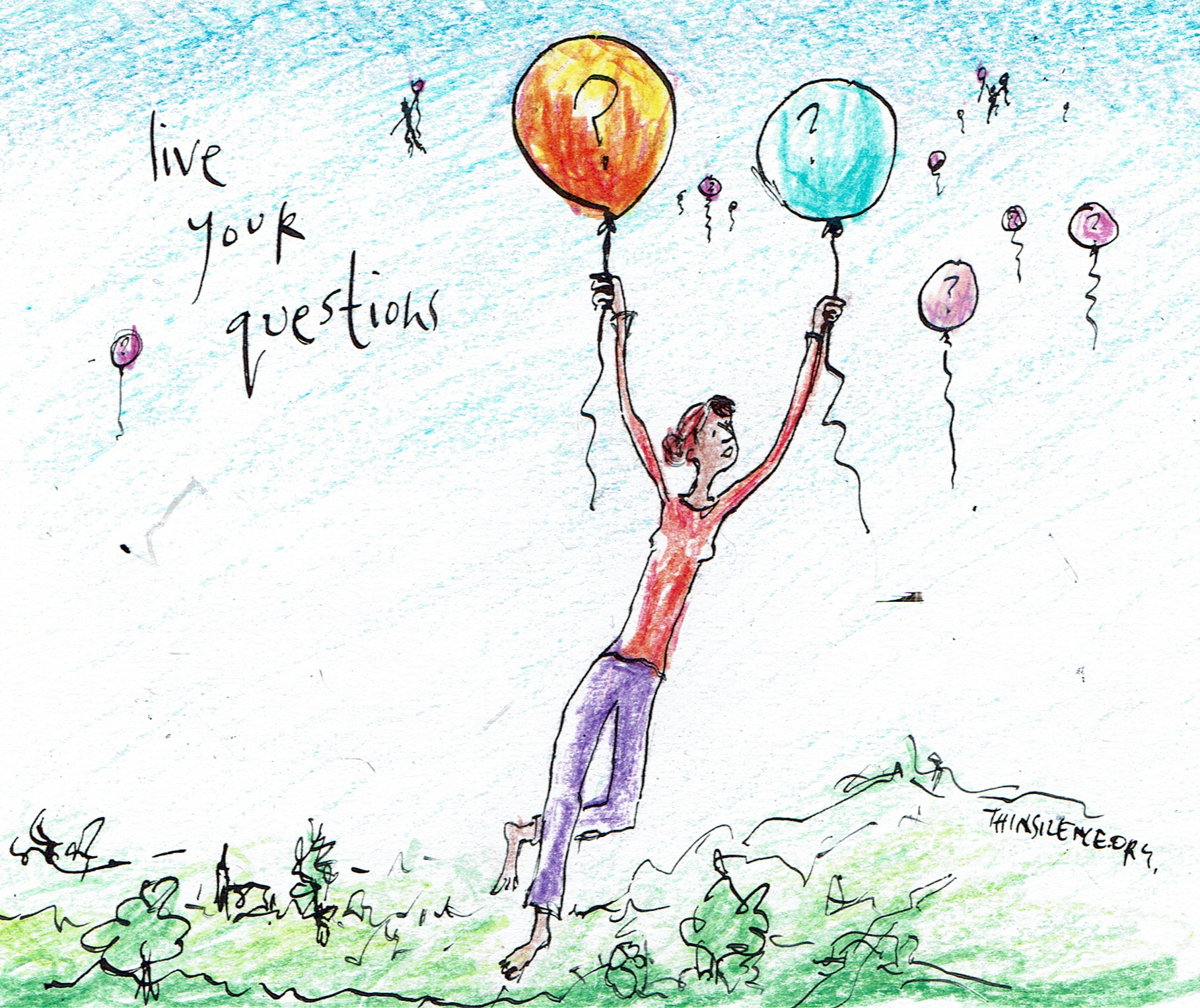
Live the questions now.*
(Rainer Maria Rilke)

There is no greater adventure than to explore every day what it means to be human, not as someone else, but as who we are.

Adventure is to enter into something, escape, to leave something.

When we follow our questions, boundaries become borders to be crossed.

While some search for the perfect job, others create their own.

(*Rainer Maria Rilke, quoted in the Northumbria Community‘s Morning Prayer.)

Amateurs and dilettantes


Willpower is for people who are still uncertain about what they want to do.*
(Helia)

Longing is the deepest and most ancient voice in the human soul.  It is the secret source of all presence and the driving force of all creativity and imagination: longing keeps the door open and calls towards us gifts and blessings of which our lives dream.**
(John O’Donohue)

In their original meanings, an amateur is one who loves what they do and a dilettante someone who takes delight in.   In exploring flow and identifying amateur scientists who made significant breakthroughs, Mihaly Csikszentmihalyi writes:

‘They simply did what they enjoyed doing.’^

At the end of our days, life doesn’t get better than this.  If we end up being paid for this and bring rigour to what we do, then we can count ourselves blessed.

We can all pursue what we love and delight in with rigour.  It may be not where the big money is found but there are lots of significant things big money isn’t interested in.

(*Helia, quoted in Ben Hardy’s These 20 Pictures Will Teach You More Than Reading 100 Books.)
(**From John O’Donohue’s Eternal Echoes.)
(^From Mihaly Csikszentmihalyi’s Flow.)

My peace I give to you

Isolated in the freezing night, [Icelanders] used to chant their poems huddled around fired in precarious hurts, while outside the winds of the interminable arctic winters howled.  If the Icelanders had spent all those nights in silence listening to the mocking wind, their minds would have filled with dread and despair.  By mastering the orderly cadence  of metre and rhyme, and encasing the events of their own lives in verbal images, they succeeded instead in taking control of their experiences.*
(Mihaly Csikszentmihalyi)

When Jesus left his peace with his followers I have to wonder whether he knew that the best things would come from a place of peace that we each find, rather than the rush and push, the  hotheadedness and bloodymindedness for achievement, we can fall into valuing.

It may work in the short-term but the Icelandic winter reminds us that life is about the long-term and we have to find the kind of peace that makes it possible to turn up with the best solutions again and again.

Mihaly Csikszentmihalyi is exploring the flow of thought, and it is in the different things we value and enjoy thinking about that we will find peace.  Warren Berger reminds us that peace is very practical, very practical indeed:

‘Part of being able to tackle complex and difficult questions is accepting there is nothing wrong with not knowing.  People who are good at questioning are comfortable with uncertainty.’**

(*From Mihaly Csikszentmihalyi’s Flow.)
(**From Warren Berger’s A More Beautiful Question.)

Three-flowing

It’s ever easier to weave our own reality, to find a bubble and to reinforce what we believe with what we hear.  We can invent our own rules, create our own theories, fabricate our own ‘facts’.

It turns out, though, that when your reality is based on actual reality, it’s a lot more stable and resilient, because you don’t have to be so vigilant about what you’re going to filter out.*
(Seth Godin)

Contrary to what we tend to assume, the normal state of the mind is chaos.
(Mihaly Csikszentmihalyi)

In his groundbreaking work on how people find happiness in their lives, Mihaly Csikszentmihalyi, provides three flows that proffer an alternative way for ordering our lives than routine or some unquestioned order:

‘The integrated cells and organs that make up the human organism are an instrument that allows us too get in touch with the rest of the universe.’**

The first is the body in flow, when we are lost in the beauty and wonder of the world through which we move – in small and large and all things between – as the walking sensor arrays we are:

‘The body is like a probe full of sensitive devices that tries to obtain what information it can from the awesome reaches of space.’**

It is through my body that I am writing to you and through yours that you are receiving this – the technology between us only allows us to extend our reach to one another:

‘It is through the body that we are related to one another and to the rest of the world.  While this connection itself may be quite obvious, what we tend to forget is how enjoyable it can be.  Our physical apparatus has evolved so that whenever we use its sensing devices they produce positive sensation and the whole organism resonates in harmony.’

Food and travel and sex are some of the simplest ways of organising what otherwise might become chaotic but then we do more, we play mind games: the flow of thoughts.

Memory and its organisation allows what comes to us from the past to be so important for arranging the present.  Philosophy, science, and history are ways of thinking that we enjoy and can be lost in.  If we named the things we enjoy thinking about, they will likely fall into one of these.  We can so love to think about certain things that we can be lost in thought.

We are increasingly opening ourselves to what is around us rather than only within us, through what our bodies are sensing and our minds are thinking, but, as we know, there is more: the flow of work, of making something out of what we experience and think about and feel for.  Largely we may describe people as scientists or sales-people or artists or machinists but the diversity or individuality is far greater.  As Anne Lamott holds out:

‘The world has an awful beauty.’^

But with extras.

(*From Seth Godin’s blog: Reality-based reality.)
(**From Mihaly Csikszentmihalyi’s Flow.)
(^From Anne Lamott’s Hallelujah Anyway.)

We crave such things

I learned the beauty of simple things.  And the simplest and most sophisticated thing I experienced was drinking tea.*
(Paulo Coelho)

The walk along the old railway line produced the unexpected and the wonderful that had I stopped to take in a fraction of them, I would n’t have completed the journey in the day: the river that flowed through the trees, the surprise of a field between the trees, the haphazard pattern of different-coloured flowers, the scents and fragrances carried on such fresh air, the remains of platforms that had not seen a train since 1967 … .

The one thing I did allow myself and take in for longer was the  field golden with a crop of barley or oats – I watched the waves of movement created by the warm breeze, brushing what seemed an endless palette of yellows.

All of this made more poignant the reading of Maria Popova’s Brain Picking’s Tiny Perfect Things, in which she quotes Hermann Hesse:

“My advice to the person suffering from lack of time and apathy is this: Seek out each day as many as possible of the small joys.”**

The title of Popova’s blog echoes the title of a book from poet Mary Higgins Clark, illustrated by Madeline Kloepper.  Not enough time, too much time … here are two of our greatest 21st century issues or challenges (how strange they should both exist together in such large amounts).  Becoming noticers of small things can save us from boredom or criticising or criticism:

“in the emotional world a small thing can touch the heart and imagination every bit as much as something impressively gigantic”.^

It doesn’t have to be a walk through the countryside.  We can walk a familiar urban path more slowly and notice the things we often miss or that are only visiting this footpath at this time on this particular day.  We only need slow down a little and look around.  How this becomes a part of the larger day and what we have to do may well feel magical:

‘Each sensory organ, each motor function can be harnessed to the production of flow.’^^

(*From Paul Coelho’s Aleph.)
(**Herman Hesse, quoted in Maria Popova’s Brain Pickings: Tiny Perfect Things.)

(^Henry Beston, quoted in Maria Popova’s Brain Pickings: Tiny Perfect Things.)
(^^From Mihaly Csikszentmihalyi’s Flow.)