how to complete this sentence?

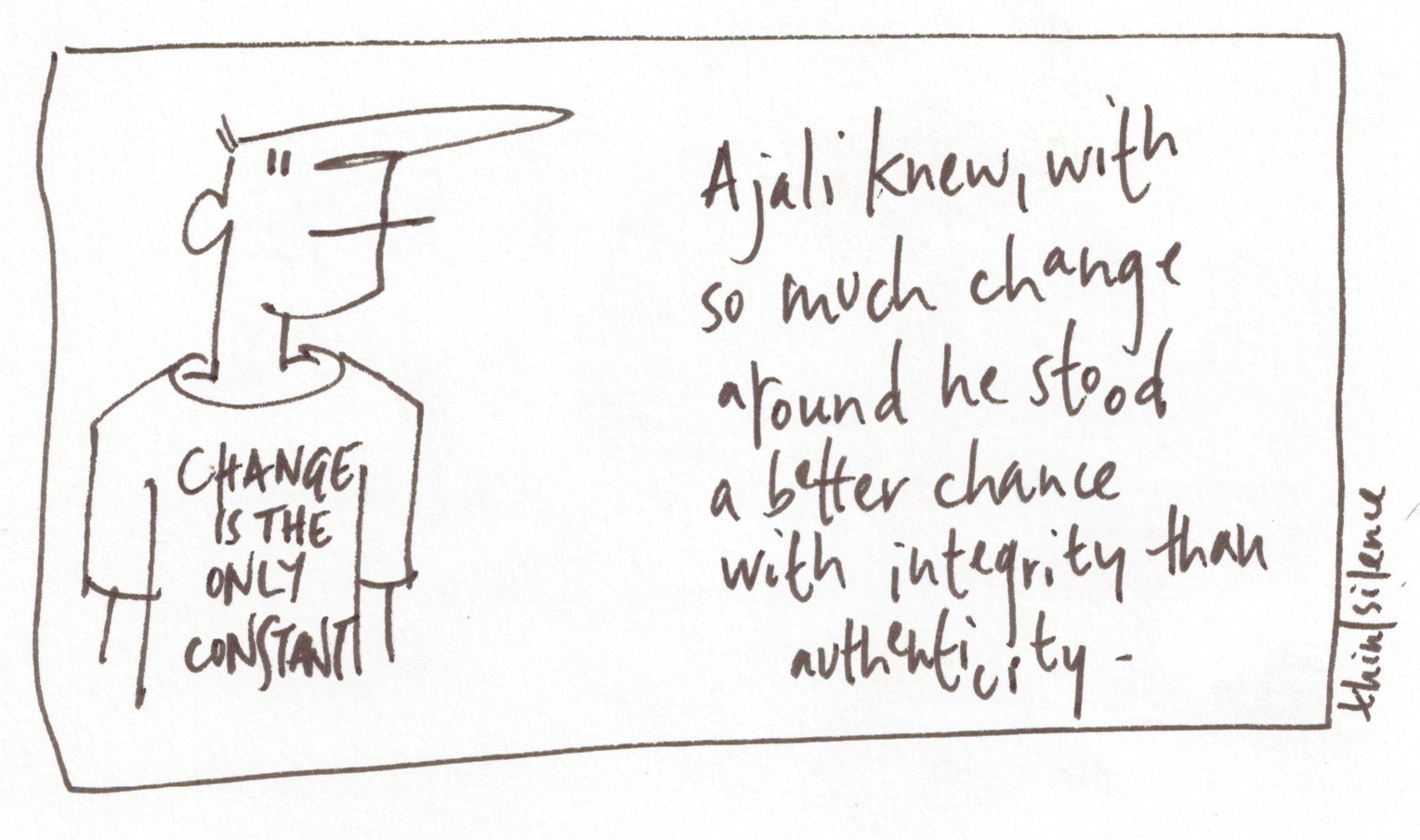
4 ajali knew ...

As I started the day, I’d been thinking about how there’s more to us than we know and what this means for the future in way of new possibilities before us:

‘When you are too familiar with who you are, you
have become, in fact, a stranger to your self.’*

I took notice of this because I realise I’m being challenged to step out of the familiarity of me.  There is a fear in this.  I see this fear in others too – a fear towards …

I couldn’t complete this sentence.

What is it we fear?  Change?

Even when there’s a possibility of moving away from dissatisfaction or frustration or hurt or loneliness we can find it hard to move.

We probably feel more uncomfortable about change rather than fear it.

So, is it the unknown that we fear – the unknown we find in ourselves and the unknown we may find if we leave the predictable road?

John O’Donohue describes the unknown as our closest companion.  Interesting.  If he means I walk each day inhabited and surrounded by so many things I don’t know, he’s right.  My future Self calls to me through the unknown; I moved towards it when I live in awareness and innovation and love and courage

‘Wisdom is the way you learn to decipher the unknown,
and the unknown is our closest companion.  So wisdom
is the art of being courageous and generous with the
unknown, of being able to decipher and recognise its treasures.’

More than theory, this is a path I find myself on.  Seth Godin has got it right:

The question isn’t, Is it possible for me to do that?  
Now the question is, Will I choose to do it?

Encounters with the new and the unknown allow us to see more of who we are.

Over to you.

(*From John O’Donohue’s Anam Cara.)
(Cartoon: In his blog, Seth Godin writes, ‘Perhaps the only truly authentic version of you is just a few days old, lying in a crib, pooping in your pants.’  After that it’s all change, by choice.)
 

tribes of possibility

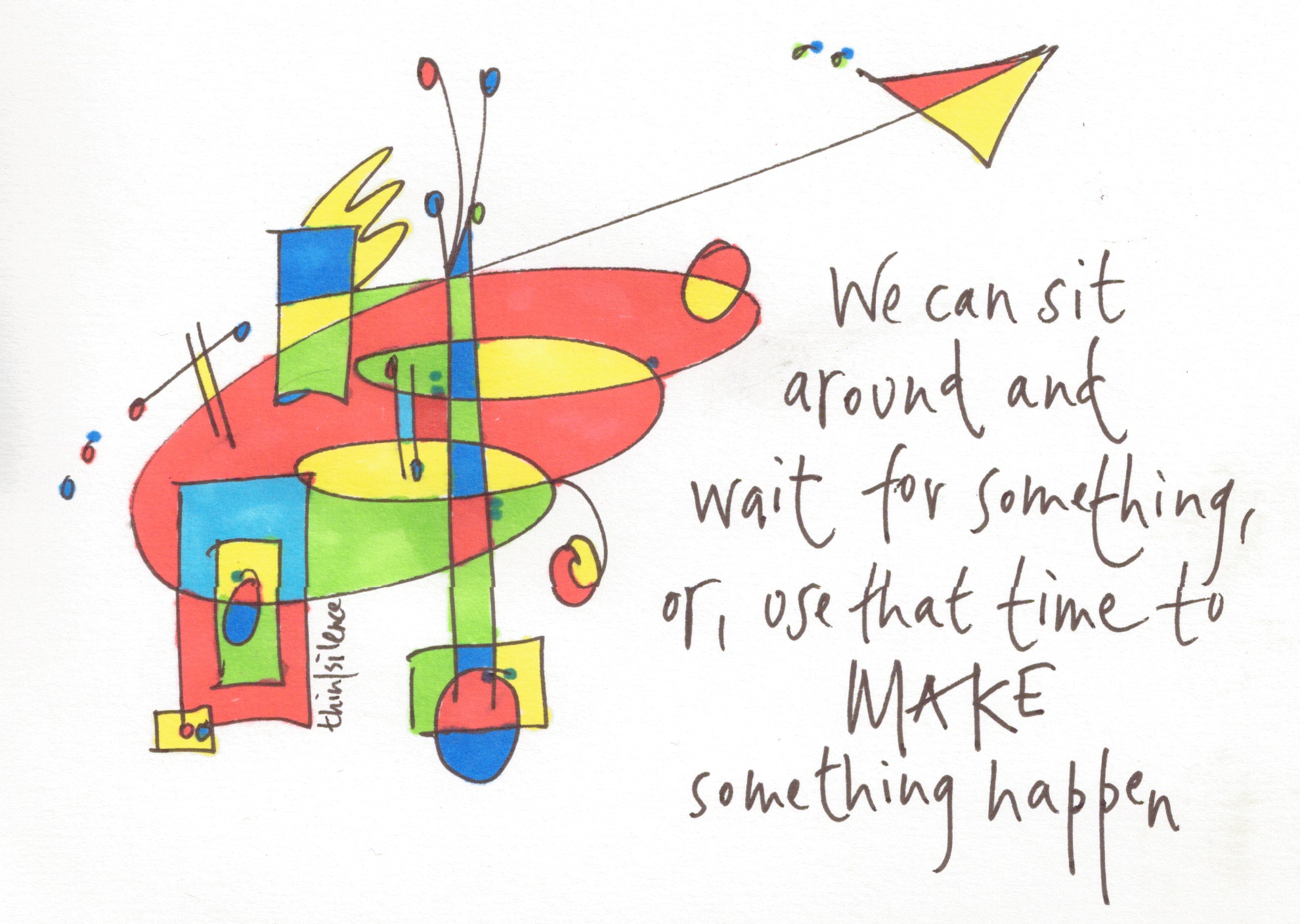
3 we can sit around and wait ...

What we are able achieve together is greater than what we can as individuals.*

It might well be that for many a group for creativity is the best way to be released into imaginative and creative work, proffering opportunities people might never have imagined or picked up on otherwise.

More than this, there is evidence to show that people being fascinated and absorbed in something greater than themselves, a cause that is worthy, noble, and brave, allows them to deal with their own wounds and failures in a way that is better than therapy.**

From this perspective, everything we’ve experienced in our lives has potential value towards creativity and generosity.

We all have a choice.

We can regret that our lives appear to be aimless and opportunities come to others but never  to us, or, we can make something happen with others – even trying to find others to engage with in a quest makes things happen.

Don’t wait for something to happen.  Find a tribe, or start a tribe, and make something happen.^

‘Frequently in a journey of the soul, the most precious
moments are the mistakes.  They have brought you to
a place which you would otherwise have always avoided.’^^

(*There are caveats which need to be attached to this – there are elements of creative development which can be better pursued individually, it requires everyone to fully contribute their genius, … things like that), but basically scalability and sustainability require more bodies.)
(**Whilst therapy for many is crucially important, for many it can be what John O’Donohue labels woundology – the ongoing reopening of wounds, never allowing the more natural healing of lives, valuing all things as experiences to be invested in a greater mission.)
(^Seth Godin’s Tribes is a great resource.  I’m about to read it again because of what I’ve been thinking about today.)
(^^From John O’Donohue’s Anam Cara)

we are our memories

2 you can live your life ...

We ponder our memories so we might live more presently to our lives and environments and relationships, integrating as much as we can so we might be fully awake and, so, fully alive.  The mindful person not only wants to experience something but to discern the meaning of it.

In his novel Invisible Cities, Italo Carvalo has his character Marco Polo describing a bridge to Kublae Khan stone by stone.  The Khan responds, “Why do you speak to me of the stones?  It is only the arch that matters to me.”  Polo simply replies, “Without stones there is no arch.”

Like the stones which form the arch, our lives are formed by our memories, including those from our future.*

The question which forms out of the importance of being mindful to the memories which form our lives, is this: If I am not grateful for who I am, can I have a proper understanding of myself, and will I then go on to do the things I must do?

(*The narrative arc of a story, like the arch of a bridge, is made up of words, sentences, sequences, scenes, and acts.  Robert McKee in his significant Story points out that what a good story does is help us to reflect upon our lives, not just to experience it.)
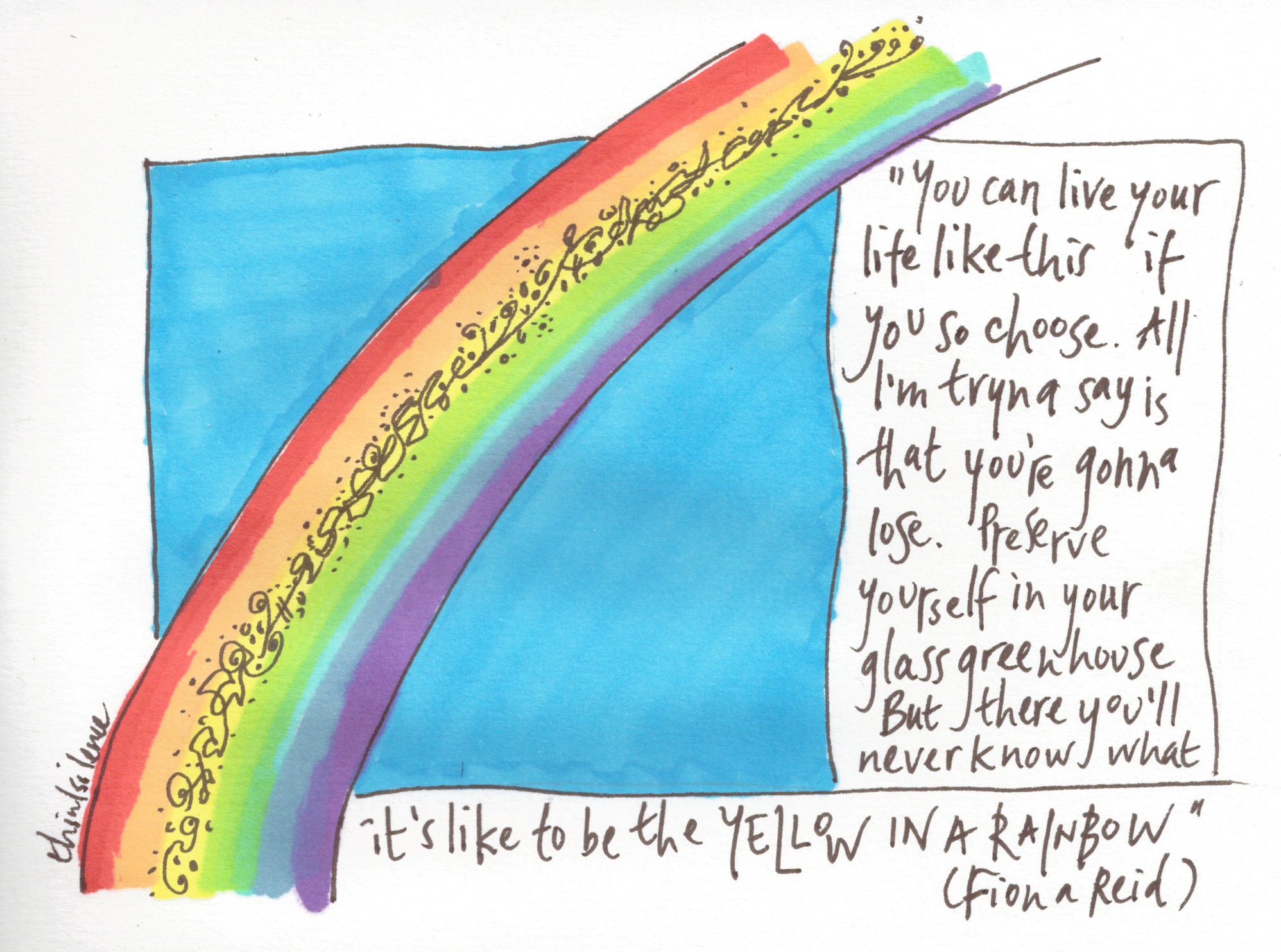
(The words on today’s cartoon are the lyrics from a song I loved on first hearing, by Fiona Reid – Yellow in a Rainbow (you can check out more of Fiona great sound and songs here).

memories of a future

1 our obituaries ...

Human memory is an amazing thing.  We might talk of computers having memory, but the two things are completely different.  When you purchase a computer, you’re keen to check out how much memory the different models have to make sure it will do what you want it to.  Every computer, though, will open your files in the way you saved them.  You’d  be sorely frustrated if the computer decided to lose bits and change things around.

Humans store things differently.  Somebody who remembers a list of facts will tell you there’s a way to do this in order to recall everything correctly – but look how long they take to do it.  It’s a nice trick but we haven’t got enough time to do that with everything.  Whilst we’re asleep the brain stores our memories in ways we can recall and use – rarely are they complete but we don’t tend to think of this meaning they’re corrupted.*

A crazy thing about the way my brain stores memories is the interconnected way it does this.  I can be walking along think about one thing when I catch a smell attached to a memory and I’m flooded with memories of places and times and experiences I didn’t ask for.

Sometimes I experience the same thing forwards.  Some possible future a friend imagined for me a couple of years ago offers itself as a memory of a future I would very much enjoy being a part of.  This is not about forecasting or predicting the future; it is more about a faint future possibility which I’m attracted to and decide whether or not to incorporate into my life – a future memory.

Memories of a future are important because they ask, What do you want to be, to do, despite your past?  They offer the possibility of living now what I hope for the future: I see how much I will have to use and can anticipate this now; I can see how far I have travelled and take a step now.

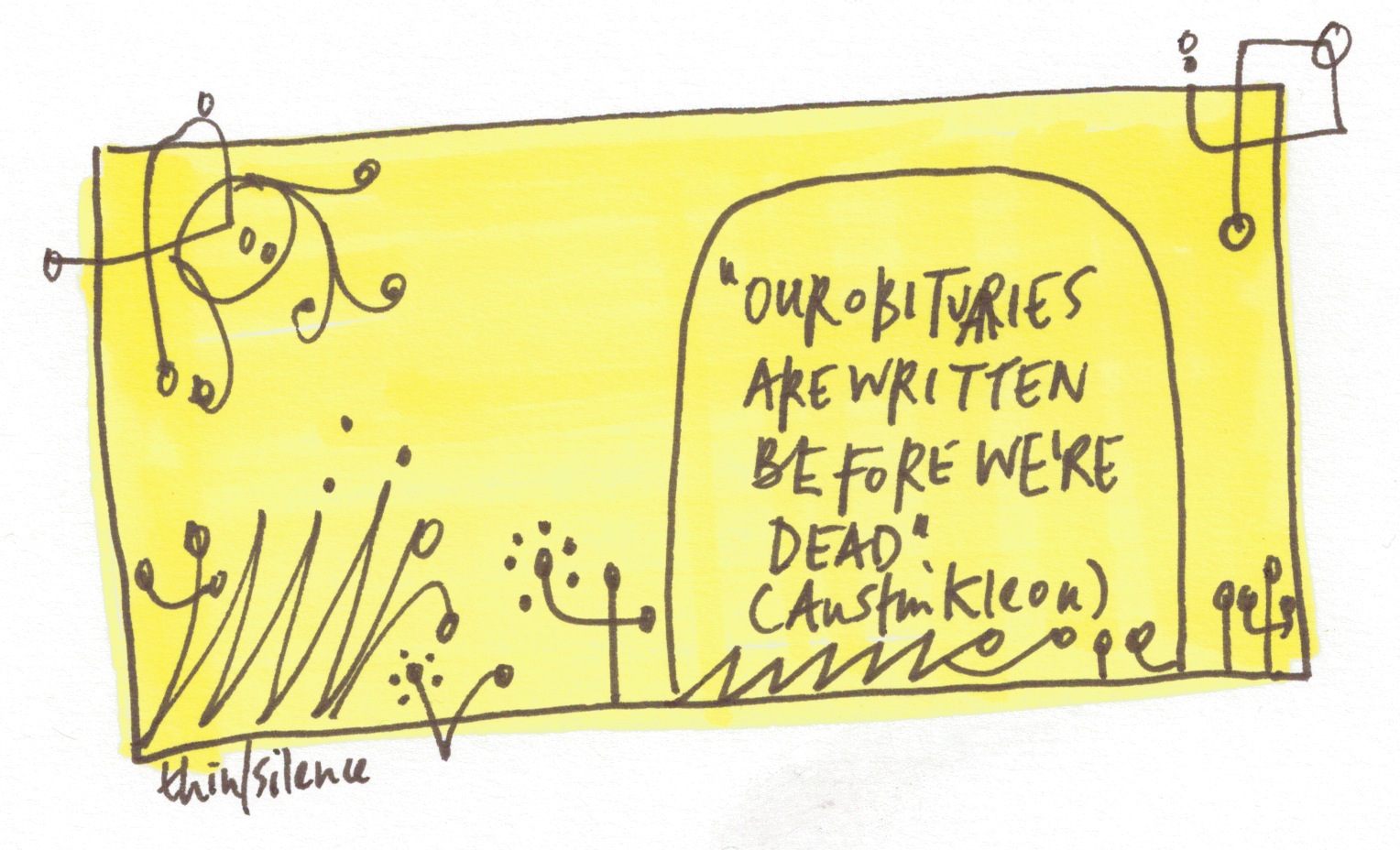
‘Our obituaries are written before we’re dead.’**

(*It is possible to have totally corrupted memories, remembering things which never happened,)
(** Austin Kleon in Show Your Work.)

harvests

31 develop and grow ...

Harvests are important to Humans in more ways than one – we realise we can produce fruit from our lives as well as out from nature.*

Industrialisation has set us free from many of the vicissitudes of nature and life, but it has also held many back from what they can be.  We have traded autonomy and mastery for stability and guarantee.

Things are changing, though.  On the one hand, industries can no longer guarantee work for life, whilst on the other, we are understanding more of what every Human is capable of contributing through their lives being produces of art and goodness.

It is not with a sense of superiority we pursue this hope, but in the crazy belief there is more for me and you to do than we know in this moment, how it is possible to keep pushing further and further** what we love to be about and to keep it fresh and new.

Have a great harvest today, this week, this month, this year, this life.

(*We realise we are part of nature, but are able to step outside and begin shaping nature.)
(**I love Seth Godin’s word for this = zooming.)

the curve of imagination

30 it was supposed to be ...

Sometimes life requires we take a practical approach which might be described as linear: this plus this plus this equals this: just use the door to get into the car, you don’t have to tip the car up it’s nose and parachute through the open hatch – as imaginative as this might be.

Other times, life needs us to take an imaginative approach which allows for a less than straight path to be taken, this times this times this produces this.  It takes a more generous view of the world: There is more than we know and all things are connected.

To foster and train our imaginations, we require opportunities to focus, to concentrate – which sounds hard and so we don’t do it.  The reality of this training can often be that we get lost in the moment, we are absorbed and energised, we are connecting with our element or purpose or bliss or passion or art,* and will often only notice this afterwards.

To allow us to follow the curve of imagination we will need to identify attractive spaces and times, create personal routines and rituals, which we can then use to move more readily into the imagining of more.  What are some you are already using and can lean into more?

(*When there’s a plethora of words describing something you know something’s afoot; so it is in our time when it comes to that thing you do.)

open questions

29 question

Ask the questions no one else has thought to ask.

This is how we move to what is original and important which the other questions won’t take us to.

Many want to revisit the questions long since answered, they want to look again on the answers that have been around for oh-so-long.  We need to develop our imaginations towards the better questions.

Our imaginations allow us to produce the new questions taking us towards the possibility of new answers.

Our imaginations follow a path which lies between what is and what is not.

Our imaginations allow us to be present to possibility in its first dimension, and what we experience is energy – without which there is no life.

Here are three framing questions to help us be present to what is not yet:

What is my creativity?

What is my generosity?

What is my enjoyment?

please yourself

28 the scream

You have to please yourself first.

This requires a little explanation.

We cannot live our lives according to how others think we should – some get it, others don’t.  John O’Donohue helpfully shares: ‘The heart of the matter is, you should never belong fully to something that is outside yourself.’

If we belong fully to something or someone else, we are dependent on others for our sense of wellbeing and fulfilment, requiring constant reinforcement and feedback.

When we belong to ourselves, though, we know what it is we must do, sometimes despite what others think and do.

Here’s the thing: to arrive at this place of belonging to ourselves we must appreciate others and what they bring, and desire to live our lives generously towards them – I know what you want and I know what I want and now we can be creative.  (If I don’t know what I want I can’t be creative.  If I only know that I don’t want what you want, I can’t be creative.)

Nothing is guaranteed, however.  Maybe nothing will happen when people try to collaborate, and that’s okay when we belong to ourselves first.

And sometimes what others want for us can help frame more of what it is we must do.  Austin Kleon mischievously suggests, ‘Sometimes when people hate something about your work, it’s fun to push that element even further.  To make something they’d hate even more.  Having your work hated by certain people is a badge of honour.’

makerbots

27 be curious ...

My wife Christine and I have been sorting out our house to sell.  Carpets and woodwork all cleaned and washed, appliances all sorted.  Spit spot!  There are some in our family wondering why we should go to such lengths, which got me to thinking – whilst I clipped the privet hedge with nail clippers (well, hedge shears, but small ones).

I think one of the reasons is, we want to finish well – whilst the benefits were for the next owner of the property, we valued the hidden work inside us.

One of the stories which impressed us in our trip a week earlier to the Kennedy Space Centre, was that of Apollo 13, which carried the strap line: “Failure is not an option.”

This line also works for our lives, which we get the one chance to live and which we do not want to arrive at the end of with regrets.  Towards this, we are supplied with curiosity – each one of us is curious towards something different, but maybe we’re not aware of just how this curiosity can lead to some amazing making of things.

Here are six future-orientated disciplines which can help – future-orientation is important because curiosity is about something we don’t know yet, or see yet, or have yet.

Reflection is about finding space to ponder what we observe: to notice what piques our curiosity.

Anticipation is asking more and deeper questions – not only What happens next?, but, What happens next because of what happens next?

Imagination takes us outside of our familiar worlds, the silos of what we know, so we can look at what is in new ways and innovate.

Design takes us from thinking to making – prototyping what we have in mind whether it be an item or a way of relating and befriending.

Create means we produce in a sustainable way, whether we sell what we make or give it away.*

Synchronise is about writing ourselves into the great Human story of being makerbots.

Have fun: failure is not an option.

(*Whether we make a living as a makerbot, or pursue it in our downtime is up to us.)

more needed

26 needed more to ...

John O’Donahue rightly says, ‘Days are where we live.’

Every day, we have the opportunity to live with creativity, generosity, and enjoyment.  This is my definition of what it means to be Human;what’s yours?

How can you live this in the days you inhabit?

Days for some are more of a struggle than this.  They do not see the day as a gift but as a burden; their work is not creative but mundane; they do not see themselves as having anything anyone wants; joy is not not found there.

Whilst I want to live more fully; I want others to also – in their own way.

What if there was a movement of people who gave the rest of their days to this – in the places they live – making this happen for others?

Starting today.