alternatives

25 yes it's nice

We all have them, fed by these three resources:

Who I am,
What I have,
What I can do.

This is thin|silence: awareness of mind, heart, and will.

More often than not, though, the biggest obstacles we face lie within us, not around us:

‘By reinforcing the separation of people from their problems, problem solving often functions as a way of maintaining the status quo rather than enabling fundamental change … where problems often arise from unquestioned assumptions and deeply habitual ways of acting.’*

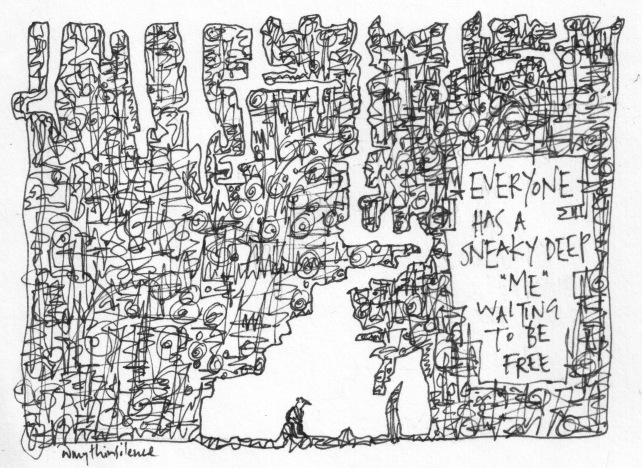
Many do not want to go sifting through the things inside of them, but as I’ve suggested elsewhere, this is a kind act, a loving act towards oneself.  And it is the place people wanting to make a difference are prepared to go.

The life which finds its alternatives, is the life which is able to offer alternatives to others.

(*From Peter Senge, Otto Scharmer, Joseph Jaworski, and Betty Sue Flowers’s Presence.)

talking boundaries and horizons

24 we should

They’re not the same.  We often must pass through boundaries to move towards horizons.

Which can be unnerving.

Boundaries anchor us, especially when we’re tired – mentally, but also emotionally, spiritually, even physically:

‘As in the case of lines, you are likely to stop when you are no longer sure you should go further – at the near edge of the region of uncertainty.*

Boundaries tells us we’ve done enough; horizons remind us we can always go further.

If we want to progress, we will need to stop speaking the language of boundaries and begin speaking the language of horizons.

Which can be unnerving.

The prophet knows this.  She describes the way things are, discerns what is important and what is possible, and then discovers new ways towards the future horizons**.

The language of boundaries can be nice and polite, even tough and debating, but the language of horizons is inquiring and reflective, and can become generative and find people in their flow of creativity.

(*From Daniel Kahneman’s Thinking Fast and Slow.)
(**Describing, discerning, and discovering are the triad of leadership abilities included by Alex McManus in Makers of Fire.)

transcendance

23 just gotta

transcendence
trɑːnˈsɛnd(ə)ns,tranˈsɛnd(ə)ns/
noun
  1. existence or experience beyond the normal or physical level.

We do not know what we are capable of.

What we are right now is not all we can be.  What we can be takes effort but we can move beyond the normal.  Martin Seligman offers the following personal strengths for taking us to this different place:

appreciation of beauty and excellence
gratitude and wonder
optimism and hope for the future
spirituality and purpose
forgiveness and mercy
passion and enthusiasm*

He got me wondering about how I’m doing.  Where am I now compared to ten years ago, or five years ago?  What would it look like to put more in front of each of these?

Seligman identifies twenty four strengths altogether.  If you want to check out how you fair, towards overcoming the voices of judgement coming from inside and outside, you can try it here for free.

Time to transcend.

(*From Martin Seligman’s Flourish.)


weirdly imaginative

22 you don't need

Weird, as in, weird as the new norm.*

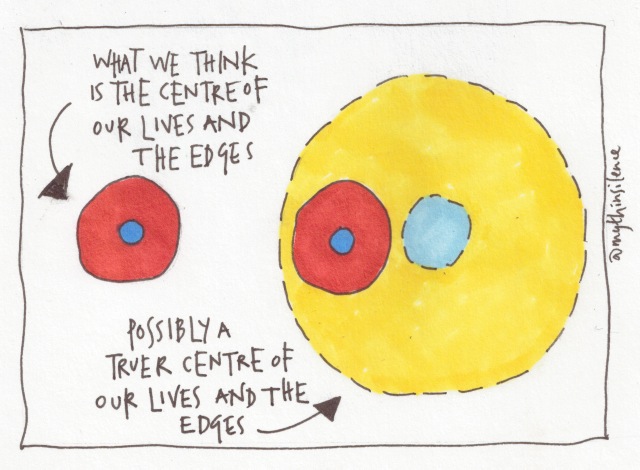
Old normal has been around a long time and will take some getting over, mind you.  It’s remains dominant, meaning the weirdly imaginative are found around the edges, where they share their stories, forming alternative communities around their “edgecraft,” finding their (prophetic) voice.

They know the edge will become the new centre (and then they’ll have to journey to the edges again, but that’s another story).

If we doubt this, or resist entering into it, we may ourselves unconscious producers of “despairing conformity.”

There’s a world of difference between moaning about work and plotting to make work better.

One is accepting of how things are, the other is beginning to embody subversive hope.  The latter types are, in effect, saying, We have one life and we’re not going to miss the opportunity to live it boldly and brightly – which means something different for every person, but weirdly imaginative people know this.

Some may doubt the power of imagination in the face of reality, but what we think is reality is only how certain people are imagining things.

Your turn: imagine weird.

(*See Seth Godin’s We Are All Weird.)

prophets and imagination and leading

21 thus saith the crowd

It was thought prophets were lone voices, standing against everyone who didn’t “get it” – usually everyone.

The new thinking** has the voice of the prophet as representative of people who hope for something different.  Their imagining and words and enactments express alternative worlds.

“The part is a place for the presencing of the whole.”*

If this is so then a group I’m part of are imagining prophetically at the moment.  Our concern to provide a space for nurture and empowerment for people who are disenchanted with their work-spaces, in which others don’t appear to care as much as they do.

‘Your purpose is not what you do but why you do it.’^

You are being prophetic when you hope on behalf of others for something which does not exist, and when you imagine it into being you are leading.

(*Henri Bartoft, quoted in Peter Senge, Otto Scharmer, Joseph Jaworski, and Betty Sue Flowers’s Presence.)
(**From Walter Brueggemann’s The Prophetic Imagination.)
(^From Bernadette Jiwa’s Difference.)


eye test

20 london underground

I’ve just had my annual eye test.

My mum left her children and grandchildren with the blessing of cataracts.  Two of my children have already had cataracts removed from both eyes.

I got away with something different: opacities: “firework displays” in each eye, as one optician told me one time.

So, I know I don’t see the world as you do!  Different conditions of light and tiredness are issues to deal with; fortunately, the eye test tells me nothing has changed since last year.

Here are a couple more eye tests which can lead to better vision.

When I think someone else can’t see things clearly, maybe it’s me.

Am I prejudiced about something but unaware?
Do I think I know better than someone else?
Is this really what the “customer” wants, or is it what I want?

Bernadette Jiwa writes about, ‘the ability to see an experience through another person’s eyes’.*  This helps my vision no end.

‘Humble inquiry maximises curiosity and interest in the other person and minimises bias and preconceptions about the other person.  I want to access my ignorance in the least biased and threatening way.’**

As someone pointed out, my problem with seeing may not be the speck in the other person’s eye, it may be the log in mine.^

Here’s an eye test (being more present) for when you’re with others and things aren’t going your way – it only takes a minute or two; no-one needs to be aware of what you’re doing:

Sit comfortably in the room, feet flat on the floor.  
Acknowledge: where you are, what you carry (aches, issues at home, etc.) how you feel (frustrated, wary, annoyed, etc.). 
Become aware of your breathing (it’s a gift): not only gathering the air you need, but also your humility and talents, gratitude and curiosity, hopes and caring.
Expand your awareness: into the space, the conversation, the people, bringing what you have reconnected with in yourself.^^

(*From Bernadette Jiwa’s Difference, as she reflects on the practice of IDEO.)
(**From Edgar Schein’s Humble Inquiry.)
(^It was Jesus of Nazerath who told his disciples this.)
(^^Adapted from Mindfullness from Mindfullybeing.)

flow

19 don't assume

‘Many people have not found their Element because they don’t understand their constant potential for renewal.’*

Should we expect or anticipate a flow to our lives?

In concluding his book Flourish, Martin Seligman offers his Signature Strengths Test.  I was reading through the group of six knowledge and wisdom strengths (in all, there are twenty four signature strengths).  These include (in rising complexity): being curious, love learning, critical thinking,** practical ingenuity, social (emotional) awareness, and perspective (wisdom).^

When I take a new path with curiosity – whether curiosity in particular things or in all things – I discover a desire to learn more.  When I learn my thinking become better, stronger – my questions improve.  When my thinking gets stronger, creativity has a chance to flourish.

My own curiosity was piqued when I saw how Edgar Schein uses curiosity to describe his preferred way of listening:

‘Accessing your ignorance, or allowing curiosity to lead you, is often the best guide to what to ask about.’^^

This encourages me to see how human curiosity, learning, critical thinking, and ingenuity should be poured into relationships (with one another, with our planet and its many species, and with ourselves).  We stand a better chance at arriving at a different way of seeing what life can mean.

‘There’s a famous old quip: “A lot of people in business say they have twenty years experience, when in fact all they have is one year’s experience, repeated twenty times.”‘*^

Perhaps, when we develop these strengths and step out on the new path, we might find ourselves in the flow of what our life can be.

I’d love to hear what you are curious about.

(*From Ken Robinson’s The Element.)
(**Critical thinking is marked by the kind of dimensions which make Nassim Taleb’s sceptical empiricist – able to arrive at judgements whilst remaining open-minded: see The Black Swan.)

(^From Martin Seligman’s Flourish.)
(^^From Edgar Schein’s Humble Inquiry.)
(*^From Hugh Macleod’s Ignore Everybody.)

the yes campaign

18 flourish

2051.

In 2051 I will be 92 years old.

It’s also the year Martin Seligman hopes 51% of the world’s population will be flourishing – more people will be flourishing than won’t be.

1451: Florence has taken to heart the counsel of Cosimo the Elder, ignoring the militarios, who wanted to use the state’s new-found wealth to conquer, Florence ‘invested its surplus in beauty.’*

The Renaissance began.

Here’s one definition of flourishing: having high positive emotion, engagement, and meaning, plus any three from the following list:

Self-esteem
Optimism
Resilience
Vitality
Self-determination
Positive relationships.

You don’t have to have them all to flourish, you do have to have some.

I seriously question whether I’ll get to be 92 years of age, but I can determine to use every day I get to invest my surplus in beauty.

Our ultimate infinite game, measured by how many people we have participating, taking part for a lifetime, bringing their unique creativity and boldness.**

‘We can all say “yes” to more positive emotion.
We can all say “yes” to more engagement.
We can all say “yes” to better relationships.
We can all say “yes” to more meaning in life.
We can all say “yes” to more positive accomplishment.
We can all say “yes” to more well-being.’*

(*From Martin Seligman’s Flourish.)
(**I add creativity and boldness from something Mailchimp’s Lain Shakespeare offers – quoted in Bernadette Jiwa’s Difference: “When return on investment is measured by delight instead of sales or conversions, there is a lot more freedom to be creative, to be bold, or maybe even to be creative and bold.”)

tipping points

17 tipping point

This is the phenomenon brought to light by Malcolm Gladwell in his book The Tipping Point, about how people and ideas and movements become contagious when they reach a certain mass and momentum which not be as big as we think, but is significant:

‘the very idea of a tipping point centres on the long term impact of relatively small groups adopting new ideas and behaviours’.*

These tipping points are “out there” in the macro-world of groups and organisations, but can they also be found “in here” in the micro-world of an individual, when we intentionally live each day so we may reach a tipping point in our own belongings, believings and behaviours?

I’ve mentioned before how we overestimate what can be achieved in a day and underestimate what can be achieved in a lifetime.  When we embrace the longer journey, things begin to happen.

Often, how we think about and describe our lives disguises their reality, maintaining the status quo: if we can somehow ignore or be oblivious to reality then we can get on with life as usual.

To see if this is so, here’s a reality game you can play at any time of the day in a few moments.  Infinite games (which is what this reality game is) shake things up:

‘ceaseless change does not mean discontinuity; rather change is the very basis of our continuity as persons’.**

Find a place where you can sit comfortably for a few moments, feet on the ground, hands resting by your side or on your knees, with eyes closed.  For a moment or so, bring to mind moments from the past 24 hours when you have powered up or servanted up to those around you.   Perhaps you have wanted to get your own way or think someone has made a mess of something, and you take pleasure in it.  Or maybe you’ve put yourself out so someone else could do what they wanted or you have encouraged someone because you want them to feel better about themselves.  Then be aware of your breathing, sense your breathing in filling your life with good things and breathing out the toxic; breathe in the word humility and breathe out the things it gets rid of for you.  In a final moment, be aware of your surroundings and imagine breathing out humility in words and behaviours.^

Do this towards a tipping point.

(*From Peter Senge’s The Necessary Revolution.)
(**From James Carse’s Finite and Infinite Games.)
(^There are other words which can be attached to the breathing which I’ll share sometime.)


hurry

16 to be wise

‘We notice how our breath changes with our moods, our thoughts, our body movements.  We don’t have to control the breath, just notice it and get to know it, like a friend.’*

We cannot see “what is” in a hurry.

Like the proverbial tip of the iceberg, we notice things on the surface of life and hurry on without being mindful of why this is: what it is that lies beneath the surface.

Most of all, we’re unaware of what lies beneath the surface of our lives: behind how we think, relate, and behave.

When Daniel Kahneman warns us of “delusional optimism” he’s highlighting something about our characters as well as our personalities:

“People do things they have no business doing because they believe they’ll be successful.”**

We may say “I am what I am,” unaware we can change at a genetic level.

It’s important to be optimistic.  It’s important to reach beyond what others often think is possible.  This is called hope.  We all need hope and hope is born of optimism. And we can’t always wait for someone to bring hope.  Sometimes we have to make some of our own.

Deep down within us are primal Human desires to belong, become, and believe.

Deep connection, deep wellbeing, and deep hope cannot be seen or produced in a hurry.

(*From Mindfulness by Mindfullybeing.)
(**Quoted in Martin Seligman’s Flourish.)