synchronicity

4 synchonicity

synchronicity  (sɪŋkrəˈnɪsɪti/)
noun
  1. 1. 
    the simultaneous occurrence of events which appear significantly related but have no discernible causal connection.
    “such synchronicity is quite staggering”

“Synchronicity is being open to what wants to happen.”*

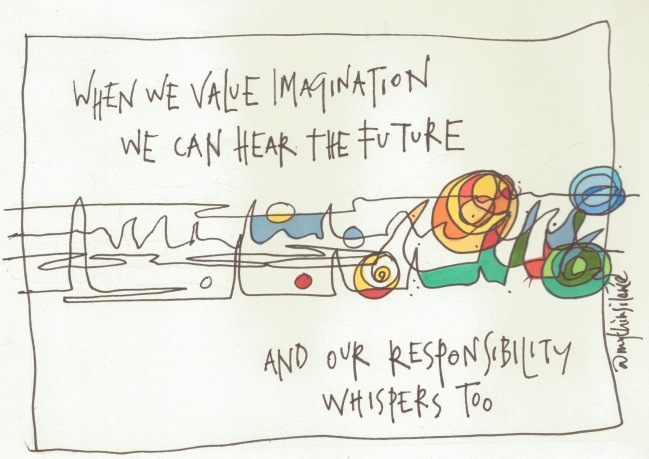
Steven Sasson is the guy who came up with the first digital camera.  He was a prophet of the future in the kingdom of Kodak, but the company struggled to ask the really important questions about the technology.  If it had, maybe it would have imagined the exponential possibilities for this new way of taking pictures.

Kodak is representative of so many organisations and institutions, which have become detached from their raison d’être and ended up preserving the past when threatened by the new and imaginative.

Something wants to happen, though, wants to emerge, and there are prophets who want to tell us about what it is.  They come in all shapes and sizes with all manner of messages.**  They do this in almost playful and imaginative ways for good reason:

‘Hope is a tenacious act of imagination given in a dream, oracle, narrative, and song, rooted in absolute authority … . It is given in an imaginative way, because it is out beyond what we know.’^

Synchronicity seems to occur more often when we prepare ourselves through the playfulness of sensing (acknowledging what is), presencing (gathering the things which are of greatest significance and resonance to us), crystallising and realising (identifying what it is we must do and expanding this to others).^^

Bring a group of people into a playful space and something will happen.

(*David Morsing, quoted in Peter Senge, Otto Scahrmer, Jospeh Jaworski, and Betty Sue Flowers’s Presence.)
(**As I think about what this means for me, I keep returning to the importance of people’s potential, the need to be a prophet of talent.)
(^From Walter Brueggemann’s Reality Grief Hope.)
(^^A combination of Theory U: sensing, presencing, crystallising, and realising, and, Mindfulness: acknowledging, gathering, and expanding.)

embracing imagination and pathos

3 we are determined to learn

In his speech at the state opening of Parliament, David Cameron spoke about aspiration:

“In recent days, I have noticed some of the candidates for the Labour leadership seem to have discovered a new word: the word being aspiration. Apparently it has upset John Prescott, he went on television to explain he doesn’t know what it means. I am happy we should spend the next five years explaining what it means and how vital it is to everyone in our country. If the party opposite truly believe in aspiration, they will vote with us to cut people’s taxes so people can spend more of their own money as they choose. If they believe in aspiration, they will be voting with us to cap welfare and use the savings to fund more apprenticeships.”*

Aspiration appears to mean a good job, good pay, good spending, good pension, good retirement.  As important as these things are, the next thing the prime minister could have said was, “so that every Briton can arrive at death in the best way possible.”

He didn’t, though.  It’s not where most politicians of different shades and leaning would want to acknowledge.  It’s not in their interest to say anything which upsets the need for everyone to be a good citizen within society.

Institutions of many kinds and size don’t want to admit the emptiness of their circular arguments; neither do they want to admit they don’t know how to encourage people’s imaginations outside of the work hard, earn as much as you can, save, and retire well message.

Pathos: here’s a larger tale, though, from behind the facades of government and employment and taxes and healthcare. First the pathos:

Homo sapiens drove to extinction about half of the planets big beasts long before humans invented the wheel, writing or iron tools.’**

Then followed the agricultural revolution around 12,000 years ago, followed by the industrial revolution 300 years ago – each having an incredible impact on the world and all of it fauna and flora.  We are presently using the resources of one and a half Earths.

One of the things my friend Steve does is work with secondary school students science through Non Fi-Sci – remaking well known movies by putting the science right.  If they were to remake Independence Day – in which Jeff Goldblum and Will Smith save planer Earth from aliens aiming to eradicate Humans and plunder all the Earth’s resources – maybe they’d have to cast the Humans as the alien plunderers.  Our ancestors were exterminating all kinds of species long before farming came along, as they travelled to new continents and islands.

We have to acknowledge the destructive nature of our species: they didn’t realise the devastation they brought, we do, and ignore it.

Imagination: We need everyone’s imagination set free and encouraged so that we may find better ways and means of living as the peculiar species we are on planet earth.  Imagination which connects people with each other, outside of the silos we build, as well as connecting us with the only planet we’re able to live on at the moment.

Here are the five elemental truths which I have share before:

Life is hard
You are not as important as you think
Your life is not about you
You are not in control
You are going to die.^

I include them here as imagination, because they are only half formed.  We can complete, or transform them, with great imagination.

(*From theguardian.com.)
(**From Yuval Noah Harari’s Sapiens.)
(^Five things taught to young people entering adulthood by tribes and societies around the world, as identified by Richar Rohr in Adam’s Return.)

the upside and downside of passion

2 breathing and passion 2

2 breathing and passion 3

The up: to live with passion is to be alive.

We are not so much concerned with discovering the meaning of life as to know we are alive.

Passion is unique to each person.  What the best passionate kinds of life have in common is they are blue – as in hyperlinked. To others, to other worlds and to the universe.

The down: people and institutions will be threatened by your passion, and make you suffer for it.

But, with the first deep, primordial breath of life a Human takes, there also comes passion: our striving to be fully alive.

Not to be able to do what we are passionate about is like being asked not to breathe.

I can quieten myself and listen to my breathing.  I can quieten myself and listen to my passion too.

the trouble with maps

1 mapping

Maps are not reality.

Even the most accurate maps only show some of the the facts relating to a place or an area.  As Denis Wood writes, in contemplating the power of maps:

‘They are, consequently, in all ways, less like windows through which we view the world and more like those windows of appearance from which pontiffs and potentates demonstrate their suzerainty.’*

Maps are a way of seeing things.  The status quo has maps, and so have gentle revolutions – one is not more real than the other.

Here’s how a map of Scotland was displayed today at a U.Labs Scotland event run by the Scottish Government – interesting, how something like this can change things.

scotland on its side

Four years ago, I’d met some people I sensed were going to be important to my exploring of new communities.  It’s proven to be the case.  I think we’re defining what a gentle revolution (and expression of an infinite game) might look like where we are, as we produce alternative maps for collaboration towards wellbeing.

We have to remember institutional maps are just their maps.  We don’t have to use it, or it doesn’t have to be the only map we use.

The gentle revolutionary knows the maps of the future will not only show what they are doing, but who they are becoming.

‘We have a physical, a spiritual, an emotional and a mental body.  The idea muscle is what powers the latter.’**

(*From Denis Wood’s The Power of Maps.)
(**From Claudia Altrucher’s Become an Idea Machine.)

a gentle revolution

31 gentle revolutionaries

Dissolves borders and barriers: within us, between us and ideas and people, and between us and the world and the future.  It makes possible the mixing of things we didn’t think could mix towards something new.

‘Collaborating is ultimately about relationships, and relationships do not thrive based on a rational calculus of costs and benefits but rather because of genuine caring and mutual vulnerability.’*

This kind of revolution takes a lot of energy, a lot of new skills.  And when something is achieved, the temptation can be to rest and maintain, rather than begin over.

There’s always a need for an alternative consciousness or alternative community.

James Altucher suggests writing down ten ideas day to exercise the idea-muscle: When we stop having new ideas, recycling old ones becomes the new danger.

‘It is the genius in us who knows the past is most definitely past, and therefore not forever sealed but forever opened to creative reinterpretation.’^

(*From Peter Senge’s The Necessary Revolution.)
(**From Claudia Altucher’s Become an Idea Machine.  I’ll be trying out James Altucher’s idea, maybe giving it a little more shape by looking at personal ideas, playful ideas around the things I love, and collaborative ideas.  By the end of a year, over 3,500 ideas will have accumulated.)
(^From James Carses’s Finite and Infinite Games.)

gentle people

30 blessed are the gentle

What makes people gentle?

They hope to see more, not only beyond themselves, but also within themselves.

They hope to play imaginatively with what they especially notice in and around them – what they are curious about and are passionate in – because they have done more than ‘work within the outlines of their imaginations,’ they have ‘reworked their imaginations.’*

They hope to play with others via what Edgar Schein** calls “Here and now” humility – deferring to each other when the time is right for particular skills to take the lead, and so realise more:

‘You can only have what you have be releasing it to others.’*

Gentle borders.

Peter Senge points to why collaboration is necessary for greater impact when he focuses on the ecological challenges ‘such as water, energy, material waste and toxicity’, going on to quote Randy Overbey: “Collaboration is key for achieving scale.”^

(*From James Carse’s Finite and Infinite Games.)
(**See Edgar Schein’s Humble Inquiry.)
(^From Peter Senge’s The Necessary Revolution.)

things dangerous and difficult

29 sign of the future

Staying where we are isn’t difficult, but it is dangerous.

Equilibrium, embedded in establishment and complacency, is a most dangerous place to be.

Moving to the edges isn’t as dangerous as we think, but it is difficult.

Disequilibrium, expressed in alertness, industry, and freshness, is our best hope.

Richard Pascale, Mark Millemann, and Linda Gioja argue we have a lot to learn from nature – which makes sense as we are species within it:

‘Coping mechanisms that have atrophied during long periods of equilibrium usually prove inadequate for the new challenge.  Survival favours heightened adrenaline levels, wariness, and experimentation.  Alfred North Whitehead got it right, “Without adventure, … civilisation is in full decay.” … At certain scales (i.e., small) and in some frames (i.e., short), equilibrium can be a desirable condition.  But over long intervals of time and on the very large scales, equilibrium becomes hazardous.  Why?  Because the environment in which an organism (or organisation) lives is always changing. … Prolonged equilibrium dulls an organism’s senses and saps its ability to rouse itself appropriately in the face of danger.’*

There is always a new challenge: if I can’t see the challenges then I’m not really looking.

Part of what we might call equilibrium-thinking is trying to face a new challenge with an old solution.  This thinking also gets lost in time, merging what look to be safe periods of equilibrium into the kind of hazard Pascale, Millemann, and Gioja are warning of.

In the West, we’re often getting on with life, getting things done, finding quick answers: ‘The result of a pragmatic, individualistic, competitive, task-orientated culture is that humility is low on the value scale.’**  This humility equates to wariness as mentioned by Pascale, Millemann,and Gioja.

I see prophetic communities living alternative realities, playing the infinite game.^  It may be difficult for everyone to be as alert and adaptive as they are, but they make it possible for new ways to be discovered by others.  Even when those within the established culture wake up to what is happening, they often do not possess the skills acquired on the edges.  Here is Peter Senge describing a movement away from competition to collaboration:

‘Fortunately, more people are discovering that collaboration is the human face of systems thinking.  Collaborating successfully requires more than good intentions.  It also requires improving your “convening” skills so that you can get the right people together and have more open and productive meetings.’^^

Prophetic communities hone the new skills whilst supporting their members – the very skills others need.  Above everything else, they value the way of humble inquiry.  Though their questions are seen as uncomfortable and dangerous, and are difficult, they bring a freedom of adventurous thought and concern for all.

(*From Richard Pascale, Mark Millemann, and Linda Gioja’s Surfing the Edge of Chaos.)
(**From Edgar Schein’s Humble Inquiry.)
(^The infinite game is a reference to James Carse’s description of a game marked by including as many as possible for as long as possible, and when the rules get in the way of these two values, they are changed: Finite and Infinite Games.)
(^^From Peter Senge’s The Necessary Revolution.  Systems thinking refers to seeing the whole picture of how operating systems often have other systems around them, which make them work, or not.)

trust and songs and stories

28 how about being

Trust and songs and stories are the stuff of prophetic communities.

‘The best way to be trusted … means I must first trust myself, and the best way to trust myself is to make myself trustworthy.’*

I want to be someone I can trust.

For this, I know I must be open with others and with the world of which I am a part – how can I trust myself if I’m socially and/or ecologically disconnected?

My experience of what is beyond me must keep growing:

‘Organisations around the world are recognising that either they can expand their thinking to match the real system they belong to or they can artificially shrink the system they are managing to match their thinking.’**

Those who expand their thinking avoid fitting everyone and everything encountered into a confined and static way of seeing and understanding.  Isolate hope and it withers, idealise hope and it reduces to the staleness of soundbites and rhetoric.  Hope captured in the movement of dangerous stories and songs and drama of the prophetic community has the chance of remaining fresh and alive:

‘To speak or act, or think originally is to erase the boundary of the self.  It is to leave behind the territorial personality.  A genius does not have a mind full of thoughts but is the thinker of thoughts, and is the centre of a field of vision.^

(*From Stanley Hauerwas’s With the Grain of the Universe.)
(**From Peter Senge’s The Necessary Revolution.)
(^From James Carse’s Finite and Infinite Games.  Genius, here, is more about the unique contribution a person can make than their IQ.)

hoping to be heard

27 everyone has a cry

What are you teaching me but don’t know you are?

These learnings for me are whispers heard in conversations which move through a journey of inquiry.

Through humble inquiry (opening mind) I discover what you know but I do not,

Through diagnostic inquiry (opening heart), we discover what is most important of all to each other

Through confrontational inquiry (opening will), we identify what we can do together, and determine not to be put off by what gets in the way of this.*

This process is infused with the prophetic.  If Walter Brueggemann’s definition of what makes Human history is useful, then history comprises of both crying out and being heard.  He claims, ‘the task of prophecy is to empower people to engage in history,’ which is, ensuring people’s cries are being answered.

Why prophetic?

When people cry out, and there is no answer, the prophet emerges in the form of women and men who hope for more with those who cry out.  The tasks of the prophet are those of inquiring, listening, and whispering.

In particular, there is in every person, a restlessness which will not go away.  It is not easy to voice this, and when others hear it, they are not sure how to respond.  The response might be well intentioned, but unhelpful, like the “off the peg” euphemism – “another door will open, you’ll see” – or in some deep care – “don’t worry about it, I’m here.”

It’s not the prophetic process is not caring, it’s just that it cares too much to leave us without new hope anchored in reality and possibility.

Here is the timeless story of the protagonist who wants something and overcomes all obstacles to get it and to bring it back for others.**

“In that special silence, you can hear or see, or get a strong sense of something that wants to happen that you wouldn’t be aware of otherwise.”^

(*Humble, diagnostic, and confrontational inquiry are the three elements of Edgar Schein’s process inquiry, from Humble Inquiry, which I have overlaid with the three elements of Theory U from Otto Scharmer.)
(**Check out Joseph Campbell’s The Hero With a Thousand Faces.)
(^Joseph Jaworski, from Peter Senge, Otto Scharmer, Joseph Jaworski, and Betty Sue Flowers Presence.)

system and spirit

26 she's got spirit

They sound diametrically opposed, but maybe they’re not.

First of all the negatives:

A system is too rigid and inadvertently provokes a spirit of revolt. 
A creative and imaginative spirit is too carefree and prompts a system clampdown.

Then there are the positives:

A creative spirit can produce a generative system.
A generative system can stimulate an increasingly creative spirit.

Life is full of negative examples: ask a critical question at the wrong time and no new ideas emerge; ask an open question at the wrong time and shipping doesn’t happen.

We daydream but never action our hopes.  Or we feel too ensconced within the system and daren’t upset it.

System and spirit need each other.  Some of us need some shape to lead us from idea to shipping; some of us need more openness to fresh innovative thinking.

Perhaps you’ve found your sweet spot?

(I love this idea and cartoon from Hugh Macleod, which I had in mind when I wanted to bring spirit and system together.)