no idea

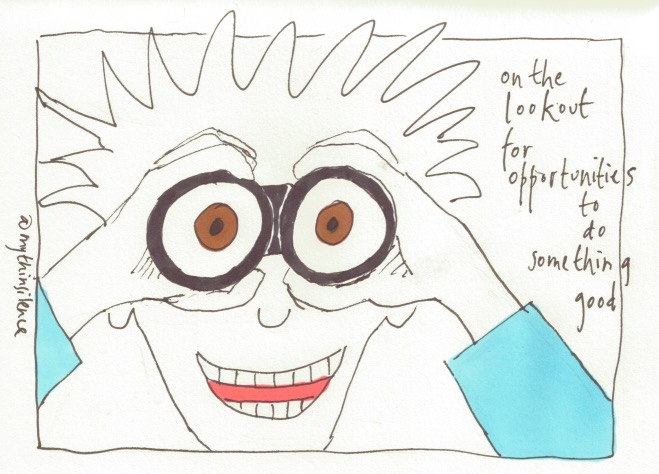
6 on the lookout

We’ve no idea what we are going to walk into today, but we can all live as if something might happen.*

This provides us with an advantage.  We can be ready to bring something good and graceful and even loving to someone or some situation.

‘If your only goal is to love there is no such thing as failure.’**

(*All our plans changed today when cancelled trains meant we needed to take our daughter south into England, but remembered someone was stranded in England and arranged to bring them north when we returned.)
(**From Richard Rohr’s Eager to Love.)

imagination with a cause

5 imagination with a cause

‘I still haven’t reached a decision.  I only know that a life without a cause is a life without effect.’*

What if, with the Big Bang, the possibility of love was sent careering across the void. It has found expression in Humans – who knows where else – and we don’t know just how far it can expand.  We do know we have not travelled to the outer-reaches.

Sometimes we react in love, other times we respond – to prompts of one kind or another that come from beyond us.

We’re also capable of freely acting out of love – to imagine and initiate – not waiting for a prompt, moving from within.

(*From Paulo Coelho’s Aleph.)

natural faith

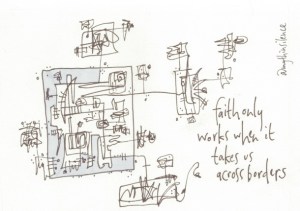
4 faith only works

I wonder whether faith is a natural Human state?

What is it that makes us set out towards the new, the unknown, the other?

So, I’m curious about how faith helps us to connect, beyond being with someone or something, to being in relationship.

Faith takes us into the borderlands, the places between people, between things, and between people and things.

‘A movement into a borderland is different.  It is an extension of one’s homeland, not a separation from it.’*

For you and me, as a place of faith, the borderland is not somewhere beyond me or beyond you, but is an extension of who you and I am, a place of presence rather than absence.

There are contexts and spaces which help me to be more aware of this.  Usually though, I forget, oblivious to my personal border controls, my unwillingness to explore beyond, displaying a lack of faith.

We each have our own way of meeting others.  I get overwhelmed with large numbers, others are in their natural element in a crowd.  For me, to see the individual helps me to see everyone.  This is part of my natural faith.

Whoever we are, we’re naturally creatures of faith, something which takes us across the borders and thresholds and boundaries, into the worlds of others and into the future.

(*From Brené Brown’s Daring Greatly.)

for those who enjoy diversity

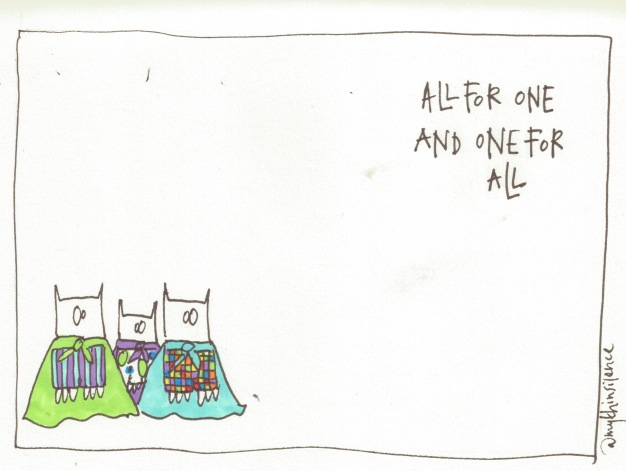
3 all for one and one for all

And for those who do not – everyone makes up the numbers on diversity.

Lewis Hyde writes about politicians betraying the people:

‘In times like these the spirit of the polis must be removed from the hands of politicians and survive in the resilient imagination.’*

Strictly speaking, polis is about shaping of the city for everyone who lives in it.  We now live in a global city.

The diverse city was observed with delight by Walt Whitman in the nineteenth century.  On an omnibus ride through New York he took in all the sights, people from around the world and all their activity, the buildings, and the trade which had furnished them:

“You will not wonder how much expectation all this is, on a fine day, to a great loafer like me, who enjoys so much seeing the busy world move by him, & exhibiting itself for his amusement, while he takes it easy & just looks on & observes.”**

Whitman’s description of himself as a loafer here catches my attention.  He reminds me of the flaneur or flaneuse: someone who does not quickly move through life and thereby misses things.  Neither do they make up their mind about something or someone hastily or lazily.  Instead, they take their time to remain open for as long as they can to as much as they can and towards as many as they can.

Such a person sees the importance and uniqueness of the one as well as the needs of the many.  Richard Rohr puts this well when he identifies the relationship of holons and fractals:

‘In these discoveries, we know that the part contains the whole or replicates the whole, and yet each part still has a wholeness within itself – the “appreciative accumulation” is what makes the whole Whole.’^

If we betray the one, we betray the many; and, if we betray the many we betray the one.

(*From Lewis Hyde’s The Gift.)
(**Walt Whitman, quoted in Lewis Hyde’s The Gift.)
(^From Richard Rohr’s Eager to Love.)

flawed

2 the future won't be

“Bless and you will be blessed.”*

I wonder, what kind of best-future can I imagine?

One that is flawless?

Or one that is graceful?

I can’t imagine living in a world which is flawless.  I can imagine a world in which we always seek to respond to the flaws within and around us with grace.

These words from Madeleine d’Engle remind me of how, as a child, I used to wonder whether I’d ever survive in an adult world:

“When we were children, we used t think she we were grown up we would no longer be vulnerable.  But to grow up is to accept our vulnerability.  To be alive is to be vulnerable.”**

I’ll get many things wrong today.

Sometimes, as the world gets bigger, I feel I’m becoming “clumsier.”  But I don’t want to stay clumsy, I don’t want to repeat my mistakes.

Here’s another way of to understand gracefulness, one that doesn’t clumsily stomp on the feet of others or the planet:

‘Graceful is artistic, elegant, subtle and effective.  Graceful makes things happen and brings light but not heat. … It’s not a gift, it’s a choice.’^

(*From Paulo Coelho’s Aleph.)
(**Madeleine d’Engle, quoted in Brené Brown’s Daring Greatly.)
(^From Seth Godin’s Graceful.)

you must move on

1 dissatisfied

‘When a sense of dissatisfaction persists, that means it was placed there by God for one reason only: you need to change everything and move forward’*

‘[I]t is essential to put yourself into the unconditional service of the future possibility that is wanting to emerge.  Viewed from this angle, presencing is about a dialogue with the future possibility that wants to emerge.’**

We use imagination to open up future possibilities: ‘The poet “places himself where the future becomes present.”‘^

Then we act upon what we imagine.  Steven Covey referred to imagining something as being the first creation, to make it happen, the second.^^

When we believe and act the future seems to open up for us, and something happens inside of us: ‘The willingness to show up changes us.’*^  When we do not believe, meaning we are unable to act, the future remains closed.

Moving with our imaginations will bring us to new days of possibility.

(*From Paulo Coelho’s Aleph)
(**From Otto Scharmer’s Theory U.)
(^Walt Whitman, quoted by Lewis Hyde in The Gift.)
(^^Steven Covey’s The 7 Habits of Highly Effective People.)
(*^From Brené Brown’s Daring Greatly.)
nourishing

30 giftmakers

We’re discovering our natural state can be one of gift-maker, on a journey from the ego and self, to the eco and Self – from a wrong understanding of who we are now, to a greater understanding of ourselves in connectedness with others and the future.

Yesterday, I mentioned there are three things we use the name of gift for.  There is the  gift we receive; the gift which is the magic we bring to life – more than the sum total of our talents and passions and experiences; and, there’s the gift we make and give to others.

In each of these ways, we are nourished: nourished in receiving, in making, in giving – the nourishment we need to thrive and flourish

The gift will always take me into the lives of others, and their lives into mine.

‘Travel is never a matter of money, but of courage.’*

(*(From Paulo Coelho’s Aleph.)


you must leave here

29 given up waiting

“You’re not here any more.  You’ve got to leave in order to return to the present.”*

It’s the archetypal narrative arc of a great story: the reluctant protagonist leaves “here” and will wrestle their way back to the present.

Jerome Bruner refers to there being “no internal push to growth without a corresponding external pull”.**

Otto Scharmer^ speaks of there being internal context, external context, and a third: the context of the emerging future.

I offer these to understand gift.

We use the same word to mean three things.  There’s the gift which comes to us, which we must acknowledge (gratitude) – the external.  Then there’s the gift within us (more than the sum of our talents, passions, and experiences) – the internal.  And there’s a third gift, the one we produce (the emerging future) – that which did not exist before.

The question is, will you be present to this new possibility if you remain here?

(*J, Paulo Coelho’s friend and guide, quoted in Paulo Coelho’s Aleph.)
(**Jerome Bruner, quoted in Denis Wood’s The Power of Maps.)
(^In Otto Scharmer’s Theory U.)

limits

28 such a fast universe

What do I want?

How do I know what I want?

Apple gave a generous gift with the iPhone 6 – an entire U2 album.  The problem was this was not how the gift was received.  Many purchasers of the phone thought the gift to be an intrusion.  Apple had then to provide a way for owners of new phones to remove the album.

I’m exploring using my city library as a creative space and borrowed Paulo Coelho’s Aleph. The following extract caught my attention.  I wavered for a split second over whether to use the faintest of pencil markings as a highlight – as I do in my own books.

I didn’t, though, because this would be an intrusion for those who borrowed the book after me and who will find their own favourite places in it.  Here’s the quote, though, with Coelho speaking to his friend and guide J:

‘”I can’t evolve any further,” I say, falling, as always, into the trap of being the first to speak.  “I think I’ve reached my limit.”

“That’s funny.  I’ve been trying all my life to find out what my limits are and have never reached them yet.  But then my universe doesn’t really help, it keeps expanding and won’t allow me to know entirely,” says J provocatively.’*

What do I want?

How do I know what I want?

What if what I want is less or different to what I really want?

We’re made of the same stuff as J’s expanding universe, the same dynamics of expansion at work within us – involving us in continual exploration.

Maybe the gift I can give, which does not assume or presume, is to ask, If I could help you know what you want, would this be useful to you?

(*From Paulo Coelho’s Aleph.)

schools of magic

27 wow, it's amazing

‘I began my apprenticeship in magic when I was twenty-two.  I followed various paths, walked along the very edge of the abyss for many years, slipped over and fell, gave up and started all over again.  I imagined that, by the age of fifty-nine, I would be close to paradise and the absolute peace I thought I could see in the smiles of Buddhist monks.’*

I am nearer now to where I must begin.

Magic is about seeing things differently to everyone else, and everyone’s magic is different.  I included this quote a year ago; it still excites me one year on:

‘The task is not so much to see what no one has yet seen, but to think what no one has yet thought about that which everybody sees.’**

I think my magic is to help you find your magic.

We have this wrong notion that most Humans are Muggles, that only a few are special and talented in magic.  The thing which stands between us and our magic is an illusion with teeth:

‘”Grown-ups have no time to dream, struggling from nine to five to support their family …, always bumping up against the thing we all know as harsh reality.’*

There are more schools of magic appearing.  No matter our age or background, there’s hope for anyone who will learn to open their minds, their hearts, and their wills.

(*From Paulo Coelho’s Aleph.)
(Albert Schopenhauer, quoted in Mikael Krogerus and Roman Tschäppeler’s The Decision Book.)