crossroads of necessity

29 i'm a portkey

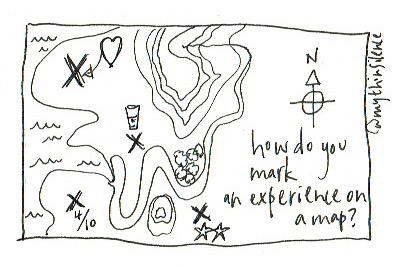
If it were to produce a map for our lives which showed every path we had taken and every path we decided not to take, then, simply on the major decisions alone, it would be a mesmerising spider’s web of pathways.

We’re crossroads people.  Not only finding ourselves at crossroads and having to make decisions, but also being creators of  crossroads for ourselves and for others.

The latter are the crossroads of necessity – something akin to Harry Potter’s Room of Requirement.  When we’ve ventured down a road or path and find it to be the wrong one, we don’t have to retrace our steps but we can produce a crossroads which allows us to take a different direction.  Like hyperlinks, or blue moments, as my friend Alex names them, these crossroads make it possible for us to travel a different route.

‘Blue moments open windows of insight into what it means to be human, and they call upon us to do something to follow them.’*

There are a few realities to be aware of.

It isn’t possible to produce a crossroads of necessity to somewhere we can never go and to something we haven’t got the skills to do.  To be humble – the ability to have an accurate and true picture of ourselves; to be grateful – the ability to see just how much we have; and, to be faithful – the daily practice of turning these into small steps of thinking, relating, and behaving is what makes things happen:

‘When you come into the rhythm of your nature, things happen of themselves.’**

My friend Jo and I were chatting just today about how important saying yes to people is, providing permission to do what they want to do with all their heart – which is really about encouraging them to give themselves permission.  She’s a great example of a crossroads person.  Jo has recently made a crossroads of necessity for herself and lives her life making crossroads available to others.

Each of us is more than capable.

(*From Alex McManus’s Makers of Fire.)
(**From John O’Donohue’s Eternal Echoes.)

maps of simplicity

28 a big thank you

‘Persons who have been transported back in time are easy to identify.  They wear dark, indistinct clothing and walk on their toes, trying not to make a single sound, trying not to bend a single blade of grass.  For they fear that any change they make in the past could have drastic consequences for the future.’*

Alan Lightman’s novel plays with many notions of time, around the last months of Albert Einstein concluding his theory of relativity in 1905.

There’re other ways we can play with time, of there being people from the future among us.

These future people are are from the present, though they appear to be from the future because their minds and hearts are so open they’re able to imagine future possibilities vividly, so much so, they begin to build these in the present.

Richard Rohr writes about a “third eye” of seeing.

The “first eye” sees something for what it is and enjoys it.

The “second eye” sees and enjoys something for what it is but wants to understand what is seen, too.

The third eye, though, whilst enjoying and understanding, wants to be be one with ‘an underlying mystery, coherence, and spaciousness that connected him with everything else’.**

Simplicity, complexity, SIMPLICITY = BIG simplicity:

“For the simplicity on this side of complexity, I wouldn’t give you a fig. But for the simplicity on the other side of complexity, for that I would give you anything I have.”^

This can also be understood and experienced as the wisdom of mind and heart and being one.

All of us know the compulsion to “grow up.”  Like the force of a Star Trek tractor beam, we feel the force to leave the simplicity of childhood behind – it almost takes too much energy to resist it.

Geographer William Bunge notices how, when it comes to maps, “there seems to be no geography of children, that is, the earth’s surface as the home of children”^^  Maps are about knowing, and knowing is power – the dark side of the power of the second eye.

Denis Woods then asks this question about how we use maps:

‘What is this?  It is the heat of the darkness of our times, the assurance (and arrogance of the … expert … that he knows better than you.*^

Here is the danger of the one who knows.  Nassim Taleb speaks of how it is too hard t0 remain open to there being more than what we see and understand, to walk through time as a sceptical empiricist.^*  It’s hard to become an “un-expert”:

‘You have no idea what you are doing.  If you did, you’d be an expert, not an artist.’⁺

This simplicity on the far side of complexity is where our future lies, and we are all able to move into the art which awaits us there.

Three myths about creativity which will disappear in the future are: only a a few people are creative, creativity is a solo occupation, and, creativity is about finding answers rather asking questions.

There are those among us who are drawing maps from the future, so connecting us to possibilities of what might be rather than only what has taken place, of what cannot yet be seen rather than what we understand.

‘In no walk of life have people failed to use the power of the map to connect themselves to the world.’*^

(*From Alan Lightman’s Einstein’s Dreams.)
(**From Richard Rohr’s The Naked Now.)
(^Attributed to writer and physician Oliver Wendell Holmes Sr.)
(^^William Bunge, quoted in Denis Wood’s The Power of Maps.)
(*^From Denis Wood’s The Power of Maps.)
(^*See Nassim Taleb’s The Black Swan.)
(⁺From Seth Godin’s The Icarus Deception.)

if we are to meet ourselves in our future

27 breathing is easy

‘We can change the script,’ claims Alex McManus,* and he’s not wrong.  Alex’s brother Erwin offers: ‘When we embrace our responsibilities, we open up our opportunities.’**

Here are three realignments we can try:

from separation to being with others,
from being apart from the Earth to being a part of it, and,
from a fixed mindset about who we can be (What You See Is All There Is) to one of growth.

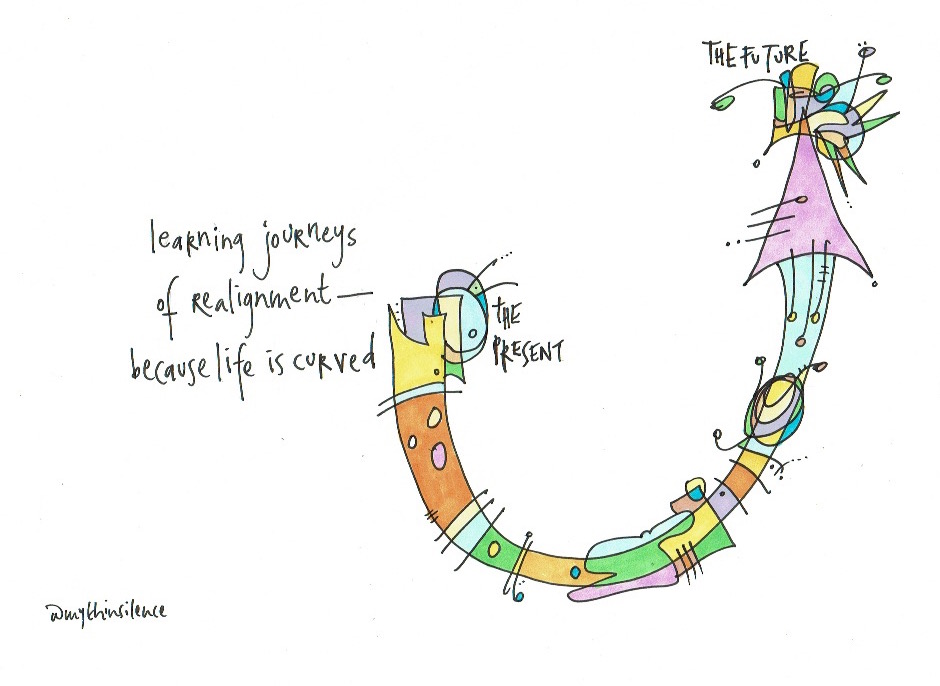
The person we’re able to be is already within us, already imagining the future.  We must listen, be present to the whispers, and, then, grow – or zoom the things we do, as Seth Godin names it.

We’ll know we’ll never be perfect but we can be increasingly connected. We know we’ll never complete but we know we are more than enough to bring our art to the world.  And while ours is an ongoing journey, we know we’re strong enough to keep going.

When we recognise and embrace who we can be, the responsibility only we can take up, we become script-changers – for ourselves and for others.

While we’re breathing, it’s our turn to change the script, and it’s not too late to begin.

(*From Alex McManus’s Makers of Fire.)
(**From Erwin McManus’s Uprising.)

the present moment

26 all in a moment 1

‘I love what I see: life excites me.’*

For all the painfully difficult and difficultly painful things in the world, we find within a deep down hope, and earnest longing for something better, a more beautiful place to belong.

In these moments, the goodness and wonder and energy of life breaks upon us – a moment of presence – a present moment, when we can feel the possibility of love and hope and beauty.

As Humans, we live with the elemental truths: life is hard, we’re not as special as we think, life is not about us, we’re not in control, and, we’re going to die.  It’s as if we need these things to see the better possible.

‘It is, however, through difficulty and opposition that we define ourselves.  The mind needs something against which it can profile and discover itself.’**

There’s a simple question which can be more than we can handle: “Am I prepared to see more than I can see in this moment?”  Does this come to me as a promise or threat, even as I know I will be changed.

But in this change I find my hope again.  In a universe which doesn’t appear to care, we find ourselves as a focus of possibility.

‘The human face is the icon of creation.  In this countenance, creation becomes intimate.’^

In this moment, when you are most you, aware of your dreams and talents and questions, what possibilities come to you?

Creativity, generosity, enjoyment.

(*From Richard Rohr’s The Naked Now.)
(**From John O’Donohue’s Eternal Echoes.)
(^From John O’Donohue’s Eternal Echoes. Whilst O’Donohue speaks of creation, it seems reasonable to speak of nature or the universe.)

futures

25 it's not what you do next

‘We must ask what happens because of what happens next?’*

‘The end isn’t the point, of course.  It is the journey, the mightness.’**

There’s another step, another moment, and after that, another.

Most of us are canny enough to know there’s something not quite right in our lives most of the time.

The important thing is to do something, to take another step; maybe not for that step but for the one that’ll follow and the one after that.

Perhaps what we want most of all is to know we’re making the most of this one life as we possibly can.  To keep moving because there’s time and room and energy to do this.

These thoughts are most of all for those make themselves available to those who are asking questions, those who open up the future for others, and those beyond.

(*From Alex McManus’s Makers of Fire.)
(**From Seth Godin’s What To Do When It’s Your Turn.)

towards the positive

24 every promising idea

What if life were so engaging that it didn’t take much for us to be drawn in the direction of the positive?

That is, when we connect with our talents and values, our lives are capable of generating countless positive ideas to be turned into gifts and art and the kind of things others need?

Such a journey from idea to reality would need us to move towards others, to those with complementary talents to our own.

There’d be two things we’d need from this interaction with others.

One is playfulness, with a willingness to be open and exploring of something different.

The other need is deep inquiry.  Questions are fire sparks, igniting the not-so-good parts of our ideas.  Historian David Hackett calls such questions “cerebral machines that convert curiosity into controlled inquiry,” whilst Polly LaBarre adds, the best questions are “fundamentally subversive, disruptive, and playful.”*

I just thought I’d share this idea.  Enjoy playing with the ideas arising from your life and asking questions of it.

Creativity, Generosity, Enjoyment.

(*David Hackett and Polly LaBarre, quoted in Warren Berger’s A More Beautiful Question.)


storymakers

23 the best stories

‘Creativity has to start somewhere, and we are true believers in the power of bracing, candid feedback and the iterative process, reworking, reworking, and reworking again,until a flawed story finds its throughline or a hollow character finds its soul.’*

Every day is an opportunity to write a story.

A great story always takes a lot of hard work, trying out ideas, failing, learning, and trying again.

Pixar’s Ed Catmull shares how difficult it is to move from a story that sucks to one with realised creativity – and every Pixar story sucks at first.  Even the best writers and directors can lose their way and need help to move from something that’s less than mediocre to something that is imaginative, and from something which is a story for themselves to a story that’s for others.  Catmull continues:

‘We give filmmakers both freedom and responsibility. … we believe that the most promising stories are not assigned to filmmakers but emerge from within them.’*

Every day, we get to be the filmmaker, the director of a great story, battling to take it from poor or mediocre to something imaginative and creative, and from being focused on ourselves to focusing on others.

Just as Pixar’s directors have the help of the company’s Braintrust – a supportive group of people who knew filmmaking but whose ideas didn’t have to be taken on board – so we’re helped by all sorts of others around us to create the best story of all.  In the end, though, only we have the responsibility and it’s up to us to decide what’s included and what’s left out.

Only we can live the story, the one that emerges from within.

(*From Ed Catmull’s Creativity, Inc..)

cultures of change

22 hands up

A story through the following quotes:

‘[Culture] is a layer of human design.’*

‘Many powerful organisations fear a truth-teller.  They work hard to avoid being confronted by an individual who sees the world as it is, and by a person who cares enough to change things.’**

‘A life that wishes to honour its own possibility has to learn too how to integrate the suffering of dark and bleak times into a dignity of presence.’^

‘If we look at what we do best as well as what we want to change the most, we will often find that the two are varying degrees of the same core behaviour.’^^

You can place these in any order to make a story, but here’s the one I found this morning.

Culture is not how things really are.  It’s the story people create to live by, whether a small group, a whole country, or a whole world hemisphere.

Cultures don’t remain the same, they change, usually towards the better.  Change coming about through small numbers of people doing what they feel they must do.

We’re all capable of being culture-changers.

Culture needs this good news because it’s always “broken” and needs to be developed towards something healthier, more Human.  What is most feared is someone pointing out that the emperor is not wearing any clothes.  Suffragettes and Gay Rights activisists are two groups that have changed culture towards the better.

Both of these movements illustrate how honouring Human possibility requires embodying suffering.  Hoping for something better is like looking into the darkness knowing we must enter into the dark to dream our hope into the light.

Your life is already telling you what it is you want to change.  You’re the best person to do this with all your talents and passions and experience.

(*From Alex McManus’s Makers of Fire.)
(**From Seth Godin’s What To Do When It’s Your Turn.)
(^From John O’Donohue’s Eternal Echoes.)
(^^From Brené Brown’s Daring Greatly.)

in search of dignity

21 when we value being

“Listen to your life.
See it for the fathomless mystery it is.”*

Dignity is essentially living our our worthiness.

It emerges from humility: being exactly who we are is to find our dignity.

‘What they really want, in fact, is to be helped to do the things they want to do. … The smallest thing can feel like magic to someone who has been living with a problem they may not be able to articulate.’**

Bernadette Jiwa reminds me that the thing which brings dignity to another doesn’t have to be big or complex.  It does ask us to listen to our life, perhaps to ask, “Does this make me feel fully Human?”

I realise I’m stringing these random quotes together because it matters to me that people find out just how amazing they really are, and that they are able to share the beauty of their resulting art with others.

“Try not to become a person of success, but rather try to become a person of value.”^

Some wish for there to be an easier way, but shortcuts don’t take us to our dignity, as Robert Greene points out – mastery being a part of our dignity:

‘The very desire for shortcuts makes you eminently unsuitable for any kind of mastery.’^^

This sentiment is echoed by Seth Godin:

‘Sooner or later, it comes to this: Great work is the result of seeking out tension, not avoiding it.  Great work doesn’t require reassurance, in fact, it avoids it.’*^

This last point from Godin is important, suggesting, as it does, that our dignity doesn’t come from outside, from another; it is already within us, waiting to be uncovered.

Create, give, enjoy.

(*Frederick Buechner, quoted in The Northumbria Community‘s Morning Prayer for 21/1/16)
(**From Bernadette Jiwa’s Meaningful.)
(^Albert Einstein, quoted in Bernadette Jiwa’s Meaningful.)
(From Robert Greene’s Mastery.)
(*^FromSeth Godin’s What To Do When It’s Your Turn.)

city of dreams

20 notice dream connect do 1

“And above all, if you must:
shine!”*

So, I thought, “whatever it is you must do, give it to others.”

I’m reading through Nesta‘s Visualise Plan Test Build & Launch and it’s asking me these questions about what I feel I must do:

What does it enhance?
What does it replace or make less desirable?

What does it bring back?
What does it flip when pushed to the limits?**

So I wrote down my answers, …

How I want to enhance the lives of others, not only my own.
How I want to replace “the story so far” as the way it has to be into the future.
How I want us to be able to respond to our primal needs to be free to choose, to do something uniquely well, and to live for something bigger than ourselves.
How I long to be part of a gripping story passed from one to another.

I continued to reflect on this, knowing this is not about people being pushed from outside, but motivated from what they find within.  Edward Deci offers this thought:

‘The proper question is not, “how can people motivate others?” but rather,“how can people create the conditions within which others will motivate themselves?”^

Seth Godin dreams of as many people as possible choosing this way:

‘When it’s your turn, it’s your turn.  You own it.  Your choice.  Your freedom.  Your responsibility.’^^

I found myself imagining a city of dreams.  A place of belonging for those who would  bring out and explore their unique dreams, around who we are, not who we are not; where we’re aware of what we have, not regretting what we lack; knowing we have enough to take our turn.

Now it’s your turn, and what will you do?

(Create, give, enjoy.)

(*Kerry Hillcoat, quoted in The Northumbria Community‘s Morning Prayer for the 10th January, 2016.)
(**From Nesta’s Visualise Plan Test Build & Launch.)
(^From Edward Deci’s Why We Do What We Do.)
(^^From Seth Godin’s What To Do When It’s Your Turn.)