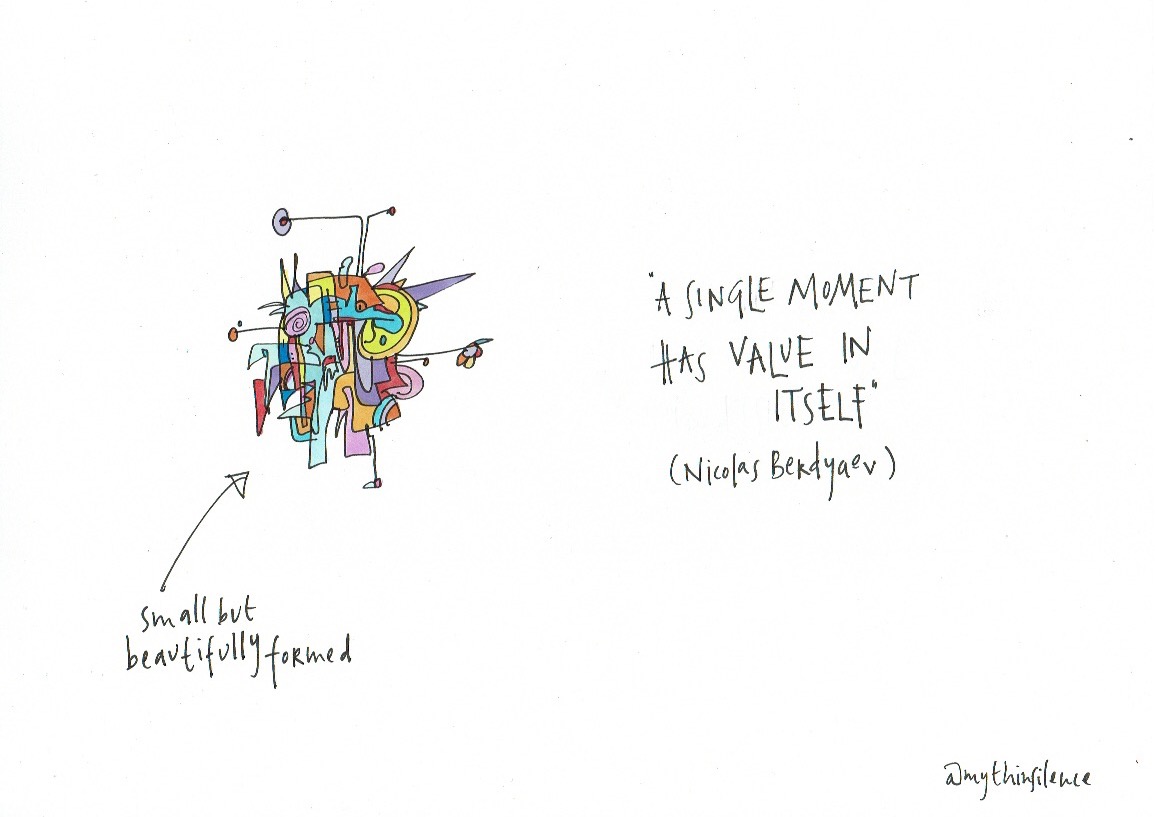
what will you be doing as a result of the next five steps you’re going to take?

6 do something

Who knows where the next step will take us, never mind the following four.

Exactly.

‘In order to harness complex forces you must first create something for the force to latch on to.  You must actually do something, even if you are not sure where it will lead.’*

What do you do if you have a lot of snow?

Build an ice hotel!

But you’d be wrong.

You start with an idea of bringing in some people who can create some ice sculptures, get even more people involved, have a go at making an igloo, then a bigger building able to house an expo, and eventually get to build an ice hotel – which took several winters to achieve*

To begin a journey like this, we need to observe more, but not from the sidelines.  When we enter into the complexity and see what happens, then wen find ourselves on one of the most amazing journeys in the universe, and it involves exploring our humanity.

When we see more, we can try more.  This is what makes an infinite player: finite players  believe they have to be free to do what they want to do; infinite players know they are free to make time to do what they want to do.**

We’re already free to prototype,^ and when we do, we’re allowing ourselves to step into the complexity full of unknown possibilities.

“Once we had that idea we had to try it out immediately.  I like that way of working – you don’t just talk about it, you try it.  No matter if it doesn’t work.”^^

(*From Frans Johansson’s The Click Moment.)
(**See James Carse’s Finite and Infinite Games.)
(^ See Otto Scharmer’s Theory U.)
(^^Creator of the original ice hotel Yugre Bergqvist, quoted in Frans Johansson’s The Click Moment.)

performance or development?

5 presence

‘Call them forward to learn, improve and grow, rather than to just get something sorted out.’*

An ancient scripture speaks about focusing on inner beings and hidden hearts, which I take to mean development over performance.

Improving performance helps us to deal with a given situation better, but the situation may be a one-off in what is a random, and some would argue, chaotic universe.

Development helps someone to be more imaginative and adept in the same universe.

Pixar undertakes post-mortems on its films, learning from both the good and the bad (don’t we wish we could get away with just the good things?), with five things to look out for: consolidate what’s been learnt, become a teacher of others outside of the project, don’t let resentment fester (everything is people, i.e., relationships), force reflection, and pay it forward (there’s always a What next?)**

We may occasionally need to focus on performance, but it’s a short game; those who focus on development are playing the longer game.  And those who help others to cross borders, rather than simply identifying them.

(*From Michael Bungay Stanier’s The Coaching Habit.)
(**From Ed Catmull’s Creativity, Inc..)

gently does it

4 when we are gentle

None of us can take pride when others get it wrong; we all make mistakes.

We wished we didn’t.

We need is a way to recover; we require a gentle way back. Perhaps gentleness is the way.

Life is fragile; handle with care.

There’s no point in comparing ourselves to someone else.  It doesn’t help us become our future Self.

Gentleness isn’t about “anything goes.”  Gentleness has powerful substance in that it is humble, grateful, and faithful.  Or, in other words, gentleness arises out of deeply knowing who we are – warts and all; it carries a deep gladness for being able to begin again; and, displays a deep willingness to pass gentleness on to others.

The gentle person refuses to judge, instead remaining open for as long as possible – they are grateful for not being judged by others.

If a Tunisian municipal officer slapping a market vendor can ignite a series of actions and events that lead to the Arab Spring, what can gentleness instigate?*

The question is, how can gentleness become a force of nature in a random world when it comes from within: deep calling to deep?

Gently does it. The challenge to be gentle is one we face each day.

Be gentle to yourself, don’t judge too quickly that this is who you are; be open to who you can become.  Then share with others, gently freeing their hopes and dreams, as well as their talents and experiences.

(*The story of the opening movement of the Arab Spring are played out by Frans Johansson in The Click Moment.  Johansson identifies three different complex forces: unintended consequences, a cascade, and, the self-reinforcing loop, of which the Aran Spring is a cascade.)


passionate short stories

3 passion wrapped in talent

‘But the differences between directing a five-minute short and directing an 85-minutes feature are many.  Doing the former is merely a baby step on the road to the latter, not the intermediate step we thought it was’*

I was talking with someone yesterday about writing; they told me how writing a novel is very different to writing a short story.  This seems to be what Ed Catmull is saying about making Pixar’s animations, above.

My experience is that it’s very difficult to “write” a great short story, when this is about living out our purpose with a daily purpose, focus, and clarity.

These daily stories still need a “spine,” or narrative arc, but they’re rarely about making mighty leaps, offering the opportunity to make what Frans Johansson names purposeful small bets, chosen because of their affordable loss, rather than return on investment.**

These small “bets” aren’t going to ruin us but afford us the opportunity to try and fail and learn – another term for which is deep practice.

Then there’s passion.

Much of what I’m about is helping people to identify their talents, key experiences, and passion.  Passion is the all-important motivation which keeps us going through hundreds and hundreds of hours of practice.  All short stories need to be filled with passion.  Johansson encourages us to ‘use passion as fuel to get past the inevitable failures.’**

(*From Ed Catmull’s Creativity, Inc..)
(**From Frans Johansson’s The Click Moment.)

what are you prepared to live for?

2 today is a short experiment

‘As soon as you try something new, you’ll get resistance.’*

‘[L]iving for something can be mundane – and therefore far more sacrificial, because seldom does anyone else notice.  You just go on living, beating the drum for the thing you’ve chosen to value above all else.  Genuinely living for something, day after day, is much more valuable than looking for a blaze of glory at the end.’**

Chris Guillebeau writes about how, as a young person in church, he’d sit through some high-octane delivery finishing with some variant of the question, “What’s worth dying for?”  He’s come to the conclusion that a better question is, “What’s worth living for?’

This is a more difficult question.  When we’ve decided what we want to live for, we’ll need to make some changes, and change brings resistance, from without, and most of all, from within.

Walter Brueggemann claims there’s nothing more upsetting to a regime of order than passion.  What if the prime regime of order is our own life, towards which we’ve made a number of tradeoffs?

‘The gift of freedom was taken over by the yearning for order.  The human agenda of justice was utilised for security. … And in place of passion comes satisfaction.’^

Personal order, personal security, personal satisfaction, but we long for more.

When we begin to open ourselves to there being more, that there is something we want our lives to stand for, we meet the resistance.

First comes judgement: Who are you to think you can do that?  Isn’t that someone else’s responsibility?  You’ll never make it.

Then comes cynicism: Who cares?  The world won’t get any better?  Shouldn’t you think about yourself firstly and foremostly?

Finally comes fear: This could ruin me.  I’ll be the laughing stock.  What will happen to me.

We need to figure ways of taking on the resistance on an everyday basis, to grow the newly found passion before it evaporates.  Frans Johansson asks What is the smallest executable step?^^  Pixar’s Ed Catmull talks about short experiments.*^  These allow us to try, fail, and learn.  Invaluable.

When I look back on my own journey, I realise this is how I’ve made progress to be.  Not some seamless leap.  But many small steps, sometimes stumbling, sometimes progressing, but over a long period, a journey of possibility results.

Everyday provides us with many opportunities to try out our passion in small executable steps and short experiments.  We don’t know what might emerge from these, but something will, and everyone can do it.

‘Remember this the next time you moan about the hand your dealt.  No matter how limited your resources, they’re enough to get you started.’^*

(*From Michael Bungay Stanier’s The Coaching Habit.)
(**From Chris Guillebeau’s The Happiness of Pursuit.)
(^From Walter Brueggeman’s The Prophetic Imagination.)
(^^From Frans Johansson’s The Click Moment.)
(*^From Ed Catmull’s Creativity, Inc..)
(^*From Twyla Tharp’s The Creative Habit.)

fractal it

1 do not give up on the habit

When the complexity of the whole is fully evidenced in the part.

Knowing this helps us to bring our art into the world.

Whether this is about an idea, relationship, artefact, or action, it can be imbued with the whole, no matter how small.

Even this blog post is smaller than intended because it completely vanished from my website.  Disappointing, but I guess that’s okay, because the big truth evidenced in the smaller blog, is that we don’t have to wait to be able to do something big to begin.  We only need do lots and lots of small things.

Press “Publish”

really?

31 really

‘There is a concept in psychology called risk homeostasis.  It refers to the idea that humans have a degree of risk they find acceptable and strive to live their lives at that level.’*

‘Organisations around the world are recognising that either they can expand their thinking to match the real system they belong to or they can artificially shrink the system they are managing to match their thinking.’**

What if one way of defining happiness is being open to more, present to more, and realising more?

If you were then to identify your happiest time in life, would this be some point in the past?  Or right now?  And, depending on your answer, is the future positive or negative for you?

It has been said that we are not so much concerned with the meaning of life, but wanting to know if we’re alive.

In the West we’ve developed stable and less risky environments, but these appear to have come at some cost.  Stability becomes a disadvantage when leaves us wondering if we’re alive.

The first quote, above, is Frans Johansson’s auditing of the way people are willing to take more risks when the degree of safety goes up – like pushing cars harder when we know ABS is fitted.  There appears to be something about being human that needs to risk.

The second quote comes from Peter Senge, and makes a lot of sense for the individual as well as the organisation.  We’re asking questions about what is real, about the stories we tell ourselves, and are these the only way of understanding life in this world.

We’re reworking our imaginations, dreaming more, opening up possibilities, exploring reality, and risking from a strong place within – integrity leading to wholeness, wholeness leading to perseverance, perseverance leading to integrity – the cycle of the revolutionary life.

(*From Frans Johansson’s The Click Moment.)
(**From Peter Senge’s The Necessary Revolution.)

you have to sing it

30 you can have what you have

What is the song you sing deep within?

Where does the journey of the song take you?

What’s the refrain you repeat to ensure you never lose the purpose of your song?

How does it differ to the songs of others (twelve notes, yet so many possibilities)?

When and where does it complement the songs others around you sing?

Who are the people with whom you share “choir moments” and make something bigger happen?

‘Presence is about observation, presencing, and realising.’*

Notice it, feel it, sing it.

Once you begin singing, you never know where the song will lead you.

(*From Peter Senge, Joseph Jaworski, Otto Scharmer, and Betty Sue Flowers’s Presence.)

the unpredictable path

29 actively rejecting

‘Research trips challenge our preconceived notions, and keep cliches at bay.  They fuel inspiration.  They are what keeps us creating rather than copying.’*

There’s nothing new under the sun.  No-one has yet figure out how to do ex nihilo work; everything new begins with things that already exists.

And yet, we come up with some astonishingly amazing things, so much so that we properly wonder when we’ll reach the limits of human innovation and creativity.

When we’re prepared to leave behind the predictable and the familiar, the truth of this becomes more and more apparent.  The unpredictable is mind-blowing, but not impossible – new ideas, imaginative ways of relating and working with people, different ways of behaving.

Best of all, the things we need to guide us are already within us.

Our openness is critically important.  Staying open takes huge amounts of energy.  It’s why the easier option is to do what everyone else is doing, participate in the groups everyone else is in, and reiterate the predictable ideas.  What e’re about is bypassing the divergent, avoiding the emergent, and going straight to what we predict to be the convergent.

So, what do I love in all of this?  In my work with people exploring their passions, talents, and experiences, it’s coming upon their unpredictable paths.

(*From Ed Catmull’s Creativity, Inc..)

curiously you

28 to ensure she

‘In this special silence, you can hear or see, or get a strong sense of something that want to happen that you wouldn’t be aware of otherwise.’*

Who hear the cries of silence?

As we grow older we grow less curious.  It’s something we learn, and we can unlearn it, says Mihaly Csikszentmihalyi and offers the follow steps:

‘So the first step toward a more creative life is the cultivation of curiosity and interest, that is, the allocation of attention to things for their own sake. … Try to be surprised by something every day. …Try to surprise one person every day. … Write down each day what surprised you and how you surprised others. … When something strikes a spark of interest, follow it.’**

Curiosity is our guide out of the world of measurement and into the universe of possibility.^

We each have our own curiosity; I’m curious to know what yours is.^^

‘If you learnt to listen to your curiosity, you will find that you become curious about those things that are different and new.’*^

Walter Brueggemann makes a curious remark when he proffers, ‘Prophecy cannot be separated very long from doxology, or it will either wither or become ideology.’^*  Which I take to mean, those who hear the cries of silence must translate their openness and presence to what can be turned into a song they sing each day, ever new and ever alive, moving them deeper into the mystery.

(*From Peter Senge, Joseph Jaworski, Otto Scharmer, and Betty Sue Flower’s Presence.)
(**See Mihaly Csikszentmihalyi’s Creativity.)
(^So would say Roz and Ben Zander in The Art of Possibility.)
(^^My curiosity is to know what yours is and to help you pursue it.)
(*^From Frans Johansson’s The Click Moment.)
(^*From Walter Brueggemann’s The Prophetic Imagination.)