it matters

I came upon these two thoughts on opportunities, the first from Hugh Macleod, the second from Seth Godin:

‘We can only accomplish something when we feel strongly – and there is no feeling strongly without feeling fear.’*

‘[Opportunities] often come enshrouded with hassle, perceived risk and the need to overcome inertia.  It’s easier just to say no.  What happens if instead of ignoring opportunity you triage it?’**

The funny thing is, the more we say yes to the right opportunities the more opportunities present themselves.

Seizing the right opportunities builds personal capacity, as when we’re faithful to building something with who we are ad what we have, we build perseverance: the capacity to thrive in pressured situations.

Another dynamic being increased is our freedom to act, meaning when a great opportunity comes along we have taken the time to build our capability and we can act.

To act is to see abundance – we are more than enough, as opposed to scarcity – we are not enough.  A simple triage for whether we should take this opportunity is made up of experience, talent, and passion or dreams:

What are our important past experiences?
Do our talents offer themselves to this opportunity in the present?
Is this something we are passionate or dream about for the future?

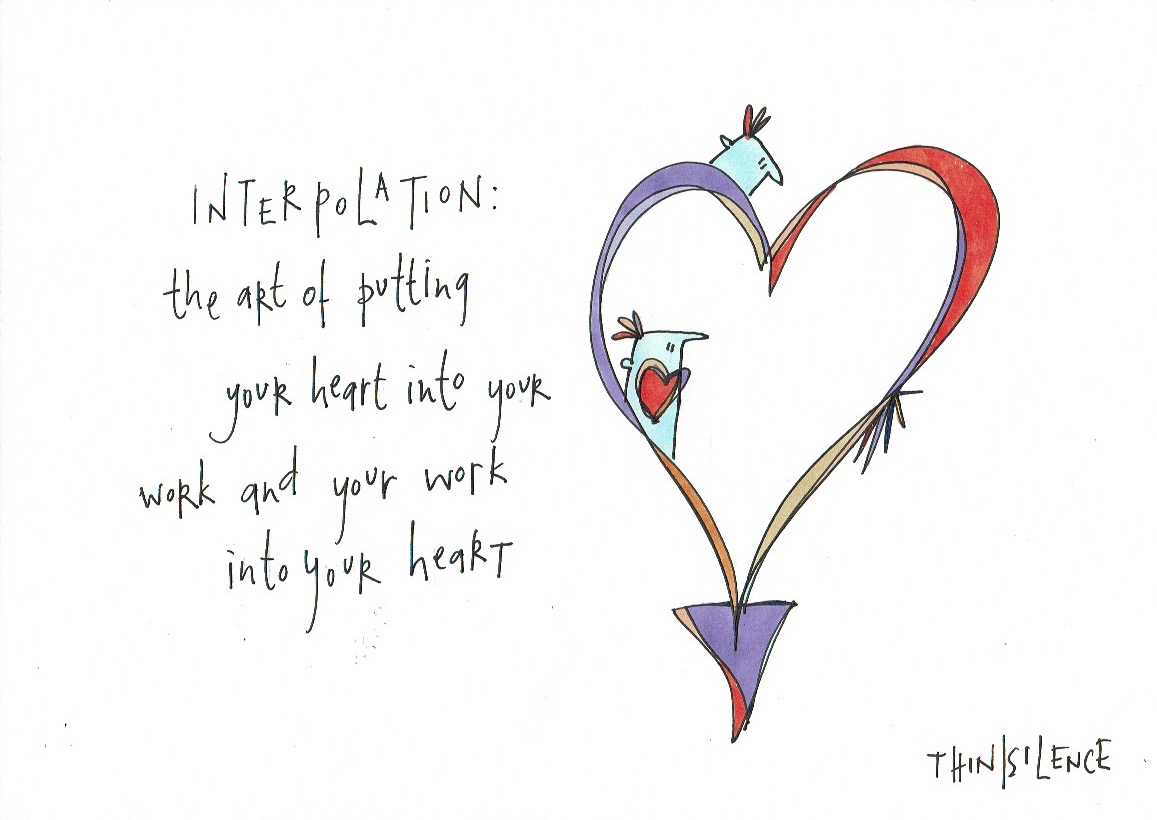
All of these add up to; We do this because it matters.

(*From Hugh Macleod’s gapingvoid.)
(**From Seth Godin’s blog Opportunity Triage.)

infinity

“If Facebook were deleted, I’d be deleted. … All my memories would probably go along with it. … That is where I am.  It’s part of your life.  It’s a second you.”*

‘The question each of us has to ask is simple (but difficult): What can I become quite good at what’s really difficult for a computer to do one day soon?  How can I become so resilient, so human and such a linchpin that shifts in technology won’t be able to catch up.’**

I’ve pulled these two quotes together as they’re both about the impact technology has upon our lives – one negative and the other, positive.  Seth Godin argues that artificial intelligence nibbles away at the things we don’t really want to do, that who we are is formed outside of this.  We cannot allow ourselves to be formed within technology.  In the first quote, though, Audrey sees her online self as being different to her offline self, being the person she wants to be but isn’t.  Her words are full of angst.

Then this poem from John O’Donohue about our lives seeking their own shape after we are born:

‘Since then something within me
strains through closed pores
of words to get its echo out,
but becomes dumb again
when it hears their foreign voices
mangle outside what is tender within.’^

Perhaps Audrey’s ‘foreign voices mangle’ offline, making her run to her online ‘tender within.’

In Godin’s words I hear an echo of my hope that everyone has something they can ‘become quite good at.’  We do not find it by hiding with some wrong idea of self, hidden from others.  Rather it is in others we discover who we are.  O”Donohue continues:

‘I open like a swift breeze
over a meadow of clover
seamless, light and free;
helplessly, everything in me
rushes together towards
the dark life of your eyes.”^

‘Your little “I Am” becomes “We Are.”^^

Thereafter, when when we sit still with ourselves, we perhaps will notice this charge of excitement within (literally: to set in motion) and not the dull ache of angst.  In noticing this, it becomes stronger.  This is our infinity.  I’ve borrowed this word from Lillian Lieber’s book on science and mathematics Infinity: Beyond the Beyond the Beyond for exploring the unlimited nature of our lives and the contributions that emerge.

Lieber points to the need for facts (S), intuition (A), and reason (M).  Capitalisation of SAM indicates the fullness of each.  A SAM life is what we must aim for, not Sam, sAm, saM, SAm, sAM, or SaM, so:

“The yearning for infinity, for immortality, is an intuitive yearning (“A”): we look for support for it in the physical world (“S”), we try to reason about it (“M”) – but only when we turn the full light of SAM upon it are we able to make genuine progress in considering infinity.”*^

This is our universe of possibility.

(*Sixteen year old Audrey, quoted in Sherry Turkle’s Alone Together.)
(*From Seth Godin’s blog post 23 Things Artificially Intelligent Computers Can Do Better/Faster Cheaper Than You Can.)
(^From John O’Donohue’s Echoes of Memory: Arrival.)
(^^From Richard Rohr’s The Naked Now.)
(*^Lillian Lieber, quoted in Maria Popova’s BrainPickings.)

what is your seeing?

This is about what you see and others do not, and how some of our finest moments occur in the most surprising places.

We may see the same things as others but see more.  Someone was sharing with me today about how she seeing different things in the lives of the people she worked with, things her colleagues didn’t see.

Our seeing connects us with the world of myths and dreams, mythologist Joseph Campbell offering a helpful description for these:

‘The myth is the public dream and the dream is the private myth.’*

It’s in the dynamic relationship between these two that change and transformation take place.

But be careful about how we see because seeing leads to actioning: the place where dreams and myths collide.  Lillian Leiber warns that what we see (facts), must be matched by equal intuition (heart) and reason (mind).

What will we do?  We might wish we could close our eyes.

Action is speculative.  It has no idea whether it will succeed or not.  It’s in understanding these things as myth, though, that we see the implications of what we see and what we do:

‘[Visionaries have] moved out of the society that would have protected them, and ito the dark forest, into the world of fire, of original experience.  Original experience has not been interpreted by you, and so you’ve got to work out your life for yourself.  Either you can take it or you can’t.  You don’t have to go far off the entered path to find yourself in difficult situations.  The courage to face the trials and possibilities into the field of interpreted experience for other people to experience – that is the hero’s deed.’*

It can be something large or something small but to act on what we see will likely bring resistance and even opposition:

‘Every day, employees follow processes and rules that were designed for a time when the world worked differently.  Many cultures are risk-averse.  Those who wish to change are challenged, undermined or under-appreciated by those who want to hold onto the past.  But the world has changed.  Whether you like it or not.’^

When something you see turns into a dream, or private myth, and you move this into the public world through action, though you may have no idea what you are doing, then, in the strictest sense of the term, you are being heroic.   Just remember that.

(*From Joseph Campbell and Bill Moyers’ The Power of Myth.)
(**From Brian Solus and gapingvoid’s 10 Reasons Your Culture is Failing and New Insights on How to Fix It.)

stick or twist?

‘I would send a raven
to your window with a green blade
to show you the flood that blinded
is gone down and my eyes can see
the torn sinews of the impoverished
earth gasp in this white, winter light.’*

If you think this is as good as it gets – your life, society, world – then maybe you want to stick and make sure you don’t lose what you have.

If you suspect there is more and have decided this is not what you’re going to settle on then you need to twist, see what comes next.

In his book Sapiens, Yuval Noah Harari imagines someone falling asleep in the year 1000 CE and awakening in as Christopher Columbas’ sailors were boarding their ships, they would find a familiar world, but one of Columbas’ sailors falling asleep to awaken five hundred years later would find himself in an incomprehensible world .

A closer look at life between 1000 and 1500 would show plenty of sticking and twisting.  As would a closer look at life at the time.  Moving on in some ways, sticking where we realise we need to get sustainable.

We’re recognising that our freedom in being a species that has the ability to twist without limits is not really freedom at all, is actually more similar to what Lillian Lieber calls “a PATHOLOGICAL FREEDOM as against a NORMAL HEALTHY FREEDOM.”*  The latter is marked for Lieber by exalting of observable facts, intuition, and reason together.  Raising one or two over the other(s) results in an unhealthy freedom.

With these three things held in tension, I’m not ready to stick.  There is more to see, feel, and do.  I am prepared to unlearn and learn anew.  This is the way of twisting first of all:

‘You normally have to let go of the old through a stage of unknowing and confusion, before you came move to another level of awareness or new capacity.’^

(*Messenger of Sight, from John O’Donohue’s Echoes of Memory.)
(**Lillian Lieber, quoted in Maria Popova’s BrainPickings.)  
(^From Richard Rohr’s The Naked Now.)

gently does it

Gentleness is a strength with many qualities

It’s slow when other strengths are fast.  It sees and feels particularly when others can only grasp generalities. It’s adept with smaller things when other strengths lack the finesse.

Gentleness is able to open possibility because it comes with compassion to understand and appreciate the other.  As a result, it makes for freedom and choice:

‘Stay free.  Stay different.  Embrace your weird.  Embrace your brain.  Embrace what inspires you.’*

Gentleness doesn’t shy from the story with conflict where it is able to shine with the attributes it possesses.

These stories are always closer than we think:

‘The most dangerous stories we make up are the narratives that diminish our inherent worthiness.  We must reclaim the truth about our lovability, divinity, and creativity.**

I only wish I was more gentle.

(*From Hugh Macleod’s gapingvoid.)
(**From Brené Brown’s Rising Strong.)

beyond the beyond the beyond

‘Drink in the silence.  Seek solitude.  Listen to the silence.”*

There is a time for activity and there is a time for silence.

In 1953, mathematician and writer Lillian Leiber published a book with the wonderfully evocative title: Infinity: Beyond the Beyond the Beyond.  Leiber intended her writing be for everyone to enter into the wonder of science.  Maria Popova considers her style poetic, offering this description for Leiber’s writing:

‘it does what poetry does, which is slow down a spinning world and dilate the pupil of attention so that the infinite becomes comprehensible’**

This too feels like poetry, slowing down our thoughts so we may be gaze upon the thin silences or whispers we may miss.  Otherwise, how will we get to beyond the beyond the beyond?

I can’t help but think of Leiber’s title in terms of a people’s lives: what people don’t know about themselves because it doesn’t lie on the surface, nor beneath it.  Hugh Macleod voices just how when he writes:

‘Finding the people who need help is the first step to really helping.  It’s easy to give a hand to someone who’s almost there … But what about the rest?  What about the ones … who can’t even put words to their dreams?’^

Oh my!

In the silence, the whispers from beyond the beyond the beyond begin to emerge.

(*Frances Roberts, quoted in the Northumbria Community‘s Morning Prayer.)
(**From Maria Popova’s BrainPickings.)
(^From Hugh Macleod’s gapingvoid.)

slowly into the silence

“Live from day to day, just from day to day.  If you do so, you worry less and live more richly.”

Last night, as I switched off the lights and turned towards sleep, I noticed a twitch of a thought, the desire to be more present to the contents of a day.

I’m sure this has something to do with getting older, knowing every day counts and how it’s becoming more important to turn my attention to the things that fill my them.

So, to noticing more.

I read these words from Georg Hegel:

“The familiar, precisely because it is familiar, remains unknown.”**

This sounds hopeful.

John O’Donohue uses these words to lead into his beautiful poem Chosen.  Written in six short parts, the lines follow the life of a young woman married to a numbing existence with a farmer and his land.  Here she has:

‘learned to become
immune within,’^

Everything in here existence is dead and pale:

‘In the Sunday church
the same priest
winds dead talk
in dark wreathes
around their minds.’^

Yet there are some hidden things that speak of presence and intimacy.  Firsty in the third part, O’Donohue describes an underground stream, the course of which the woman knows nothing of, but:

‘She is often drawn
along its rumble line
to the spring well
where its face
appears to form.^

She watches her cows drinking and, for the briefest moment, something hidden comes into view:

‘Some extend her
that oracle stare
of animal to human;
then turn around again
to graze the land.’^

So fleeting a moment of presence.

The second hidden thing appears in the final part.  This relationship with her partner had begun with a simple desire:

‘just a tender
wish to nourish
a golden oleam
his touch first
sung awoke
in her womb.’^

Though their love had gone, O’Donohue hopes for one more hidden thing:

‘Who would wonder
if somewhere deep
in an oak drawer
she kept the whole time
something intimate

maybe a silk chemise
and dreams a dance
to banish distance
and moistly with musk
entice, entrance.’^

I also had happened to read Sherry Turkle’s story of sixteen year old Audrey who expressed her longing to the researcher for an intimacy of daughter and mother but they are separated by technology.  When picked up after school, her mum doesn’t connect but keeps talking on her phone and texting”

‘”Like, it could have been four days since I last spoke to her, then I sit in the car and wait in silence until she’s done.”  Audrey has a fantasy of her mother, waiting for her expectant, without a phone.’^^

Every day can be an experiment in being more present, to uncover what has always been there, exploring some reciprocal depth.

Perhaps tist is what faith is for, the human ability to see what is unseen with new eyes an heart:

‘Faith is a word that points to an initial opening of the heart space from our side.’*^

(*Anne Morrow Lindbergh, quoted in the Northumbria Cecmmunity‘s Morning Prayer.)
(**Georg Hegel, quoted in John O’Donohue’s Echoes of Memory.)
(^From John O’Donohue’s Echoes of Memory: Chosen.)
(^^From Sherry Turkle’s Alone Together.)
(*^From Richerd Rohr’s The Naked Now.)

who are you waiting for?

Peter Diamandis and Steven Kotler tell some of the XPrize story, offered for a better cleaning-up solution to the Deepwater Horizon oil disaster.  Twenty seven teams went after the $1.4 prize.  The most intriguing part of this story involves a team that didn’t actually win but came up with a solution doubled cleaning-up efficiency – they were from outside the industry and had met in a Las Vegas tattoo parlour.  It’s amazing what we can get up to with some imagination and focus.

‘The obstacles are less important that the opportunities if we replace ignorance with insight, inattention with foresight, and inaction with mobilisation … if we realise we are the people we have been waiting for.’*

This oil story reminded me I’d picked up a copy of Winning the Oil End Game, which includes amongst its authors, the wonderfully named Odd-Even Bustnes.  The book offers a vision of an oil-free United States by 2050, naming several policies that would have made this possible.  Would because Donald Trump has come to the White House with environmental policies that owe more to the ignorance, inattention, and inaction, than to insight, foresight, and mobilisation.

Whilst the story and quote are from the oil industry, the truth could be about anything within imagining and shaping a better world.

The greatest threat to a more imaginative future is thinking we know:  The best way to begin a day is to arise knowing we do not know, starting with what we do not know about ourselves and our motivations:

‘The ego self is by definition the unobserved self, because once you see it, the game is over.’^

This ego is the self that is less than we can be.  It is a compassionate activity when we are prepared to look beneath the surface of our life, though some, like E. O.Wilson, discredit compassionate behaviour as hypocritical and calculated:

‘”[Homo sapiens] good behaviour is calculating, often in a wholly conscious way, and his manoueveres are orchestrated by the excruciatingly intricate sanctions and demands of society.”

No doubt, some will use compassion as a technique or skill to get something but there are many who are deeply fascinated at what this means for us as a species. When you think about it, life is all about compassion.  Opening our minds, hearts, and wills are compassionate actions.  Compassion makes it possible to look at ourselves more honestly and hopefully towards our future Self, and then to look at others, our societies, and the environment of which we are a part and are sustained.

H are the most important words:

If we realise we are the people we have been waiting for.

(*From Amory Lovins, Kyle Datta, and Odd-Even Bustnes’ Winning the Oil Endgame.  I use the acronym TEESA to remind me to read around Technology, Entrepreneurship, Environment, Society, Arts – this book is my environmental read.)
(**From Richard Rohr’s The Naked Now.)
(^E. O. Wilson, quoted in Karen Anderson’s Twelve Steps to a Compassionate Life.)

give it time, or, the journey out of suckerhood

Yuval Noah Harari claims, ‘history’s choices are not made for the benefit of humans,’ that we’re unable to claim one worldview is better than another.*  Furthermore he purports the notion that cultural ideas are simply parasitical,  inhabiting their human hosts, spreading from person to person and generation to generation in memetic fashion:

‘They multiply and spread from one host to another, occasionally weakening the hosts and sometimes even killing them. … cultures are mental parasites that emerge accidentally, and thereafter take advantage of all people infected by them. … The nationalist virus presented itself as being beeneficial for humans; yet it has been beneficial mostly for itself.’*

I understand what Harari is saying here but it feels like only half the story: the half that says, The stories we tell ourselves, as to how life on earth is best lived, are just that – stories, and we can tell ourselves better stories.  Hugh Macleod and Nassim Taleb give me more hope for our relationship with ideas.  First of all, Hugh Macleod proffers:

‘Helping to fix a company culture and helping a company to become more creative are actually the same thing. … Creativity and culture in the workplace come from the same place. … Creating culture is creating meaning within your organisation.’**

That culture is the product of creativity and creativity needs to be embedded in culture pertains to more than the business world.  We can’t have one without the other.  None of us were very old when we first stepped into our creativity, and at that moment a universe of possibility opened before us and cultures emerged – both large and small.  But, where either of these exist for their own sake, we find absence rather than presence.

Nassim Taleb shares in his inimitable way how openness to another offers the possibility of a better culture:

‘Half of suckerhood is not realising that what you don’t like might be loved by someone else (hence, by you later), and the reverse.’^

There’s no requirement for most of the lines we have drawn between “them and us” when it comes to seeking the way of presence over absence.

‘”We unwittingly amplify commonalities with friends, dissimilarities with strangers, and contrasts with enemies.’^

How would creativity and culture best meet?

Compassion appears best placed as a place of hope, for stepping into another’s world.  Any creativity or culture that unable to step into another’s world is not worth having, though it may be worth fixing – itself a compassionate act.

Two-and-a-half thousand years ago, Confucius expressed what we recognise as the golden rule:

‘people should not put themselves in a special, privileged category but should relate their own experience to that of others “all day and every day.”  Confucius called this ideal ren, a word that originally meant ‘noble’ or ‘worthy’ but which by his time simply meant ‘human.” … A person who behaved with ren “all day and every day” would become a junzi, a mature human.’^^

Of course, this is still a story we tell ourselves, but it’s a pretty good one.

(*From Yuval Noah Harari’s Sapiens.)
(**From Hugh Macleod’s gapingvoid.)
(^From Nassim Taleb’s The Bed of Procrustes.)
(^^From Karen Anderson’s Twelve Steps to a Compassionate Life.)

the poet

‘The first breath of morning breaks the dark enough
to let the sky out of night, it gathers up
the trust of trees that leaned with such relief
against the dark, leaves them stripped and lost
to reach ever further into the nowhere of air.’*

John O’Donohue could have written, “It’s the morning and with the increasing light I can see more of my surroundings,” though this wouldn’t have caught my attention.  Instead, by using familiar words in different ways, O’Donohue says more with less: I notice and I feel the dawn.

There’s something about a poet and her poem that can make us feel and value life while we have it.  Soon enough it will be gone and we will be forgotten.

‘Let nothing bless
the human head
that climbed so high
to praise itself.’*

Whilst our willingness to be forgotten may be our greatest humility, this is not about death.  It’s about life and joy.  We’re not dead yet, so while we see the light coming each day to us, we  have life.

‘One thing that comes out in myths is that at the bottom of the abyss comes the voice of salvation.  The black moment when the real message of transformation is going to come.  At the darkest moment comes the light.’**

‘The greatest art is an intersection of contrasts … pain and healing, despair and hope, darkness and light.’^

Our art is both myth and poem, holding together that which would normally be missed, helping us to see how things are and that we can overcome and live richly.  I can miss what is already there.

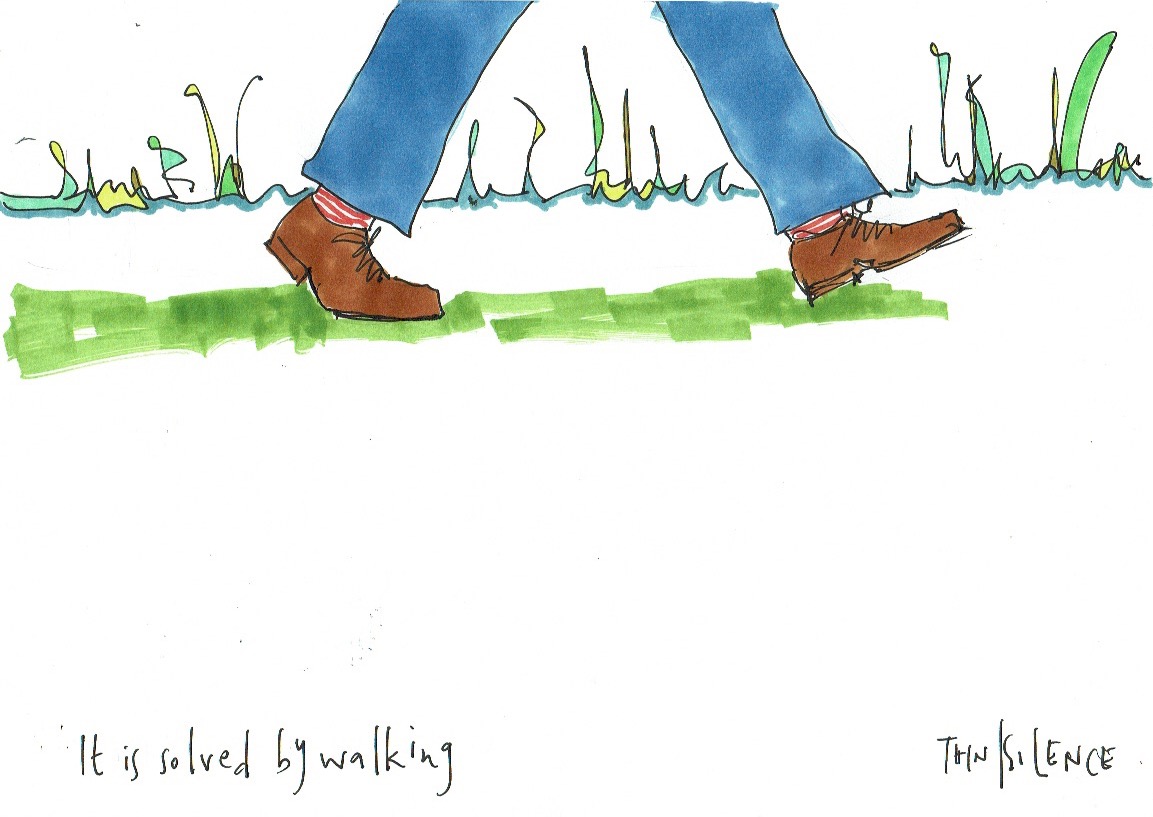
In his pilgrimage, Paulo Coelho’s guide Petrus teaches a simple walking exercise.  At first Coelho feels tortured but then he begins to see more:

“Walk for twenty minutes at half the speed at which you normally walk.  Pay attention to the details, people, and surroundings.  The best time to do this is after lunch.’^^

‘The world was there around me, and I realised that seldom had I paid attention to it.’^^

You are a poet, able to make more with less.

I leave the final word with Coelho’s guide Petrus:

“Changing the way you do routine things allows a new person to grow inside of you.”^^

(*From John O’Donohue’s Echoes of Memory: Betrayed by Light.)
(**From Joseph Campbell and Bill Moyers’ The Power of Myth.)
(^From Erwin McManus’s The Artisan Soul.)
(^^From Paulo Coelho’s The Pilgrimage.)