my poem

For those who seek a different wisdom to the prevailing wisdom, an alternative story to the one often told.

‘I sit, alert
behind the small window
of my mind and watch
the days pass,
strangers,
who have no reason
to look in.’*

Will this wisdom come to us?  Or must we seek the story?

Whilst reflecting on these words from John O’Donohue I reread some words that caught my attention a year ago:

‘All great spirituality is somehow about letting go.’**

Understanding spirituality in its widest sense, I’m wonder if there’s something I must let go if the different story is to come – what my friend Alex McManus has called the ‘open possibility of tomorrow.’^

Another  note catches my eye, this time from Gretchen Rubin:

“When the student is ready, the teacher appears.”^^

I must miss so many things when I’m not ready.

But sometimes we’re never ready.  What then?

So I wonder how we can make ourselves ready.  That is, how we might open and increase our readiness, though I suspect it isn’t easy.  What if we notice something we want to see some change in?

Jean-Pierre Siméon’s book This is a Poem that Heals Fish tells the story of a child discovering what a poem is and what it does.  Arthur’s fish Leon is stricken with boredom.  His  mother tells him to give the fish a poem, and then leaves for a tuba lesson!  He is left searching for a poem.  After searching in the kitchen to no avail be, Arthur begins to ask people to describe a poem.  Each person gives a different answer; his grandfather tells him:

“A poem, well … It’s what poets make. … Even if the poets do not know it themselves.”*^

After all the answers the boy returns to his fish confused.  He begins by saying he doesn’t know what a poem is but continues with what he knows from all the answers he’s been given – this is, of course, his poem

A poem
is when you have the sky in your mouth.
It is hot like fresh bread,
when you eat it,
a little is always left over.

A poem
is when you hear
the heartbeat of a stone,
when words beat their wings.
It is a song sung in a cage.

A poem
is words turned upside down
and suddenly!
the world is new.*^

This story contains many things but here are two.

Arthur begins with his concern for Leon and a journey begins.

His grandfather’s response really is pointing to how we all have a poem – and we may not know this.  We may use the same words as others, but differently, in telling about the things that matter to us.

The magic of a poem is how we are able to make more with less.

I’ve just picked up Karen Armstrong’s Twelve Step to a Compassionate Life.  Armstrong by telling how she was granted a wish for a better world by TED, so she launched a charter for compassion.

I love the idea of this but we don’t have to wait for TED or anyone else to grant us a wish.  We’ve been granted one already.  We also get to make it come true:

‘You can’t receive what you don’t give,’ as Eckart Tolle said^*

This is about our poem.

When I notice what it is
I notice,
when I turn my attention
to this,
bringing my hands to what I see,
I am discovering
my poem.

(*Cottage, from John O’Donohue’s Echoes of Memory.)
(**From Richard Rohr’s The Naked Now.)
(^From Alex McManus’s Makers of Fire.)
(^^From Gretchen Rubin’s The Happiness Project.)
(*^Grandfather in Jean-Pierre Simeon’s This is a Poem that Heals Fish, quoted in Maria Popova’s BrainPickings.)
(^*From Eckhart Tolle’s A New Earth.)

an unredacted life

‘A poem turns words around, upside down, and – suddenly! – the world is new.”

Sometimes a poem is just what we need.

‘In coils of wave, winding in dance, the sea
Is too fluent to feel its own silence,
Only for the sure gaze and grip of share
It would not know itself to be the sea.’*

You are the shore to my sea.  We need each other to know ourselves.

The world of messaging, texts and emails, makes it much easier to hide, for the sea hesitantly approach the shore. It becomes far easier to edit the life others see.  Relationships become more efficient rather than deep.

Hiding is easy, it’s being present that is difficult:

‘Presence is wisdom!  Presence is the one thing necessary, and in any ways, the hardest thing of all.  Just try to keep your heart open, your mind without division or resistance, and your body not somewhere else.’**

Hard but not impossible.  My hope is that,, whilst technology advances, the sea will still reach the shore.

(*From Jean-Pierre Simeon’s This is a Poem That Heals Fish, quoted in Maria Popova’s BrainPickings blog.)
(**From John O’Donohue’s Echoes of Memory: Expectation.)

(^From Richard Rohr’s The Naked Now.)

focus and breadth

It’s important not to get these the wrong way around.

Covering many things probably means we won’t get a lot done … well.  Bringing a breadth of people to work on something specific provides impact.

‘More breadth … doesn’t cause change … . Focus works.  A sharp edge cuts through the clutter.’*

‘The massively transformative purpose (MTP) galvanises passion, attracting the best talent and inspiring them to give it their all.’**

Peter Diamandis and Steven Kotler describe the power of an MTP for focusing and providing breadth in the best ways: twenty five teams compete for the prize offered for the design of spaceships at one hundredth of the cost of the original vehicles sent into space.

We don’t have to get into competitions for designing a new generation of spacecraft to experience the power of the right kinds of focus and breadth.  Who wouldn’t want to harness the power passion, talent, and giving all?

Behind this there are people identifying their personal foci, being able to add this to a breadth of people working together to bring about change, not because they feel they have to but because they want to.

‘In the sphere of material things giving means being rich.  Not she who has much, but she who gives much. … She gives of herself, of the most precious she has, she gives of her life.  This does not necessarily mean that she sacrifices her life for the other – but that she gives her that which is alive in her: she gives her of her knowledge, of her humour, of her sadness – of all expressions and manifestations of that which is alive in her. … Love is the active concern for the life and the growth of that which we love.’^

“What stands in the way becomes the way.”^^

What we choose to love comes from within, not without.  Personal responsibility isn’t something forced upon us but is what we come to believe we must do – this in response to the needs we see in the world around us and others may not.  If we really live in a world of abundance rather than one of scarcity, something quite astonishing happens when we understand we have what we need to create a compelling story to live in.

‘Every creative endeavour becomes a realisation of both how limited and unlimited we are.’*^

I know I’m limited – but others complete what I lack.  This is the importance of breadth.

I do know how unlimited you are – because you haven’t come to the end of exploring your passion, talent and giving of your all.

(*From Seth Godin’s blog Holding Your Breadth.)
(**From Peter Diamandis and Steven Kotler’s Bold.)
(^From Erich Fromm’s The Art of Loving.  I have changed the gender from him to her; I don’t think Fromm would mind – he was writing in the 1950s.)
(^^Marcus Aurelius, quoted in Ryan Holliday’s The Obstacle is the Way.)
(*^From Erwin McManus’ The Artisan Soul.)

maps 4.0

‘… it is just coincidence that most people today believe in nationalism, capitalism and human rights.  History cannot be explained deterministically and it cannot be predicted because it is chaotic’*

When he mentions chaos, Yuval Noah Harari is thinking about two levels of chaos – one being the natural world and universe, the other being what happens when we react to this world and universe.  Life cannot be predicted without hindsight, that is, ‘an event that has already taken place has 100% probability.’  As we turn towards the future, the probability percentile drops.**

Harari wouldn’t have known but the order in which he mentions nationalism, capitalism, and human rights, causes me to think of Theory U‘s Societies 1.0 to 3.0.  In a nutshell, 1.0 is an autocratic society in which a few people determine the fates of everyone else.  This spawned 2.0 with the merchant traders and guilds becoming the forerunners of industrial capitalists.  In response to these initiators, groups began to organise themselves for protection, trade unions and, later environmental groups: 3.0.  Each of these have left a hertitage of “maps” and are still creating them – and maps are very important, as Denis Wood is at pains to point out:

‘In no walk of life have people failed to use the power of the map to connect themselves to the world.’^

Denis Wood makes a helpful point when it comes to the shortcomings of Society 3.0 – some are always left out:

‘Accusingly, there seems to be no geography of children, that is, the earth’s surface as the home of children.’^

I think this is changing but there’s always someone left out and this begs the question about what the characteristics of Society 4.0 and its maps will be.  Perhaps this is where we find ourselves but I remind myself that just when you think the world is moving forward, there’s something that happens to yank us back.  I confess my optimism, though.

Maps 4.0, I think, will involve the different ways and places in which we find each other.

‘Every social association that is not face-to-face is injurious to your health.’^^

‘What connects us beyond our kinship ties?  Story.’*^

Whilst 3.o is about rights, 4.0 isn’t about everyone having the same.  It’s going to be more about those who make the discovery that they are able to give and, therefore, to receive:

‘Whoever is capable of giving of himself is rich.’^*

(*From Yuval Noah Harari’s Sapiens.)
(**From Nassim Taleb’s Fooled by Randomness.)
(^From Denis Wood’s The Power of Maps.)
(**From Nassim Taleb’s The Bed of Procrustes.)
(*^From Jonathan Gottschall’s The Storytelling Animal.)
(^*From Erich Fromm’s The Art of Loving.)


inclusive is the new exclusive*

‘Being inclusive … means building an identity upon letting people in.  And redefining who you want to be by who you want to be with.’*

Everyone is capable of doing something in a way no-one else can – we often miss the nuances but there’s some way of relating or thinking or behaving that brings a slightly different dimension or perspective.  It doesn’t mean we have to act all exclusive because of it, though.

Alan Lightman tells a story from his early research days when, in the final days of writing things up for publication, he came upon a freshly published article from two Japanese scientist who’d solved the same problem, with results within three decimal places:

‘I experienced a complex set of emotions.  I was embarrassed.  I was humiliated.  I grieved the loss of several months of my time.  I worried about whether the wasted effort would compromise my chances for an assistant professorship.  But then, another emotion began working its way through my body.  Amazement.  I was utterly amazed that people on the others side of the planet, with no correspondence between us, no comparing of notes, had decided to solve the same problem and had gotten the same answer to three decimal points.  There was something wonderful and thrilling about that’**

Beneath this personal tale of being scooped, then realising how amazing science and mathematics are, there’s a personal journey from exclusivity into inclusivity witnessing Lightman moving to a place of wonder.  As John O’Donohue insightfully writes, ‘when you wonder, you are drawn out of yourself.’^

To make a personal or corporate journey from exclusivity into inclusivity isn’t easy, though, especially as it requires suspending the way we see things in order to see from another person’s perspective, redirecting our attention from ourselves towards others, and letting go of exclusive goals for inclusive ones shared with others.  Inclusivity means we get to wonder from the inside of things.

“When the universe makes you wonder, all is at it should be.”^^

What’s more, people who include those excluded by others are also including themselves.  Ultimately is a loving act.  Erich Fromm offers a helpful framing of love:

‘Love is an activity, not a passive affect; it is “standing in,” not “falling for.”  In the most general way, the active character of love can be described by stating that love is primarily giving, not receiving. … Giving is the highest expression of potency.  In the very act of giving, I experience my strength, my wealth, my power.  This … fills me with joy.  I experience myself as overflowing, spending, alive, hence as joyous … in the act of giving lies the expression of aliveness.’

Love is giving and, therefore inclusive; it’s not waiting to receive, especially permission from others – which is how we often let exclusivity win.

Bring what you see.

‘I envy
… the absolute eyes of children,
meeting everything
dirt blobs jewelled,
rusty strips of tin,
ducks, dogs, flowers …’*^

(*From Hugh Macleod’s gapingvoid blog.)
(**From Alan Lightman’s A Sense of the Mysterious.)
(^From John O’Donohue’s Eternal Echoes.)
(^^Cirque de Soleil’s Varekai, quoted in Alex Mcmanus’ Makers of Fire.)
*^From John O’Donohue’s Echoes of Memory.)

blue not red

‘Value is in the spaces between people.’*

Some environments value competitiveness in order to produce results: beneficial short-term but often destructive long-term.  The flip of this is submission on the part of some to those with dominant characters or ideas – again, this strategy has short-term benefits but long term is corrosive to creativity.

To create value between people requires everyone turning up with their personal value or sense of worth – we’re all meant to be explorers of our personal value.

Three creativity myths: only a few people are creative, creativity is a solo occupation, and, creativity is about finding answers rather than asking questions.

Competitive or abdicating spaces are red – people get hurt, either by the excessive cut and thrust, or by an inner undermining of personal value.  Spaces filled with personal creativeness are blue – not only blue as in blue sky and open, but also in being hyperlinked – taking the conversation, planning, executing to new places.

Alan Lightman smokes his grandfather’s pipe and is taken in a Proustian like way to a time he never knew – his grandfather had died before he was born.  Lighting the pipe released smells locked up in the pipe for all those years.  Lightman reflects:

‘There is a kind of time travel to be had if you don’t insist on how it happens.’**

I’m not advocating taking up smoking but I’m thinking about a kind of time travel made possible when we are open to what another brings – all the experience and expertise built over so many years, often encapsulated in a story they tell.  This kind of blueness is made possible by being present, listening not only with our minds but our hearts and our bodies, too – this can take longer to write than how it looks in realtime, so it doesn’t necessarily take more time than going with the harde=-headed or the “tried and tested.”  As Brené Brown points out, the relationship between being present to others and being present in the moment of activity is one of blueness:

‘mindfulness and flow aren’t in competition with each other.  They aren’t the same thing but they share the same foundation: making a choice to pay attention’^

Yesterday I was part of a conversation exploring the compassionate university.  A larger understanding of the dynamics of compassion consists of compassion to others, compassion to society, compassion to our world, and compassion to self.   Compassion requires presence, presence requires compassion.  It is about allowing spaces between people to be full of value and meaning and therefore to be blue, producing more than we could otherwise imagine.

A year ago I had begun to read Roz and Ben Zander’s The Art of Possibility.  What I’d read a year ago today offers fitting words to close with, that is, to open with:

‘The action in a universe of possibility may be characterised as generative, or giving, in all senses of that words – producing new life, creating new ideas, consciously endowing with meaning, contributing, yielding to the power of contexts.  The relationship between people and environments is highlighted, not the people and things themselves.  Emotions that are relegated to the special category of spirituality are abundance here: joy, grace, awe, wholeness, passion, and compassion.’

(*From Hugh Macleod’s gaping void.com.)
(**From Alan Lightman’s Dance for Two.)
(^From Brené Brown’s Rising Strong.)
(^^From Rosamund and Benjamin Zander’s The Art of Possibility.  My TOP READ of 2016.)

the additionist

“You get reduced to a list of your favourite things … in a conversation, it might be interesting that on a trip to Europe with my parents, I get interested in the political mural art in Belfast.  But on a Facebook page, this is too much information.  It would be the kiss of death.”*

Sherry Turkle acknowledges that self presentation conflicts for adolescents is nothing new, rather, ‘What is new is living them out in public.’**

This is not about being hesitant about social technologies so much as about enlarging life.   What we can find, however, is that it takes our attention away from what is more important.  Hugh Macleod reflects on our timeless needs:

‘Our needs aren’t changing.  They’ve been the same since day one.  The point of technology is to make filling those needs easier – no to change them, and certainly not to create new ones.’^

Technology is mesmerising at times but often comes with conditions – these often don’t become and issue until it’s too late.  Seth Godin warns us about building up compromises:

‘When we add up lots of little compromises, we get to celebrate the big win.  But overlooked are the unknown costs over time, the erosion in brand, the loss in quality, the subtraction from something that took years to add up.  In a competitive environment, the key question is: What would happen if we did a little better?’^^

Godin is thinking about the marketplace but because of his heart for people, I think we stretch these words to our personal lives, brand being identity, quality meaning understanding our depths, and subtraction being about what we lose to our addictions.  This kind of addition enlarges life.

As Macleod points out, it’s about technology helping to fill our ancient needs rather than creating new ones: cyberchondria, internet rage, Facebook depression, Munchausen Syndrome.*^  (This reminded me to recharge my iPad for taking out with me and making sure my smartphone was sufficiently charged for the rest of the day – whilst I worked online writing a weblog post.)

Instead of being reductionist, I want to encourage us to become additionists – the ability to add to our lives through noticing more about what we notice more of.  Rohit Bhargava imagines a future shaped by those who develop their skills of observation:

‘I believe the future belongs to those who can learn to use their powers of observation to see the connections between industries, ideas, and behaviours and curate them into a deeper understanding of the world around us.’^*

Beyond  industries and ideas, we are each capable of developing our significant human skills to bring together in new ways the things we connect with and generate something new.

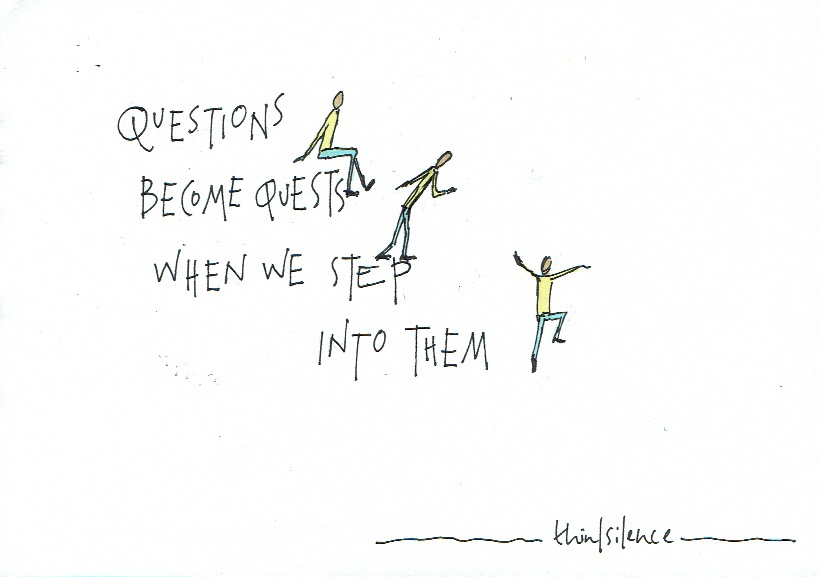
This is like a pilgrimage or quest.  When I heard that Paulo Coelho had written a book entitled The Pilgrimage, I picked up a copy to see what pictures and images for our journeys he might share along the way.

Coelho is setting out to walk the El Camino de Santiago with his guide Petrus.  He is old that he will learn things on the way:

“During the journey, I’m going to teach you exercises and some rituals that are known as practices of [Rigour, Adoration, Mercy].”⁺

The reason I mention this is because we need to find some way in which we are able to add to rather than reduce life.  Coelho’s guide Petrus speaks of there being three characteristics to a true path to freedom: agape, practical application, and it’s open to anyone.

Who would doubt the increase of love is critically important in our world, but the way must also be practical, moving it beyond a theory, and, yes, this has to be open to everyone.  Technologies cannot produce these things, but they can help.

Of course, walking towards something also means walking away from some other thing.  Of this, Geoff Nicholson has some consoling words:

‘And as I went, I realised that walking away is one of life’s greatest pleasures, whether it’s walking away from a bad job, a bad relationship, a bad educational course or a bad psychogeography festival.’⁺⁺

(*Brad, eighteen, quoted in Sherry Turkle’s Alone Together.)
(**From Sherry Turkle’s Alone Together.)
(^From Hugh Macleod’s gapingvoid.com.)
(^^From Seth Godin’s blog Counting Beans.)
(*^These came up when I googled “internet illnesses.”)
(^*From Rohit Bhargava’s Non-Obvious.)
(⁺From Paulo Coelho’s The Pilgrimage.)
(⁺⁺From Geoff Nicholson’s The Lost Art of Walking.  Psychogeography is the practice of drifting around the geography of urban environments with playfulness, like following the route of a map that appears to be the outline of a cat, noting all the cats along the way – I just made this one up.)

the limitations of truth

“Listen to your life.  See it for the fathomless mystery it is.”*

“I would love to live
Like a river flows,
Carried by the surprise
Of its own unfolding.’**

I like the idea of a life being “carried by the surprise of its own unfolding.”  The truth about our lives is where we find our beginning.  It’s not the final word.

Facing the good, the bad, and the ugly of my life, embracing its limitations and constraints, can be more hopeful than if I get into thinking, “I could do more if I hadn’t decided to do that back then, if I only had more time, more education, better people around, more money.

Our limitations and constraints, including the more negative, are about where we begin – if we choose.  We cannot go back but we can go forward.  And whilst it won’t be easy, it will be worth it.

‘One thing that comes out in myths is that at the bottom of the abyss comes the voice of salvation.  The black moment is the moment when the real message of transformation is going to come.  At the darkest moment comes the light.’^

‘Three simple and difficult steps:
Get smarter.  Hurry.
Solve interesting problems.
Care.  More.’^^

Truth is critically important to dreaming.  It tells me when I’ve turned my dreams into daydreams to hide in.  I don’t expect to do anything spectacularly grand in life.  I do hope to turn my dreams – the things I find my life focusing on most of all – into something real.

Mitch Joel helps us to see the entrepreneurial spirit exists in everyone because, at it’s core, to be entrepreneurial is to see something that isn’t working and step up and change that:

‘A true entrepreneur is someone who uncanny desire to create the future, someone who sees the inefficiencies in the work they’re sound – day in and day out.’*^

As Walt Whitman’s poetry helps us see, when we connect with our world – the “press of my foot to the earth” – we see all manner of needs to invest our dreams in:

‘The press of my foot to the earth springs a hundred affections,
They scorn the best I can do to relate them.’^*

Whitman sets off into four pages of poetry listing his affections, and truth unfolds into possibility.

(*Frederick Blechner, quoted in the Northumbria Community’s Morning Prayer.)
(**From John O’Donohue’s Echoes of Memory.)
(^From Joseph Campbell and Bill Moyers’ The Power of Myth.)
(^^From Seth Godin’s blog Three Simple and Difficult Steps.)
(*^From Mitch Joel’s Ctrl Alt Delete.)
(^*From Walt Whitman’s Leaves of Grass.)

what is my voice?

“If you must be heard, let it be like a babbling brook over the rocks.”*

Erich Fromm describes immature love as masochistic or sadistic.   The former witnesses someone becoming the instrument of someone else, whilst the latter makes the other part of him or herself.  Alternatively, ‘mature love is union under the condition of preserving one’s integrity, one’s individiuality.‘**

I found myself thinking about how there may be masochistic and sadistic voices, then.  These voices being the expression of our lives.

‘The difference is only that the sadistic person commands, hurts, humiliates and that the masochistic person is commanded, exploited, hurt, humiliated.**

Some people have submissive voices.  They don’t believe they have anything worth saying, they simply get on with their lives and let others shout louder – though, they can often display a negative subversiveness, sabotaging what others have to say, what others want to do.

Others have domineering voices.  They want the controlling or final word on all things – even if they don’t say it out loud but only think it, meaning they can’t hear what others are saying.  What they pursue is more important, their agenda comes first.

Those with mature voices maintain an inner and outer integrity, believing part of what they must be doing is raising of the voices of others.  Because of this integrity, the mature voice knows that there is the possibility of more significant creativity – the sadistic and masochistic voices are more concerned respectively with telling others what they should do or seeking the advice of others.  They are more about feeding passions rather than needing to love as verb or action.

“As we are part of the land, you too are parr of the land.  This earth is precious to us.  It is also precious to you.  One thing we know, there is only on God.  No man, be he Red Man or be he White Man, can be apart.  We are brothers after all.”^

(*Kerry Hillcoat, quoted in the Northumbria Community‘s Morning Prayer.)
(**From Erich Fromm’s The Art of Loving.)
(^From Chief Seattle’s 152 letter to the United States government, quoted in Joseph Campbell and Bill Moyers’ The Power of Myth.)

a life more ordinary

Shouldn’t it be less ordinary?

I want to tell people there’s something special and unique about their lives.  Maybe this is true precisely because we’re all ordinary.  For a start, there are seven billion of us on the planet – we’re hardly special on the grounds of scarcity.

Maybe its extraordinary to live ordinarily well.

‘You have no idea what you’re doing.  If you did, you’d be an expert, not an artist.’*

D. Jean Hester sweeps the street outside an art gallery.  She calls it ‘Sweeping (Sidewalk Performances #1).  It’s part of a “walking-art” project and Hester explains it’s “an expression of pride in one’s place, as well as a gift given to others who use the area.”**  It was raining, though, and it’s difficult to sweep a lot of pavement and hold a brolly at the same time!

I likee the sentiment and I’m open to persuasion about whether it’s worthwhile turning something this ordinary into art.

If we pull back a little, what about the reality of the universe in which we find ourselves, where’s the big bang left us?  Alan Lightman points out in his novel about the creation how we can’t get further back than the big bang:

‘The origin of the first event would always remain unknowable, and the creature would be left wondering, and that wondering would leave a mystery.’^

Part of the ordinary and the everyday the universe has spewed out is this mystery.  A mystery, we might say, that is in each one of us – something we can never escape.

Maybe noticing this kind of more and positively interacting with others is literally some of the most out-of-the-ordinary stuff we can get up to.

“What will happen when the buffalo are all slaughtered?  The wild horses tamed?  What will happen when the secret corners of the forest are heavy with the scent of many men and the view of the ripe hills is blotted by talking.  Where will the thicket be?  Gone!  Where will the eagle be?  Gone!  And what is it to say to the swift pony and hunt?  The end of living and the beginning of survival.”^^

(*From Seth Godin’s The Icarus Deception.)
(**From Geoff Nicholson’s The Lost Art of Walking.)
(^From Alan Lightman’s Mr g.)
(^^Chief Seattle, in a letter to the United States government in 1852, quoted in Joseph Campbell and Bill Moyers’ The Power of Myth.)