When we grow up

‘As generalists, we must be curious.  Curiosity is what makes things come together in that unique way, where “innovation” happens.’*

‘If we are looking for something specific, we set aside anomalies and remain focused.’**

My hope is that life is becoming more interesting for more people.   I was born at the end of the 1950s and have increasingly realised how I have lived through what feel like seismic shifts in our understanding of everyone’s capacity to open their minds, hearts, and wills with artists and passion.

‘In each new epoch – perhaps every generation, or even every few years, if the conditions in which we live change that rapidly – it becomes necessary to rethink and reformulate what it takes to establish autonomy in consciousness.’^

I don’t see a flowing in one greater, stronger direction.  There are cataracts and eddies and white-water and meanderings along the way.  We don’t know yet how much our increasing reliance on technology will impoverish our consciousness.  This is the simply the adventure of life we find ourselves in.  Astronomist Vera Rubin reflects:

“If there were no problems it wouldn’t be much fun.”^^

In this remark, Rubin is commenting on how how here discovery of dark matter was not so welcome at first:

“I think many people initially wished that you didn’t need dark matter.  It was not a concept that people embraced enthusiastically.”^^

As Alan Lightman points out about Rubin’s work:

‘As in her earlier work on the bulk motions of whole galaxies, dark matter would require a revision in cosmological thinking.’*^

We are curious, we explore, we discover, our thinking shifts.  In the cosmological world but also in the amazing universes that are human lives.  Rubin had wanted to be an astronomer from childhood, some of us figure out what it is we want to do in our forties.  We have to be noticing.  It’s something we can all do, even if it’s to relearn it. Jamil Mahuad points out:

“Possibilities can be disguised.  They can be blurred, and the most important thing – they flicker.”^*

The most important expert we can be is an expert in ourselves.  You being an expert in you.  Me being an expert in me.  E.E. Cummings encourages us towards this when he writes about the courage to be ourselves:

“As for expressing nobody-but-yourself in words, that means working just a little harder than anybody who isn’t a poet can possibly imagine. Why? Because nothing is quite as easy as using words like somebody else. We all of us do exactly this nearly all of the time — and whenever we do it, we’re not poets.”⁺

Cummings says, don’t let people say you can’t be a poet.  Rubin despairs at the the kind of gender stereotyping that robs science of female scientists, something that takes hold at such an early age.  Rubin’s granddaughter at the age of three had cried out at an uncle “Boys can’t be girls”- he’d suggested he be the nurse and she be the doctor when treating a sick rabbit:

“So you may talk about role models and your thinking about colleges but this happens at the ago of three.  I think its a terrible problem.  It sets in very young.  Somehow or others, you have to raise the little girls who have enough confidence in themselves to be different.”^^

This is where we are, rethinking consciousness of self, helping others to explore the Self they can be.  Cummings, on seeing what everyone else was fitting in with and the kind of world that might result, reflects:

“And so my advice to all young people who wish to become poets is: do something easy, like learning how to blow up the world — unless you’re not only willing, but glad, to feel and work and fight till you die.

Does that sound dismal? It isn’t.

It’s the most wonderful life on earth.

Or so I feel.”⁺

What do you want to be when you grow up?

I am 58 years old and, in one sense, I still don’t know, but I am certain that when we explore our consciousness then, as Eugene Peterson points out:

‘The larger the world we live in, the larger our lives develop in response.’⁺⁺

(*gapingvoid’s blog: Generalists vs experts.)
(**From Frans Johansson’s The Click Moment.)
(^From Mihaly Csikszentmihalyi’s Flow.)
(^^Vera Rubin, quoted in Alan Lightman’s A Sense of the Mysterious.)
(*^From Alan Lightman’s A Sense of the Mysterious.)
(^*Jamil Mahuad, quoted in Frans Johansson’s The Click Moment.)
(⁺E.E. Cummings, quoted in Maria Popova’s Brain Pickings: The Courage to be 
Yourself.)
(⁺⁺From Eugene Peterson’s Run With the Horses.)
Writing better lives

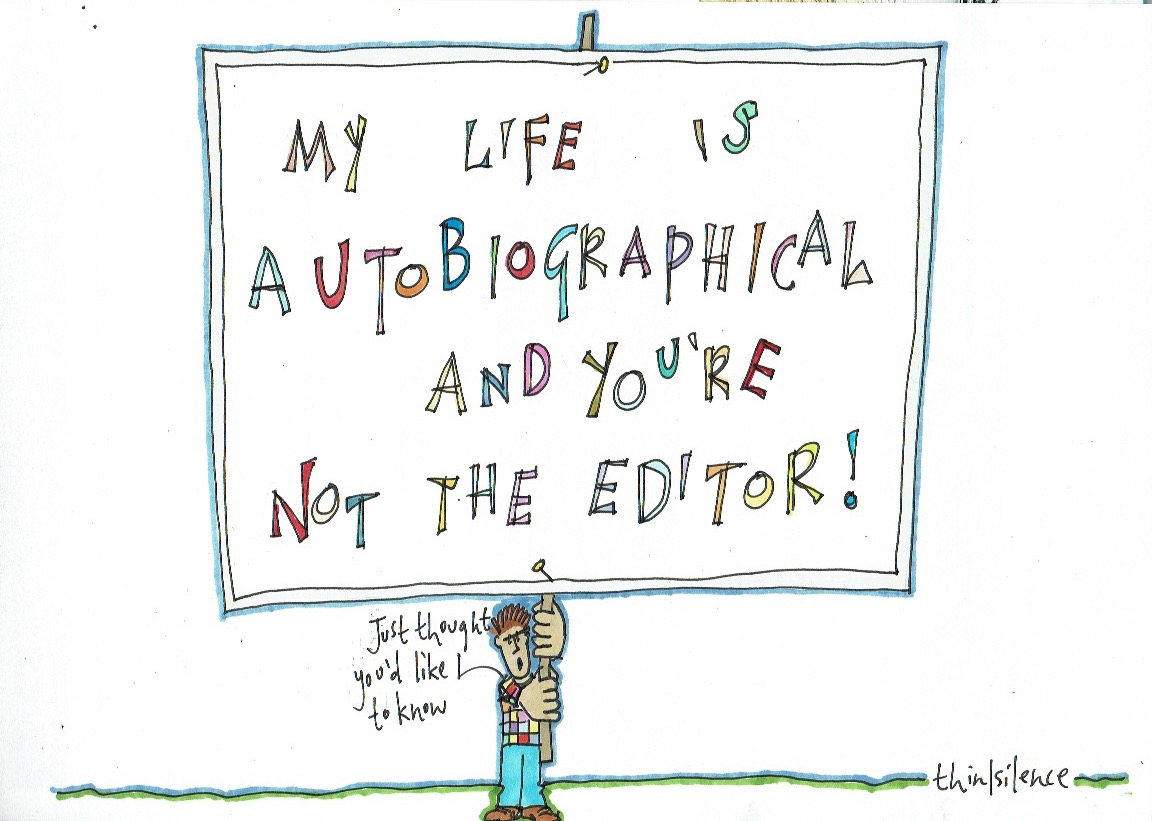
The story we have for our lives may not be great but we have one and we can work on it.  We only need to own the reality that we create our own character arcs.  Our lives are unfolding.  Nothing is set in stone:

‘”You’re doing it all wrong.”  But at least you’re doing it.  Once you’re doing it, you have the chance to do it better.  Waiting for perfect means not starting.’*

Mihaly Csiszentmihalyi writes about the “control of consciousness” determining our lives.  What he is describing relates to determining our story:

‘The most important step in emancipating oneself from social controls is the ability to find rewards in the events of each moment.  If a person learns to enjoy and find meaning in the ongoing stream of experience in the process of living itself, the burden of social controls automatically falls from one’s shoulders.  Power returns to the person when rewards are no longer related to outside forces.’**

I happened to hear cricketer Andrew (Freddie) Flintoff speaking about how the nerves that were so difficult to overcome for other cricketers, when batting or bowling, were the feelings he loved; he understood his nervousness differently, making them a special part of who he was.

When it comes to feelings, E.E. Cummings claims:

“Almost anybody can learn to think or believe or know, but not a single human being can be taught to feel. Why? Because whenever you think or you believe or you know, you’re a lot of other people: but the moment you feel, you’re nobody-but-yourself.”^

Whatever we can learn or believe or know has to be connected at a heart level.  Getting to know our heart, and allowing this to create a better story is what we have the opportunity of doing every day of our lives.  I leave the last words to Cummings:

“To be nobody-but-yourself — in a world which is doing its best, night and day, to make you everybody else — means to fight the hardest battle which any human being can fight; and never stop fighting.”^

(*From Seth Godin’s blog “You’re doing it wrong”.)
(**From Mihaly Csikszentmihaly’s Flow.)
(^E.E. Cummings, quoted in Maria Popova’s Brain Pickings: The Courage to be Yourself.)

The courage of being yourself

“If I chose to hide you away, it is for a reason.
I have brought you to this place.
Drink in the silence. Seek solitude.

Listen to the silence.

It will teach you. It will build strength
Let others share it with you.
It is little to be found elsewhere.

Silence will speak more to you in a day than the world of voices can teach you in a lifetime.
Find silence. Find solitude – and having discovered her riches, bind her to your heart.”*

Courage is found in an unexpected place.  It begins with our awareness, the breaking open of our pride, greed, and foolishness by our mindful use of humility, gratitude, and faithfulness.

The courage to be ourselves is the courage to be ourselves for others.

This has serious implications for our planet, as I will come to.  Seth Godin describes the difference between pleasure and happiness from his perspective as a marketer with a heart, in which he sees the marketplace wanting us to buy from it for our personal pleasure:

‘Pleasure is short-term, addictive and selfish. It’s taken, not given. It works on dopamine.

Happiness is long-term, additive and generous. It’s giving, not taking. It works on serotonin.

This is not merely simple semantics. It’s a fundamental difference in our brain wiring. Pleasure and happiness feel like they are substitutes for each other, different ways of getting the same thing. But they’re not.’**

Pleasure is becoming an increasingly powerful force in a world of more choice, twisting how we think of happiness; Godin continues:

‘More than ever before, we control our brains by controlling what we put into them. Choosing the media, the interactions, the stories and the substances we ingest changes what we experience. These inputs lead us to have a narrative, one that’s supported by our craving for dopamine and the stories we tell ourselves. How could it be any other way?

Scratching an itch is a route to pleasure. Learning to productively live with an itch is part of happiness.

Perhaps we can do some hard work and choose happiness.’**

Pleasure is often short-lived, we need the next fix.  Happiness tends to be self-growing because it reaches a part of us that is regenerative.  Ed Catmull offers a metaphor from his experience within Pixar:

‘But the differences between directing a five-minute short and directing an 85-mibute feature are many.’^

Life isn’t a short.  And we can’t find the happiness we’re wanting in life the way we can provide ourselves with pleasure.

The harder work Godin alludes to is enabled by our humility, gratitude, and faithfulness, because these lead to integrity, wholeness, and perseverance – the generative self I mentioned earlier and the second part of being our courageous self – I discover I have more than enough and can be about ‘giving not taking’ (Godin).

Within this there’s a sense of less is more, that we do not need to go after everything because what we have allows us to be far more imaginative and creative than we know.  It’s the equivalent of shopping at Aldi over Sainsbury’s:

‘Less is more contradicts two core beliefs held in our culture:

More information is always better.

More choice is always better.’^^

We’re connecting to our gut feelings, our essential Self.

The reason this has planetary implications is that moving from pleasure to happiness is a movement from making more faster, to making what we need: at the moment we’re consuming 1.5 Earths and one day that will catch us up.

The third part of this moment to being our courageous self, then is a movement towards sharing ourselves – from integrity comes personal courage, from wholeness comes generosity, and from perseverance comes living-wisdom.

It all begins in the silence, the emptiness we so often try to flee is not empty at all.  Ken Mogi writes about why in Japanese culture there’s a sense that the morning is the most productive time of the day:

‘In the morning, assuming you have had a sufficient amount of sleep, the brain has finished its important night job.  It is in a refreshed state, ready to absorb new information as you start a day’s activities.’*^

And maybe we don’t simply need more of what we had yesterday.  Perhaps at the beginning of the day, for a few moments or more, we can wait in the silence and imagine something new out of the deep source of our lives:

‘They just see more because they’ve learned how to turn off their minds’ tendencies to jump to conclusions.’^

(*Frances Roberts, quoted in the Northumbria Community‘s Morning prayer.)
(**From Seth Godin’s blog, The pleasure/happiness gap.)
(^From Ed Catmull’s Creativity, 
Inc..)
(^^From Gerd Gigerenzer’s Gut Feelings.)
(*^From Ken Mogi’s The Little Book of Ikigai.)


Ardently

Ardently: very enthusiastically or passionately.

“Love from day to day, just from day to day. […] If you let yourself be absorbed completely, if you surrender completely to the moments as they pass, you live more richly those moments.”*

Some are always waiting for the future and miss today; others are busy visiting the future in order to live today more ardently.

We don’t have to wait:

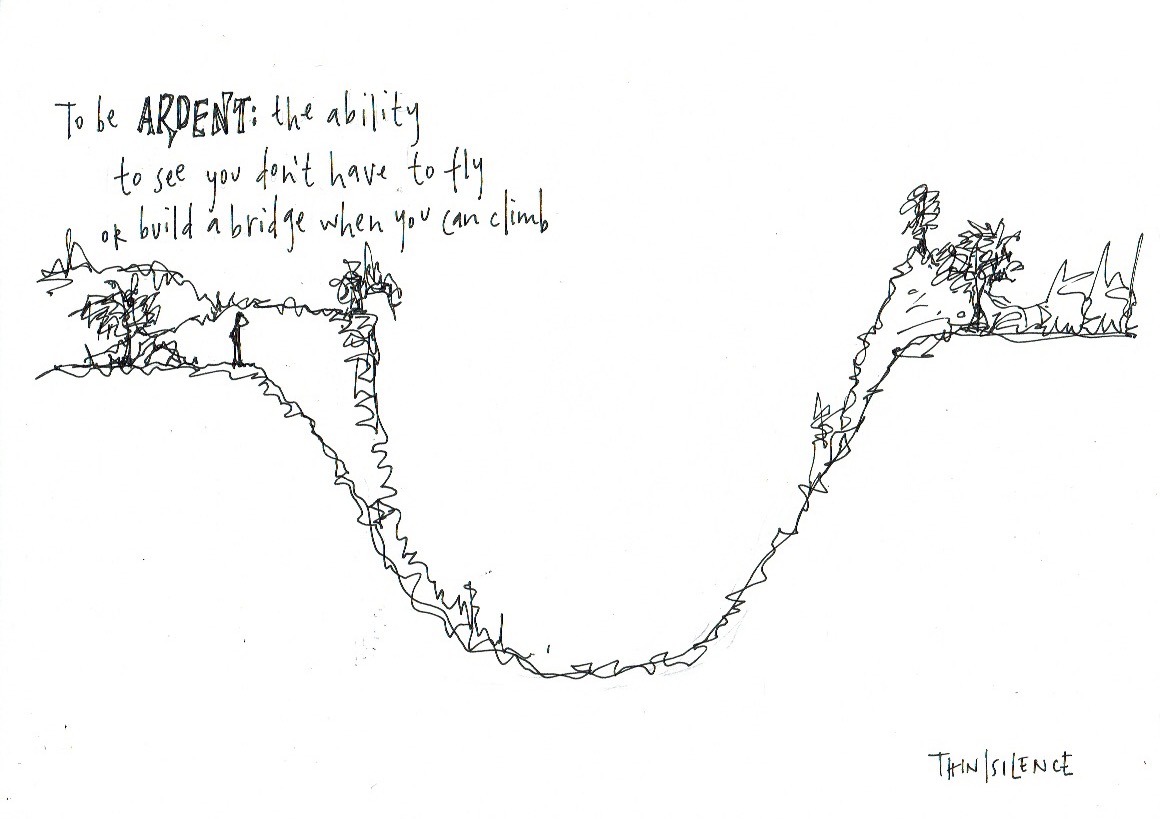
““No one can build you the bridge on which you, and only you, must cross the river of life.”**

We have enough to build the bridge Friedrich Nietzsche imagines.  To live in the moment of who we are and what we have now will provide us with what we have to begin, though Eric Ries reminds us that there is a cost when he points out:

“If you cannot fail, you cannot learn.”^

When we fail and learn we are discovering that se are generative beings: Okay, that didn’t work; what if I do it this way?

We need to explore with playfulness; the game takes us farther:

‘Mixing what we see, hear, learn, and read – that’s an art in itself, not to be underestimated.’^^

I have never failed to come across amazing abilities and experiences in the people I work with that makes me conclude, not only can we know we have choice and feel what that choice might be, but we can use it ardently.

I like playing with words that ought not to be only for people who are religious but for everyone.  So this is about identifying a personal sacrament, the elegant interface we enter each day connecting us to our story, defined by Iris Murdoch in this way:

‘A sacrament provides an external visible place for an internal invisible act of the spirit.’*^

Let bridge-building begin.

(*Anne Morrow Lindbergh, quoted in the Northumbria Community‘s Morning Prayer.)
(**Friedrich Nietzsche, quoted in Maria Popova’s Brain Pickings: The Courage to Be Yourself.)
(^Entrepreneur Eric Ries, quoted in Frans Johansson’s The Click Moment.)

(^^Alfredo Carlo, from Drawn Together Through Visual Practice.)
(*^From Iris Murdoch’s The Sovereignty of Good.)


And what can we be?

James Carse writes about how infinite players don’t play within boundaries but with boundaries.  Their game is about including as many people for as long as possible and, when the rules get in the way, they change the rules.*

Kio Stark introduces us to the social convention called “civil inattention,” meaning when we approach someone, we notice them and then avert our attention, indicating we’re not going to interrupt their progress – sometimes it can be accompanied by a brief “hello of some sort .”**

These are more finite game rules, playing out to different strengths in different cultures, but needing to be moved beyond if we’re to explore what it is to be human.

Theory U encourages us to push the boundaries social norms, moving us towards one another and towards presence, rather than away from one another and absence.^

It simply asks that we invent ways of opening our minds to there being more, before we open our hearts, and before we move to working together.

It’s a good start.

(*See James Carse’s Finite and Infinite Games.)
(**See Kio Stark’s When Strangers Meet.)
(^See Otto Scharmer’s Theory U.)

To see the wildness in one another

“Where, my friends, have the wild ones gone?”*

Wisdom sometimes looks contrarian, like wildness.

One of K.M. Weiland’s six lifestyle changes to protect creativity is to notice the seasons.  This makes good sense.  We think nature is wild yet we are made of nature.  There are many things with which we immunise ourselves from this, at the same time losing sight of the sheer exoticness and vibrancy of life:

‘But the overwhelming problem that confronts most of us in the world most of the time is that we are not falling in love with the heart of another another and the heart of other nations and species. […] Yet within us is everything.’**

This journey is from ego to eco: this wildness allows us to be our true self, not more and not less.  It is where we are able to see the wildness in one another.

(*Joel McKerrow, quoted in the Northumbria Community‘s Morning Prayer.)
(**From Philip Newell’s The Rebirthing of God.)

Original fruit

‘[Ikigai] is about discovering, defining and appreciating those of life’s pleasures that have meaning for you.  It is OK if no one else sees that particular value, although […] pursuing one’s private joys in life often leads to social reqwards.  You can find and cultivate your own ikigai, grow it secretly and slowly, until one day it bears a quite original fruit.’*

‘You can only have what you have by releasing it to others.’**

Ikigai feels like our personal holy ground.  The thing that makes everything special and significant will also benefits others.  I’ve been trying to work on a colouring book with a difference so Bernadette Jiwa’s closing words in Hunch caught my eye:

‘It’s possible to change tiny corners of [the world] with simple, thoughtful ideas.  By designing a beautiful colouring book that allows people to pause and create.’^

At least that’s the hope.

This “holy ground” is what we each need to find and not to lose.  It can be closer than we know, the urging from our lives to try this idea out and see what happens.  It’s in the smallness.  Bigness can get in the way, as Anne Lamott confesses from her experience as a writer:

“I just try to warn people who hope to get published that publication is not all that is it cracked up to be.  But writing is.”^^

And as Patagonia‘s Yvon Chouinard points out:

“How you climb the mountain is more important that reaching the top.”*^

This even sounds like what Jesus once pointed out one time, about what does it gain someone if they obtain the whole world but lose their soul.  Or to put it another way, as my friend Alex McManus has written about being Makers of Fire, what good is it to have all the fuel and oxygen in the world but to have no spark with which to light it.

Brené Brown identifies loss, longing, and feeling lost as the three most fundamental elements of grief that her research has shown up.⁺  I wonder whether these are also signs for us for we have lost our holy ground.  We feel loss, that something is missing though we may not be able to name it.  There’s a longing for something more, even when our homes and diaries suggest there’s nothing missing.  And when we find the odd moment of stillness or reflection – perhaps watching a movie or reading a book – we feel disorientated, our life is not where we should be.

It is when we need to look more closely, to notice the small things, to notice – like Lamott’s writing and Chouinard’s climbing – what matters most to us.  Nassim Taleb writes about a number of practices that offer us some helpful means:

‘My idea of the modern stoic sage is someone who transforms fear into prudence, pain into information, desire into understanding.‘⁺⁺

What we may find is that our holy ground is not so far away., that, like James T. Kirk, we can leave the Nexus and find the fear of failure that tells us we are engaged in something that matters to us and to others, something that makes a difference.

(*From Ken Mogi’s The Little Book of Ikigai.)
(**From James Carse’s Finite and Infinite Games.)
(^From Bernadette Jiwa’s Hunch.)
(^Anne Lamott, quoted in K.M. Weiland’s 6 Lifestyle Changed You Can Make to Protect Creativity.)
(*^Yvon Chouinard, quoted in Bernadette Jiwa’s Hunch.)
(⁺See Brené Brown’s Rising Strong.)
(⁺⁺From Nassim Taleb’s Antifragile.)

Powerful

That thing you do, it’s powerful.  Or at least it used to be.  What’s happened?

‘I have always had cause to accept the idea that “the thing we love most is what kills us.” However, I’ve always skated rather tenderly around the adjoining idea that “we all kill the thing we love.”’*

In his book on randomness and serendipity, Frans Johansson writes:

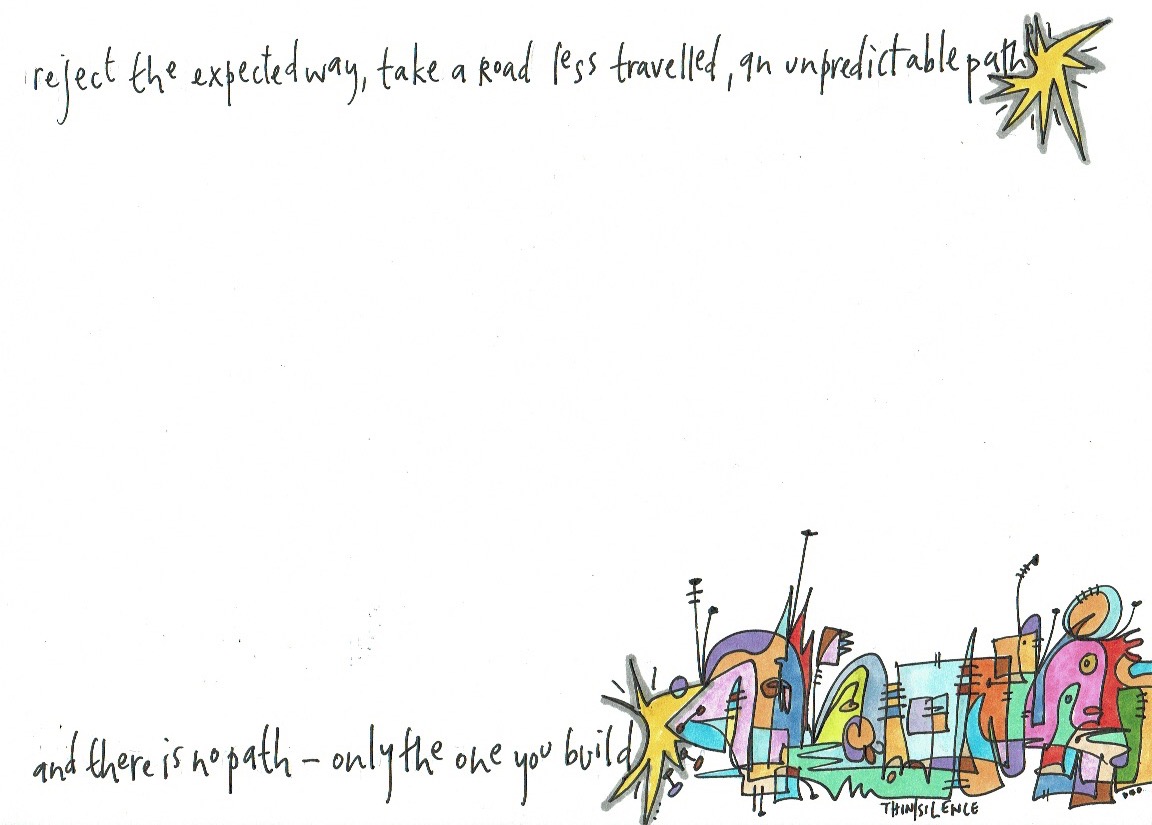
‘Actively rejecting the predictable insight leaves you nowhere else to go except making unpredictable, random connections.’**

Predictability can rob us of new insights or ways of doing what we do.  Once we were described as a breath of fresh air but now the air has grown stale.  Walter Brueggemann writes of how the powerful thing we bring needs to be moved  into the realm of poetry rather than ideology, a portal to new insights rather than This is the only way we can do this:

‘Prophecy cannot be separated very long from doxology, or it will either wither, or become ideology.’^

It is the infinite game that keeps alive our love, that continues us doing the powerful thing we do.  It must not become a finite game in which we slip into a fixed rather than a growth mindset:

‘There is a concept in psychology called risk homeostasis.  It refers to the idea that humans have a degree of risk they find acceptable and strive to live their lives at that level.’**

That powerful thing you do.  It came about because you were prepared to go wehere no one else would go, whether it was to speak in a bright way at your checkout to every customer, come up with oblique ideas that made you look silly at first, honouring the person you are a carer for with a deep dignity, seeing the way something didn’t work and offering to sort it out.  In thousands of different ways powerfulness breaks, only to lose its way in the  predictable, reaching a height that turned out to be a plateau.

Your love has waned but not gone.

Time to get wandering again, to leave the well travelled path, to notice what others do not, allow yourself to feel what others do not, and then to make something happen that is quite simply … powerful.

(From K.M. Weiland’s blog: 6 Lifestyle Changes We Can Make to Protect Creativity.)
(**From Frans Johansson’s The Click Moment.)
(^From Walter Brueggemann’s The Prophetic Imagination.)

Forever young

‘Though outwardly we are getting older with all the signs of ageing, inwardly, every day sees us becoming younger and younger.’*

‘The deepest irony about the young being cynical is that they are the ones that need to move, and dance, and trust the most. They need to cartwheel through a freshly burst galaxy of still-forming but glowing ideas, never scared to say “Yes! Why not!” — or their generation’s culture will be nothing but the blandest, and most aggressive, or most defended of old tropes.’**

The good is, we don’t have to get old on the inside, our hearts don’t have to become wrinkly, our brains don’t have to put on weight, we don’t have to become curmudgeonly.  To be open with a yes is our biggest discipline:

‘To speak or act, or think originally is to erase the boundary of the Self.  It is to leave behind the territorial personality.  A genius does not have a mind full of thoughts but is a thinker of thoughts and is the centre of a field of vision.

[…]

The earlier artists worked within the outlines of their imaginations: the latter reworked their imaginations.’^

Its seems it’s our choice.

(*2 Corinthians 4:16; my translation.)
(**Caitliin Moran in Maria Popova’s Caitlin Moran on Fighting the Cowardice of Cynicism.)
(^From James Carse’s Finite and Infinite Games.)

Generous otherness

Asking a generous question will elicit a generous answer.’*

I marvel at how everything is made of the same stuff as the planets and stars … and yet everything is different.

We live in this wonder of sameness and difference.

This kind of difference is not the same as surface-difference – lamented here by Erich Fromm:

‘If I perceive in another person mainly the surface, I perceive mainly the differences.  If I penetrate to the core, I perceive our identity, the fact of our brotherhood.’**

Deep openness to one another is a compassionate act.  The opposite action of closedness is cynical:

“When cynicism becomes the default language, playfulness and invention become impossible. Cynicism scours through a culture like bleach, wiping out millions of small, seedling ideas. Cynicism means your automatic answer becomes “No.” Cynicism means you presume everything will end in disappointment.”^

We can only discover our sameness and difference with the help of others in a generous otherness.

(*Krista Tippett in the online course The Art of Conversation.)
(*From Erich Fromm’s The Art of Loving.)
(**Caitlin Moran, quoted in Maria Popova’s BrainPickings: Caitlin Moran on Fighting the Cowardice of Cynicism.)