All people

We’re a species that can be shaped by our future as well as our past.

Often we think of our possibilities being shaped by the limitations or entitlements of our past, but our imaginations mean we can also travel to and from our futures.  In this way, we are creatures who can begin over because the future can be what we want it to be, more or less.

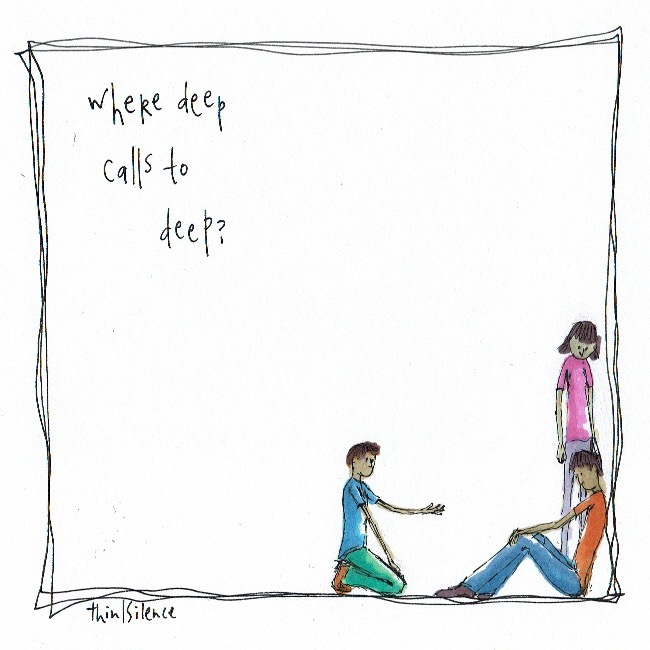
My hope is that we’ll increasingly invent ways of coming together for the future to be imagined, where we’re able to release the power of our imaginations to meet the pressures of our realities, where strangers can meet and explore together, where we can learn to be all people.

In his book Sapiens, Yuval Noah Harari writes about how we instinctively divide ourselves into “us and them” – when one group calls themselves Dinka, they are saying “We are people,” when another group refer to themselves as Nuer they’re calling themselves “original people,” and another group names themselves Yupiki, they’re saying, they are “real people”.  To each of these examples of “us” there is a “them.”

Earlier in the week, I was participated in a small group of people – some of whom had never met each other beforehand – engaging in an open conversation about the future.  It was such a positive experience that they want to meet again to take it further and to spread it to more.

Hopeful conversations which come from the future as well as the past don’t take much effort to make happen – as long as we’re prepared to leave the familiar behind and meet one another in the futures that are suggesting themselves as being possible.

If we keep harping on about the past, that’s exactly what we’ll get more of, like the frog that can’t tell the water is warming and they are becoming more incapable of escape.

We do it poorly, I admit, but we are exploring becoming all people.

Mooving

Mooving, my made-up word, from moving and the first Seth Godin book I picked up back in 2006.  Entitled Purple Cow, the book begins with a family holiday in Europe, being enthralled by all the black and white cows to be seen.  But this soon wore off, but to see a purple cow, that would literally be remarkable.  You would talk about a purple cow for quite a while.

Mooving, then, is moving in a remarkable way.

Something is more likely to happen when we are moving rather than waiting to move.  James Carse puts this well in his description of the infinite traveller:

‘Travellers do not go somewhere, but constantly discover they are somewhere else.’*

Madeleine L’Engle helps us to see destinations and travelling as answers and questions, respectively:

“The minute we begin to think we have all the answers, we forget the questions.”**

Perhaps this is why we’re not moving or mooving in the first place, we think we already have the answer.

I’ve returned to This is a Poem that Heals Fish, the story of a boy called Arthur who wants to save his fish Leon from boredom.  He was told by his mother that he must hurry and give him a poem.  Arthur doesn’t know what a poem is and searches cupboards, underneath his parents’ bed, and asks a series of people what a poem is: Lolo at the bike shop, Mrs. Round at the bakers, and Mahmoud who comes from the desert.

He returns to check on Leon, who ‘appears to be asleep’:

‘He is floating gently amidst the seaweed
as if thinking …

Arthur goes straight to the other end
of the house to question
his canary Aristophanes,
who is no bird brain.

Puffing himself up, Aristophanes chirps
– A poem is when words beat their wings.
It is a song sung in a cage.

– Oh…?  Okay.’^

Arthur continues his quest by asking his grandma what a poem is.  She thinks really hard and then replies:

‘- A poem turns words around, upside down, and – suddenly! – the world is new.’^

Grandma then continues:

‘- But ask your grandpa,
he often writes poems …
instead of repairing the pipes!’^

Arthur finds his grandpa … in his shed, writing poems.  (Here, I want to recommend the movie Paterson.)

– A poem? grandpa says,
tugging on his moustache
and looking worried,
A poem, well… it’s
what poets make.

[…]

Even if the poets do not know it themselves!’^

Arthur returns dejectedly to Leon,  He tells him what he knows, but also what he does not know:

‘- I’m sorry, Leon,
I have not found a poem.
All I know is that:

A poem
is when you have the sky in your mouth.
It is hot like fresh bread,
when you eat it,
a little is always left over.

A poem
is when you hear
the heartbeat of a stone,
when words beat their wings.
It is a song sung in a cage.

A poem
is words turned upside down
and suddenly!
the world is new.’^

Something remarkable then occurs:

Leon opens on eye, then the other,
and for the first time in his life he speaks.
– Then I am a poet, Arthur.
– Oh…?
– And my poem is my silence…
– I see!’^

What catches my interest is how Arthur does not include his grandpa’s definition of a poem.  Arthur seems to be that definition and delivers a poem even though he doesn’t know it himself.  It is the thing that allows Leon to realise that his poetry is silence.

We live in the question, not in the answer.

Joseph Pine and James Gilmore identify the commoditisation of experiences: ‘best exemplified by the increasingly voiced phrase, “Been there, done that.”‘^^

We haven’t been there yet – the destination, and so haven’t done that yet … but we have discovered many more something-elses and somewhere-elses along the way as we moove.

(*From James Carse’s Finite and Infinite Games.)
(**Madeleine L’Engle, quoted in Michael Bungay Stanier’s The Coaching Habit.)
(^From Jean-Pierre Siméon and Olivier Tallec’s This is a Poem that Heals Fish.)
(^^From Jospeh Pine and James Gilmore’s The Experience Economy.)

Understanding and the slow walk of freedom

Understanding increases freedom and freedom brings choice.  The path doesn’t become straighter and more straightforward, but more windy with forks begging choices – becoming, in a word, interesting.  Of course, this may not be what you want to hear:

‘But most of the turns, we don’t even see. We’ve trained ourselves to ignore them […] a choice isn’t often easy. In fact, the best ones rarely are.

But we can still choose to make one.’*

We’d probably prefer to drive across the thresholds of possibility, or be carried across by someone else or fly over them, something painless.  But we need to walk through them; exhausted at times, the pace of understanding and freedom and choice is achieved at the speed of “walking” – something available to just about everyone from a very early age.  We begin and then we continue with small steps:

‘Crucially, starting small is the hallmark of youthful days.  When you are young, you cannot start things in a big way.  Whatever you do, it does not matter much to the world.  You need to start small.  And what you have in abundance is open-mindedness and curiosity, the great kick-starters devoted to one’s cause.’**

Slowness allows information to become knowledge and to turn into understanding and eventually become wisdom.  Wisdom is an embodiment of what we are understanding, when it seeps into the entirety of our lives, as Jonah Lehrer points out:

‘We do not have a body, we are a body.  Although our feelings feel immaterial, they actually begin in the flesh.’^

Freedom involves noticing what our bodies are telling us.

This slow journey from understanding to wisdom creates or uncovers choice.  Slowness may look totally wasteful to those convinced that the productive life is the faster life, but as Albert Einstein shared from his own experience:

‘Creativity is the product of “wasted” time.”^^

Ken Mogi, quoted above concerning taking small steps, writes about how craftswomen and men are honoured in Japan:

‘Often their lives are regarded as the embodiment of ikigai – lives devoted too creating just one thing properly, however small.’**

There’s something about his description that feels slow, something about the pursuit of their craft, about making something properly.  Properly suggests a journey.  Perhaps this is why I found myself journalling a year ago:

Do something small today, do it again tomorrow and the day after, and something takes shape.  It’s not techniques but a story […]. I think my slow journey is about who I am becoming over a lifetime. […] the slowness is me.  I now see I can become, I can choose.

Rebecca Solnit adds to this sense of becoming through slow journeying when she comments on the walking of William Wordsworth:

‘For Wordsworth, walking was a mode not of travelling but of being.’*^

And Henry David Thoreau sees those inheriting the family business or farm, in a different way, as the tethered or disadvantaged, whereas:

‘The portionless, who struggle with no such unnecessary inherited encumbrances, find it about enough to subdue and cultivate a few cubic feet of flesh.’^*

Perhaps we can take this encouragement to have a starting from scratch mentality, taking nothing for granted.  Thoreau continues:

‘The finest qualities of our nature, like the bloom on fruits, can be preserved only by he most delicate handling.  Yet we do not treat ourselves nor one another so tenderly.’^*

There is more to your life and mine when we come to it slowly.

(*From Seth Godin’s blog Degrees of freedom.)
(**From Ken Mogi’s The Little Book of Ikigai.)
(^From Jonah Lehrer’s Proust was a Neuroscientist.)
(^^Albert Einstein, quoted in Maggie Berg and Barbara Seeber’s The Slow Professor.)
(*^From Rebecca Solnit’s Wanderlust.)
(^*From Henry David Thoreau’s Where I Lived, and What I Lived For.)

Omnipresence

I’m not thinking of the kind of omnipresence that means we can be everywhere at the same time.  This is the sort that means we can be fully present wherever we happen to be, with whoever we happen to be with.

I’m still practising.

Here!  Now!  O! Three words Brian McLaren offers as expressions of the Season of Simplicity.  Simplicity is followed by the seasons of Complexity, Perplexity, and Harmony, so this is a starting point.  When we are fully here, now, then wonder can follow: O!*

Joseph Campbell claimed here-ness and now-ness for his hero:

‘The hero’s sphere of action is not the transcendent but here, now, in the field of time, of good and evil – of the pairs of opposites.’**

The hero is the one who is pushed or has to jump from the familiar into the unfamiliar in order to find what is necessary: a purpose, a solution, a missing person, safety … . They appear to belong nowhere but really have to belong everywhere if they are to survive:

‘The lesson is to know your motivations.  That way, you’ll keep going even if no one else cares.’^

We are fully capable of being present to our need, our self, our surroundings.  Technology appears to offer this possibility to be present but Alan Lightman is right to question this, to put fully before us our incredible capacity to be fully present with whoever and whatever:

‘Using technology, we have redefined ourselves in such a way that our immediate surroundings and relationships, our immediate sensory perceptions of the world, are much diminished in relevance.  We have trained ourselves not to be present […].  We have marginalised our direct sensory experience.’^^

Three expressions I believe can help us in our presensing are humility, gratitude, and faithfulness.

Here, now: I am me and you are you.  We notice things we have which speed does not allow us to see and we are grateful.  We consider the many ideas and possibilities possible because of who we are and what we have that allow these things to take form and come alive.

You may have noticed, what this means is life is unfolding, we don’t know where it will take us next, or with whom.

In this way, we do not know our own story.

(*See Brian McLaren’s Naked Spirituality.)
(**Joseph Campbell in Joseph Campbell and Bill Moyers’ The Power of Myth.)
(^From Chris Guillebeau’s The Happiness of Pursuit.)
(^^From Alan Lightman’s The Accidental Universe.)

The average trap

‘An effective [life] is far more valuable than a much-noticed one.’*

I changed one word in this quote from Seth Godin.  I swapped life for ad.  It seemed to work.

We live in a world that measures everything, including people.  One of these measurements is averages.  We’re either average, below average, or above average:

‘Odds are that you and I will fall at the average.’**

I get why, this is a finite game we sometimes have to play.  But we need to understand that we’re all part of an infinite game too, where the only average that’s important is the one that compares me with me and you with you.

How are you doing?  Pushing on to above average with that thing you must do with your life before it’s all over?  Others can inspire us, can provide us with ideas and ways of seeing that we hadn’t come across before, but then it’s over to us.  What are we going to do?

Here’s another quote from Seth Godin with none of the words changed:

‘An artist is someone who brings new thinking and generosity to his work, who does human work that changes another for the better.’^

That would be you.

(*From Seth Godin’s blog Stuntvertising.)
(**From Erwin McManus’ The Last Arrow.)
(^From Seth Godin’s Whatcha Gonna Do With That Duck?)

An element of scarcity

‘there is an element of scarcity in what you do and how and why you do it, a combination of your story and your superpower’*

‘Desire leads to conception and conception leads to birth.  This is the efficacy of desire.’**

You knew it all along but didn’t do anything about it.

Now you suspect it’s too late.  People your age don’t do anything like what you’re imagining.

Who told you that?

Bring your scarcity, the thing you see and no one else does.

(Here’s an offer: if you want to be helped in progressing your idea, get in touch.)

(*From Bernadette Jiwa’s Make Your Idea Matter.)
(**From Philip Newell’s The Rebirthing of God.)

Exiguous: it’s how you see it that counts

I needed to look up the word exiguous.  It turns out to mean:

Very small in size or amount.

It perhaps describes how we can see our lives.  The word is used by Iris Murdoch not long after she’d written these words about us:

‘I assume that human beings are naturally selfish and that human life has no external point or telos.  That human beings are naturally selfish seems true on the evidence, whenever and wherever we look at them, in spite of very small number of apparent exceptions.’*

Darn the exceptions.  

Murdoch sees self-contained lives and wonders whether what we call good is just our little goods and we can disagree over these when we meet each other.  But what have others found that the many, in Murdoch’s mind, haven’t?

Frederick Buechner had opened my day with this thought:

‘Listen to your life.
See it for the fathomless mystery that it is.
In the boredom and pain of it
no less than in the excitement and gladness:
touch, taste, smell your way to the holy and hidden heart of it
because in the last analysis all moments are key moments,
and life itself is grace.’**

I am grateful to so many who have opened my eyes to see more.  Some of these I have met: Erwin McManus, whose latest book The Last Arrow I’ve opened for the first time today, and his brother Alex.  Others I have not met: Seth Godin and Hugh Macleod have altered the trajectory of my life with a gracefulness.  I came upon these words in Godin’s latest blog:

‘If you have a safe place to sleep, reasonable health and food in the fridge, you’re probably living with surplus. You have enough breathing room to devote an hour to watching TV, or having an argument you don’t need to have, or simply messing around online. You have time and leverage and technology and trust.’^

It’s a different way of seeing the same stuff we had yesterday in new way today, we now become actors rather than being acted upon:

‘For many people, this surplus is bigger than any human on Earth could have imagined just a hundred years ago.

What will you spend it on?

If you’re not drowning, you’re a lifeguard.’^

Today’s doodle contains the words of Bernadette Jiwa^^ – someone Godin connected me with because he is always telling of the amazing work others are doing.  The scarcity is the gift is what we have received from – well, sometimes we’re not sure where – and we have to personalise it and pass it on.  Lewis Hyde comments on this gift:

‘A gift, when it moves across a boundary, either stops being a gift or abolishes the boundary.’*^

Which sounds to me like: our gift risks everything to be shared with another.

It’s so small, though; how can it count or matter?

It just so happened that Hugh Macleod shared these words about Godin on the same day as Godin was writing about our surplus:

‘The media loves to write stories about the big guys. The big CEOs running the big companies, with billions of dollars changing hands and thousands of employees doing their bidding.

And yet, here are people like our old friend Seth Godin, who has zero employees, and just runs his not-insignificant empire, mostly by himself from a wee loft, an hour North of Manhattan.’^*

In one sense, Godin is exiguous but what does that matter?  Macleod continues:

‘What does that tell us?

It tells us that size is irrelevant. That you can have an amazing career with or without scale.

It just depends on you. It just depends on the size of your heart; what matters to you and what’s worth doing.

People matter, love matters, size is unimportant.’^*

What if we knew this in our families?  What if they taught it in our schools?  What if businesses allowed space for it?  I find myself wondering whether people would appear less selfish because they have been encouraged and enabled to see themselves and others differently, the scarcity of their lives we need to have shared with us.

(*From Iris Murdoch’s The Sovereignty of Good.)
(**Frederick Buechner, quoted in the Northumbria Community‘s Morning Prayer.)
(^From Seth Godin’s blog: What will you do with your surplus?)
(^^From 
Bernadette Jiwa’s Make Your Idea Matter.)
(*^From Lewis Hyde’s The Gift.)
(^*From gapingvoid’s blog What’s love got to do with it.)

A wandering mind

‘For not letting my mind wander and roam, I must blame myself.’*

Capitalism and technology don’t always help us use our imaginations.  Often they get in the way.  Some years ago, I read Jack Welch’s encounter with someone who’d worked for many years in General Electric.  Under Welch’s leadership GE had instigated innovative time for people in its companies. The worker had said For twenty five years you have paid for my hands; all that time you could have had my brain for free.**

The world is better when we let our minds wander.  We can take our advancements and do good and beautiful things with them.  There’s often a separation between technology and the common good but the opening of the mind for imagination can produce more.

‘Our role is to help uncover and release the promise of union that is in all things.

[…]

Jung observes that the marriage of opposites leads to pregnancy’.^

A rebirthing of human ingenuity.

Wander on.

(*From Alan Lightman’s A Sense of the Mysterious.)
(**From either Jack Welch’s Straight From the Gut or Winning.)
(^From Philip Newell’s The Rebirthing of God.)

Gifted or what?

‘Between the time a gift comes to us and the time we pass it along, we suffer gratitude.  Moreover, with gifts that are agents of change it is only when the gift has working in us, only when we have come up to its level, as it were, that we can give it away again.

[…]

Once a gift has come to us it is up to us to develop it.’*

Whether we see this day as a gift from the universe or god, there is something about it that is true.  It is incomplete, it will not lay things out to us as if on a plate.  It doesn’t need to.  We must be or do something with it, to it, in it.  Thankfully, the human life comes with imagination, an ally of human curiosity.

It is why a day isn’t all that it appears to be and can be what we imagine it to be:

‘And I hope there will always be an edge between the known and the unknown, beyond which lies strangeness and unpredictability.’**

(*From Lewis Hyde’s The Gift.)
(**From Alan Lightman’s The Accidental Universe.)