51/49 or 49/51

The most basic definition of wholeness is simply 51 percent […] where you give more than you take.*
(Erwin McManus)

Beyond eating, sleeping and reproducing, Ken Robinson names three more processes in our lives:

The first is imagination: the ability to bring to mind events and ideas that are not present to our senses. The second is creativity: the process of having original ideas that have value. The third is innovation: the process of putting original ideas into practice.**

Each of these are present in every person waiting to be developed, we only need to give ourselves to experiences.

Austin Kleon confesses why he continues to blog after fifteen years: he wants to leave a trace, figure out what he has to say, and he has found that he likes it.

We can translate these into all the activities we choose to get up to.

Furthermore, they espouse the best ways to live our lives in a meaningful way, as M. C Richards intimates:

For I know of no trouble in life which does not stand as a counterpart to some positive capacity.^

Something we each find ourselves energised in doing can make a difference for the better in someone’s world.

Though, there’s always risk involved in switching 49/51 for 51/49, as Richards continues, taking us beyond the familiar or comfortable:

Life always lies at some frontier, making sorties into the unknown. Its path leads always farther into truth. We cannot call it trackless waste, because as the path appears, it seems to have lain there awaiting our steps. We walk a magic carpet which, as we move, unrolls. Thus the surprises, thus the continuity.^

Where to begin?

If Ken Robinson is right – and I believe he is – if we want to innovate, we need to be creative, and if we want to be creative, we need to be imaginative, and if we want to be imaginative, we can’t do much better than follow Richards’ counsel:

Use your senses.  Open your eyes, your ears, your smeller, your taste buds, your skin, your throat, your lungs, your heart, your blood, your interstices.  Listen.  If we listen, we will not have to ask.  If we listen, we will find ourselves at the centre of the entertainment.^

And we have all today to play with.

*From Erwin McManus’ Uprising;
**From Sir Ken Robinson’s Out of Our Minds;
^From M. C. Richards’ Centering.
Remembering our future

One may think of metamorphosis as the principle by which creative energy is saved from being bound in static forms*
(M. C. Richards)

The truth about who you are lies not at the root of the tree but rather at the tips of the branches, the thousand tips.**
(Lewis Hyde)

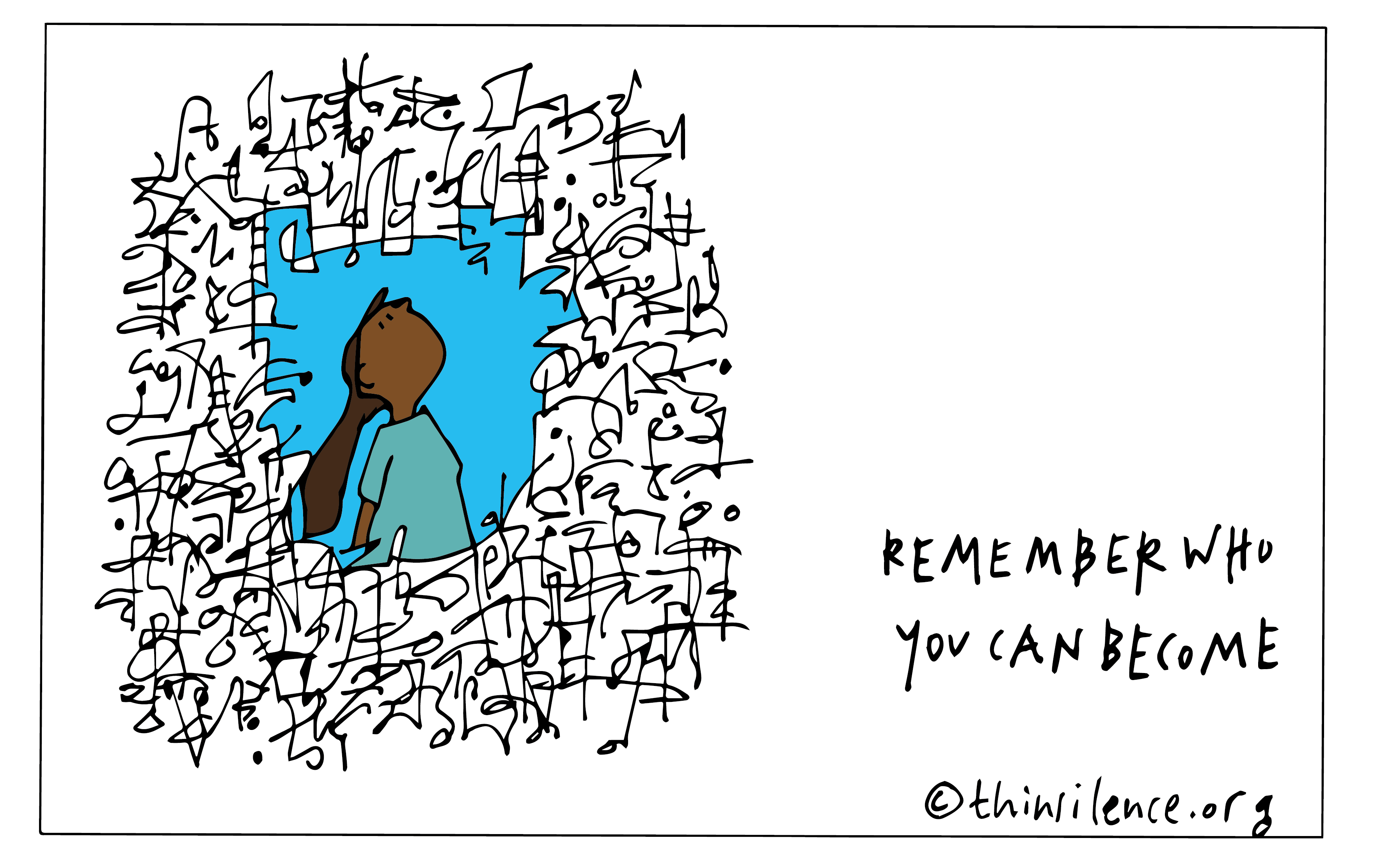
There’s never been a more important moment in recent history for us to remember or discover that we are all innovative creatures.

Whoever we are and what we are doing, this is not it.

What we need for the journey already exists within us and can grow out.

I’m borrowing Lewis Hyde’s words to make a different point to the one he makes.^

We each have thousands of growing tips so may we each set our energy free and grow and become.^^

*From M. C. Richards’ Centering;
**From Lewis Hyde’s A Primer for Forgetting;
^Lewis Hyde is referring to the thousands of forgotten people in a genealogical tree, rather than the remembered one at the roots
;
^^The image of the tree is also an important reminder that innovation is often small slow alterations and improvements.

Opening stories

Stories are what we use to understand the universe, and our place within it.*
(Hugh Macleod)

The world is alive, generous, and within patiently for us to figure it out.**
(Tom De Blasis)

How’s your story unfolding?

Richard Rohr reflects:

Spiritual maturity is largely a growth in seeing, and full seeing seems to take most of your lifetime, with a huge leap in the final years.^

While we may think we can manipulate the universe, and to a certain extent we can, the universe opens to the one who is willing to see, who understands it is what it is whether there’s anyone around trying to capture, mine, drill, melt, or eat it.

This is a different kind of seeing, arising through humility rather than pride, openness rather than forcefulness: that is, not forcing our will upon the other, but opening our will to what is wanting to emerge between ourselves and the other.

I mention the will because more than thinking and feeling, doing is what opens us to the possibility of being changed:

once we’ve had an experience we don’t go back to the way that we were before that experience^^.

Which brings us back to our story, connecting us to today and all things and people within it.

A little journaling at the beginning of the day can be a great way to connect us with the story we want to fins ourselves within and to give expression to as it unfolds before us.

*gapingvoid: Love in the Time of Coronavirus, Part 2;
**Tom De Blasis‘ letter to young readers from Maria Popova and Claudia Bedrick’s A Velocity of Being;
^From Richard Rohr’s Falling Upward;
^^Taryn Marie, quoted in Bernadette Jiwa’s What Great Storytellers Know.

Give it my all, not just a part

Rather than living a long life, are you willing to live a life worth living?*
(Erwin McManus)

It’s a good question.

I don’t get to influence the length of my life too much, beyond the obvious Don’t step in front of moving vehicles or Remember you’re not good at swimming or Watch what you eat.

But I can influence the quality of my days.

And here comes another opportunity today.

*From Erwin McManus’ The Barbarian Way.

You’re obsessed

Talent is cheap – you have to be obsessed, otherwise you are going to give up.*
(John Baldessari)

May you be obsessed throughout your days by something that you cannot stop doing, something you cannot stop thinking about.

Some things are worth obsessing over: it’s how we make things better.

*John Baldessari, quoted in Austin Kleon’s blog: You have to be obsessed.

Into the wilderness

And there’s a special kind of resilience that comes from the level of scrutiny that happens in the wilderness. I know those experiences left me with a truer belief in myself and a much stronger sense of when I’m not being true to what I think is right.*
(Peter Carroll)

We will always need to be humble enough to accept our heart knows why we are here.**
(Paulo Coelho)

We can hear ourselves think and breath in the wilderness, feel our feelings, notice our energies.

No distractions, no razzmatazz, no gimmicks.

Just time and listening and awareness.

Dreamwhispering is an invitation to step into the wilderness.

Nothing swish or complicated, so we can step into a person’s complexity.

*Pete Carroll, quoted in Brené Brown’s Braving the Wilderness;
**From Paulo Coelho’s Aleph.

Into the library

TSUNDOKU n. Leaving a book unready after buying it, typically piled up together with other unread books.*
(Ella Frances Sanders)

The art of reading a book is the best example of distance learning ever invented.**
(Neil Gaiman)

It was the second space in our walk-through experience of Communication Through the Ages.^

The walls were covered with newsprint, words becoming lines on paper, providing clear lists or instructions; stacks of books populated the floor, and it was possible to pick up one of these and connect with someone who was in a different place or even dead, but their voices were present to us in the text.

We take books and reading for granted but when you step back and see this technology for what it is, it is quite magical, capable of igniting imaginations and changing lives.

I am speaking to myself, really, because for many years I found an excuse for not reading more than a few books a year, but then a great desire to grow and to become changed all of that, and I am grateful for all the mind-openers, companions, navigators and encouragers I have met through the words of their books.^^

I recommend Maria Popova and Claudia Bedrick’s A Velocity of Being for all ages to read about books and reading.

*From Ella Frances Sanders’ Lost in Translation: tsundoku is Japanese;
**Neil Gaiman, quoted in Austin Kleon’s blog: The best distance learning is reading a book;
^The first space centred on a communal fire around which we sat and communicated our news and stories; the third space would be filled with TV screens where we silently watched and listened; the fourth with laptop computers where silence again would reign as keys were pressed to communicate with someone far away, or perhaps in the same room.
^^We can count podcasts and audio books and such as alternatives or additions.

Solitude as a rite of passage

We enter solitude, in which also we lose loneliness … True solitude is found in the wild places, where one is without human obligation.  One’s inner voices become audible. One feels the attraction of one’s most intimate sources. In consequence, one responds more clearly to other lives. The more coherent one becomes within oneself as a creature, the more fully one enters into the communion of all creatures.*
(Wendell Berry)

We connect to an inner place of wonder, and thus we are open to recognising the spirit of wonder in the world around us.**
(Kelvy Bird)

A rite of passage concerns itself with life-transitions that demand both inner and external preparations.

We still have many transitions in our society and culture – in education, work and relationships, but perhaps these tend to be more about external movement, lacking equal emphasis on the internal element.

Here are two rites of passage that are very valuable: solitude and opening to the other.

Imagine someone entering a great aloneness so they might hear their true voice.

And out from this, see the possibility of the initiate exploring how to open and form a place within themselves for the other: fauna and flora, the non-physical, ideas, new persons.

Some might suggest these rites are towards the never-ending quest of becoming more human.

*Wendell Berry, quoted in Maria Popova’s Brain Pickings: Wendell Berry on Solitude and Why Pride and Despair Are the Two Great Enemies of Creative Work;
**From Kelvy Bird’s Generative Scribing, concerning reflective journaling.

Out of my way

The urge to make something is a precious energy.*
(Alex Pellew and Martin Amor)

More often than not, I am the person in my way.

I have found myself wondering about the missed opportunities to take what I really want to do further.

Too many times and too many regrets.

But life has a way of continuing to bring opportunities our way, so much so that it looks as if life isn’t linear but helical.

This matters to me because I want to make something.

We all do.

In story terms, this is the through line:

The through line is the invisible thread that pulls the reader or listener through the story, from event to event. You can think of the through line as your story’s theme, conveying what the story is about.**

I am grateful for this idea of the through line.

It tells me I haven’t completely missed the plot, or if I get off-track, where to come back to and be ready for the next opportunity, which tends to be when things get hairy:

When you feel that rush of fear as you put your point of view, your art, or your idea out into the world, this is not an invitation to step back into the shadows; it’s a sign that you are at the edge, right where you should be, exploring how things might be.*

It’s up to me now not to get in my way.

*From Martin Amor and Alex Pellew’s The Idea in You;
**From Bernadette Jiwa’s What Great Storytellers Know.

Spooky behaviour over long distances*

As a species, we have proved to be good historians but poor futurologists.**
(Robert Macfarlane)

There’s a word in Spanish. … Instead of saying ‘to wake up,’ you say recordarse, that is, to record yourself, to remember yourself. … Every morning I get that feeling because I am more or less nonexistent. Then when I wake up, I always feel I’m being let down. Because, well, here I am. Here’s the same old stupid game going on. I have to be somebody. I have to be exactly that somebody.^
(Jorge Luis Borges)

Is our daily path from the past or from the future?

Imagination allows us to look towards the misty cerulean horizon of the future, with its possibility and promise of meaning.

No matter how well we progress, the experience must always be one of being close but not arriving. We only know where we have arrived by turning around and looking at the past:

We are in effect, always, close; always close to the ultimate secret: that we are more real in our simple wish to find a way than any destination we could reach: the step between not understanding that and understanding that, is as close as we get to happiness.^^

This pregnant distance invites us to approach with imagination, to be open to surprise along the way, to deeper understanding and appreciation not because we know but because we don’t know:

The imagination is more like the moon than the sun because it is dependent on another thing and exists in no pure state by itself. … It needs an openness to whatever is there at the moment and to not reject whatever is there because of any formulaic concept from the past. … The imagination allows me to give a credence and an integrity to any existence outside of myself.*

And it is openness to the other that enables us to be a different somebody today, what Michael Burkard articulates as spooky behaviour over long distances.

*Michael Burkard, quoted in Mary Ruefle’s On Imagination;
**From Robert Macfarlane’s Underland;
^Jorge Luis Borges, quoted in Lewis Hyde’s A Primer for Forgetting;
^^David Whyte, quoted in Maria Popova’s Brain Pickings: Proximity: A Meditative Visual Poem for Those Reaching for Something They Can’t Quite Grasp, Inspired by Trees.