who are you?

18 we come from the future

Is it possible for someone to come from nowhere and make a significant contribution?

Yes and no.

Yes, because we are living in a time when our changing perspective on Human contribution, together with technology, makes it possible for someone to bring their art into the world.

No, because no-one come from nowhere; everyone comes from somewhere:*

“position yourself and wait for the wave to come to you.  So then you ask, Position myself where?  Position yourself with something that captures your curiosity, something you’re missionary about”**

You have been positioning yourself somewhere for the whole of your life.  You may not have recognised this place (with its ways of thinking, relating, and behaving), but if you take a closer look then you’ll find curiosities and skills and values which allow you to be smarter about this.

And waiting doesn’t meaning inactivity.

It means filling your days with activity around your “smarts.”  Here are my three encouragements:

Be open to more (more has never been more accessible);
Follow your heart (what you feel can be more important than what you think);
Be willing to try and fail, often (it’s the best way to take something from okay to wow).

Waiting for the wave is about listening for your emerging future: ‘Attend.  Listen to what your life calls you to.’^

Who are you?  You are someone who has come from your future.

“I will not die an unlived life,
I will not live in fear
of falling or catching fire.
I choose to inhabit my days,
to allow my day to open me,
to make me less afraid,
more accessible,
to loosen my heart
until it becomes a wing,
a torch, a promise …”^^

(*Malcolm Gladwell’s Outliers is a good place to check out where people come from.)
(**Jeff Bezos, quote in Peter Diamonds and Steven Kotler’s Bold.)
(^From Otto Scharmer’s Theory U.)
(^^Dawna Markova, quoted in the Northumbria Community’s Morning Prayer for 17 December, 2015.)
 

what do you want?

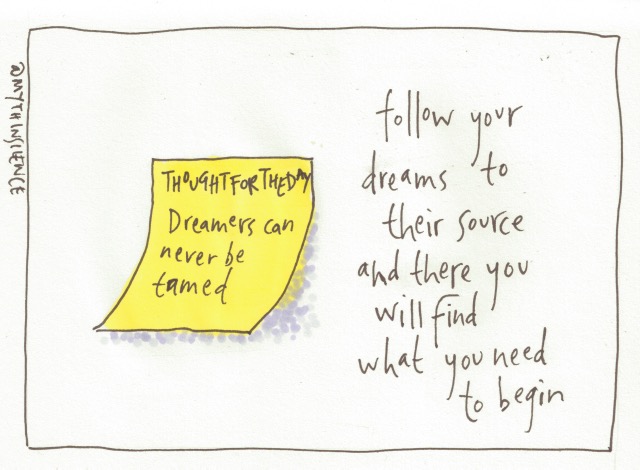
17 follow your dreams 1

‘The nature of life based on photosynthesis assures this will happen: fire will occur unless something blocks it. … A unique fire planet finally evolved a unique fiery creature.’*

When asked, What do you want?, many of us may be tempted to say we need something from outside of our lives right now.

Maybe what we need to know is that the answer, the something lies within, that we have enough to begin.  Only something is blocking it.

“Dreamers can never be tamed,”** writes the interpreter Yau on a Post-it – the thought for the day for Paulo Coelho and guests on his pilgrimage.

(*From Stephen Pyne’s Fire.)
(**From Paulo Coelho’s Aleph)

why what who when

16 who why what when

What happens when these four things come together, identifying a moment in time when a group of people are meant to do something exceptional, to do some great good in the universe?

Up close, each appears to have an inner and outer expression:

Why do others need this and why do I need this?
What kind of thinking, relating, behaving would really help others, and how does this help me?
Who will I work with and who will benefit?
When, as in, is this the time when others need this, and am I ready.

To see our own why/what/who/when needs as such an important part of this may sound selfish; Brené Brown helps us to see that we’re really talking about love here when she explains it this way:

‘Love is not something we give or get; it is something that we nurture and grow, a connection that can only be cultivated between two people when it exists within each of them – we can only love others as such as we can love ourselves.’*

If you find yourself with a special group of people at a particular time in history for a significant challenge.

Of course, there’s only one way to find out.

(*From Brené Brown’s Daring Greatly.)


unlikely

15 unlikely 1

‘True worth, for such a person, inheres in the creative spirit, and the objects of the world should move accordingly, not to some other, illusory value.*

The person described is expatriate American poet Ezra Pound, an unlikely hero for those who awaken to their creative spirit.

Pound became a supporter of the Axis Powers during the Second World War, having moved to Italy when he turned his back on what he saw to be the destructiveness of usury and capitalism.

In 1927 Pound had won the $2,000 Dial Award prize, promptly investing the prize money to be able to use the annual interest for supporting struggling artists.

For all the wonder of our modern life, it leaves many thinking they are devoid of creativity, or that they must pursue creativity in the scarcity markets of sport and show business and such – so robbing them of their true Human capacity.

Pound expresses how we can all use what we have in encouragement of others.  Indeed, this may be one of the most useful talents in the world today: enabling others to express and give form to their talent.

(*From Lewis Hyde’s The Gift.)

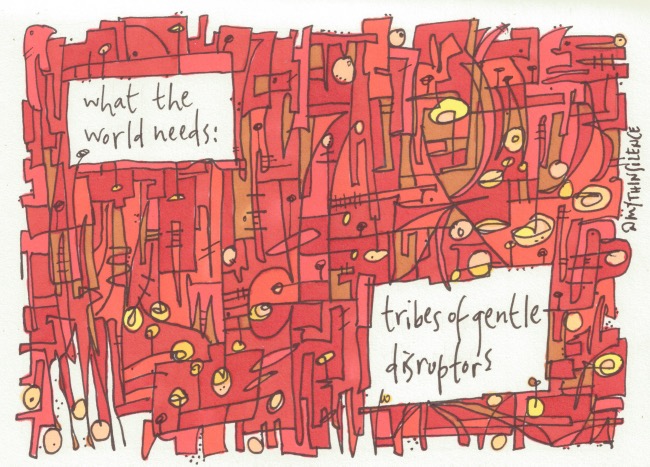
tribes of gentle disruptors

14 what the world needs 1

Eckhart Tolle makes a critical distinction between the form of something and its Being:

‘Only beyond form, in Being, are you equal, and only when you find the formless dimension in yourself can there be true love in that relationship.’*

Institutions and titles and roles and recognition are all forms.  They can both beguile and disempower those who do not belong to them.

The most extreme expressions of form of being can be found in the example of the Haitian children who told Compassion‘s Wess Stafford, “I don’t have anything you would need or would want”**

Beneath the surfaces of all these forms, there is equality.  We are “inter-beings,” as Richard Rohr describes us.^  Everyone is equal in being.  Everyone has something to give, and everyone has need of something someone else can give.  No-one can say “You have nothing that I need.”  Everyone has enough.

We find our enoughness around the things we love to do and love to do for others.

We are gentle disruptors, and tribes of gentle disruptors can change the world.what the world needs 100

(*From Eckhart Tolle’s A New Earth.)
(**From Wess Stafford’s Too Small To Ignore.  The phrase was M’pa gagne, meaning “I don’t have.”)
(^From Richard Rohr’s Eager to Love.  Person is derived from per sonare: we are sounded through each other, an expression of the many.)

love is a dance

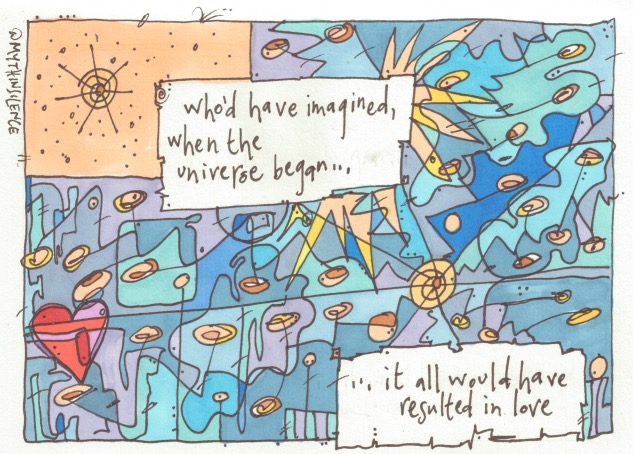
13 who'd have imagined

Paulo Coelho’s interpreter Yau counsels the author:

“Seek out people who aren’t afraid of making mistakes and who, therefore, do make mistakes … they are precisely the kind of people who change the world”.*

Love is what the universe is about, but it feels more like a dance rehearsal than a performance.  Moving this way or that way with someone or with many, until some way of connecting with rhythm is found making it possible for giving and receiving.

It’s hard, and many lose interest, or get tired or exasperated, long before the connection is found, but life is about having the time we need.  Those who hope for more are willing to stumble their way forward, finding some way to dance together.

Yau also said to Coelho:

“Only mediocrity is sure of itself, so take risks and do what you really want to do.”*

Pride and greed and foolishness pulls me away from others, but humility and gratitude and faithfulness pulls me towards others.

And, if you don’t expect some perfect dance moves from me, then I can join in the dance, too.

(*From Paulo Coelho’s Aleph.)

when i close my eyes

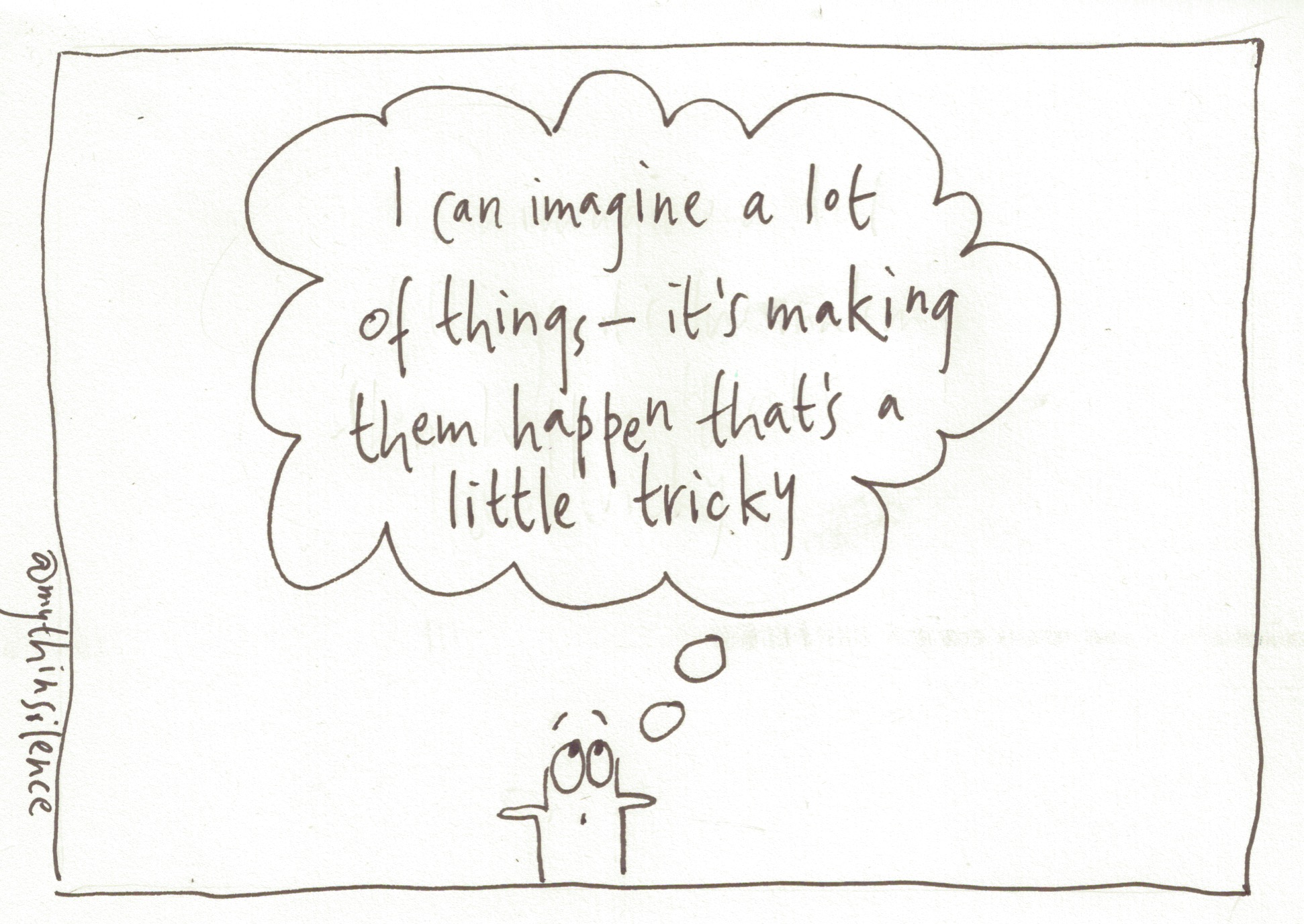
12 i can imagine

‘Do you believe in a spiritual world, in a parallel universe, where time and space is eternal and always present.’*

When I close my eyes, I can imagine how I am one with everyone who is, has been, and who has ever been.  The kind of moment in which I feel the universe to be for everyone, hoping for an alternative reality to how things are.

We can all imagine something better and then to try and do something about it in a small way.**

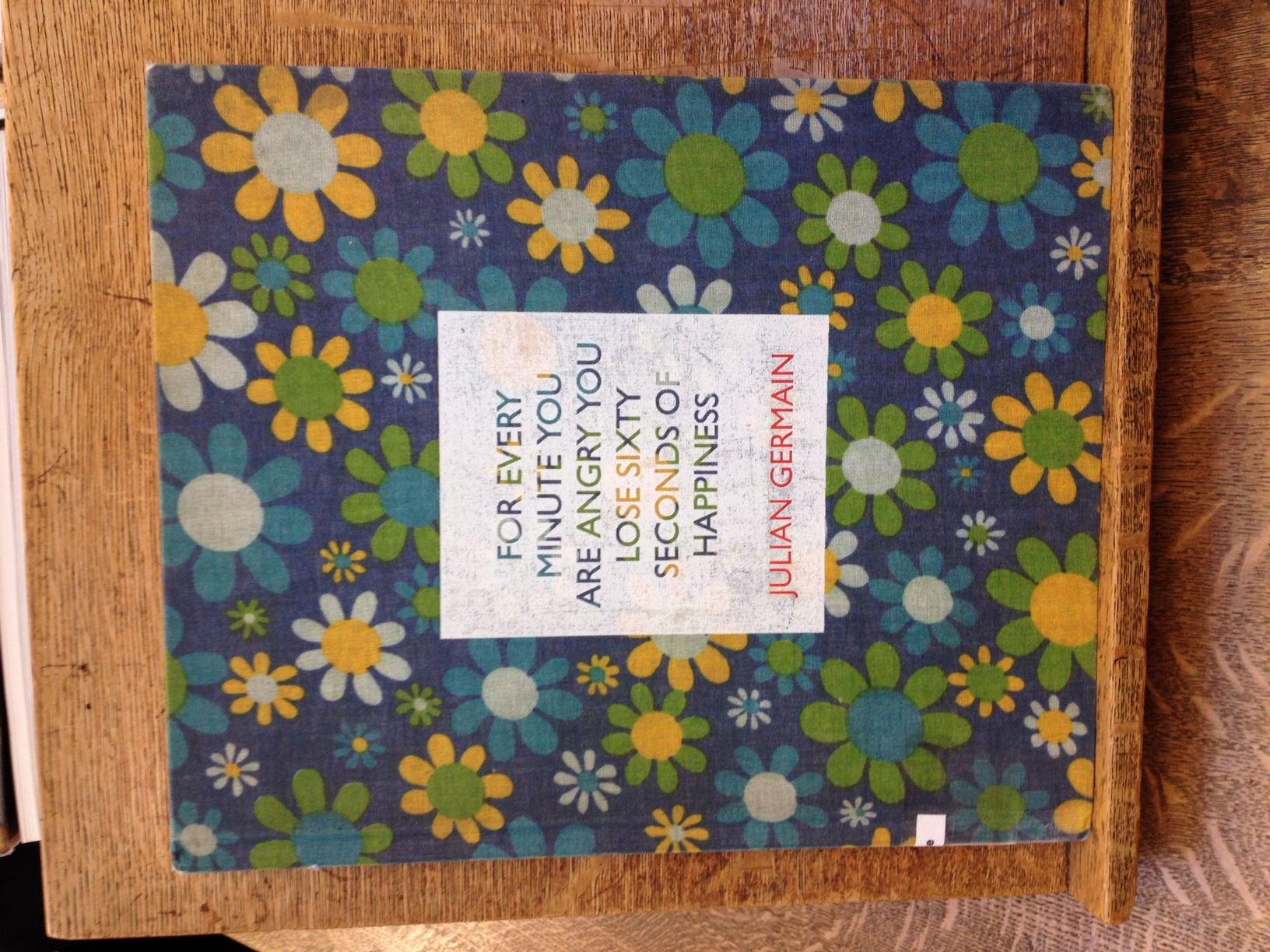
I was sat in the local library yesterday and saw this book cover on a stand on my desk:

‘For Every Moment You Are Angry You Lose Sixty Seconds Of Happiness’^

12 60 seconds

(*From Paulo Coelho’s Aleph.)
(**Later today, someone told me about a group of people who drove up in a Land Rover from Manchester to Carlisle – hit so bad by the flooding.  I thought the story was about using the Land Rover, but it wasn’t.  The Land Rover was full of food, and the Mancunians set up a kitchen and cooked for the people forced out of their homes.  Sean, who was telling me this story, said that some really great Human things were happening in Carlisle at the moment.)
(^Julian Germain’s For Every Moment You Are Angry You Lose Sixty Seconds Of Happiness.)

movement and meaning

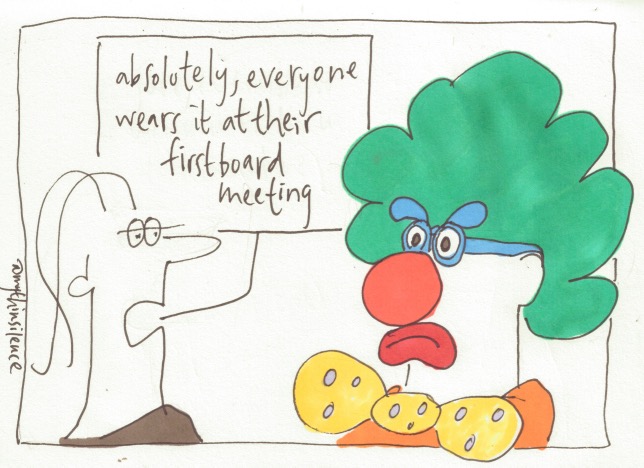
11 absolutely, everyone wears 1

Rites and rituals just aren’t what they used to be.

I don’t mean they were all good, either – did I really want to be sent out as a hairdressing apprentice for “skyhooks” at the local ironmongers?*

The best of these bring meaning to the movement of our lives: childhood to adulthood, education to work, a new role, moving geographically, friends bonding, and more.

The value of a rite is in how it helps a person or a community to move from one state to another, empowering them to know exactly what is changing and how they’re doing.

The value of a ritual is in how it affords a person or group frequent, even daily, habits which make it possible to move in their chosen, desired direction, allowing them to reflect, evaluate, and correct their thinking, relating, and behaving.

What this means is, we can create better rites and rituals which make it possible to bring movement and meaning together so they flourish and thrive in a person and tribe, enabling people to bring their heads, hearts, and wills together, to become a force of nature.

Rites and rituals may sound as though they’re about attachment to the past, but a closer look reveals the best are about alignment or realignment to the future.**

I have loved the following words from the moment I first read them.  The context is a student speaking to their tutor:^

“But do not try to bring them to where you are, either, as beautiful as that place might be to you.  Rather, invite them to go to a place neither you nor they have ever been before.’^^

(*The ironmonger asked me to wait whilst he looked for some, and even though I knew I was being had, I had to go through with it.  Another rite of passage I heard of was for metalworkers.  As part of an initiation rite, apprentices would be told to pick up a block of lead.  When they did realised it was aluminium, it was too late!)
(**This is the real sense intended by the term “repent”: realign to your future Self.)
(^The tutor was a Roman Catholic missionary frustrated with how the church’s approach to the Masai people wasn’t working.  I believe the words hold true, though, for anyone regardless of their worldview.)
(^^Vincent Donovan, quoted in Brian McLaren’s Why Did Jesus, Moses, the 
Buddha and Mohammed Cross the Road?)

data producers

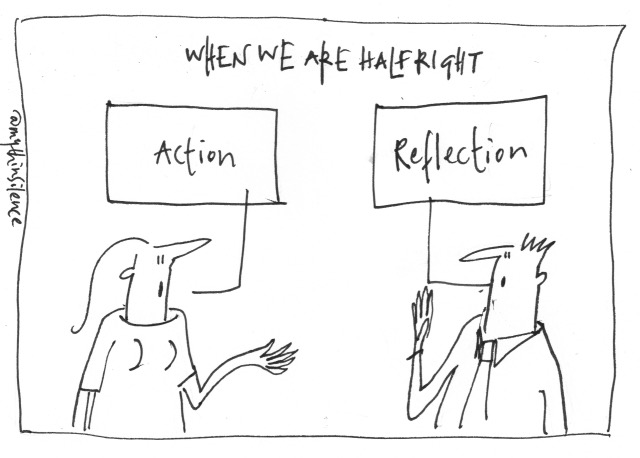
10 when we are half right 2

“Civilisation occurs and maintains itself when the two forces – the striving and the ordering – approach equipoise.”*

Action and reflection make the most sublime things happen – we could substitute the word creativity for civilisation.

Paulo Coelho sees himself as a pilgrim when he avers:

“To live is to experience things, not sit around pondering the meaning of life … I can only speak to my soul when the two of us are off exploring deserts or cities or mountains or roads.’**  

This sounds very much like all action; perhaps Coelho doesn’t see how his writing is reflection.

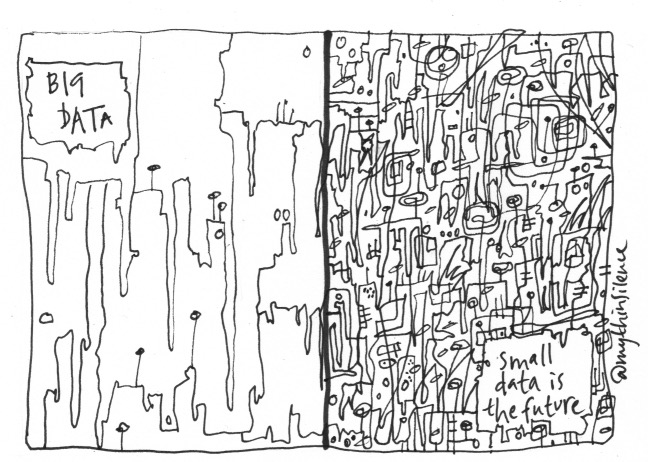
More happens in journeying and reflecting, in striving and ordering.  Experience don’t come to us as big data but as small data.  When we see the bits and bytes of the world or a relationship or an idea or a practice, we can reconstruct these in an infinite number of new ways.

Or to put it another way …

Not long ago, most of us were data consumers.  Data is what happened to us or we found ourselves counted in, but now we are data producers.

It’s infectious.  When we identify our small data we can help others identify theirs.

(*Writer Clark Emery, quoted in Lewis Hyde’s The Gift.)
(**Paulo Coelho in Aleph.)

small data

9 big data

‘I remember the many occasions on which help has come from precisely those people whom I thought had nothing to add to my life.’*

Often, we receive people and circumstances and environments as big data.  The trouble is, though it can be impressive on a good day, big data is largely indigestible and ends up being viewed as irrelevant.

Maybe I say to you in a feedback situation: “You work well with people.”  This may sound fine, but then you begin wondering:

What kind of work was I referring to?
What kind of skills was I observing and how can they be developed?
Was it a case of people getting what they wanted from me or was there a deeper impact?
Did I mean you work better with others rather than alone?
Was it about leading a team or fitting in?
Getting things done or helping the process along?
Do I know that enjoy doing this, or it drains you?

These kinds of questions are about small data:

“Big data can be made smart data if it can be made smaller, by transforming it to become contextual, relevant, and delivered to the right person at the right time in the right format.”**

I read this and realised small data is what I help people with when it comes to improving talents and performance, or which way to go next or the challenge to go for.

Small data helps us to make the journey, because it’s the journey which keeps us alive.

We then become the kind of people who can bring something to others, those who didn’t realise it wasn’t the big data they needed, but the small stuff from people who know how to work it.

(*From Paulo Coelho’s Aleph.)
(**Michael Fauscette, quoted in Rohit Bhargava’s Non-Obvious.)