before and after

28 a new law

There once was a before to 2015 and now there’s an after.

I took a step forward and the horizon changed; I took another and it changed again.

Really, I know I am still a before person moving towards a better after.

Here I am, at the before to 2016 and I’m imagining what my preferred after will be.

I back at the beginning again, as T. S. Eliot has helped me to see:

“We shall not cease from exploration, and the end of all our exploring will be to arrive where we started and know the place for the first time.”

No one is just a before person; everyone can be an after person, too.

And maybe we can be helpers of one another to move from before to after.

muse

image

Who is my gift for?

“Yet maybe this small and mysterious exchange of gifts remained inside me also deep and indestructible, giving my poetry light.”*

Chilean poet Pablo Neruda is reflecting on when he, as a child, found a worn toy sheep in a hole in the fence between his family home and their neighbour’s.  He left a pine cone in it’s stead, and, though he later lost the toy in a fire, this exchange of gifts directed his work.

Ideo’s Fred Dust dared to see the notion of design and product to be more than a financial transaction when he suggested:

“You’re a better designer if you love the people you’re designing for.”**

In the beginning, there is the gift.

The thing we most want to give for someone.  We must not compare ourselves with anyone else – who they are, what they have, how they express themselves.

There’s only you and what the universe has given you the opportunity to express.

And to carry this through life.

Otto Scharmer only warns us of three pitfalls: fame, money, and empire-building.^

(*Pablo Neruda, quoted in Lewis Hyde’s The Gift.)

(**Fred Dust, quoted in Bernadette Jiwa’s Meaningful.)

(^Otto Scharmer’s Theory U.)y


discoverers all

image

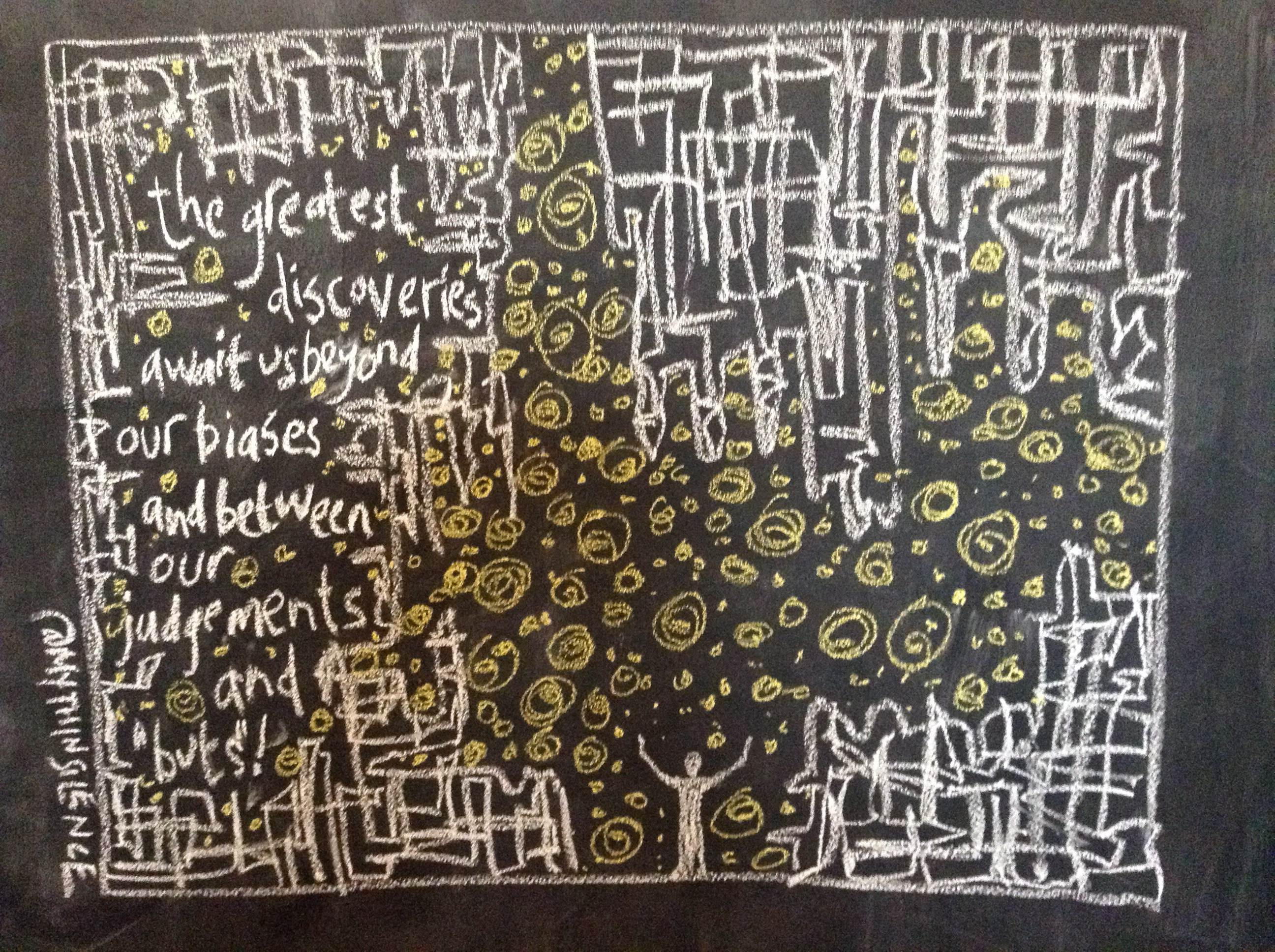
‘The very nature of the universe invites you to journey and discover it.’*

If the new year is to be one of new discoveries, then here are three things to help:

Avoid bias – which will only lead you to somewhere you already know.

Don’t critique or judge – which will only close possibilities down before they’ve had a chance to open up.

Play the “yes and” game – adding to what others share with you.

Discovering lies on the far side of exploring.

(*From John O’Donohue’s Eternal Echoes.)

a child is born

image

‘The child and the artist are pilgrims of discovery.’*

A child is born with many possibilities before them, born of their curiosity, inquiry, and attention.  Finding the right path – the one with a heart – is about finding purpose.

And our purpose is our art.

We will know this is what we have found if there’s a spirit to it – if what we do is more than than the thing itself.  And we will know this is what we have found when it creates deep relationship and community.

And perhaps what Christmas does is remind us we too are born for a purpose, and it’s never too late to identify this.

For this reason, Happy Christmas.

ho snow love hope

(*From John O’Donohue’s Eternal Echoes.)

find me here

24 local is here to stay 1

‘Once our basic needs are taken care of, the things that we want most of all as humans is to matter.’*

This feels local.

Perhaps the best Christmas gift of all is for someone to help  another feel local, here – at home in who they are and what they have and what they can do.

Each of us is capable of this.

When we find each other, we can say we are local, find us here.

You belong here.**

(*From Bernadette Jiwa’s Meaningful.)
(**See Taiye Selasi’s moving TEDtalk: Don’t ask where I’m from, ask where I’m local.)

and we will be travellers

23 we are travellers

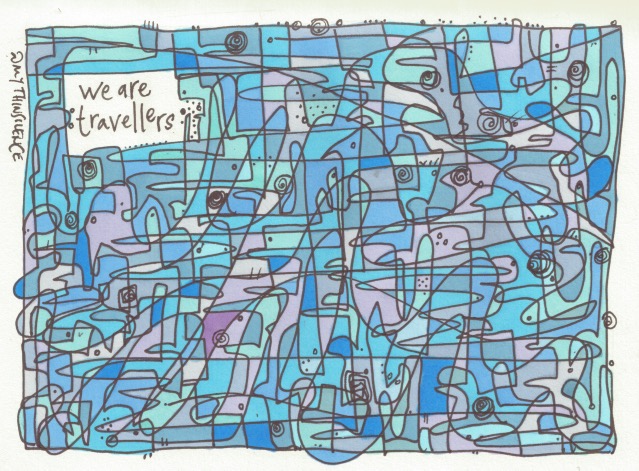
One of the stories played out as part of the nativity story I mentioned a couple of days ago was that of the wise men guided by a star (likely a comet).

I love the thought that these men set out on a hazardous journey because they just had to follow their curiosity and their need to continually explore.

We each are guided by something different, as Bernadette Jiwa’s insight into meaningful companies proffers:

‘The customer is their compass.’*

Jiwa tells the story of the outdoor clothing company Patagonia sending their repair service on the road.  A truck was despatched around the United States, offering a repair service to ‘a jacket that had travelled the world with a customer.’*

It’s an honouring of allthose who’ve worn their clothing through the thick and thin of life; check out this message received by Patagonia with a repair ask:

“My mom raised my brother and I to explore the world with unwavering curiosity: the deep south, the Ozark Mountains,  the Great Plains …”

There’s something else happening here.  People are increasingly purchasing items which come with a story.  Part of our story is that we are a travelling species, migrating across the face of the Earth and, now, out into space.

What many of these travellers have achieved is to make the invisible visible for the rest of us.

They remind me I must travel from what I know to what I do not know, to where new possibilities occur – what Rohit Bhargava names intersections.

Places and spaces which will become our new “local”**

Bhargava shares three principles for intersectional living: see similarities, not differences,** purposefully look away from your goal, and wander into the unfamiliar:

‘In a world where we have a map in our pocket, ready to assist us with turn-by-turn directions to anywhere, wandering must be a choice.’^

As a traveller not depending on google, what’s your compass?

(*From Bernadette Jiwa’s Meaningful.)
(**Check out Taiye Selasi’s TEDtalk: Don’t ask where I’m from, ask where I’m local.)
(^From Rohit Bhargava’s Non-Obvious.)

get real

22 humans at their best

‘When we are in rhythm with our own nature, things flow and balance naturally.’*

Modern life tends to get in the way, mind.

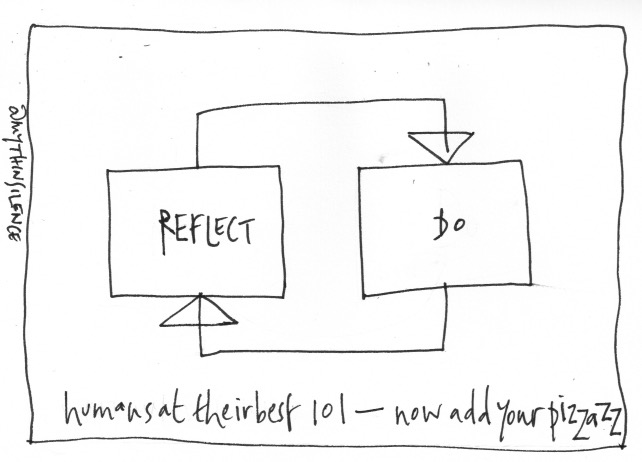
So much so, we get to feeling that to be in rhythm with our own nature is simply not realistic.  But each of us is a deeply creative being:

‘What I do care about, though, is each human’s ability to express her art, to develop into the person she is able to become.  I care about the connection between people and our ability to challenge and support others as we create our own versions of art. And I care about freedom, the ability to express yourself until it impinges one someone else’s happiness.’**

How less real is this than the circumstances which led to, say, the economic bubble burst of 2007-08?

Bubbles form wherever there are disconnections:

‘Real credit is the purchasing power of a group over time – all that comes of labour, technology, and the gifts of nature.  Financial credit is the same things expressed with money.  Social Creditors did not oppose the monetary expression of credit – large industries and nations cannot operate without that abstraction – but they said, financial credit should equal real credit.’^

We live in bubbles all the time.  The recent closure of the steel works in Redcar was not because of the poor performance of steelworkers, who were working as hard as ever, but with market forces over which they had no control, and they had to rely on others to represent them – or not.

In 1994 John Elkington proffered the term “triple bottom line” for business to reconnect and get more real: people and planet and profits.

Maybe I’ve strayed from my original premise; that being, each day, we can identify with the rhythm of our own nature.  Pragmatism requires we learn to live in the bubbles, somehow, but we don’t have to do this blindly and soullessly.

We’ll need to find daily practices for reconnecting.  Otto Scharmer suggests we find some intentional silence amidst all the noise:

‘Pick a practice that helps you connect to your source.’^^

When we do this, we’re not only being pragmatic, we’re also being subversive.  Again, here’s something from Scharmer who likens the journey we make to the heroic adventure:

‘a call to adventure, crossing the threshold, following the road of trials, making the supreme encounter, and returning with a gift’.^^

Those who say get real about your creativity are more in tune with how things really are than those who say it’s just not possible.

(*From John O’Donohue’s Eternal Echoes.)
(**From Seth Godin’s We Are All Weird.)
(^From Lewis Hyde’s The Gift.)
(^^From Otto Scharmer’s Theory U.)

so this is christmas*

21 the darkness cannot overcome

The young children were playing out the familiar nativity story yesterday.

All was going well unto one of the lambs picked up the baby Jesus and dropped him on his head so that he suffered head trauma.  (It was a doll baby Jesus.)

I wonder, though, whether this story, revisited and reenacted every year by millions of people, holds within it an important message that every child has the capacity and potential to bring really good things into the world – peace and hope and forgiveness.  And we were children once.

We only need stories we can connect to which will help us to see and be this.

This light of the world story finds us all grown up now.  We know there’s darkness “out there,” but, if we’re honest, there’s darkness “in here,” too.

The good gift of light changes everything: we can begin again, we can always start over.  Alvin Toffler shares:

“The illiterate of the 21st century will not be those who cannot read or write, but those who cannot LEARN, UNLEARN, and RELEARN.”**

Here’s a metaphor for transforming, for morphing people.  Richard Rohr believes:

‘Transformed people transform people.’^

We can still be the children of light we felt ourselves to have lost:

May I live this day
Compassionate of heart,
Gentle in word,
Gracious in awareness,
Courageous in thought,
Generous in love.^^

As Yoda would say: “So, Christmas this is.”

(*This echoes John Lennon’s classic Christmas song; when you read the lyrics you could be mistaken for thinking it was written by a child.)
(**Alvin Toffler, quotes in Sunni Brown’s The Doodle Revolution.)
(^From Richard Rohr’s Eager to Love.)
(^^From John O’Donohue’s Eternal Echoes.)

it’s all about love

20 everyone can see what we can see 1

“If you must be heard, let it be like a babbling brook …
If you must be seen, let it be like sunlight … .”*

This is more an intention of the heart than bringing the one perfect thing to another.

It is an intention to which we apply all of our inventiveness:

‘Intersection thinking is a methods for creating overlap between seemingly disconnected ideas in order to generate new ideas, directions and strategies for powering your own success.’**

Then, we ask of the word or idea or presence or action we offer:

Does this have a good spirit?
Does it forge relationship or community?

Our willingness to see and understand differently makes the offering of something which has a good spirit and creates community more possible:

“Discovery consists of seeing what everybody has seen and thinking what nobody has thought.”**

I watched the clouds moving from right to left across the sky, passing across the place the rising sun was to be found.  To my right, the clouds were purple-grey but, as they passed over the rising sun, they became salmon-cream.

20 clouds

It left me wondering: what kind of person can I become to others?

In the end, it’s all about love.

(*Kerry Hilcoat, quoted in the Northumbria Community‘s morning prayers for 20th December.)
(Physiologist Albert Szent-Györgyi, quoted in Rohit Bhargava’s Non-Obvious.)

shadows

19 everyone fails

Twyla Tharp identifies six kinds of failure: skill, concept, judgement, nerve, repetition, and denial.*

I’d add a seventh, although it can be found in each of the above: character.

When we fail to deal with our failures they become our shadows – we drive them to the hidden places in our lives, hoping to starve them of light, yet they remain a part of us, hurting, hungering.

If I can find a way of dealing with these then I disarm them.

When I acknowledge and embrace them, then their power is not so great.

When I gather forgiveness and learning to them, they become a place for journeying from instead of to.

Then I am able and free to expand; I can grow, I am capable – as Otto Scharmer, proffers, we can:

‘Take deep-dive journeys to the place of most potential.’**

The thing is, no-one is failure free, therefore, shadow-free.  There’re only those who try to escape their shadows and those who face them and embrace them.

The classic hero’s journey sees someone wrenched out of their day-to-day lives to face some challenge they’re rather not face.  In the course of this, they come upon their greatest shadows.  Often, they overcome and emerge to a life of greater hope – which is not the same as “happy ever after.”

‘Courage comes from willingness to “die,” to go forth into an unknown territory that begins to manifest only after you dare to step into the void.’**

Perhaps the best way for many of us is to take on a new challenge and to face the shadows as they present themselves: acknowledging, gathering, and expanding.

(*From Twyla Tharp’s The Creative Habit.)
(**From Otto Scharmer’s Theory U.)