The big sleep

“On the temple bell
Perching, sleeps
The butterfly, oh.”*
(Buson)

‘Environmentalists are always arguing that those butterflies, those grasslands, those watershed woodlands, have an utterly necessary function in the grand scheme of things, even if they don’t produce a market crop.  The same is true of meadowlands of imagination; time spent there is not work time, yet without that time the mind becomes sterile, dull, domesticated.’**
(Rebecca Solnit)

How about some marauding?

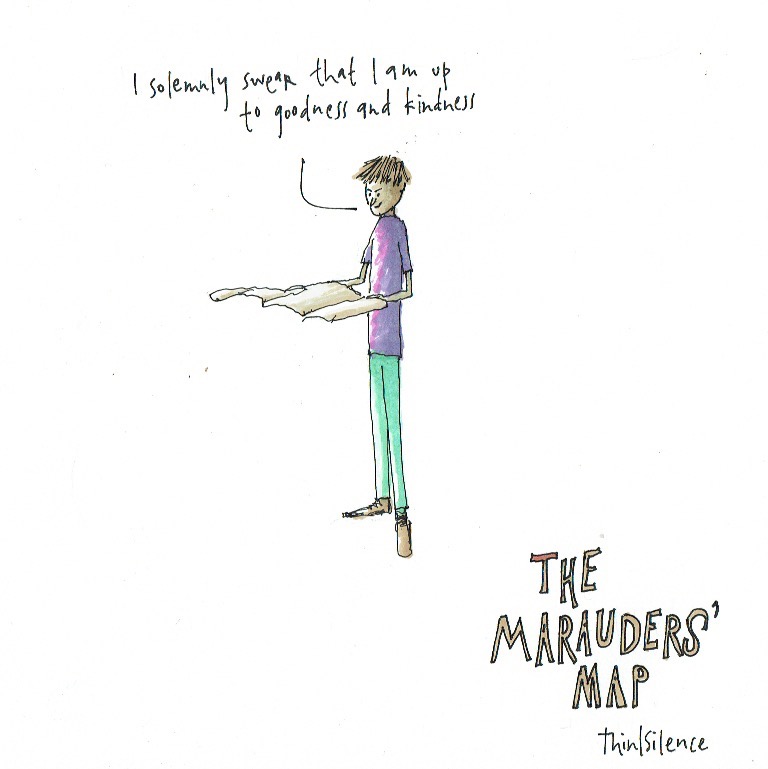
Or perhaps that ought to be amaurauding – apparently marauding means to “go about in search of things to steal or people to attack.”  We can maraud for other things, though.  Harry Potter’s Marauders’ Map allowed him to see both where he might go and others were.  As Fred and George Weasley explain, in order to open the map Harry would have to say, “I solemnly swear that I am up to no good,” and to close it “Mischief managed.”

The kind of marauding I have in mind flips no good into goodness and kindness.  I borrow this thought from Brian McLaren who describes our mission, ‘should you choose to accept it,’ as being ‘to plot goodness and foment kindness wherever you may be.’^  This can be very mischievous work.

Marauders don’t conform.  Awakened from her previous sleep state, she realises that she has just escaped a slumber that was growing deeper and deeper, and she has no desire to go back to this.  Erich Fromm writes on how we can be so unaware:

‘Most people are not even aware of their need to conform.  They live under the illusion that they follow their own ideas and inclinations that they are individualists, that they have arrived at their opinions as the result of their own thinking – and that it just happens that their opinions are the same as those of the majority.’^^

Hugh Macleod reminds me why I’ve been so encouraged and enabled by him since discovering his doodling and thinking.  He writes about the wee voice that will not go to sleep:

‘Your wee voice doesn’t want you to sell something.  Your wee voice wants you to make something. […] Go ahead and make something.  Make something really special.  Make something amazing that will really blow the mind of anybody who sees it.’*^

At first we may have no idea what the wee voice wants, only that it isn’t going to ask us to conform in any kind of sleep state life – that’s why it won’t be quiet:

‘Your wee voice came back because your soul somehow depends on it.  There’s something you haven’t said, something you haven’t done, some light that needs to be switched on, and it needs to be taken care of.  Now.”*^

The marauder has awakened and won’t again be seduced by sleep again.  Marauding is about movement and marauders keep moving – some of the concerns about modern life have to be the possibilities of sleepwalking into a life lacking movement and contact with others.  A San Francisco Chronicle article, presumably from the end of the last century, wonders:

“We’ve all heard of that future, and it sounds pretty lonely.  In the next century, the line of thinking goes, everyone will work at home, shop at home and communicate with their friends through videophones and e-mail.  It’s as if science and culture have progressed for one purpose only: to keep us from ever getting out of our pyjamas.”**

Rebecca Solnit, whose words lead us into today’s post and who also quotes the piece from the San Francisco Chronicle, connects wandering in thought with wandering through space: we need to move through the meadowlands of imagination to stay awake.

Technology blurs lines: is it a phone, is it a TV, is it a computer, is it a watch, is it a newspaper or book?  Is that idea ours or did it come from someone else?  Am I conforming or bucking the trend?  Yet there is the wee voice, the whisper from deep within that won’t be quieted.  Maybe it is asking three things of us:

Am I living as freely as I am able to?
Am I living imaginatively and creatively?

Am I living for a greater purpose than myself?

If yes, then you are a marauder.  If no, then time to wake up and get to some maraudering.

(*Buson, quoted in Kosuke Koyama’s Three Mile an Hour God.)
(**From Rebecca Solnit’s Wanderlust.)
(^From Brian McLaren’s We Make the Road by Walking.)
(^^From Erich Fromm’s The Art of Loving.)
(*^From gapingvoid’s How to be creative.)

Time, meaningless and meaningful

“I was blessed.  I was told I only had three months to live.”*
(Eugene O’Kelly)

In their book on the power of moments, Chip and Dan Heath include the powerful story of Eugene O’Kelly who, on discovering he only had three months to live due to a rare cancer, set out to “beautifully resolve” the relationships in his life.  What followed was a change in his time perspective:

“I experienced more Perfect Moments and Perfect Days in two weeks than I had in the last five years, or than I probably would have in the next five years, had my life continued the way it was going before my diagnosis.”*

To live life as moments and days is telling.  I had reread Alan Lightman outlining the kind of distances and time involved in travelling to the nearest star after our own:

‘If we set out for the nearest star beyond our solar system at [500mph], it would take five million years to reach our destination.  If we travelled in the fastest rocket ship manufactured on Earth, the trip would take one hundred thousand years, or at least a thousand human lifespans.’**

There’s no point in measuring space travel like this in anything less than years, but this way of measuring time and distance means little to us on Earth – our challenge is to live in moments and days.  We can do far more with these than we often imagine, but it will take effort.  The Heath brothers are quick to point this out when they articulate the reason for writing their book:

‘We want to build your determination.  It’s going to be way harder than you think to create peaks.’^

The peaks are the moments that are memorable and remarkable for us.  Again, these skew time, as O’Kelly testifies to experiencing in his goodbyes to those who mattered most to him in his life:

“I felt like I was living a week in a day, a month in a week, a year in a month.”*

Brené Brown describes how the protagonist in their story – and we all live in stories – has to come to terms with the path they must take being a difficult one:

‘The protagonist looks for every comfortable way to solve the problem.  By the climax, he learns what it’s really going to take to solve the problem.  This act includes the “lowest of the low.”^^

Brown is describing Acts 2 of three acts for facing up to our personal stories.  First there is the reckoning in which we come face-to-face with our reality.  And finally there’ll be the revolution or breakthrough.  In-between, though, there is Acts 2: the rumble.  The lowest of the low is a telling description for where O’Kelly found himself, in his final days living through each of the acts.  He turns towards his readers to ask some questions:

“Look at your own calendar.  Do you see Perfect Days ahead?  Or could they be hidden and you have to find a way to unlock them?  If I told you to aim to create 30 Perfect Days, could you?  How long would it take.  Thirty days?  Six months?  Ten years?  Never?  I felt like I was living a week in a day, a month in a week, a year in a month.”*

O’Kelly’s story helps us to see that here is something within the long reach of most of us; when we add moments and days to our lives, things change.

And when we make moments and days count for ourselves then it’s highly extremely probable likely they’ll begin to count more for others too.

I close with some words from Lightman, from a protagonist in another of his books exploring how the Big Bang changed everything, followed by some words I was pondering this morning, from Frederick Buechner:

“Frequently, I had no particular destination in mind, but was merely following a natural curiosity to understand how the Void had been transformed by time.”*^

“Listen to your life.
See it for the fathomless mystery that it is.
In the boredom and pain of it
no less than in the excitement and gladness:
touch, taste, smell your way to the holy and hidden heart of it
because in the last analysis all moments are key moments,
and life itself is grace.”^*

(*Eugene O’Kelly, quoted in Chip and Dan Heath’s The Power of Moments. O’Kelly tells his story in his book Chasing Daylight.)
(**From Alan Lightman’s The Accidental Universe.)
(^From Chip and Dan Heath’s The Power of Moments.)
(^^From Brené Brown’s Rising Strong.)
(*^From Alan Lightman’s Mr g.)
(^*Frederick Buechner, quoted in the Northumbria Community‘s Morning Prayer.)

Beyond the beyond the beyond

“If you must be heard, let it be like the babbling brook, laughing over the rocks.”*
(Kerry Hillcoat.)

There’s something in these words speaks to me of exemplifying our true self, to be nothing more and nothing less than who we are.  When we’re free in ourselves then we are a whirling, intimate, glorious and creative movement, leading to who know what’s next?  Something Alan Lightman captures when he writes in his wonderfully explorative book of essays The Accidental Universe:

‘Real people are unpredictable, I said.  A character who always acts rationally is a fraud.  Any character you fully understand is as good as dead.  Is that clear.’**

This is who we are – if we take the brakes off.  We are moving towards an ever changing horizon and we are capable of changing as we move.

We need and are thoroughly capable of “beyondness.”  If there is a here there must also be a there as Kosuke Koyama points out:

‘Some kind of “beyond” is inseparable from “here.”^

To only live here is to live in danger of stodginess.  Here and there are about more than distance.  People can travel the globe and still live a stodgy life – a brief escape and then back to the norm.  But to live the sparky life is to touch everything with beyondness.  I love Roald Dahl’s words on sparkiness:

‘When you grow up and have children of your own do please remember something important: a stodgy parent I no fun at all.  What a child wants and desires is a parent who is SPARKY.’^^

(*Kerry Hillcoat, quoted in the Northumbria Community‘s Morning Prayer.)
(**From Alan Lightman’s The Accidental Universe.)
(^From Kosuke Koyama’s Three Mile an Hour God.)
(^^From Roald Dahl’s Danny, the Champion of the World.) 

The noticers

“As acceleration accelerates, individuals, societies, economies, and even the environment approach meltdown.”*
(Mark Taylor)

‘Listening is such an underrated activity.  In fact it is deeply subversive.  Because when we listen deeply, we take in the voice of the other.’**
(John O’Donohue)

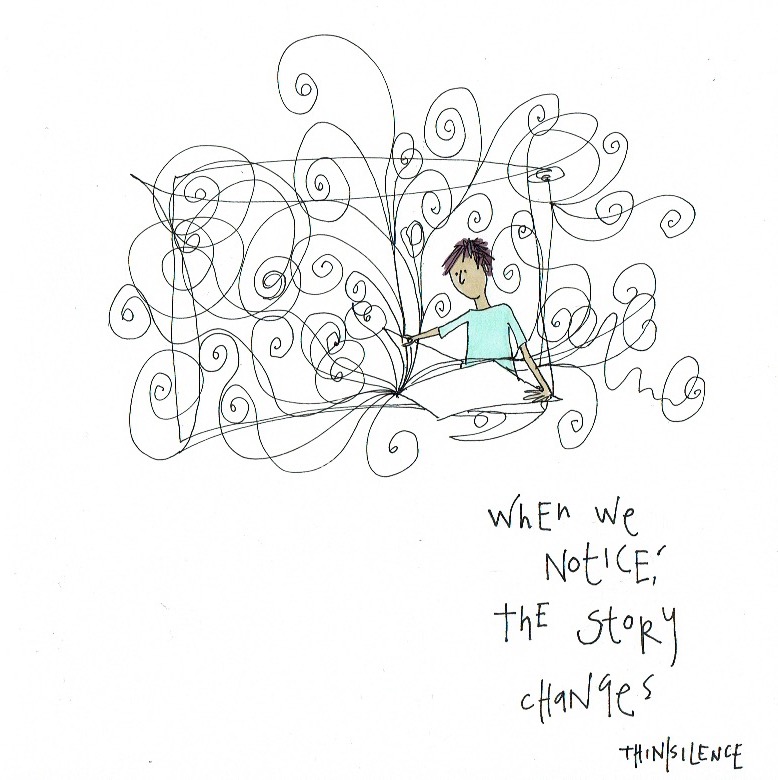
Whilst change is happening faster, whilst we advance and move on and increase, the human species shows great capacity for adaptability and finding coping methods.  What we’re not so good at is noticing what we are adapting into, where our coping methods are leading us.  For this, we’ll need to create spaces in which we are able to notice more.  There are many because we are very inventive: a walk, a room, a view, a bench, in music, in silence, in reading … but a place we are able to figure out three things:

What needs breaking – as in, what we need to get rid of;
What needs fixing – as in, what we keep and can make work better; and,
What needs making – as in, in terms of what do we need to begin.

Without a space to notice, it’s difficult to know which is which.

(*Mark Taylor, quoted and Maggie Berg and Barbara Seeber’s The Slow Professor.)
(**From John O’Donohue’s Eternal Echoes.)

The infinite game

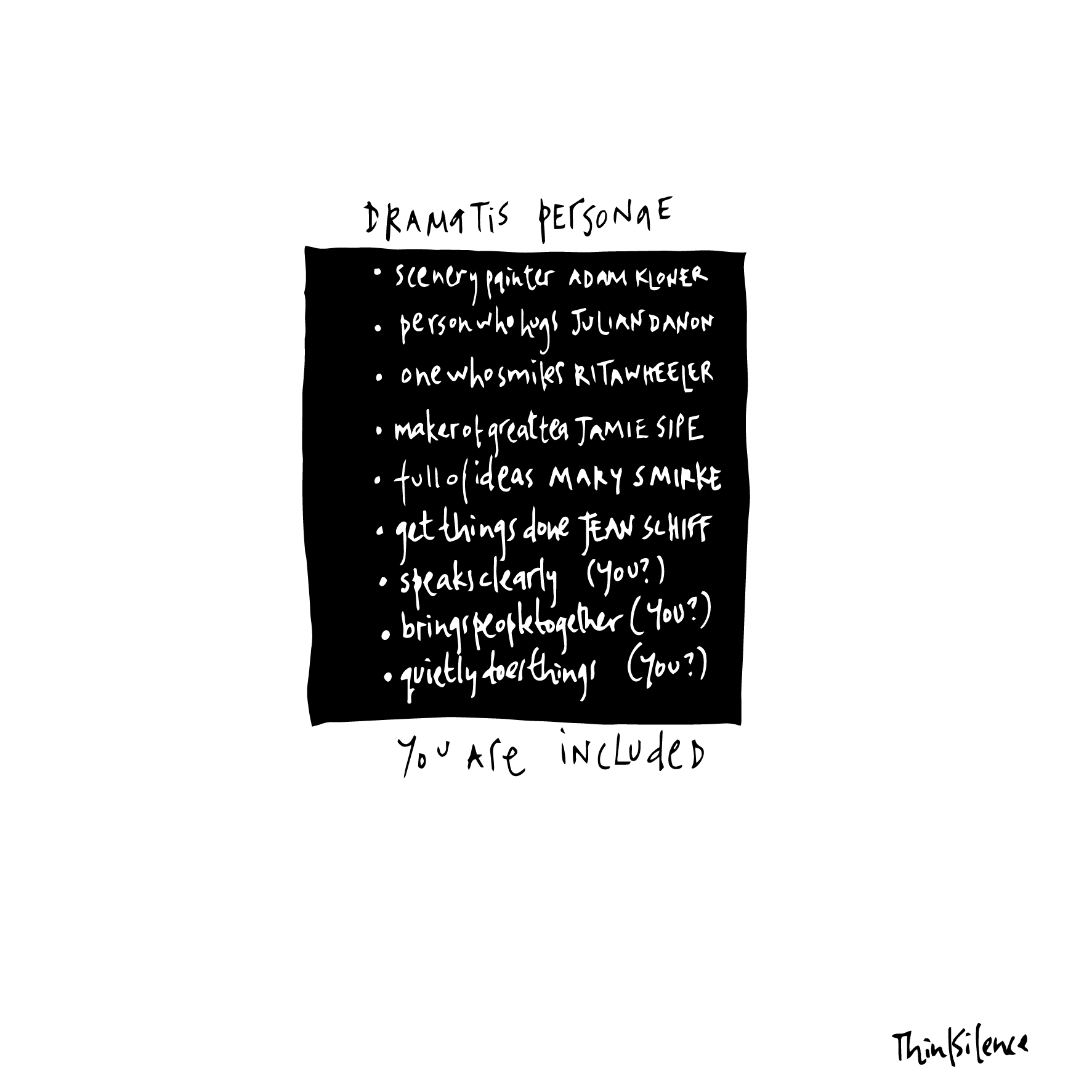
You’re in the cinema watching the (usually white on black) credits at the end of the movie – all those names rushing past so quickly it’s hardly possible to read one, never mind more.

And then, you spot your name and you try and see what it is you are being recognised as doing.  Then it’s gone.

This is the dramatic personae, a list of absolutely everyone who worked on the movie.  It’s not there for the audience but for the crew.

In the infinite game of life, everyone is included in the dramatic personae – everyone’s presence and contribution is valued.

The thing you do, that you have honed and developed – we couldn’t do without it.

Au naturale

If it was possible to take away all the things that have to make up your life: making money, paying rent or mortgage, being there for the family, food-shopping, the expectations and attention of others, and, noticing the most natural hoping and dreaming of your life, if we could pursue anything, do anything, live for anything, what would it be?

Knowing this, why not begin?  It was there all along, within all the other things you must do.   Simply put back all those other things that are a part of your life and continue.

It’s always been possible.  Who wants to get to the end of their life and regret knowing what they must do but not doing anything about it?

Please spread the word, make it possible for others to pursue their hopes and dreams right where they are.

‘Even if someone is born with a particular talent, that talent will usually remain latent if it is not fostered, honed and exercised.  Not all people get the same chance to cultivate and refine their abilities.’*

(*From Yuval Noah Harari’s Sapiens.)


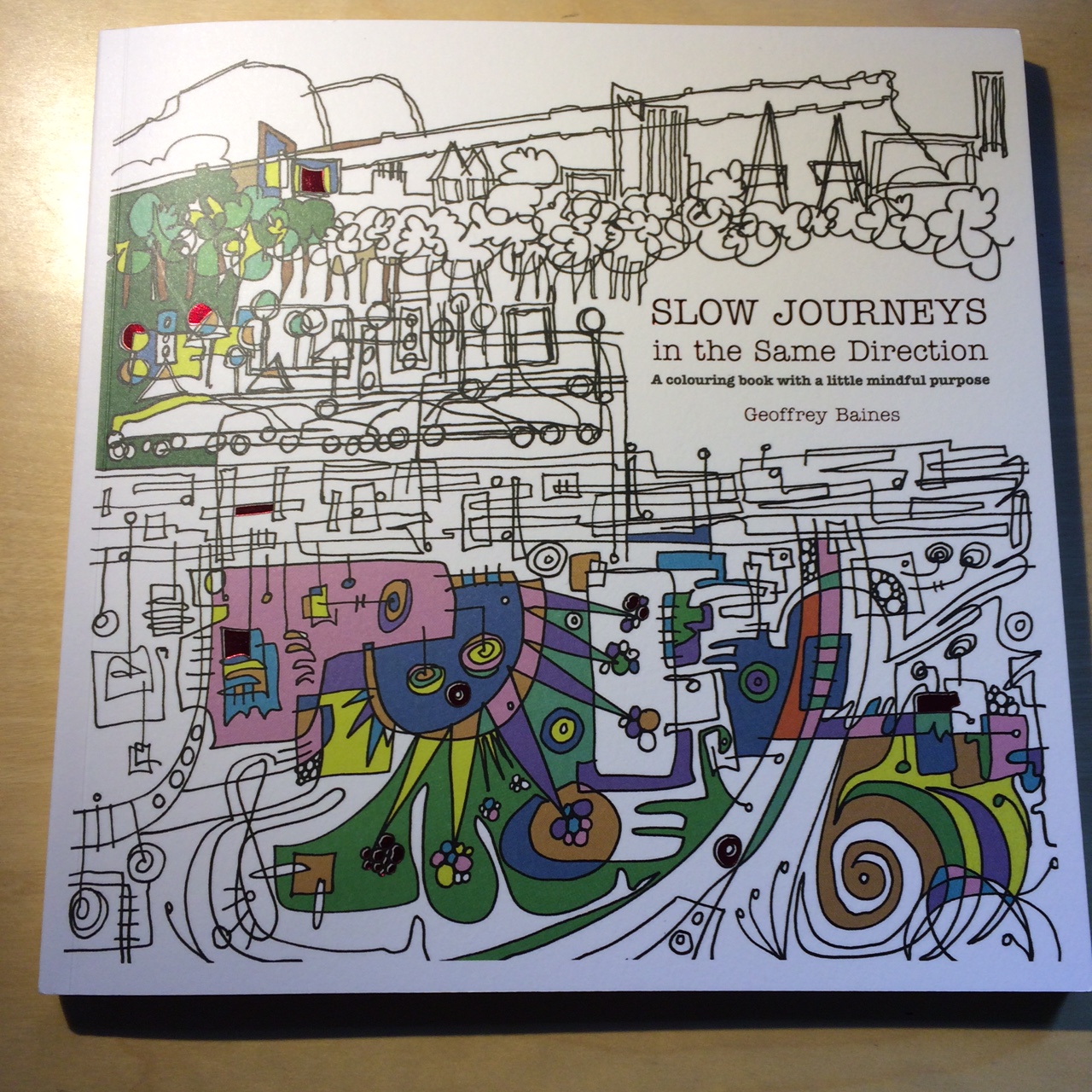
SLOW JOURNEYS IN THE SAME DIRECTION 
is now available

You can order your copy here.

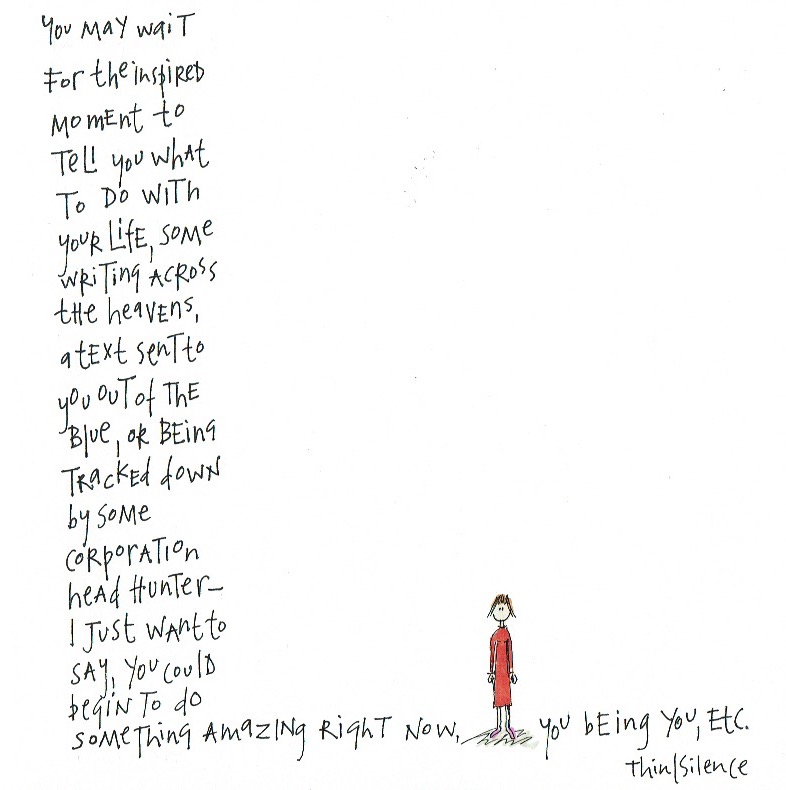
Are you still waiting for some message in the sky?

Once upon a time there was a person with an idea.  The idea caught on and became wrapped in the designs and productivity of others, and a whole institution was built around it.  Many people were employed by the institution.  It changed the way society thought about itself, everything was measured by it.  Education was designed to point everyone towards it, young people gained the qualifications that made it possible to be employed in the production that developed out of the idea.  No one thought they could have an idea that competed with the original idea.  They gave up any hope of being able to do something with the idea that once had circled around their thoughts.  They didn’t realise that the important part of this story was the experience the one person had at the very beginning.  How that person could be any person pursuing their idea.  And that person and idea could be them.

‘Faith, like fire, does not dispel the darkness.  It creates a space within it.  Faith creates a womb for hope and love within a universe that seems indifferent to both.’*

(*From Alex McManus’ Makers of Fire.)


OWN THIS PRINT

Available in the following sizes: 16×16 inches (£65);
20×20 inches (£75); 24×24 inches (£85)

Did you see that?

‘The only essential is this: the gift must always move.‘*
(Lewis Hyde)

‘Energy is either created or destroyed. […]
You’re either the person who creates energy.  Or you’re the one who destroys it.’**
(Seth Godin)

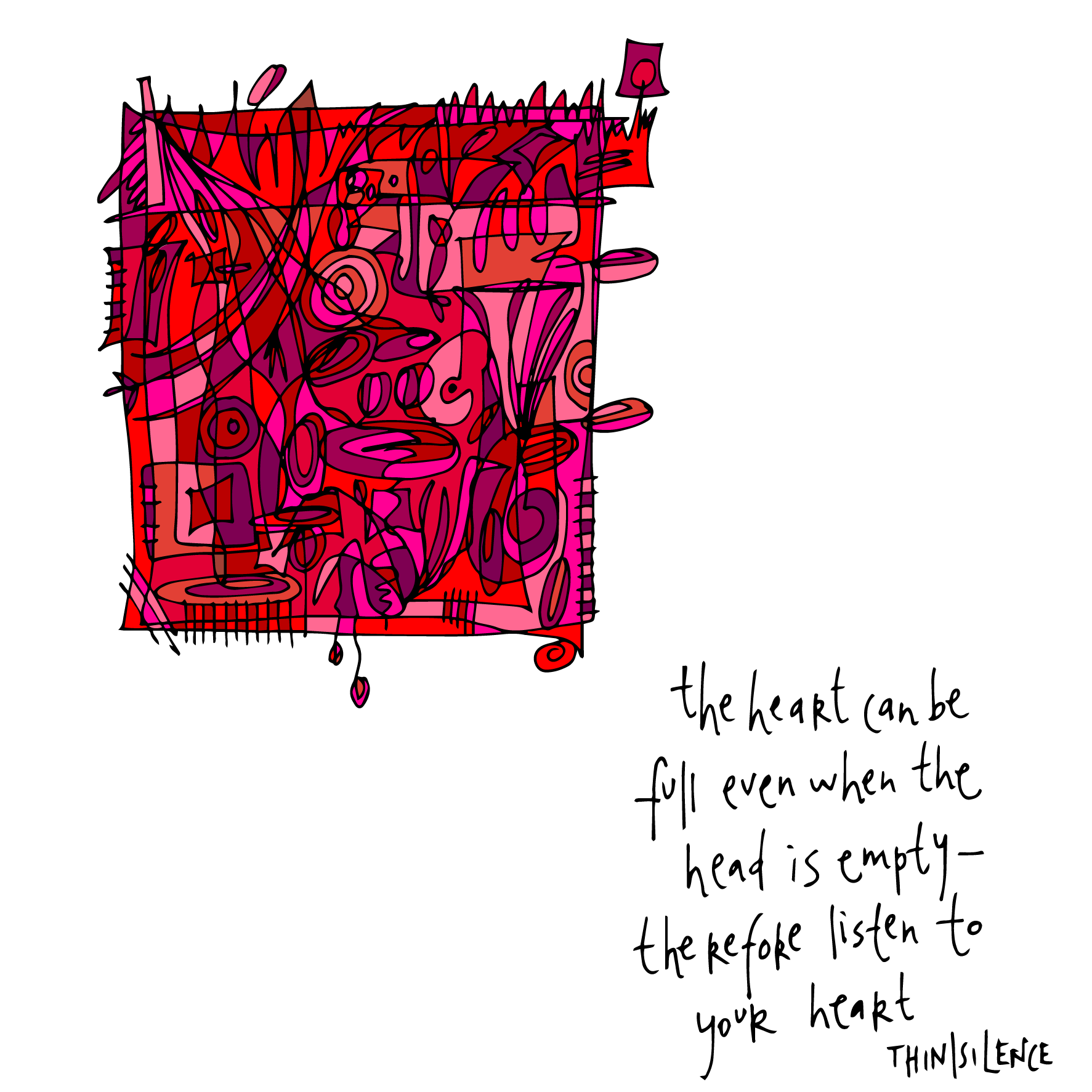
When we engage life with our hearts, we’re talking about connection and abundance and perseverance.  All of these are to do with energy and, therefore, with movement or potential movement.  There’s an energy in every person longing to take them on a journey.

Connection, abundance and perseverance are how we get to make more with less.  Conversion to the right kind of energy requires a number of turnings.  We must turn to others, to our world, to our true self, and, if we have a god or higher power, we must urn there, too.

Vital community emerges from engaging with one another at a heart level.  Parker Palmer describes what community can be:

‘Here is summertime truth: abundance is a communal act, the joint creation of an incredibly complex ecology in which each part functions on behalf of the whole and, in return, is sustained by the whole. Community doesn’t just create abundance – community is abundance.  If we could learn that equation from the world of nature, the human world might be transformed.’^

Lewis Hyde, whose words open today’s post, sees a gift existing within the community of the gift – even if the community is two people.  It’s always more than the gift itself – which may be something as a gift of food – because even though the food is consumed, the spirit of the gift and the community of the gift continue.  In this way it is regenerating, that is, capable of making more from less.

Parker Palmer, in speaking of the community as being abundance, is describing a summertime humanity.  In contrast, Karen Armstrong describes a winter community when she writes:

‘When we meet somebody new, our first impressions are often coloured by such speculations as: am I attracted to her? Is he a threat?  Can I use her in some way?  As a result, we rarely see things or people as they are.  We are frightened, insecure and restless creatures, endlessly distressed by our failures and shortcomings, constantly poised against attack – and this can make us hostile and unkind to others.’^^

These things have come from our past, though, and we are moving towards our future, towards the summertime.  These negative reactions and responses can be far more subtle and nuanced than they appear on the surface of Armstrong’s words.  They are what Seth Godin might consider to be energy destroyers.  They are our starting point but they don’t have to be our finishing place.  Armstrong continues:

‘If we remain trapped in this greedy, needy selfishness, we will continue to be unhappy and frustrated.  But as we acquire a more realistic assessment of ourselves, we learn that the envy, anger, fear and hatred (which often spring from thwarted egotism) have little to do with us; they are ancient emotions that we inherited from our earliest ancestors.  “This is not what I am,” said the Buddha; “this is not my self.”‘^^

Armstrong is describing an ego to eco journey.  Imagine what would begin taking place if we were able to move from ego-to-ego encounters those of eco-to-eco.  What everyone is saying in the words I quoted today, is that when we have emptied ourselves of ego we find that we have more than enough to be imagineers and innovators, becoming more who we are, not less – as captured by Hugh Macleod when he writes:

‘Why would you ever want to be the best, if you can be the only?’*^

Walt Whitman asks a question that leads us into our mortality:

‘Have you feared the future would be nothing to you?

Is today nothing?  Is the beginning less past nothing?
If the future is nothing they are just as surreal nothing.’^*

Carlos Casteneda writes about our need to find a path with a heart.  It doesn’t matter, he says, if the path leads nowhere, the moment-to-moment walking of it will be enough.  A path with a heart means that the future, the present and the past are filled with something rather than being simply nothing.

(*From Lewis Hyde’s The Gift.)
(**From Seth Godin’s blog: The first law of organisational thermodynamics.)
(^From Parker Palmer’s Let Your Life Speak.)
(^^From Karen Armstrong’s Twelve Steps to a Compassionate Life.)
(*^From gapingvoid’s blog: Start by having smarter conversations.)


OWN THIS PRINT

Available in the following sizes: 16×16 inches (£65);
20×20 inches (£75); 24×24 inches (£85)