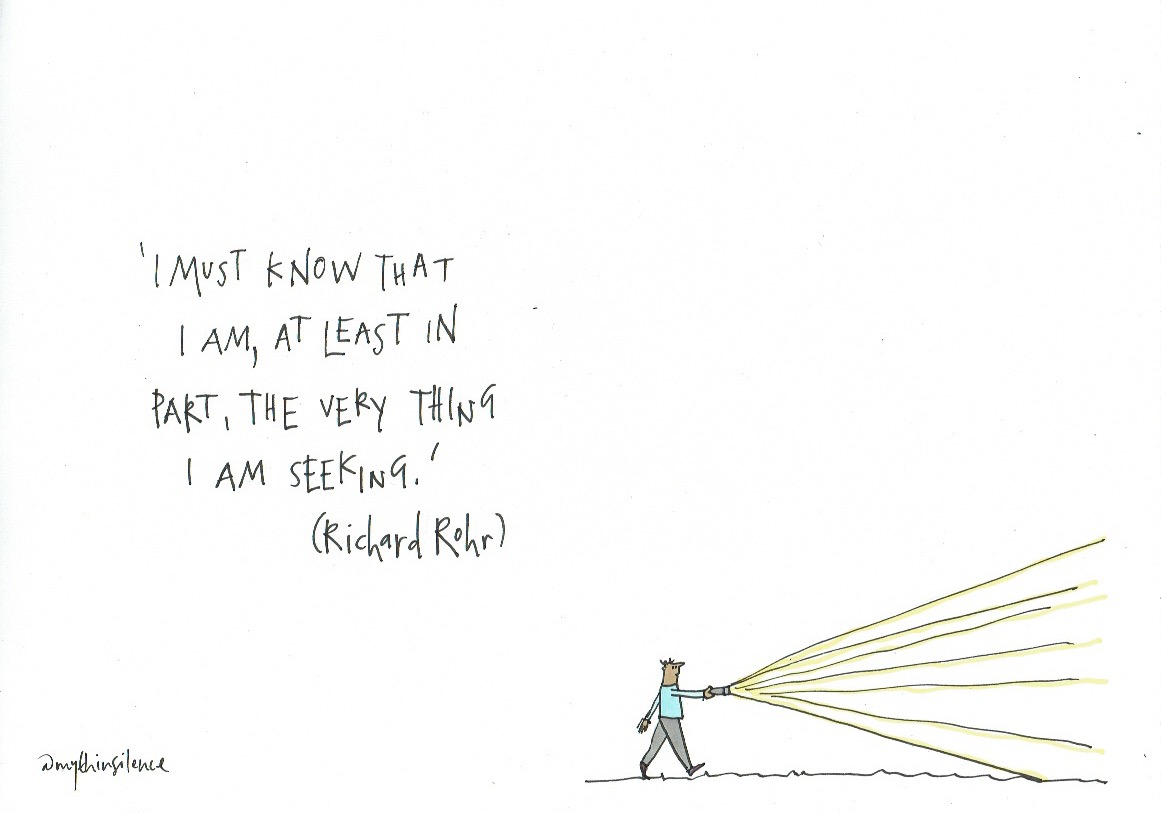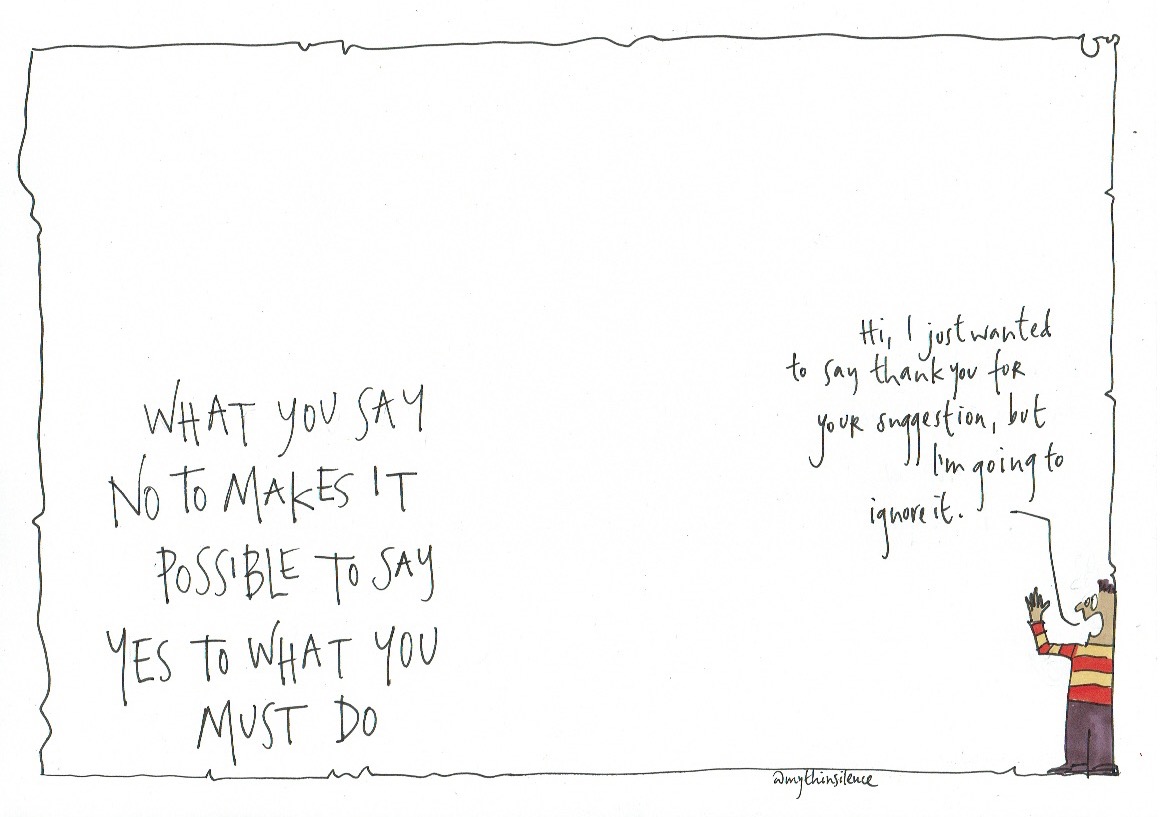
important?

13-what-you-say-no-to

‘While participating in U.Lab, what has been the most important insight?’*

U.Lab  is a massive open-online course that encourages people to find each other locally and learn and imagine together, seeking to be aware of and present to the emerging future for business, society, and self.  (There’ll be another U.Lab opportunity next back end and it’s free.**)

One of the things I’ve personally benefitted from is being able to further develop a daily practice of opening my mind, heart, and will.

Author of Source Joseph Jaworski proffers three practices for being open to the emerging future: wake every day with your deep intention or purpose in life (by journaling or similar), stay connected throughout the day to your deep intention,  and, sense and seize opportunities as they offer themselves.

These three things hold infinite possibility including: reminding me there are so many things that I don’t know but others do, there are things I must walk away from in order to do what I must do, and there will be many opportunities in a day to express this in some way for others.

(If you are interested in finding out a little more about what this looks like as “A Theory of You (U!)”, let me know.^)

(*From U.Lab Portobello.)
(**Check out Seth Godin’s post which has something to say about why this can be a world changer.)
(^How U.Lab and Theory U can be used as a means of personal transformation.)
thanks for sharing that

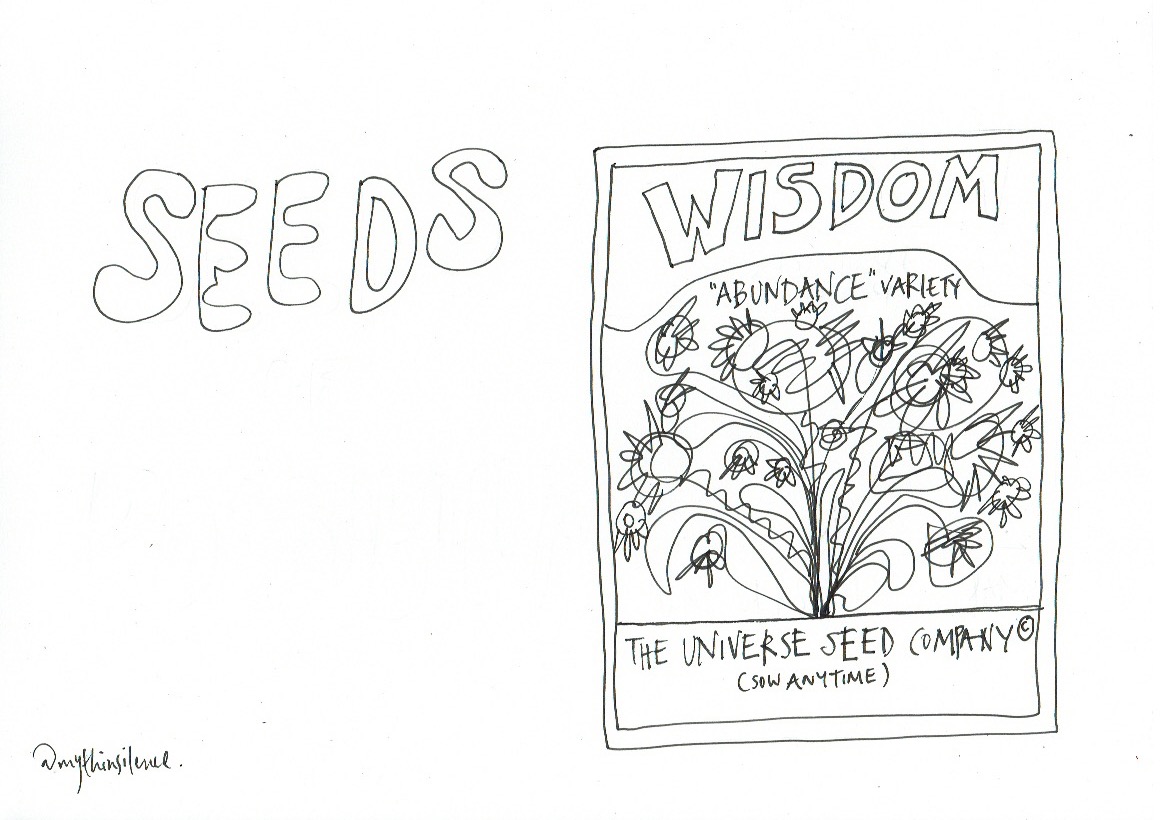
12-seeds

‘What do you need to let go of?’*

‘Scarcity appears when wealth cannot flow.’**

In the beginning there was information.

As I turn my attention to information, asking ever deeper questions, it becomes knowledge.

And as I explore my relationship with this knowledge and try it on then I find it turns into understanding.

As I live in my growing understanding day by day towards others, towards my world, towards myself, perhaps it will morph into wisdom?

An abundance we can only grow together.

But first I must let go of the notion that I know all I need to know.

(*From U.Lab Portobello.)
(**From Lewis Hyde’s The Gift.)

monuments and footprints

11-beyond-the-answer

‘What do you want to bring into being?’*

‘A monument only says, ‘At least I got this far,’ while a footprint says, ‘This is where I was when I moved on.”**

‘Live the questions now.’^

When distilleries manager Chris Anderson retired after forty years, Dewar’s marked the moment back in 2010 with 248 bottles of whisky drawn from one eighteen year old cask.  I love this story of how the distillery marked this man’s service.  Chris received the first bottle drawn and I wonder whether he still has it, or if he opened it for his family and friends to celebrate?

What would you say you want to bring into being?  Monument or footprint?

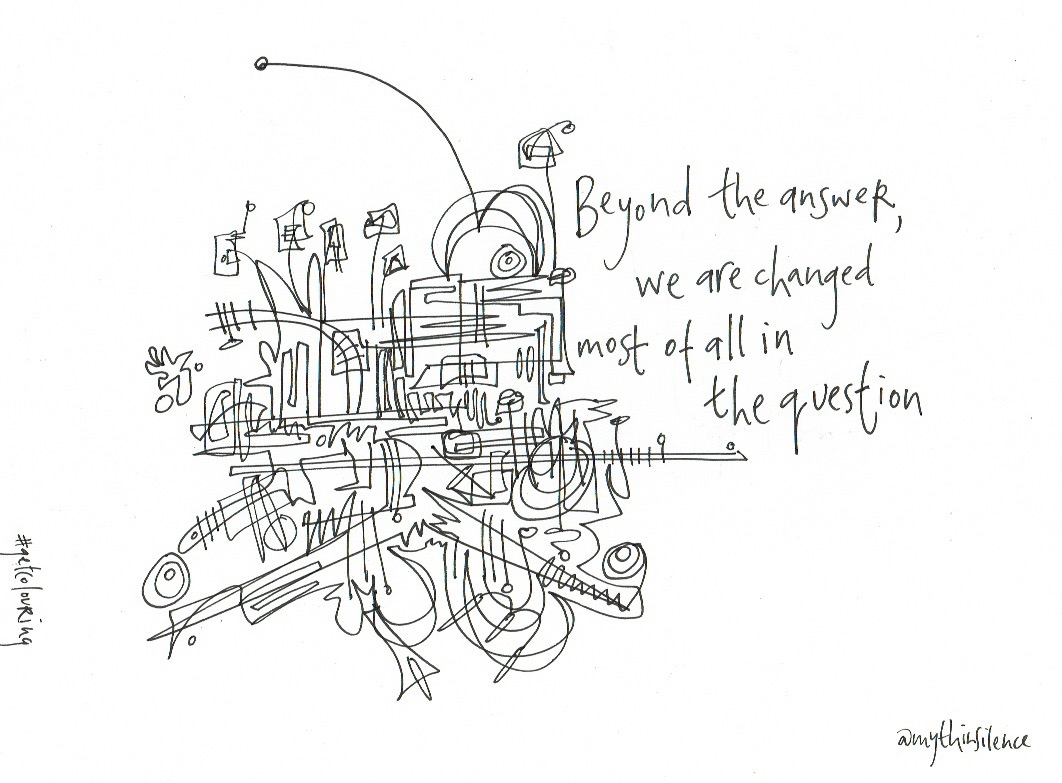
I have a sense that my want lies in a question and not in an answer.  A question is about staying as open as possible to as much as possible for as long as possible.  A question lies between the inside of who we are and the outside of our environment and world of people and things and beliefs and the natural world.

This is my want: to bring my gift, and to help others bring theirs.  But this bringing is slow and full of questions and is a footprint.

‘The gift leaves all boundary and circles into mystery.’^^

(*From U.Lab Portobello.)
(**From Eugene Peterson’s A Long Obedience in the Same Direction.)
(^Rainer Maria Rilke, quoted in the Northumbria Community‘s Morning Prayer.)

(^^From Lewis Hyde’s The Gift.)

the middle cut

10-in-a-world

“What do you feel is wanting to transform within yourself”*

“The essential thing ‘in heaven and earth’ is … that there should be long obedience in the same direction; there thereby results, and has always resulted in the long run, something which has made life worth living.”**

‘Whisky spirit enters the cask as a clear liquid and takes its colour from the wood, and more than two thirds of the flavour will come from the oak.’^

I think I may want to be changed in those things that will allow me to be more creative, generous, and enjoying of life.  Not only to see and know more, not even to feel more, but to do more.

Whisky lover Dominic Roskrow writes about how distillers ignore or reject the volatile alcohols at the beginning of a distillation run, and also the weak and bad tasting end of the run.  It’s the middle “cut” that will be stored and matured.  Thinking about how we like beginning things and finishing things but aren’t too keen of what comes in between, Roskrow catches my attention when he tells of how two identical casks can be filled with the identical spirit, sit side-by-side for the same amount of time and, yet, produce different whiskies because of the many smaller influences.

It’s another middle of the process experience.  Slowly, the ability of the alcohol to interact with its complex environment produces a unique whisky.  I think it’s the same for us, between the high volatility of beginning new things and the weak ending (when we are often underwhelmed, between the pouring of the spirit into its unique environment and it being fully matured, there is the promise of something unique taking place in us when we are prepared to enter into the slow journey involving the places and people and experiences of our lives.

‘[The Miser] remains old and indifferent to the joys and sorrows of others, even his own … the memory of past feelings or experiences is the only form in which he is in touch with his own experiences.’^^

(*From U.Lab Portobello.)
(**Friedrich Nietzsche, quoted in Eugene Peterson’s A Long Obedience,)
(^Dominic Roskrow, from 1001 Whiskies You Must Try Before You Die.)
(^^From Erich Fromm’s The Art of Being.)

when the dog bites

9-when-the-bee-stings

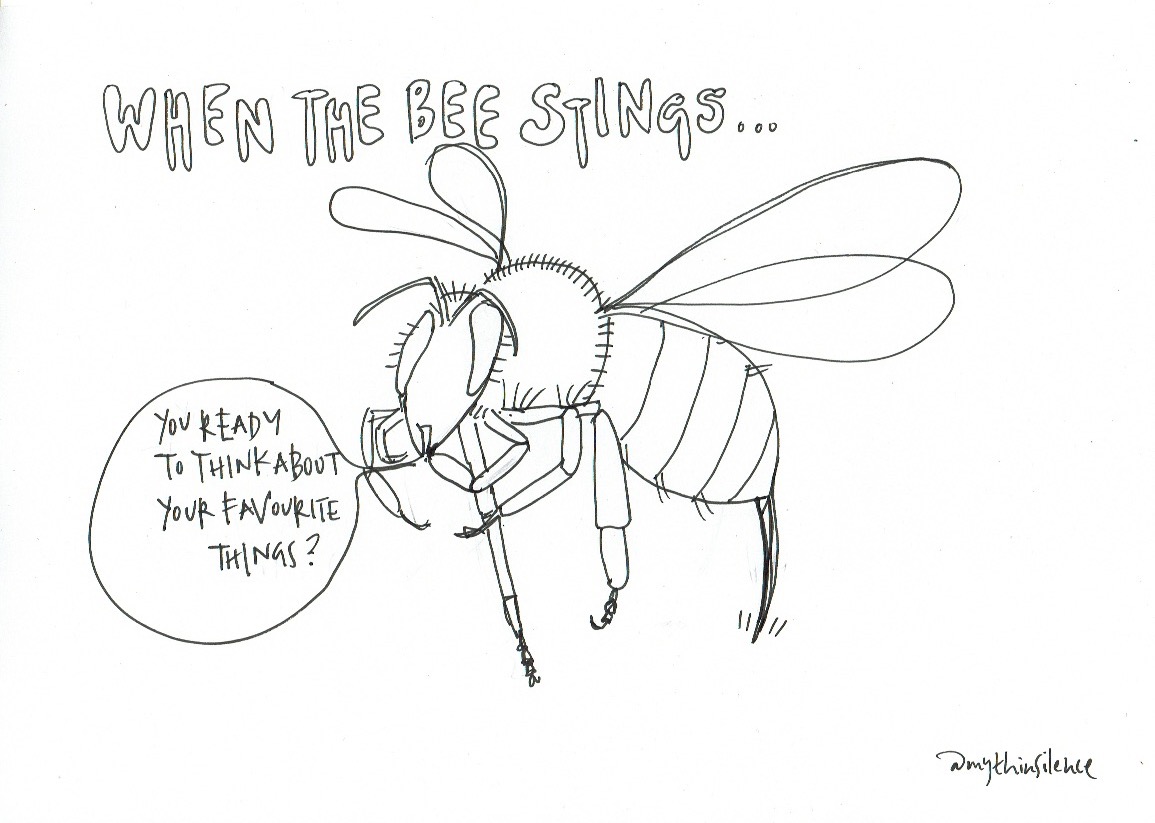
When the bee stings, when I’m feeling sad, I simply remember my favourite things and then I don’t feel so bad.

What am I hopeful in?

Human imagination and grace.

The beauty and complexity of nature.

The possibilities that come with a new day.

That there is more that we do not know than what we know.

The ability to look beyond the present towards the future.

Hope never dies.

Selflessness.

That we can change.

What’s on your list today?

‘You cannot look to the future by naive projection of the past.’*

More than a place to escape a world we do not welcome, we’re capable of creating a better story, focusing on the things that are so important to us:

‘Curation adds meaning to isolated beautiful things.’**

When we do this – and we all have different ways – we are providing a context, a place of embedding what matters most of all, offering the possibility of their flourishing and a deeper now.

“Never doubt that a small group of thoughtful, committed citizens can change the world.  Indeed, it is the only thing that ever has.”^

(*From Nassim Taleb’s Antifragile.)
(**From Rohit Bhargava’s Non-Obvious.)
(^Cultural anthropologist Margaret Mead.)


to notice the beating of the heart

8-im-excited

‘A robot’s gaze, face, and voice allow us to imagine a meeting of the minds.’*

‘”… far from being a cold engine for processing information, neural connections are shaped by emotions” … even if it were possible to maintain a disembodied brain, that brain would not be able to think …’**

The brain and the body are not two systems but one: when we feel better or more fully about something our attention and thinking improve.

A twenty six year old male’s interaction with the robot Kismet becomes increasingly intimate as he finds it mirroring him – the power of emotions and thinking.  A class’s learning goes up when the the students feel good about it – everyone becomes more clever.

Elle Luna writes about noticing our mustiness: ‘our instincts, our cravings, our longings, the things and places and ideas we burn for, the intuition that swells up from somewhere deep inside of us’^

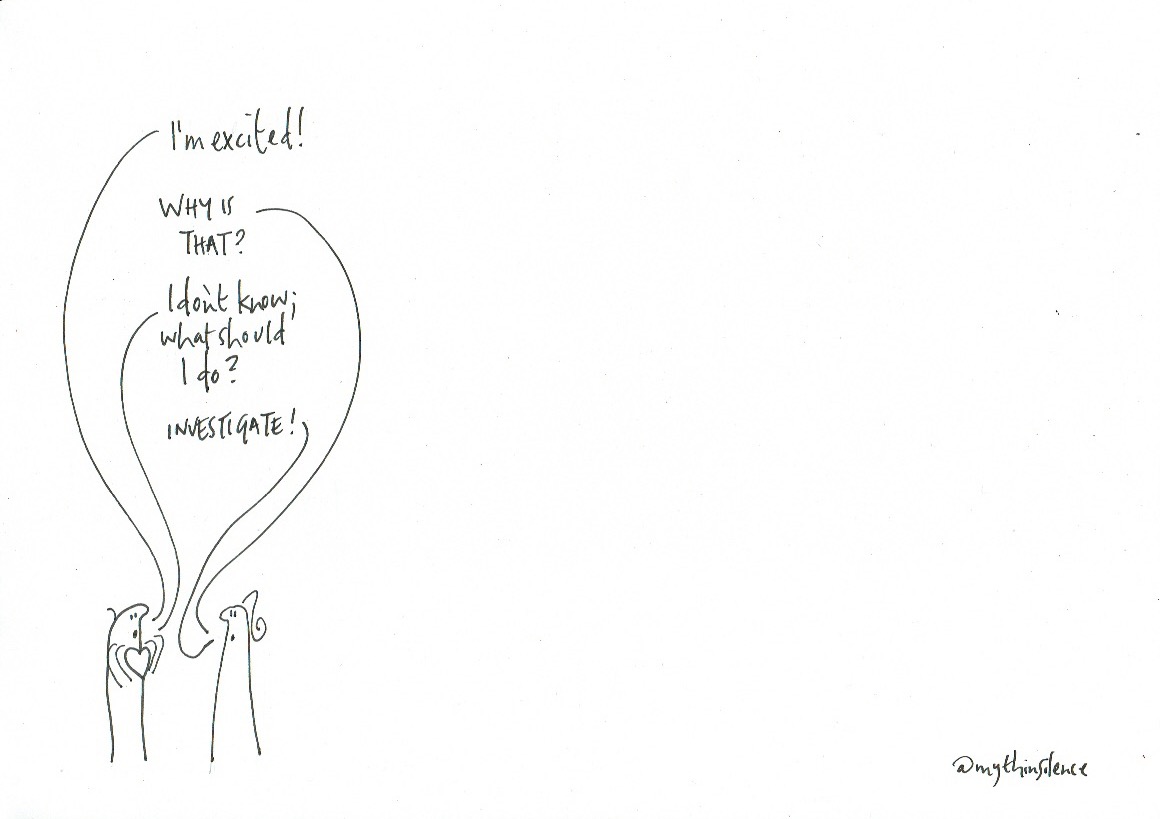
We often miss the energy we feel at some things but not others, yet this energy is critical for directing us to the bountiful life, when we are alone and when we are together.

(*From Sherry Turkle’s Alone Together.)
(**Maggie Berg and Barbara Seeber’s The Slow Professor, quoting David Brooks.)
(^From Elle Luna’s essay The Crossroads of Should and Must.)

grain, yeast, and water

7-return-to-go-forward

At some point long ago in your past, long ago, you connected to the source of who you are, and in this came to know why you are here.  At least in some simple, untried way.  As you look back, you realise you had no inkling of what it would mean.

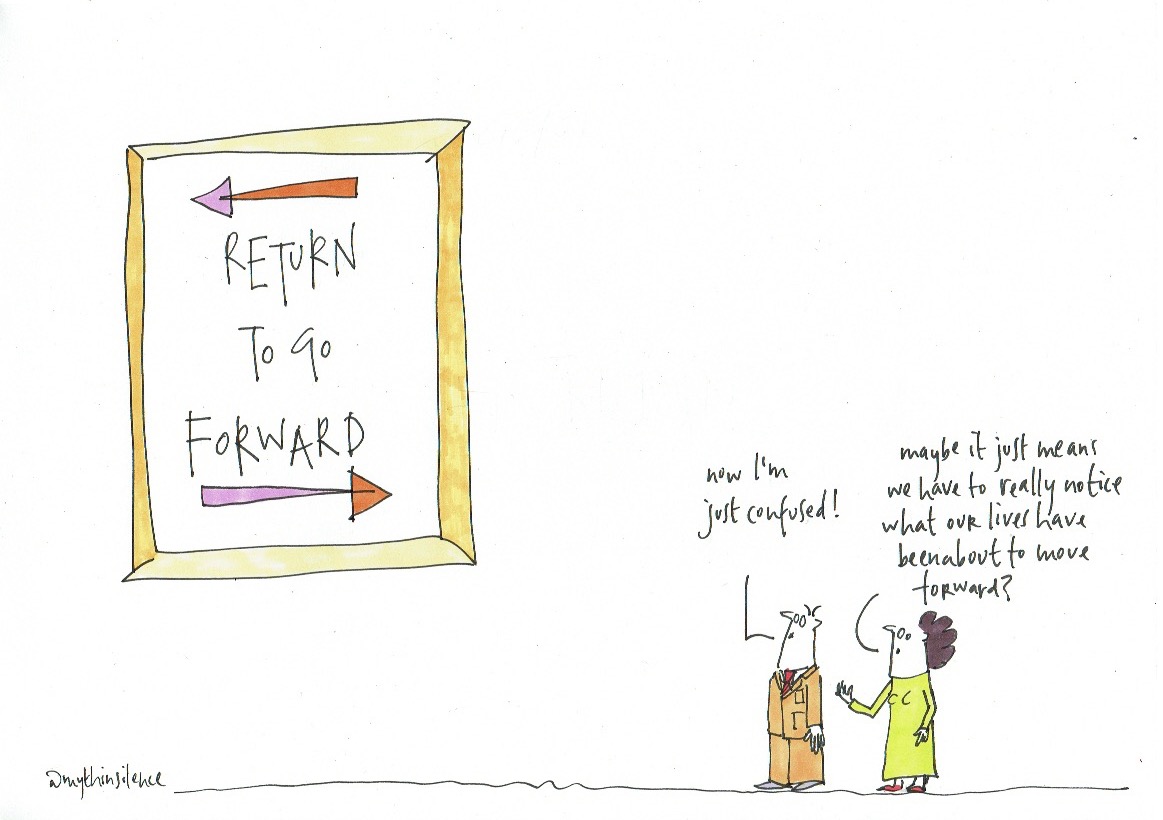
Right now, you’re able see your past and also your future, and know that both these dimensions define your now.

When my friend Will stayed with us  few days, I offered a little whisky at the end of the day, and I mentioned a book my youngest son had bought me about 1,001 whiskies.  Will ended up challenging me to read the book (did I mention it’s 960 pages long) and to include thoughts from it in my blog.

Here you are, Will:

‘The discovery and understanding of whisky is not something that happens overnight.  It requires open mouths, open hearts, and open minds.’* 

I feel I should mention, I only have three whiskies in the house, and two of these were bought as presents.  And the jury’s out as to whether I like whisky.  I do know it requires lots of time to mature, though – at least ten years.  And it requires experience: we can all get our hands on grain, yeast, and water, but we can’t all make whisky.

I realise life too is an open mouth, open heart, and open mind experience.  We need to taste it, savour it, and come to see just what has been happening – all that maturing and experience.

Every whisky is different – there are many more than one thousand and one.  The kind of grain and water makes a difference, but something magical happens through the distillation and maturation.

Just like your life.

When you add your uniqueness to the things of life, the energy deep within your chest, you begin something that takes a lot of time.

It’s a thrill to know so much can be accomplished in a lifetime: there’s more to you than you know.

(*Jim Murray in 1001 Whiskies You Must Try Before You Die.)

beyond the obvious

6-i-must-know-that

‘In one study … people judged the writers of negative book reviews as more expert and competent than the writers of positive reviews, even when the content of both reviews was deemed to be of high quality.’*

‘Unless there’s an obvious reason to do otherwise, most of us passively accept decision problems as they are framed and therefore rarely have an opportunity to discover the extent to which our preferences are frame-bound rather than reality-bound.’**

Beyond the obvious “no and …” or “yes but …” games we learn to play, there is the “yes and …” game that makes it possible for us not only to see but also feel and touch the non-obvious.

There’s a non-obvious path for each of us to explore.  The kind of understanding we usually trust will not help us find it.  Wisdom is not a head thing but develops and resides in the heart and its expressions.

Our three guides are humility and gratitude and faithfulness, enabling us to break free from our normal framing of life.

Humility allows me to accept me and accept the other.

Gratitude brings my heart into play.

Faithfulness brings my actioning of what I know and feel to the party.

Like a small country lane off a dual carriageway, it’s easy to miss our non-obvious when we’re going so fast.

(*From Gretchen Rubin’s The Happiness Project.)
(**From Daniel Kahneman’s Thinking, Fast and Slow.)

stone soup

5-when-we-dreaam

“Nothing can make our life, or the lives of other people, more beautiful than perpetual kindness.”*

‘Find your own way; innovate rather than imitate.’**

This kind of kindness is Engagement 3.0.

Engagement 1.0 is simply getting on with life without an awareness or desire to extend kindness to more than a set number of family and friend members.  2.0 is engaging with others in largely a counter-or competitive position.  3.0, though, is an open position: “yes and …”.  It’s the beginning of an infinite game: to keep open to as many thoughts as possible from as many people as possible for as long as possible.

My friend Will has been staying these last two days, and as we talked about the different things we’re engaged in he threw out some kind challenges to me – three all together.

I’ll be picking up on Will’s challenges.  Saying “yes” is about experiencing more – “and” takes me into innovation and the possibility of being changed or transformed.

I need these kind of inputs from others.

Thank you, Will.

(*Leo Tolstoy, quoted in Gretchen Rubin’s The Happiness Project.)
(**From Richard Sennett’s The Craftsman.)

be quiet and stand still

4-be-quiet-and-stand-still

We need time to do nothing.’*

‘Autonomy is the desire to steer our own ship.  Mastery is the desire to steer well.  And purpose is the need for the journey to mean something.’**

We cannot do our life’s inner work from outside.

Yesterday, I suggested the digital world can be one of the reasons why we’re separated from our surroundings and, so, our hope.  As digital becomes all pervasive we’ll find ourselves with less time to do nothing.  In the digitalising of life, more can mean less.

We need time if we’re to identify our ship, steer it, and have purpose to our voyage.  hen we don’t have time for the inner life, these hopes become distanced.

It’s not enough just to be able to think about these things; we also need to be able to feel them: autonomy emerging from our integrity, mastery from our wholeness, and purpose from our capacity to persevere.

But when were able to be quiet and stand still, we give ourselves a chance to develop our inner world, the person we’re becoming until the day we die – we keep finding new edges:

‘It is ironic that you must go to the edge to find the centre.’^

‘Suppose old people grow down as young people grow up.’^^

We don’t expect to find what we hope for lies within but it does.

(*From Maggie Berg and Barbara Seeber’s The Slow Professor.)
(**From Peter Diamandis and Steven Kotler’s Bold.)
(^From Richard Rohr’s Eager to Love.)
(^^From Ruth Krauss’s Open House for Butterflies.)