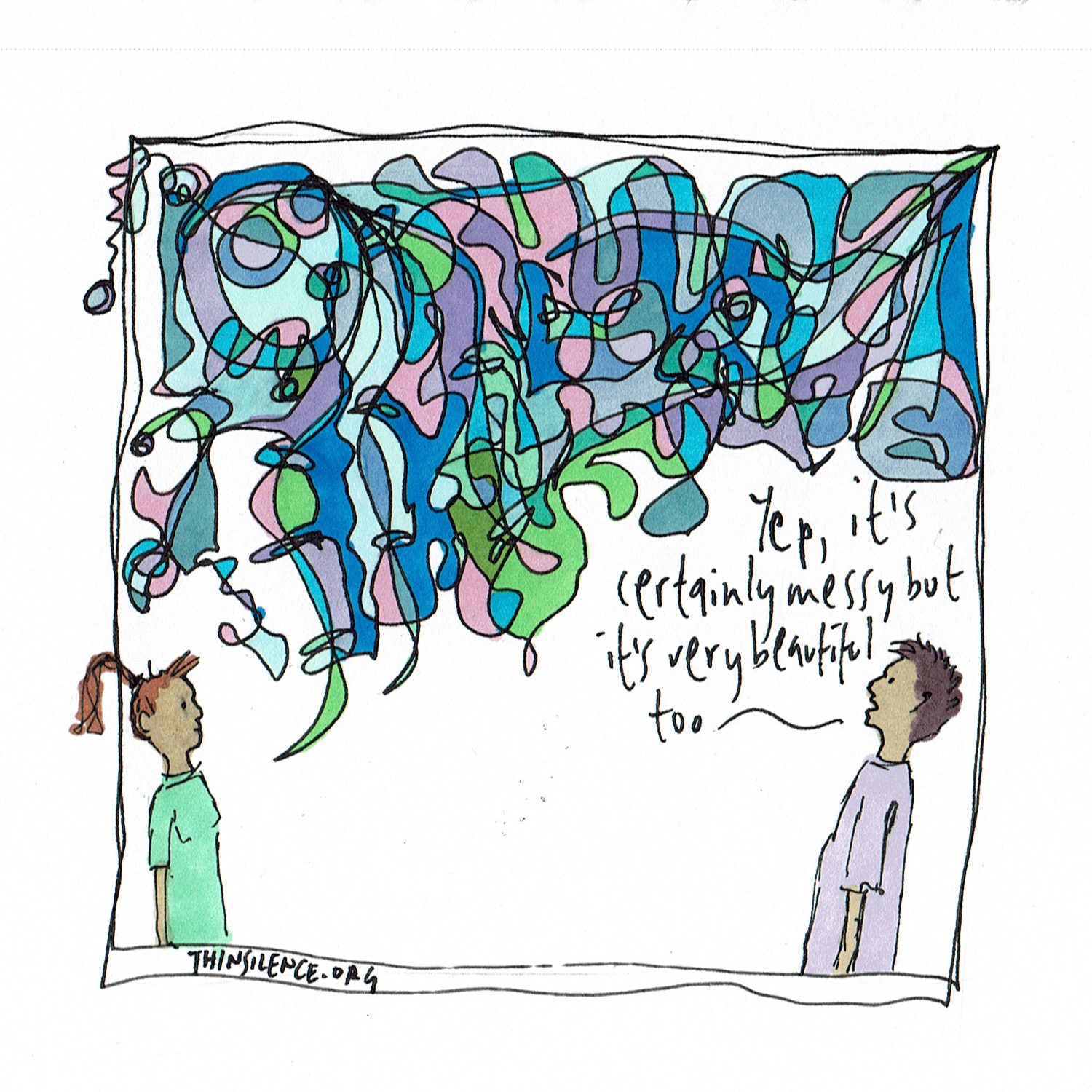
That’s not my style

When you change the way you see things, the things you see change.*
(Wayne Dyer)

Gratitude has been found to demonstrably change people.**
(Ben Hardy)

Add humility and faithfulness to gratitude and you have a powerful triad.

How we see ourselves, how we see the world around us, and the small but powerful actions we shape are the very things that can change us, especially when magified by journaling.

To write something down not only ensures it isn’t lost but allows it to grow and develop into more – more that we can see or feel and, do, do right now.  I am increasingly encouraging those I work with to engage in some reflective journaling, enabling them to see more through the flow of writing.

Visual scribe Kelvy Bird tells of how she moved beyond copying the style of others, important as it is to help us learn:

‘After one or two years of dedicated journaling, where I wrote words alongside sketches, I realised that my style – my true voice – was going to have to be something new, to me and to others.’^

It’s one thing to know when something isn’t our style but how do we identify what is?

One or two years to identify what is authentic may seem a long time but it’s a lot less than a lifetime of never knowing.  Whilst journaling may not be something we are used to doing, sometimes the tools that demand much of us are the most useful ones of all.

Back to being humble, grateful and faithful.  When we practice these things we put ourselves in the place of discovering our generative heart and to be able to help others find theirs.

As I read Marie Howe’s poem Singularity, written in tribute to Stephen Hawking, imagining a moment before what we know as the universe exploded outwards, it feels pregnant with possibilities of humility and gratitude and the possibility of faithfulness.  Beyond our crazy stories of inequality and injustice, superiority and inferiority, consumption and catastrophe, to the possibilities we might find to live with each other, with our world and everything in it, and with ourselves.

‘Do you sometimes want to wake up to the singularity
we once were?

so compact nobody
needed a bed, or food or money —

nobody hiding in the school bathroom
or home alone

pulling open the drawer
where the pills are kept.

For every atom belonging to me as good
Belongs to you.
   Remember?

There was no   Nature.    No
them.   No tests

to determine if the elephant
grieves her calf    or if

the coral reef feels pain.    Trashed
oceans don’t speak English or Farsi or French;

would that we could wake up   to what we were
— when we were ocean    and before that

to when sky was earth, and animal was energy, and rock was
liquid and stars were space and space was not

at all — nothing

before we came to believe humans were so important
before this awful loneliness.

Can molecules recall it?
what once was?    before anything happened?

No I, no We, no one. No was
No verb      no noun
only a tiny tiny dot brimming with

is is is is is

All   everything   home’^^

(*Wayne Dyer, quoted in gapingvoid’s blog Unlock the key to happiness.)
(**From gapngvoid’s blog by guest Ben Hardy: Unlock the key to happiness.)
(^From Kelvy Bird’s Generative Scribing.)
(^^Marie Howe’s SIngularity, from Maria Popova’s Brain Pickings: Singularity.)

If the world is your oyster …

It’s not a race, it’s a journey.*
(Seth Godin)

If this is true then everything changes.

We don’t have to give up if we can’t win.  There’s just another stage of the journey.  Every day a new opportunity

Ben Hardy points to journaling as the key to unlocking this.  It’s astonishing what can happen when we start writing things down, how these change, what we can overcome, how we can recover.  I’ll be returning to this in the next day or so.  Hardy suggests journaling for gratitude:

“Gratitude is having an abundance mindset.  When you think abundantly, the world is your oyster; there is limitless opportunity and possibility for you.”**

More important than beating the competition is is identifying the thing that sets your heart beating faster, finding the motivation to act, to keep journeying.

“The world is your oyster” is an interesting phrase.  You might want to try two or three minutes of reflective journaling on it.  See where it takes you.  Reflective journaling is about opening your notebook and starting to write, ignoring punctuation, spelling, editing and structure.  Just go with the flow.

(*From Seth Godin’s blog: How far behind?)
(**Benjamin Hardy, quoted in gapingvoid’s blog: Unlock the key to happiness.)

The prefatory theory

Prefatory: serving as an introduction, introductory.

What if we could know with a certainty that everything leading up to this moment in our lives has only been an introduction?

What will we do next?

This is the power of the “flip,”  To turn something over and see what it looks like from the other side.

Maria Popova, introduces me to Marie Howe’s wonderful poem Singularity, considering Stephen Hawking moved from his theory of the dying star reducing to a dense singularity and flipped this to a theory of how everything began:

‘But then Hawking did something radical – he took his final death-stage and flipped the arrow of time to consider what would happen if that singularity exploded outward and began expanding.  He theorised that is how the universe began.’*

Howe’s poem is beautiful and I will be returning to it in the near future but we are all capable of flipping.  Here are some questions to help you home in on how:

What is your curiosity?
What would you name your peculiar and exceptional talents as?
What do you imagine and hope for?
How have your experiences woven into a story?

These are important questions because everyone has an answer or a response to them.  These things, in some shape or form, are to be found in each one of us.

When Hawking turned a singularity of ending into a singularity of beginning, he provided us with a picture of how can’t can become what if?

‘Maybe every “can’t” is a gift in disguise, a twisted offering to reframe within the present moment to reframe to a mindset of “what if?”‘**

We have a choice.

‘more than ever, more of us have the freedom to care, the freedom to connect, the freedom to choose, the freedom to initiate, the freedom to do what matters’.^

(*From Maria Popova’s Brain Pickings: Singularity.)
(**From Kelvy Bird’s Generative Scribing.)
(^From Seth Godin’s What to Do When It’s Your Turn.)

The rise of the hero

But eventually everybody, I believe, needs to set an example. Either to your kids or to your friends or to your spouse or to your peers or to the world in general.

Everybody needs to stand for something. Something that matters.*
(Hugh Macleod)

The ultimate aim of the quest must be neither release nor ecstasy for oneself, but the wisdom and power to serve others.’**
(Joseph Campbell)

Two stories caught my attention on the radio yesterday.

The first was exploring people’s stories of video game addiction.  The second was a plea from a children’s writer for time to be made for daydreaming in schools.  They are not unrelated.

The universe is energy, and for a while – maybe eighty years or so – each of us is provided with some of this energy to give free expression to.  We’re all aware of this energy because we’re all made of it – it’s just a case of having the time to find out how to uniquely channel it.  Kelvy Bird describes it this way:

‘Source.  Life force.  Around us, in us, a wellspring of energy to tap into at any moment.’^

We can end up in the technology cul-de-sac, though.  Technology for the sake of technology is a dead end.  We have to develop our human capability to imagine, to imagine the difference we can make.

This isn’t about a technology-free future.  Humans produce technology, it goes with the territory  It is about being free to explore who we are and what is our contribution.  Technology can enhance this.  It can also hide it.

(*From gapingvoid’s blog: What does real leadership mean?)
(**From Joseph Campbell and Bill Moyers’ The Power of Myth.)
(^From Kelvy Bird’s Generative Scribing.)

Interbeingness

A consumerist system creates a belief in the “scarcity within,” the belief that we need material goods to invoke the imagination, that we are incapable of constructing our own lives out of whatever we have at our disposal than only others can provide us with the things needed to live.*
(Keri Smith)

This is about “being.”  To know who we are and that we have all we need to begin.

The questions Who am I? and What is my contribution? help us to find our being.

One way of doing this is to see the picture that develops when you look closely at your values, talents, dreams, and notice when you are most energised and de-energised.  Although this may look as thought it’s very ego-centric, it’s the opposite.

By doing this, we’re asking questions of others: Who are you? and What is your contribution?

Now it’s becoming really interesting because we can push on into further questions which touch on what we might term as “interbeingness.”

We may be able to ask Who are we? and What is our contribution?

Imagine where you might be today if you’d been able to begin this journey a year ago?

Here’s looking to the 11th June 2019 and another opportunity.

(*From Keri Smith’s The Wander Society.)

Messy learning

We persevere in the confidence that we ourselves are being transformed.  Perseverance produces character, and character hope.  And hope, we will discover is the ultimate gift gained in wisdom.*
(Erwin McManus)

Workers learn more in the coffee room than in the classroom.  They discover how to do their jobs though informal learning: talking observing others, trial and error, and simply working with people in the know.  Formal learning – classrooms and workshops – is the source of only 10 to 20 percent of what people learn at work.**

When we fail and mess up it doesn’t mean we’re failures.

But it can mean we’re learning.

The kind of learning that flows through us, changes us at a fundamental level, attunes us to what is happening around us, to where we have come from and where we are headed:

‘There, there, he said.  The new universe is not all suffering and ssadness.  There is much happiness in the thing.  There is joy, and there is music, and there is spirit.  Yes, I said, all these things.  It is a beautiful universe.’^

(*From Erwin McManus’ Uprising.)
(**From Jay Cross’ Informal Learning.)
(^From Alan Lightman’s Mr g.)

The creativity lounge

There’s always someone ready to give us advice but the valuable people in our lives are those who provide us with the presencing question.

They become a space in which we can explore through being fully present and fully open, a creativity lounge of possibility.

This is the most basic creativity lounge,  Others may include more people and inhabit particular spaces but it all begins here.

Building 20

Nobody would have guessed and nobody tried to guess either.  The hodgepodge of Building 20 was the result of simple expedience and neglect.  Where did MIT put disciplines that didn’t fit, researchers who had no clout, projects that made no money, student hobbyists, and anything and anyone else that just didn’t seem to matter?  In the cheapest, nastiest space they could find.  If Building 20 hadn’t been a mess, these strange collaborations might never have happened.*
(Tim Harford)

Building 20 had seen the development of some of the most amazing radar technology during World War II.  Designed and built quickly, it was full of design and safety problems and was to be torn down at the end of the war.  But a stay of demolition led to it becoming the skunkworks for technologies from video games to Bose and it was only finally demolished more than fifty years later.

There’s no denying that it was an ugly, ungainly building.  And there’s no denying these were still very smart people who were to later inhabit its spaces.  We are, though, provided with a powerful metaphor or story for what can happen when people find a place to quietly get on with the things they love doing in proximity to people who do different things with similar passion.

We may think those in control know what they’re doing.  That’s why they are in control, right?  Often, though, they may have unwittingly paid their dues to the machine, to the system, and they are in all the way to their souls.

The rest of us keep quiet when really we ought to be finding our Building 20.

Viktor Frankl, survivor of Nazi labour camps and death camps wrote:

“Life is never made unbearable by circumstances but only by lack off meaning or purpose.”**

We find the same sentiment in Paulo Coelho’s Aleph pondering life without a cause:

“After all, a life without a cause is a life without effect.”^

Building 20 found itself being crammed full of meaning and purpose and therefore with effect.

(One place we can find an expression of Building 20 is in the Presencing Institute’s U.Lab.  You can check out what this is about here but part of the experience is to connect to a local hub and/or coaching circle.  Interestingly, it’s also based at MIT.)

(*From Tim Harford’s Messy.)
(**Viktor Frankl, quoted in Dan Ariely’s Payoff.)
(^From Paulo Coelho’s Aleph.


The genius of longing

Some only live in the good and never face the bad.

Others live in the bad and struggle to face the good.

An accurate picture of “what is,” and what we hope for provides a place to move on from, to be instigators of “what can be.”

Rebecca Solnit writes beautifully about the “blue of longing” and, for me, opens up a world of possibilities:

“We treat desire as a problem to be solved, address what desire is for and focus on that something and how to acquire it rather than on the nature and the sensation of desire, though often it is the distance between us and the object of desire that fills the space in between with the blue of longing.  I wonder sometimes whether with a slight adjustment of perspective it could be cherished as a sensation on its own terms, since it is as inherent to the human condition as blue is to distance?”*

It seems to me that when we take Solnit’s counsel and turn our attention towards the blue of longing, we’re noticing there is more to us than we knew, than the simple rush we make to something in the distance and find that something is not what we wanted at all:

“For something of this longing will, like the blue of distance, only be relocated, not assuaged, by acquisition and arrival, just as the mountains cease to be blue when you arrive among them and the blue instead tints the next beyond.”*

This blue, then, is a deeper experience, a possibility imagined that can be grown, a liminal space that is the spring of our being:

“Show me the hidden things, the creatures of my dreams, the storehouse of forgotten memories and hurts. Take me down to the spring of my life, and tell me my nature and my name.  Give me freedom to grow, so that I may become that self, the seed of which You planted in me at my making.

Out of the depths I cry to You … “**

These words from George Appleton are spoken to his god but whether we allow there to be a god or not, we’re each capable of turning our attention towards the blue, holding our deepest longings and what might be that may not the destination we had thought life would be:

‘Yes, the cards are unfairly stacked against too many people.  Yes, there are too many barriers and not enough support.  But no, your ability to create and contribute isn’t determined at birth.  It’s a choice’^

I think that choice becomes visible and available in the blue.

I intend these words to be blue.  They’re intended not as a destination but simply be a space in which you may find yourself able to imagine and dream and then create because you’ve allowed yourself to long for something.  It is as Hugh Macleod sees:

‘What you love to do will grow with you, so long as you stay true to who you are and allow yourself to change and develop freely.’^^

(*Rebecca Solnit, quoted in Maria Popova’s Brain Pickings: Two Hundred Years of Blue.)
(**George Appleton, quoted in the Northumbria Community‘s Morning Prayer.)
(^From Seth Godin’s Whatcha Gonna Do With That Duck?)
(^^From gapingvoid’s blog: Life without dissonance.)

Sacre bleu

For many years, I have been moved by the blue at the far edge of what can be seen, that colour of horizons, of remote mountain ranges, of anything far away.  The colour of that distance is the colour of an emotion, the colour of solitude and of desire, the colour of there seen from here, the colour of where you are not.  And the colour of where you can never go.  For the blue is not in the place those miles away at the horizon, but in the atmospheric distance between you and the mountains. […] Blue is the colour of longing for the distances you never arrive in, for the blue world.
(Rebecca Solnit)

I have just entered sacre bleu into a French to English translator and it comes up with Damn it!  (My learning of French ended at the age of 14 having followed the adventures of the Marsaud famille in Longmans Audio Visual French)

It’s fascinating how sacred and blue, when put together, come out with something quite different.  Or is it?

In these two words we have an expression of how the sacred and holy can also be the ordinary and down-to-earth.

I find myself pondering more and more how the best way to refer to life is in terms of sacredness and holiness, beginning with how we see each other:

‘To engage in a reverential way is to maintain a sense of proportion and balance.  You acknowledge that there is a depth pf presence in every person that should never be reduced to satisfy your own selfishness and greed.’**

We don’t have to be religious to understand life in this way; indeed, those possibly free of religion can speak of this life in ways more rich and lively:

‘Must is both the journey and the destination, the upward journey of our lives that guides us toward that higher place, the oneness of all things, the ultimate source of Must.’^

We need the sacred blue.

Of course, from the perspective of another looking at us across a distance, we are enwrapped by the blue.  We just can’t see it ourselves.  The down-to-earth stuff we are right in the middle of is, at the same time, the sacred blue.

(*Rebecca Solnit, quoted in Maria Popova’s Brain Pickings: Two Hundred Years of Blue.)
(**From John O’Donohue’s Eternal Echoes.)
(^From Elle Luna’s The Crossroads of Should and Must.)