Capturing and provoking

Real learning gets to the heart of what it means to be human. Through learning we re-create ourselves.*
(Peter Senge)

You cannot look to the future by naive projection of the past.**
(Nassim Taleb)

Our limitations and constraints are a good place to begin because they are a capturing of past learnings, failures and achievements, but they are there to push out from and to provoke the new.

We are more plastic than we know; our environments, too.

Game on.

(*From Peter Senge’s The Fifth Discipline.)
(**From Nassim Taleb’s Antifragile.)

I don’t think I’m alone

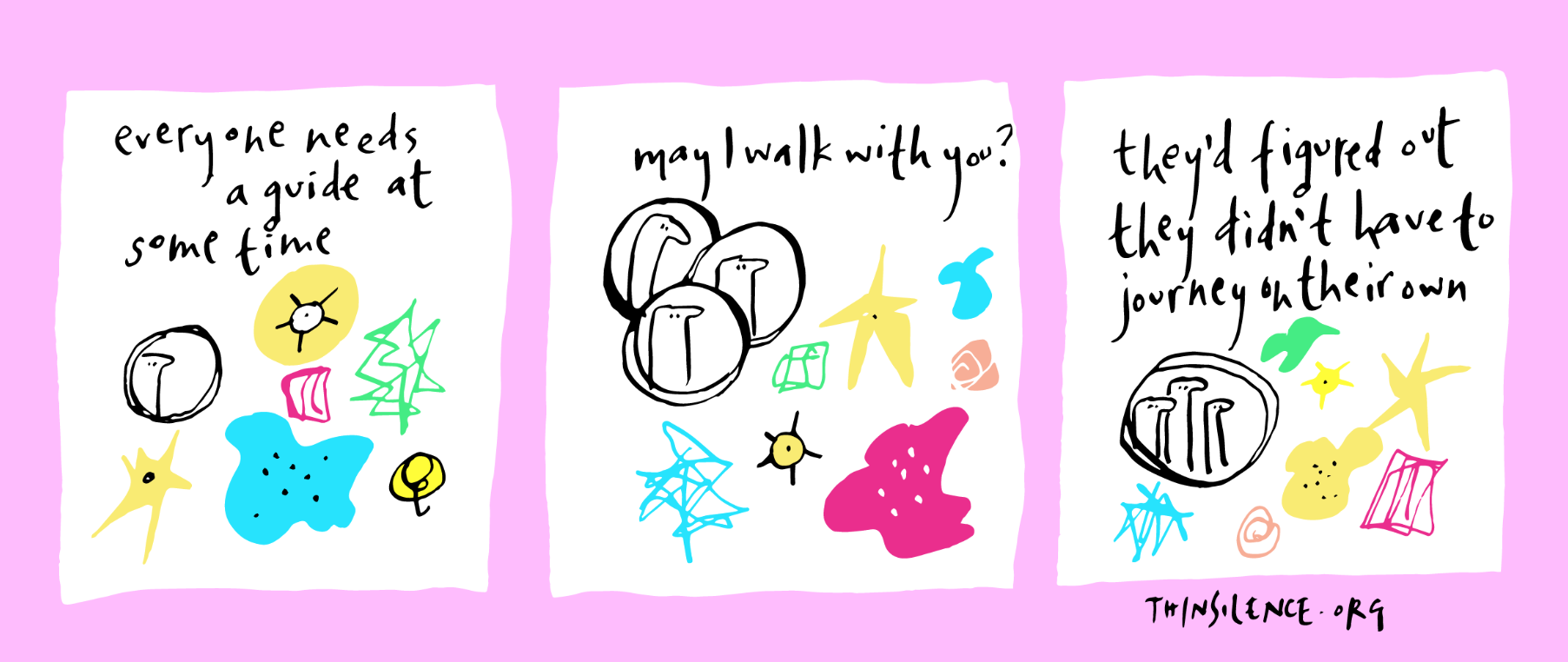
The second [route] is to fall in step with a teacher, briefly or forever, a real teacher who makes it clear that even as he or she points to the moon, we have to stop staring at the person’s fingers. […] Every one of us sometimes needs a tour guide to remind us how big and deep life is meant to be.*
(Anne Lamott)

I listen to many people talking about the things that matter to them and how they want to make a difference.

I am both wowed by the things they share and wonder whether they will make it. Specifically, will they find the ways and means, and the people they need to realise their hopes.

Seth Godin remarks on doing work that matters:

‘It might be a more difficult route, but it’s worth it.’**

He goes on to share the importance of finding others towards doing the work that matters to us:

‘And it involves surrounding yourself with people in a similar journey.’**

Some will journey with us throughout our lives, others we’ll meet and walk with for a time. Some, we’ll connect with face-to-face, others via technology, including the old technology of books.

That I need others to help me towards my meaningful work, I do not doubt. I’m going to be connecting with a couple of my guides today; we may be in Sacramento, Detroit and Edinburgh but we’re going to make it happen. I’ll be sitting with them, via technology, with a notebook open and a pencil in my hand.

(*From Anne Lamott’s Hallelujah Anyway.)
(**Grom Seth Godin’s blog: Where are you headed?)

An interpretation of time

But each incarnation, you might say, has a potentiality, and the mission of life is to live that potentiality. How do you do it? My answer is, “Follow your bliss.” There’s something inside you that knows when you’re in the centre, that know when you’re on beam or off the beam.’*
(Joseph Campbell)

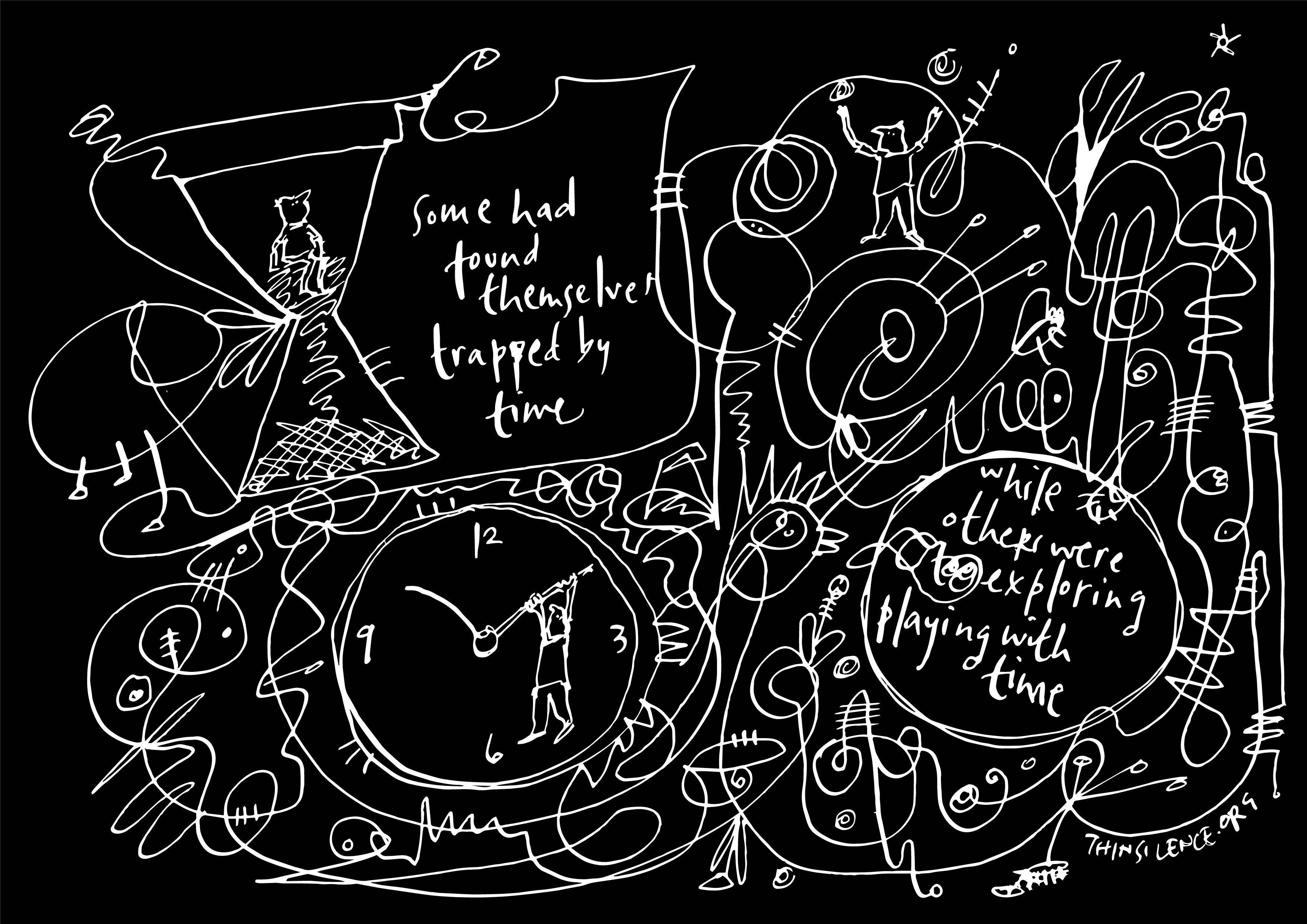
Some people see to have more time than others.

I suspect it is because they are playing with kairos time, the power of moments, rather than being fixated on chronos time, which always plays out linearly.

Their lives are increasingly becoming a unique interpretation of time.

(*Joseph Campbell, from Joseph Campbell and Bill Moyers’ The Power of Myth.)

Life beyond necessary

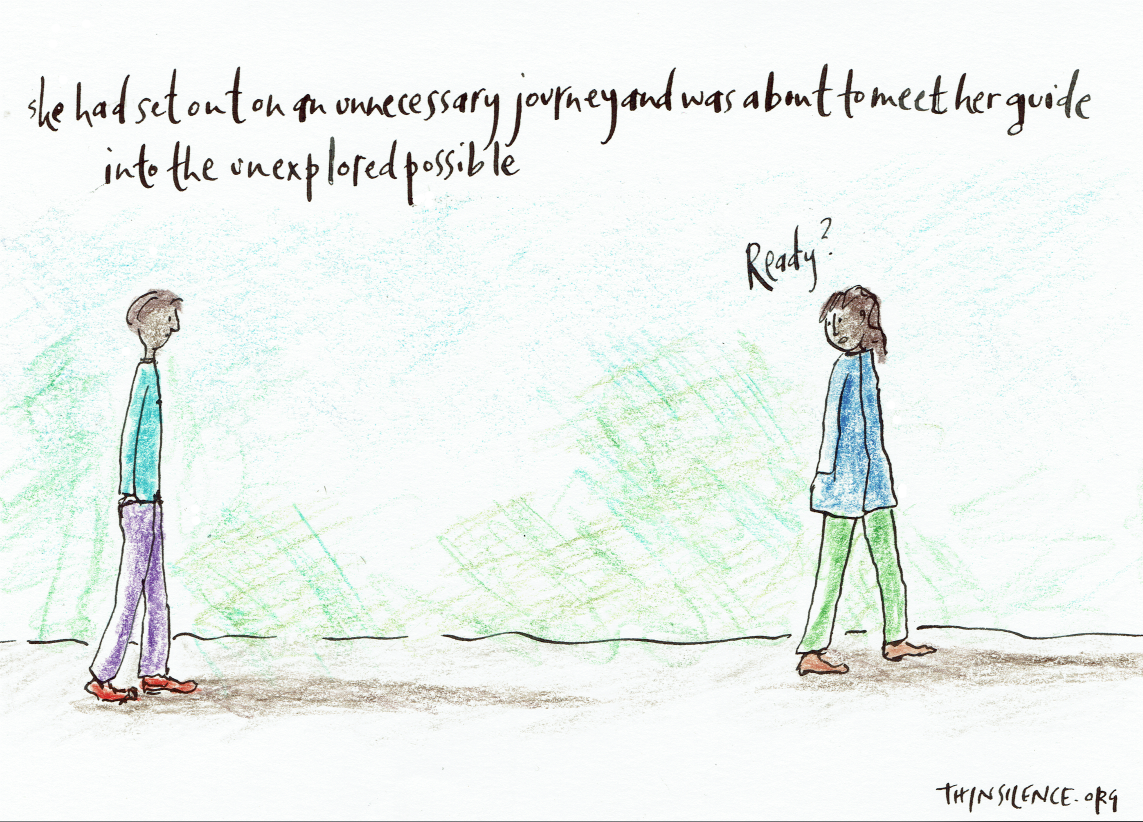
Saint Francis said that after doing what is necessary, we move on to what is possible. We pay attention, listen, open our hearts.*
(Anne Lamott)

Things happen when we move from the necessary to the possible. Whilst we are used to seeing the necessary, our “sight” is not so good when it comes to spotting the possible.

In his introduction to Nan Shepherd’s The Living Mountain, Robert MacFarlane tells of how Shepherd awakened him to noticing how the “Courvoisier whiff” of birch trees needed summer rain to bring it out.

Waiting for me were these words from Shepherd as she became my guide to seeing more:

‘This changing of focus in the eye, moving the eye itself when looking at things that do not move, deepens one’s sense of outer reality. The static things may be caught in the very act of becoming. By so simple a matter, too, as altering the position of one’s head, a different kind of world may be made to appear. Lay the head down, or better still, face away from what you look at, and bend with straddled legs till you see your world upside down, How new it has become!’**

Move from the necessary to the possible and you will guides to help you see more.

(*From Anne Lamott’s Hallelujah Anyway.)
(**From Nan Shepherd’s The Living Mountain.)

You’re just not ready for this

If you keep poking around the expected, it’s unlikely you’ll be surprised by what you find.*
(Seth Godin)

In other words, we meet unexpected problems with unexpected solutions.**
(Ed Catmull)

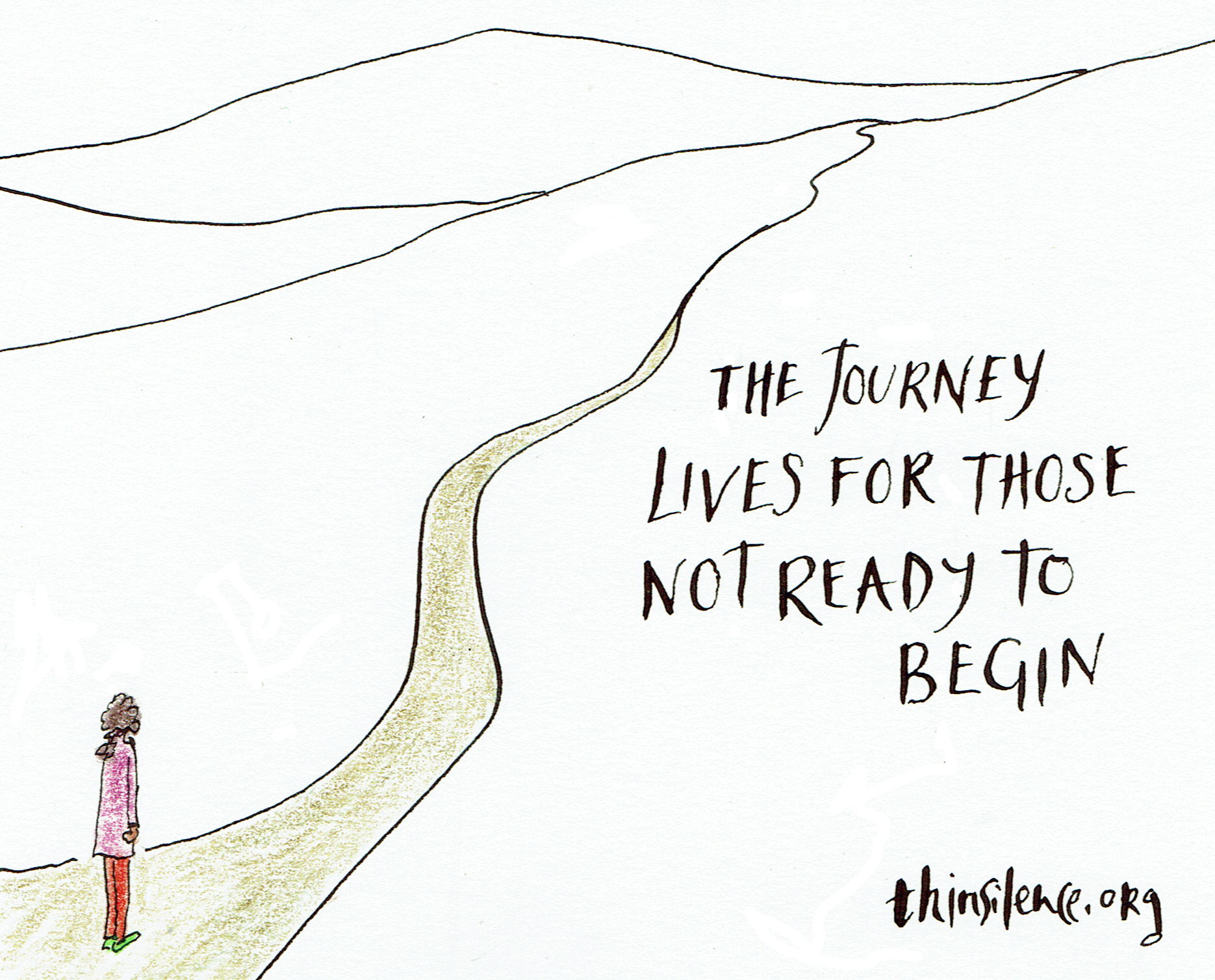
You’re just not ready for this, so you’re the ideal candidate … if you are willing to make the awkward journey, to learn en route. To learn to interact with all the journey brings, that cannot be known at the outset, that cannot be specifically prepared for.

Martin Buber says more about this in a passage I came to this morning. It’s a little long but what he’s covering is fascinating:

‘Free is the man that wills without caprice. He believes in the actual, which is to say: he believes in the real association of the real duality, I and You. He believes in destiny and also that it needs him. It does not lead him, it waits for him. He must go forth with his while being: that he knows. It will not turn out the way his resolve intended it; but what wants to come will come only if he resolves to do that which he can will. He must sacrifice his little will, which is unfree and ruled by things and drives, to his great will that moves away from being determined to find destiny. Now he no longer interferes, nor does he merely allow things to happen. He listens to that which grows, to the way of Being in the world, not in order to be carried along by it but rather in order to actualise it in the manner in which it, needing him, wants to be actualised by him – with human spirit and human deed, with human life and human death. He believes, I said; but this implies: he encounters.’^

I admit that I struggle to understand Buber as he explains It and I and Thou, but sometimes I hope I grasp his meaning, what he is picturing as it seizes my attention. Like here, as he talks about how we have a destiny but not one scripted out, but one wanting us to draw it out, to interpret it and give it life; how something must die in us for something larger to come into being, a bigger Self that will listen to and also bring into being that which can only be brought into being through the fullness and deepness of a human life.

None of us are ready for this. All we can do is to enter:

‘I am in charge of one dynamic: when a door is opened, I get to choose how I will respond.’^^

(*From Seth Godin’s blog: Unexpected yet totally plausible.)
(**From Ed Catmull’s Creativity, Inc..)
(^From Martin Buber’s I and Thou.)
(^^From John Ortberg’s All the Places to Go.)

There’s still plenty of room for originality

Who is fit to judge originality?*
(Richard Sennett)

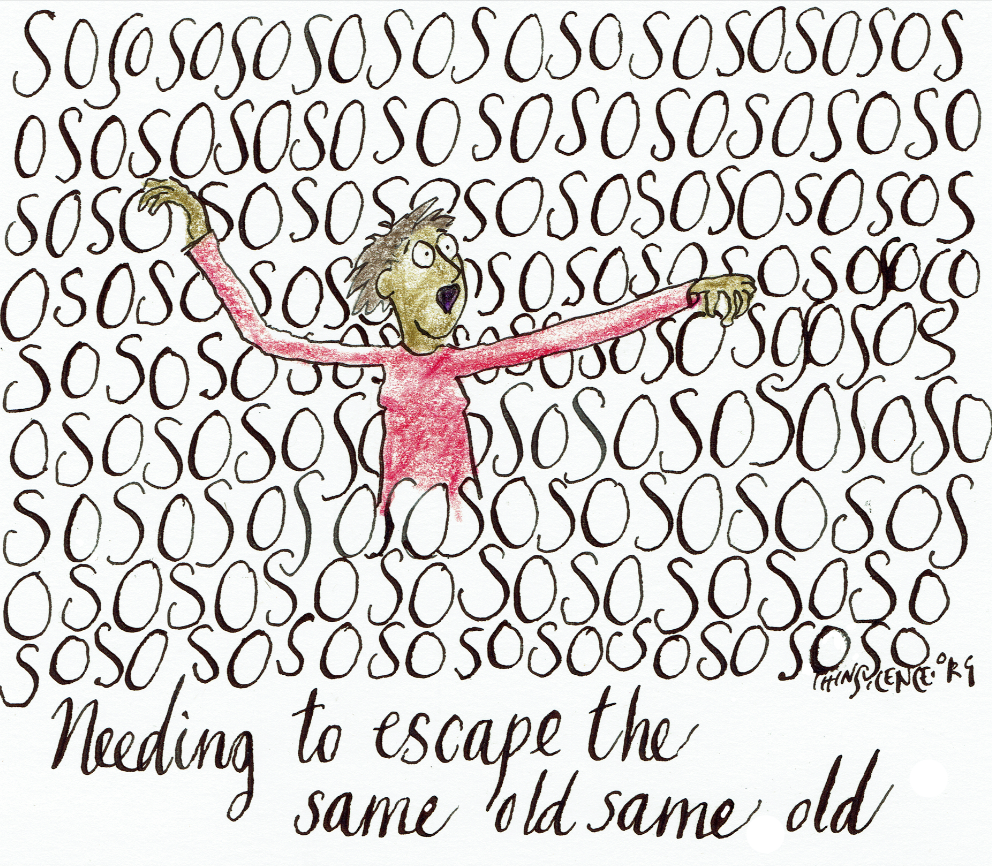
As we become older, our lives become more routine and less novel. […] Learn to recognise your own scripts . Play with them, poke at them, disrupt them.**
(Chip and Dan Heath)

How can you judge something that’s original. It’s possible to compare it with something that isn’t the same, but that’s different.

Peter Diamandis and Steven Kotler remind us of three big things we’re looking for in our lives that may lead to originality:

‘Autonomy is the desire to steer our own ship. Mastery is the desire to steer well. And purpose is the need for the journey to mean something.’^

Find these and find your originality. Bring it on.

(*From Richard Sennett’s The Craftsman.)
(**From Chip and Dan Heath’s The Power of Moments.)
(^From Peter Diamandis and Steven Kotler’s Bold.)

A brush with life

We are adventurers of who we are as we move to and fro between adventure and stillness.

Some want power and possessions but we have something better, to be most fully who we can be, carrying us into fresh adventures we cannot possibly imagine at the moment.

Towards this, we cannot underestimate the importance of solitude and silence:

‘Be quiet and stand still.’*

The more is sometimes elusive but will always yield to quietness and stillness, though seldomly to busyness and bluster and noise – only the right kinds of activity can be harnessed with quietness and stillness.

Mihaly Csikszentmihalyi uncovers for us the critical dynamic between the inner and outer worlds when he writes:

‘The bottom line is, rather, how we feel about ourselves and what happens to us. To improve life one must improve the quality of experience. […] There are two main strategies we can adopt to improve the quality of life. The first is to try making external conditions match our goals. The second is to change how we experience external conditions to make them fit our goals better.**

Within this dynamic, we experience our most important brushes with life.

(*From Maggie Berg and Barbara Seeber’s The Slow Professor.)
(**From Mihaly Csikszentmihalyi’s Flow.)

Based on a true story …

Story is metaphor for life.  You must transform day-to-day living into a work of art. This is not achieved by recounting events verbatim.*
(Robert McKee)

I had to invent the exchange between the researchers to say something true.**
(Annie Pirrie)

Stories are not about telling the truth so much as ways of portraying the truth. They are also how we create truth.

They can be full of truths but then are arranged in a way that is, perhaps, not chronologically true, or certain things weren’t said exactly that way, but what we’re trying to do is create a greater truth – something meaningful we want to bring into being, a story we want to live.

When I read these words from Joseph Campbell, I made a note about how perhaps stories are about eternity and facts are about time, and we are more than time:

‘The tick-tick-tick of times shuts out eternity. We live in this field of time. But what is reflected in this field is an eternal principle made manifest.’^

Story provides with a means of being more than the sum of our lives so far.

(*From Robert McKee’s blog: Fact Vs. Fiction: How to satisfy your audience.)
(**From Anne Pirrie’s Virtue and the Quiet Art of Scholarship.)
(^From Joseph Campbell and Bill Moyers’ The Power of Myth.)

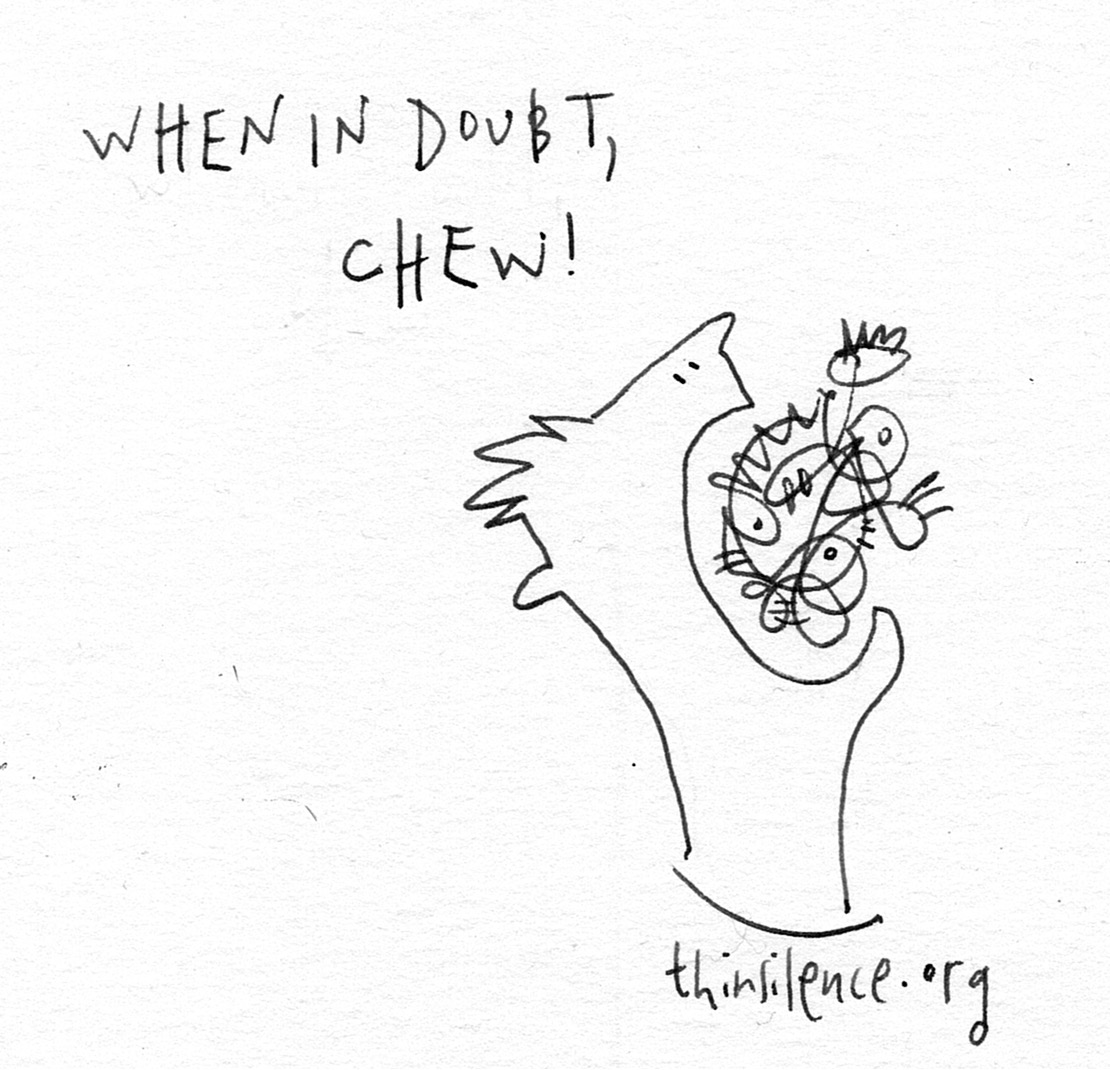
Chew well

What else changes a person’s life but the living of a story? And what is a story but the wanting of something difficult and the willingness to work for it.*
(Don Miller)

Renew thyself completely each day; do it again, and again, and forever again.**
(Tching-thang)

I have previously mentioned that I am using Keri Smith’s Wreck This Journal as my daily journal.

The page open today has two instructions:

“CHEW ON this.”

“WARNING: DO NOT SWALLOW.”^

I wonder if I swallow too quickly, when I really need to chew for longer.

(*From Donald Miller’s Scary Close)
(**Tching-thang, quoted in Henry David Thoreau’s Where I lived, and What I Lived For.)
(^From Keri Smith’s Wreck This Journal.)